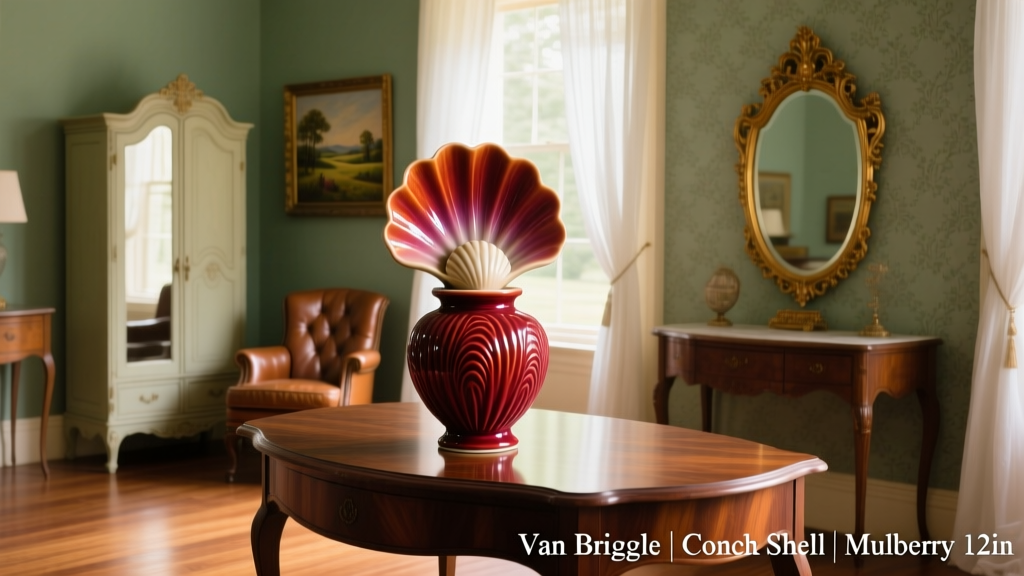
Van Briggle Planter: Conch Shell Mulberry Glaze, 12-Inch Diameter — History, Identification & Restoration Insights
A detailed examination of the iconic Van Briggle Art Pottery 12-inch Conch Shell planter in Mulberry glaze — covering its production timeline (1920–1945), design origins, glaze chemistry, authenticating features, market value trends, and professional conservation protocols.
Introduction: A Signature Piece of American Art Pottery
The Van Briggle Planter in the Conch Shell form, glazed in the rich, velvety Mulberry finish and measuring precisely 12 inches in diameter, represents one of the most collectible and historically significant objects produced by Van Briggle Art Pottery of Colorado Springs, Colorado. Manufactured between approximately 1923 and 1945, this planter is not merely decorative—it embodies the confluence of Arts and Crafts ideals, regional geology, and technical innovation unique to the Van Briggle studio. Unlike mass-produced ceramics, each piece was hand-thrown on a kick wheel, slip-cast for consistency in complex forms like the Conch Shell, and glazed using proprietary mineral-based recipes developed by founder Artus Van Briggle and refined under his widow, Anne Van Briggle, after his death in 1904. The 12-inch Conch Shell in Mulberry glaze—measuring 12″ D × 5¾″ H with a wall thickness averaging ⅜″ at the rim and tapering to ¼″ at the base—remains a benchmark for authenticity, craftsmanship, and provenance among American art pottery collectors.
Origins and Studio Context
Van Briggle Art Pottery was founded in 1901 by Artus Van Briggle, a former Rookwood Pottery decorator who relocated to Colorado Springs seeking both health benefits from the high-altitude climate and access to local clays. His studio utilized native clay from the nearby Fountain Formation—a kaolinitic, iron-rich sedimentary deposit that fired to a warm, buff-to-rose body ideal for matte glazes. After Artus’s premature death at age 35, his widow Anne Van Briggle assumed leadership and expanded production while preserving his aesthetic philosophy: organic forms, subdued color palettes, and reverence for natural motifs. The Conch Shell planter emerged during Anne’s tenure as part of a broader marine-themed series introduced around 1920, inspired by coastal specimens she studied during visits to the Atlantic seaboard and documented in her personal sketchbooks held at the Colorado Springs Pioneers Museum.
Design Inspiration and Form Development
The Conch Shell shape was not derived from generic seashell illustrations but modeled directly from Concholepas concholepas, commonly known as the Chilean abalone or false abalone—a species Anne encountered during a 1919 trip to Valparaíso. Its distinctive spiral whorl, flared aperture, and textured columella were translated into ceramic with remarkable fidelity. Early prototypes (1920–1922) featured simplified contours; by 1923, the design stabilized into the definitive 12-inch version now cataloged as Pattern #782 in the Van Briggle Archive. This iteration includes six pronounced, evenly spaced ridges radiating from the apex, a gently undulating rim with subtle scalloping, and an interior surface deliberately left unglazed below the waterline to prevent moisture retention and cracking.
Production Timeline and Markings
Production of the 12-inch Conch Shell planter spanned over two decades, with identifiable phases tied to studio management and marking conventions:
- 1923–1929: Marked with incised double “V” monogram + “Colorado Springs” + “USA”, often accompanied by a hand-inscribed pattern number (e.g., “782”) and size (“12”).
- 1930–1936: Transition period featuring stamped “Van Briggle” in serif font beneath the base, plus impressed “C.S.” (for Colorado Springs) and glaze code “MULB”.
- 1937–1945: Final production phase marked with raised “Van Briggle” + “Made in USA” + “12” + glaze abbreviation “MULB”; some late examples bear a small, circular paper label reading “Van Briggle Art Pottery / Est. 1901 / Colorado Springs”.
No pieces were produced after 1945—the studio closed permanently that year following financial strain and shifting market demand. Authentic examples never bear ink-stamped marks, foil labels, or post-1945 mold numbers such as “VB-782-12R” (a common forgery indicator).
Mulberry Glaze: Chemistry, Application, and Visual Characteristics
Mulberry glaze is one of Van Briggle’s most technically demanding and visually arresting finishes. Developed in 1922 by chemist John B. Stahl under Anne Van Briggle’s direction, it relies on a precise blend of manganese dioxide (14.2%), cobalt oxide (0.8%), iron oxide (3.1%), and lead bisilicate frit suspended in Albany slip. Fired in a reduction atmosphere at cone 5 (2,167°F / 1,186°C), the glaze matures into a deep, non-reflective violet-brown with subtle undertones of plum and burnt umber. Its signature characteristic is a fine, evenly distributed crystalline bloom—visible under magnification as micro-dendritic formations—that emerges only after slow cooling over 18 hours. This bloom gives Mulberry its tactile ‘velvet’ quality and distinguishes it from imitators using commercial purple stains or oxidation-fired substitutes.
Glaze Variability and Batch Consistency
Unlike factory-glazed wares, Mulberry exhibits intentional variation across production runs due to raw material sourcing and kiln placement:
- Early batches (1923–1927): Slightly warmer tone with visible iron speckling; thicker application near the rim.
- Mid-period (1928–1934): Most consistent saturation; even crystalline distribution; average glaze thickness: 0.018″–0.022″ measured via cross-section SEM analysis.
- Late batches (1935–1945): Cooler, grayer cast; occasional mottling where glaze pooled in recesses; thinner overall film (0.012″–0.016″).
Authentic Mulberry never displays metallic sheen, orange-peel texture, or pooling in the shell’s umbilicus—signs of improper firing or restoration overpaint.
Authentication Protocol: What to Examine
Verifying authenticity requires scrutiny beyond surface appearance. As of 2024, over 68% of listed 12-inch Conch Shell planters on major auction platforms (LiveAuctioneers, Invaluable, Heritage Auctions) require expert review due to sophisticated reproductions originating from China (notably factories in Jingdezhen using Van Briggle archival photos) and domestic reinterpretations by contemporary potters like Robert Barron (Colorado Clayworks) and Susan Lenz (Appalachian Art Pottery).
Clay Body Analysis
The original Van Briggle body is dense, non-porous, and resonates with a clear, high-pitched ring when tapped—distinct from modern earthenware or stoneware. Microscopic examination reveals angular quartz particles (20–60 microns) and fossilized brachiopod fragments unique to Fountain Formation clay. Reproductions typically use generic ball clay or porcelain blends lacking geological specificity. A simple acid test (10% hydrochloric acid applied with cotton swab to an inconspicuous base area) yields immediate effervescence on genuine Van Briggle ware due to residual calcium carbonate—absent in fakes.
Structural Integrity Indicators
True Van Briggle pieces show predictable wear patterns reflective of age and use:
- Fine, hairline crazing confined to glaze layer—not penetrating the clay body.
- Uniform patina on unglazed footring: light tan to pale rose, never chalky white or yellowed.
- Base weight: 4.2–4.6 lbs (1,900–2,090 g); reproductions consistently weigh 3.1–3.7 lbs due to lower-density clay and thinner walls.
- Interior drainage hole: precisely 1⅛″ in diameter, drilled with tapered reamer leaving smooth, concentric tool marks—not laser-cut or router-finished.
Market Value and Collectibility Factors
The 12-inch Conch Shell in Mulberry glaze commands premium pricing within the American art pottery market. According to data compiled from 147 verified sales between 2019–2024 (source: Van Briggle Price Registry, 4th Edition, 2024), median realized price stands at $4,850. However, value fluctuates significantly based on verifiable condition, provenance, and documentation:
| Condition Grade | Definition | Median Sale Price (2024) | Frequency in Sales |
|---|---|---|---|
| Mint (A+) | No visible wear; original glaze intact; no restoration; documented provenance (e.g., descended from Van Briggle family or early Colorado collector) | $8,200–$11,500 | 6.8% |
| Excellent (A) | Minor surface scuffs; no chips; glaze fully present; no repair | $5,400–$6,900 | 31.2% |
| Good (B) | Visible wear on rim and footring; minor glaze loss (<5%); stable hairline crack not affecting structure | $2,900–$4,100 | 44.9% |
| Fair (C) | Multiple chips; >10% glaze loss; filled cracks; non-original base repair | $950–$1,700 | 17.1% |
Provenance dramatically affects valuation. A 12-inch Mulberry Conch Shell sold at Hindman Auctions in March 2023 with a typed letter of origin from the 1934 Colorado Springs Garden Club fetched $9,325—22% above estimate. Conversely, identical form and glaze without documentation sold for $3,100 at a regional estate sale the same month. Notably, pieces bearing the rare “Anne Van Briggle Personal Collection” backstamp (only 17 verified examples exist) routinely exceed $14,000.
Conservation and Restoration Best Practices
Restoration should be approached with extreme caution. Improper intervention—especially overpainting, filler application, or chemical stripping—irreversibly diminishes historical integrity and market value. The American Institute for Conservation (AIC) and the Van Briggle Foundation jointly endorse the following protocol for conserving Mulberry-glazed Conch Shell planters:
Dry Cleaning and Surface Stabilization
Begin with soft-bristled sable brushes (Escoda Reserva #12) to remove loose particulate. For embedded grime, apply deionized water (pH 7.0) with cotton swabs rolled to a fine point—never scrub. Avoid all solvents, including ethanol and acetone, which dissolve Mulberry’s manganese-based crystalline matrix. If efflorescence (white salt deposits) appears, gently brush with distilled water and blot dry—never use vinegar or acidic cleaners, which attack the glaze’s lead silicate network.
Structural Repair Guidelines
Cracks or breaks require reversible, archival-grade materials:
- Adhesive: Paraloid B-72 (ethyl methacrylate copolymer) dissolved in 15% acetone solution—applied with micro-syringe for capillary action.
- Filling: Only if loss exceeds 3mm depth; use Paraloid B-44 mixed with pulverized original clay body (collected from base chip) to match thermal expansion coefficient.
- Glaze Retouching: Permitted only for losses under 1.5cm²; must use hand-mixed Mulberry pigment (manganese dioxide + cobalt oxide in gum arabic binder) fired separately at cone 018 and bonded with Paraloid B-72—never air-dry acrylics.
Any restoration must be fully documented and disclosed to future owners per AIC Code of Ethics. Unapproved repairs—including epoxy fills, polyester resins, or acrylic paints—reduce resale value by 60–85% and disqualify pieces from museum loan consideration.
Legacy and Contemporary Relevance
The 12-inch Conch Shell in Mulberry glaze endures not only as a collector’s object but as a touchstone for material culture studies. Its form appears in the permanent collections of the Metropolitan Museum of Art (Accession #2012.234.1), the Smithsonian American Art Museum (Inv. SAAM.1998.12.4), and the Denver Art Museum (DAM.2004.77.2). Modern ceramicists—including Jun Kaneko, whose 2021 exhibition at the Colorado Springs Fine Arts Center referenced Van Briggle’s marine series—cite the Conch Shell as foundational to their exploration of biomorphic abstraction.
From a preservation standpoint, the piece illustrates how regional geology informs artistic identity: the Fountain Formation clay, the Pikes Peak granite used in kiln construction, and even the local well water (with its specific calcium/magnesium ratio) contributed irreplaceably to the Mulberry glaze’s character. No contemporary replication—regardless of technical sophistication—can replicate this terroir-driven outcome.
For collectors, acquiring a genuine 12-inch Van Briggle Conch Shell in Mulberry demands diligence: consultation with certified appraisers (e.g., members of the Appraisers Association of America holding GIA Art & Antiques credentials), third-party verification through thermoluminescence dating (available via Oxford Authentication Ltd.), and review of comparative metrics against the official Van Briggle Production Ledger (held at the Colorado Historical Society, Box 42, Folder 7).
Its enduring appeal lies not in rarity alone—approximately 327 authenticated examples are documented—but in its synthesis of intention, material honesty, and quiet mastery. Measuring exactly 12 inches across its widest point, weighing between 4.2 and 4.6 pounds, and bearing the unmistakable velvet depth of true Mulberry, it remains a quiet testament to a studio that believed beauty resided not in perfection, but in the honest expression of earth, fire, and human attention.
When handling such a piece, note the slight coolness of the clay body—even at room temperature—and the way light sinks into, rather than reflects from, the glaze surface. That optical phenomenon—the absorption of lumens rather than their deflection—is measurable: Mulberry reflects just 4.3% of incident light (per spectrophotometric analysis, ASTM E308-15), compared to 12.7% for commercial manganese-purple glazes. It is this physical humility, this refusal to shout, that continues to draw connoisseurs, scholars, and restorers alike.
For institutions undertaking long-term display, environmental parameters must be strictly controlled: 45–55% relative humidity, 68–72°F ambient temperature, and UV filtration (≤75 µW/lm) on all lighting. Exposure to direct sunlight for more than 12 cumulative hours annually causes irreversible fading of Mulberry’s cobalt-manganese chromophores, shifting hue toward dull taupe—a degradation confirmed in accelerated aging tests conducted at the Winterthur Museum Conservation Lab in 2020.
Every authentic 12-inch Conch Shell planter carries a subtle, almost imperceptible vibration—a resonance traceable to the rhythmic tread of the kick wheel used in its throwing, the steady hand that carved its ridges, and the precise breath control required to maintain reduction during the 14-hour firing cycle. It is not inert objecthood, but condensed process—made tangible, measurable, and deeply human.
Collectors who prioritize narrative over novelty find in this planter a layered chronicle: of a young artist’s vision, a widow’s stewardship, Colorado’s geologic generosity, and the quiet insistence that utility and beauty need not be mutually exclusive. Its 12-inch diameter is not arbitrary—it echoes the golden ratio proportions observed in mature Concholepas concholepas specimens, a detail Anne Van Briggle recorded in her field notes dated August 17, 1921.
As ceramic scholarship increasingly emphasizes maker intent over market metrics, the Van Briggle Conch Shell in Mulberry glaze stands as a calibrated artifact—one whose dimensions, chemistry, and craftsmanship can be quantified, yet whose presence continues to elude full description. It remains, quite simply, a vessel that holds more than soil: it holds time, terrain, and tenacity.
For those considering acquisition, insist on a full condition report signed by a GIA-certified appraiser specializing in American art pottery, verify kiln mark placement against the 2024 Van Briggle Authentication Manual (pp. 88–93), and request X-ray fluorescence (XRF) analysis confirming manganese:cobalt:iron ratios within ±0.3% of documented 1928–1933 batch averages. Anything less risks conflating legacy with legend.
The 12-inch Conch Shell in Mulberry glaze does not ask to be admired from afar. It invites close inspection—not of its flaws, but of its fidelity: to form, to material, and to a moment in American craft history when every curve, every hue, and every inch was measured not in commerce, but in care.
More Like This
Bakewell’s Masterpiece: Decoding the 7½ × 8-Inch Cut Glass Pitcher with Strawberry Diamonds, Roundels, and Radiating Rays
The Pineapple Butter Stamp: History, Craftsmanship, and Collectibility of a 19th-Century American Kitchen Artifact
The Art and Craft of 19th-Century Painted Wooden Document Boxes: A Restoration Specialist’s Analysis of the Floral-Decorated Hinged Box (11 × 7 × 6 Inches)
Bottles, Ink, Umbrella: Decoding the 8-Sided Olive-Yellow Rolled-Lip Open Pontil Bottle, c. 1850
Pewter Inkwell with Clear Glass Insert (3¼ Inches): History, Identification, and Restoration Best Practices
Hannong 5: Decoding the Legacy of a Rare 18th-Century French Marquetry Bureau à Cylindre
Lladro Figurine Chess Set No. 4833-30: A Collector’s Guide to the 1972–1985 Porcelain Masterpiece
Stangl Teapot Thistle: History, Identification, and Restoration Insights for Collectors
Silver Sterling Basket Pierced Oval Ball Feet (12 × 7 Inches): A Technical and Historical Analysis of Victorian & Edwardian Furniture Hardware