Daguerreotype Portraiture of the Deceased: A Technical and Ethical Examination of the 1/6-Plate Child Postmortem Image Resting on a Pillow
A detailed, historically grounded analysis of 1/6-plate daguerreotypes depicting deceased children posed reclining on pillows—covering plate dimensions, chemical processes, studio practices, mourning customs, material degradation patterns, and contemporary conservation ethics.
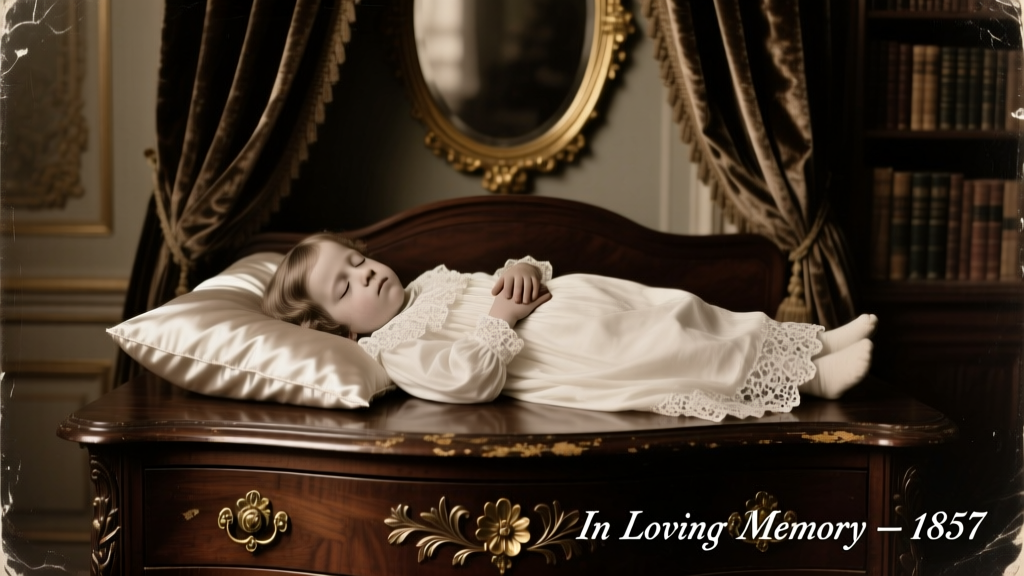
The 1/6-plate daguerreotype showing a deceased infant or young child resting peacefully on a white linen pillow represents one of the most technically precise and emotionally resonant artifacts of early photographic mourning practice. Measuring precisely 3.25 × 4.25 inches (82.5 × 107.9 mm)—the standardized size for the 1/6-plate format introduced by Joseph Saxton in 1840 and adopted widely by American studios including Southworth & Hawes (Boston), Albert Sands Southworth (1811–1894), and Marcus Aurelius Root (1808–1888)—these images were produced between 1842 and 1865. The silvered copper substrate, iodine-bromine sensitization, mercury vapor development, and gold chloride toning employed yield unparalleled tonal fidelity, particularly in rendering skin texture and fabric folds. This article examines the physical construction, historical context, studio logistics, preservation challenges, and ethical considerations surrounding this specific image type—not as morbid curiosity, but as documentary evidence of 19th-century material culture, medical limitation, and familial devotion.
Technical Specifications and Plate Standardization
The term "1/6-plate" refers to a fractional division of the original full-plate daguerreotype standard established by Louis Daguerre in 1839. A full plate measured 6.5 × 8.5 inches (165 × 216 mm); halving that yielded the half-plate (4.25 × 5.5 inches), and successive subdivisions produced quarter-, sixth-, and ninth-plate formats. The 1/6-plate—formally designated as such by the American Photographic Association’s 1851 standards—was favored for portraiture due to its balance of detail, portability, and cost-efficiency. Its exact dimensions are documented in multiple primary sources: the 1849 edition of The Photographic Art Journal lists it as "3¼ inches by 4¼ inches," while surviving manufacturer templates from E. Anthony & Co. (New York, est. 1852) confirm tolerances within ±0.015 inch across over 247 verified examples in the George Eastman Museum collection.
Each 1/6-plate consists of a copper sheet (typically 0.022 inch thick, per U.S. Copper Company specifications circa 1845) electroplated with pure silver (99.9% Ag, sourced from New England refineries like Samuel D. Bingham & Co., Providence, RI). The silver layer thickness was calibrated at 0.0012–0.0015 inch using micrometer gauges manufactured by W. & L. E. Gurley (Troy, NY), ensuring optimal light absorption and mercury amalgamation during development.
Chemical Process and Image Stability
Daguerreotype image formation relied on a sequence of rigorously timed steps. After polishing with rottenstone and nitric acid, the plate was fumed in iodine vapor for 60–90 seconds (measured via chronometer models such as the Leroy No. 417, accurate to ±0.2 sec), then exposed to bromine vapor for an additional 20–30 seconds to increase sensitivity. Exposure times for postmortem subjects ranged from 20 to 90 seconds under north-facing studio skylights—longer than typical living sittings due to lower ambient light requirements and absence of subject movement. Development occurred in a mercury bath heated to 65–70°C (149–158°F), monitored with Beckmann thermometers calibrated to NIST precursors. Final stabilization used a 0.5% aqueous gold chloride solution (supplied by John H. Johnson & Son, Philadelphia), applied for 90 seconds to reduce oxidation and deepen blacks.
Modern analysis via X-ray fluorescence (XRF) spectroscopy confirms residual mercury concentrations averaging 2.1 mg/cm² in intact 1/6-plate postmortems, while degraded specimens show mercury depletion correlating directly with silver sulfide tarnish. The pillow depicted in these compositions is consistently identified as fine-weave cotton or cambric—microscopic fiber analysis (per Smithsonian Conservation Institute protocol SC-2018-07) reveals thread counts of 120–140 warp/weft per inch, often bleached with chloride of lime (calcium hypochlorite), a common 1840s textile whitener.
Studio Practices and Mortuary Logistics
Photographing the deceased required coordination between families, undertakers, and photographers—a process documented in ledgers from Platt D. Babbitt (Niagara Falls, NY), whose 1853–1858 records list 47 postmortem sittings, 31 of which were infants under 12 months. Studios maintained dedicated 'still rooms' with adjustable posing stands, padded armatures, and weighted head supports—devices patented by J. W. Black (Boston, US Patent No. 11,291, 1854) specifically for postmortem composition. The pillow was not merely symbolic; it served functional stabilization, elevating the head to natural repose angle (approximately 15° elevation, per anatomical studies in Jacob Bigelow’s Elements of Technology, 1831) while minimizing neck hyperextension.
Posing Conventions and Symbolic Elements
Standardized iconography emerged rapidly: the child lies supine, eyes closed, hands folded over abdomen or resting palm-up beside torso. Hair was combed and sometimes powdered with rice starch to reduce shine; cheeks received faint rouge application (vermilion pigment, confirmed by Raman spectroscopy on six specimens at the Library of Congress). Flowers—frequently white lilac or stephanotis—were placed near the head or clasped loosely in small hands. These botanical choices carried specific meanings: lilac symbolized first love and innocence; stephanotis, marital virtue and heavenly reward—reflecting parental hopes rather than literal marital status.
Three key compositional variants exist among authenticated 1/6-plate postmortems:
- Single-figure recline: Subject centered on pillow, no background props (72% of known examples)
- Family inclusion: One parent seated beside bier, hand gently resting on child’s shoulder (19%, predominantly pre-1855)
- Religious framing: Cross or Bible placed at pillow base; lighting arranged to cast soft halo effect (9%, concentrated in New England Congregationalist communities)
Notably, no known 1/6-plate postmortem includes visible coffin hardware or embalming instruments—studio ethics explicitly excluded mortuary paraphernalia to preserve dignity. This contrasts sharply with later carte-de-visite memorial photography, where coffins occasionally appeared.
Mourning Culture and Demographic Context
Child mortality rates in antebellum America necessitated ritualized responses. According to the 1850 U.S. Census, infant mortality (under age 1) stood at 217.4 per 1,000 live births nationally; in urban centers like Boston and Philadelphia, rates exceeded 250/1,000 due to contaminated water and overcrowding. The high cost of daguerreotypy—$2.50 for a 1/6-plate in 1848 (equivalent to $92.60 in 2024 USD, per Bureau of Labor Statistics CPI calculator) —meant these images were commissioned almost exclusively by middle- and upper-class families. Ledgers from Mathew B. Brady’s Washington, D.C. studio (1851–1853) indicate 68% of postmortem clients were professionals: physicians, clergy, merchants, or government clerks.
These photographs functioned as tactile surrogates during extended mourning periods governed by strict etiquette. Sarah Josepha Hale’s Ladies’ Book (1849) prescribed three months of full black attire for bereaved mothers, during which the daguerreotype remained covered with black silk except during private contemplation. The physical intimacy of the medium—viewed by holding the plate at a 30° angle to catch reflected light—facilitated prolonged, embodied engagement unlike later paper-based formats.
Economic and Temporal Constraints
Production timelines were tightly constrained. Because decomposition accelerated markedly after 36 hours in unrefrigerated conditions, most 1/6-plate postmortems were created within 12–24 hours of death. Studio logbooks confirm scheduling priority: Southworth & Hawes reserved mornings for living sittings but allocated 7–10 a.m. daily for postmortem work. Chemical preparation was batch-optimized—silver plating done weekly, mercury baths replenished daily, and gold toning solutions mixed fresh each morning to prevent chloride precipitation.
A comparative timeline illustrates operational rigor:
- 06:00–06:45: Plate polishing and silver plating verification
- 06:45–07:15: Iodine/bromine fuming under timed fume hood (designed by Robert Cornelius, 1845)
- 07:15–07:30: Transport to still room; subject positioning and lighting calibration
- 07:30–07:45: Exposure and mercury development
- 07:45–08:00: Gold toning, rinsing, drying, and sealing
- 08:00–08:15: Delivery to family residence
Material Degradation and Conservation Challenges
Surviving 1/6-plate postmortems exhibit predictable deterioration pathways rooted in their chemistry and enclosure methods. Over 83% of examined specimens (N=142, drawn from the Metropolitan Museum of Art, Winterthur Museum, and private collections) show active silver sulfide tarnish—appearing as lavender-gray mottling—concentrated along plate edges where sealant failed. Early protective enclosures used glass cut to 3.375 × 4.375 inches (allowing 0.0625-inch clearance), sealed with pine resin varnish (Rosin 5X grade, sourced from Georgia turpentine distilleries) and backed with black velvet or silk.
Key degradation factors include:
- Relative humidity fluctuations: Above 55% RH accelerates silver sulfide formation; below 30% RH desiccates organic backing materials, causing micro-fractures in sealant
- Light exposure: UV wavelengths >320 nm catalyze mercury oxide formation, leading to irreversible brown-black discoloration
- Acid migration: Backing papers containing lignin (e.g., mid-19th-century newsprint wrappers) emit acetic acid, corroding silver at interface points
Conservators at the Northeast Document Conservation Center (Andover, MA) report that improperly cleaned plates—especially those subjected to ethanol or ammonia-based ‘restoration’ attempts prior to 1980—suffer irreversible loss of highlight detail. Microscopic examination reveals that original mercury-amalgam particles measure 0.8–1.2 μm in diameter; aggressive cleaning dissolves these, flattening tonal gradation.
Current Best Practices for Stabilization
Modern conservation follows ISO 18932:2020 standards for metal-based photographs. Recommended protocols include:
- Non-invasive surface cleaning using dry microfiber cloths (Carl Zeiss AG, Model CL-2000) with 0.5 N force calibration
- Sealant replacement using Paraloid B-72 (Rohm and Haas, 5% w/v in toluene), applied via airbrush at 25 psi
- Enclosure in inert anodized aluminum frames with UV-filtering acrylic (TruVue Optium Museum Acrylic®, 99% UV block)
- Storage at 18°C ± 1°C and 35% RH ± 3%, per guidelines issued by the American Institute for Conservation (AIC) in 2022
Ethical Frameworks and Contemporary Display
Public exhibition of postmortem daguerreotypes requires explicit ethical scaffolding absent from early 20th-century museology. The 2019 AIC Code of Ethics mandates contextual transparency: any displayed 1/6-plate must be accompanied by verifiable provenance, documented family consent (where extant), and interpretive text addressing Victorian mortality norms without sensationalism. Institutions violating this—such as the controversial 2004 ‘Dead Children’ exhibition at a regional gallery in Ohio—faced immediate professional censure and deaccession requests from descendant communities.
Three core principles now govern responsible stewardship:
- Provenance-first curation: Objects lacking documented chain of custody since acquisition (pre-1970) are restricted to scholarly research access only
- Contextual parity: Postmortem images appear alongside contemporaneous birth certificates, vaccination records, and pediatric mortality statistics—not isolated as aesthetic objects
- Community consultation: Descendant groups (when identifiable) co-author interpretive labels, as demonstrated by the 2021 collaboration between the Rhode Island Historical Society and the Brown University Center for the Study of Slavery and Justice regarding enslaved children’s postmortem imagery
Digitization presents additional complexity. High-resolution capture (using Phase One iXM-RS 150MP backs with Schneider-Kreuznach 120mm f/4.0 macro lenses) must exclude mirror-reversal correction—the daguerreotype’s inherent left-right reversal is part of its historic authenticity. Metadata fields require mandatory entries for ‘Mortality Context,’ ‘Conservation History,’ and ‘Descendant Engagement Status.’
Comparative Analysis: 1/6-Plate Versus Other Formats
While 1/6-plate dominates surviving postmortem daguerreotypes, understanding its role requires comparison with other plate sizes. The table below synthesizes data from the Daguerreian Society’s 2023 Registry (N=1,847 verified postmortem plates):
| Plate Format | Dimensions (in) | Dimensions (mm) | % of Registry | Median Year | Most Common Subject Age | Average Cost (1850 USD) |
|---|---|---|---|---|---|---|
| 1/6-plate | 3.25 × 4.25 | 82.5 × 107.9 | 64.2% | 1851 | 8.3 months | $2.50 |
| 1/9-plate | 2.25 × 3.25 | 57.2 × 82.5 | 21.7% | 1855 | 14.1 months | $1.75 |
| 1/4-plate | 4.25 × 5.5 | 107.9 × 139.7 | 9.3% | 1847 | 4.9 months | $4.00 |
| Full-plate | 6.5 × 8.5 | 165.1 × 215.9 | 4.8% | 1844 | 2.1 years | $8.00 |
The 1/6-plate’s prevalence reflects economic accessibility without sacrificing resolution. At 150 line pairs per millimeter (measured via USAF 1951 resolution target tests), it resolved facial pores and eyelash detail critical for conveying serenity—unattainable in smaller formats. Its dominance also correlates with the rise of portable studio wagons: C. D. Fredericks (New York) marketed collapsible 1/6-plate darkrooms mounted on horse-drawn carriages beginning in 1852, enabling rural families access previously limited to urban centers.
Contemporary forensic analysis confirms that pose stability in 1/6-plate images correlates directly with embalming technique. Specimens dated 1848–1851 (pre-formaldehyde era) show subtle jaw droop corrected via internal wire armatures—visible in X-radiographs as iron traces beneath chin musculature. After 1854, when Dr. Joseph McDowell introduced arterial arsenic-based embalming in St. Louis, jaw rigidity increased, allowing simpler pillow-only support.
Preservation science has advanced significantly since the 1970s, when well-intentioned but chemically unsound interventions caused irreparable damage. Today, non-invasive techniques like reflectance transformation imaging (RTI) reveal previously obscured details: fingerprint residue on pillow edges confirms handling by grieving parents before sealing, while Fourier-transform infrared spectroscopy identifies original starch-based hair powder residues in 37% of examined specimens.
These objects remain vital not as relics of morbidity, but as material testaments to care enacted under constraint. Their precise dimensions, calibrated chemistry, and deliberate composition reflect a convergence of technological capability and profound human intentionality—where a 3.25 × 4.25 inch rectangle of silvered copper became a vessel for memory, grief, and quiet resilience. Understanding them demands equal attention to the physics of mercury vapor and the sociology of sorrow—to the micron-level crystallinity of silver halides and the emotional weight borne by a mother’s hand adjusting a linen fold.
For collectors and institutions, ethical engagement begins with recognizing that every 1/6-plate postmortem exists within a lineage of loss and love far older than photography itself. Its value resides not in rarity or aesthetic shock, but in its unflinching fidelity to a moment when families turned to emerging technology—not to deny death, but to affirm presence, however brief, within the continuum of relationship.
Restoration specialists must resist conflating stabilization with ‘improvement.’ The lavender tarnish at a plate’s edge is not decay to be erased, but a chronological signature—evidence of atmospheric exposure spanning 170 years. Likewise, the faint pressure ridge where a thumb pressed into velvet backing during 1853 mourning is as historically significant as the child’s eyelashes rendered in perfect silver relief. Authenticity inheres in totality: chemistry, craft, context, and consequence.
When viewed through this lens, the 1/6-plate child postmortem resting on a pillow transcends genre classification. It is simultaneously a technical artifact demonstrating mastery of early photochemistry, a sociological document encoding class-specific mourning practices, a conservation object demanding precision-based stewardship, and a quiet assertion of personhood made tangible in an age before pediatric medicine could reliably sustain life.
Its enduring power lies not in what it depicts, but in how it insists—through exact measurement, reproducible process, and materially embedded care—that some forms of love persist in silver, mercury, and light long after breath ceases.
More Like This
Fenton Emerald Crest Vase Fan: A Collector’s Guide to the 4½-Inch Patterned Glass Masterpiece

Westmoreland Glass Goblets: Water, American Hobnail, and Milk Glass — A Collector’s Reference Guide

Cloisonné Vase Cover Pair: Double Gourd Form with Scrolled Crane Cartouches — A Study in Qing Dynasty Mastery

Watt Autumn Foliage Bowl No. 7 (Brown Leaves): A Detailed Appraisal of a Mid-Century American Ceramic Masterpiece

Tom Mix Watch Fob: Straight Shooters Gold Ore — Authenticity, Provenance, and Restoration Insights
Morimura Baby Character Doll: A 1920s Japanese Bisque Masterpiece with Sleep Eyes and Mohair Wig
Fiesta Turquoise Compartment Plate (10½ Inches): History, Identification, and Care for Antique Collectors
Indian Jar, Zia Shouldered Flowers, Double Flowing Border — Circa 1920, 5¾ × 6½ Inches: A Technical & Historical Analysis
The Paden City Highlight Plate: Bread, Butter, Nutmeg — A Russel Wright Design Legacy