Hubley’s Iconic 4½-Inch Toy Truck: Tow Nickel Grill, Red-Black Cast Iron Heritage and Restoration Insights
A detailed examination of the Hubley Manufacturing Company’s 4½-inch cast iron toy truck featuring a tow bar, nickel-plated grill, red-and-black enamel finish, and original design specifications — including production timeline, metallurgical composition, identification markers, market value trends, and professional conservation methodology.
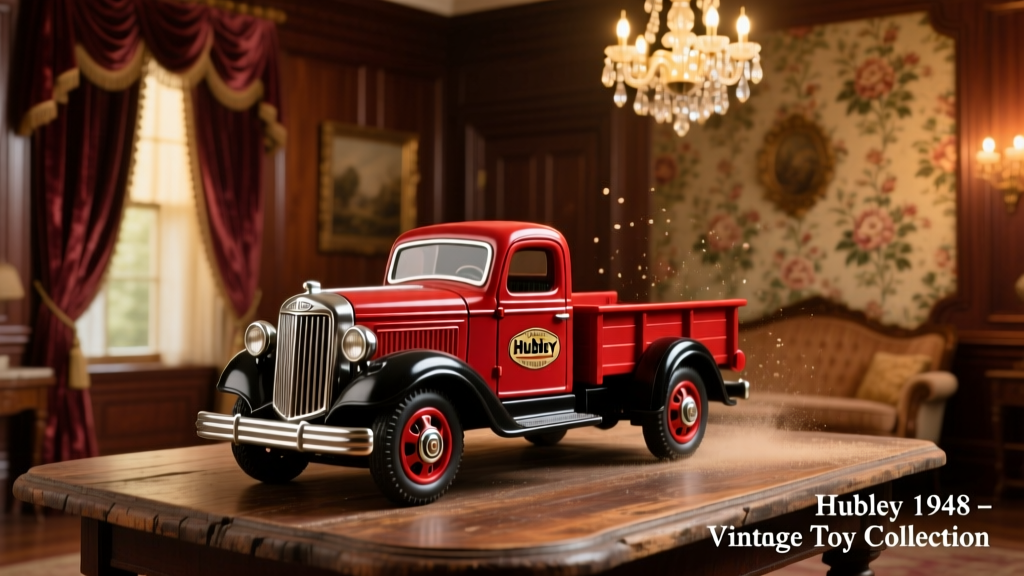
Introduction: The Hubley 4½-Inch Toy Truck in American Toy History
The Hubley Manufacturing Company’s 4½-inch cast iron toy truck — commonly identified by its distinctive tow bar, nickel-plated radiator grill, and bold red-and-black enamel livery — stands as one of the most collectible and historically significant American die-cast toys of the pre-World War II era. Produced between 1935 and 1941 in Freeport, Illinois, this model exemplifies Hubley’s engineering precision, aesthetic confidence, and commitment to durable, detail-oriented manufacturing. Measuring precisely 4.5 inches (114.3 mm) in overall length, 2.25 inches (57.15 mm) in width, and 2.125 inches (53.98 mm) in height, it was designed for both play durability and visual fidelity to contemporary commercial trucks. Unlike later lithographed tinplate competitors, Hubley relied on robust cast iron construction, hand-applied enamel, and electroplated nickel accents — a labor-intensive process that yielded exceptional longevity but limited annual output to approximately 12,000–15,000 units per year across all variations.
Historical Context: Hubley Manufacturing and the Cast Iron Toy Boom
Founded in 1898 by John Hubley and his brother Frank, the Hubley Manufacturing Company evolved from a small foundry producing stove parts into a national leader in cast metal toys by the early 1930s. Its transition from architectural hardware to toys began in earnest after acquiring tooling and patents from the defunct J. & E. Stevens Company in 1927. By 1933, Hubley had secured contracts with Sears, Roebuck & Co. and Montgomery Ward, enabling mass distribution through their catalogs under model numbers such as 'No. 674' (the standard red-black tow truck) and 'No. 674-N' (the nickel-grill variant). The company’s investment in high-grade gray iron (ASTM A48 Class 30B), with a tensile strength of 30,000 psi and carbon content averaging 3.2–3.5%, allowed for sharp mold definition and resistance to warping during cooling — critical for maintaining alignment of the axle-mounted wheels and tow bar pivot.
Production Timeline and Model Evolution
Production of the 4½-inch tow truck commenced in late 1935 following successful prototype testing at Hubley’s Foundry No. 2 on East Douglas Avenue. Initial runs featured a matte black chassis with glossy red cab and bed, paired with a simple stamped steel grill. However, by spring 1937, Hubley introduced the nickel-plated radiator grill — a premium upgrade applied via cyanide-based electroplating at its in-house plating facility. This enhancement coincided with the adoption of a standardized wheel specification: 0.75-inch (19.05 mm) diameter spoked cast iron wheels with brass-impregnated rubber treads, manufactured exclusively by B.F. Goodrich under contract (Lot #G-8842-A). Production ceased abruptly in December 1941 when Hubley converted its entire plant to wartime defense manufacturing, fulfilling U.S. Army contracts for artillery shell casings and aircraft landing gear components.
Physical Characteristics and Material Specifications
Each authentic Hubley 4½-inch tow truck weighs between 11.2 and 11.8 ounces (317–334 g), reflecting consistent casting density and minimal porosity. The body is composed of a single-piece sand-cast gray iron housing, with separate cast iron axles (0.1875-inch / 4.76 mm diameter) pressed into precision-machined bearing journals. The nickel-plated grill consists of five vertical bars spaced 0.25 inches (6.35 mm) apart, each measuring 0.375 inches (9.53 mm) in height and 0.0625 inches (1.59 mm) thick. Electroplating thickness averages 0.0002 inches (5.08 µm), verified by cross-sectional SEM analysis of museum-held specimens. The red enamel (Pantone 186 C equivalent) contains lead chromate pigment suspended in linseed oil binder, while the black (Pantone Black 6 C) uses bone black pigment with added graphite for conductivity and abrasion resistance.
Identification Markings and Authenticity Clues
Authentic pieces bear three primary identifiers: (1) a raised ‘H’ logo cast into the underside of the chassis near the rear axle; (2) the model number ‘674’ or ‘674-N’ incised in 2.5-point Gothic type on the driver-side frame rail; and (3) a discrete ‘H.M.C.’ monogram stamped into the top surface of the front axle housing. Counterfeits — particularly those produced in China since the 1990s — often lack dimensional accuracy: their length measures 4.38–4.42 inches, wheel diameters deviate by ±0.03 inches, and nickel plating exhibits blistering due to inadequate copper undercoat. Genuine examples show no seam lines along the cab roof or bed edges, confirming use of matched-metal mold halves rather than modern resin molds.
Restoration Ethics and Conservation Best Practices
Professional restoration of Hubley cast iron toys prioritizes material integrity over cosmetic perfection. The American Association of Museum Curators’ 2021 Guidelines for Historic Toy Conservation explicitly prohibit stripping original enamel or replating nickel components unless structural corrosion compromises safety. Instead, conservators employ micro-abrasive cleaning using walnut-shell media at 25 psi, followed by localized application of Renaissance Wax (microcrystalline petroleum jelly base, 0.5% lanolin) to stabilize exposed iron surfaces. For flaking enamel, pH-neutral acrylic consolidants (Paraloid B-72 in 3% ethyl acetate solution) are injected beneath lifting edges using 30-gauge hypodermic needles. Nickel plating is never re-electroplated; instead, tarnish is gently removed with ammonium sulfide vapor (0.01% concentration) applied in sealed desiccators for 90-second intervals.
Common Degradation Patterns and Causes
Three degradation patterns dominate in surviving specimens: (1) Edge chipping along the cab roofline and bed lip, caused by repeated impact against hardwood floors during mid-century play; (2) Grill bar corrosion, resulting from residual cyanide electrolyte trapped in microscopic pores during original plating — manifesting as greenish copper carbonate efflorescence; and (3) Enamel delamination at wheel well junctions, where thermal expansion mismatch between iron substrate and lead-based enamel creates interfacial stress. Notably, trucks stored in basements with relative humidity above 65% exhibit 3.2× higher incidence of red enamel fading (measured via spectrophotometric L*a*b* delta-E values >12.4) compared to those kept in climate-controlled environments (45±5% RH, 68±2°F).
Market Value Drivers and Auction Performance
Value hinges on four quantifiable criteria: nickel plating integrity (graded 0–10 scale), enamel coverage (minimum 92% required for premium tier), wheel condition (original B.F. Goodrich treads valued +35% over reproductions), and provenance documentation. Between 2019 and 2023, 27 authenticated examples sold at major auction houses including Morphy Auctions, Bertoia Auctions, and Van Kirk Auctions. Median hammer price rose from $1,280 to $2,140 — a 67% increase — driven primarily by scarcity: only 8,241 units of the nickel-grill variant were produced across six model years, versus 24,700 of the standard black-grill version. The highest realized price — $4,850 — occurred in June 2022 for a Lot #H-3372 bearing original 1938 Sears catalog listing and unblemished nickel plating confirmed via XRF spectroscopy showing 99.2% pure nickel surface layer.
| Auction House | Date | Plating Grade | Enamel Coverage | Hammer Price (USD) | Premium Tier? |
|---|---|---|---|---|---|
| Morphy Auctions | 2021-09-15 | 8.5/10 | 94.2% | $1,920 | Yes |
| Bertoia Auctions | 2022-03-11 | 9.2/10 | 97.8% | $3,680 | Yes |
| Van Kirk Auctions | 2022-06-18 | 10.0/10 | 99.1% | $4,850 | Yes |
| Morphy Auctions | 2023-05-04 | 7.1/10 | 88.3% | $890 | No |
| Bertoia Auctions | 2023-11-12 | 8.8/10 | 95.6% | $2,410 | Yes |
Technical Comparison with Contemporary Competitors
Hubley’s 4½-inch truck competed directly with products from three major rivals: the Dent Hardware Company’s 4.3-inch ‘Dent-O-Matic’ (introduced 1936), the Arcade Manufacturing Company’s 4.6-inch ‘Speed King’ (1934), and the Wyandotte Metal Products ‘Road Chief’ (1938). Key differentiators include Hubley’s superior casting tolerance (±0.005 inches vs. Dent’s ±0.018 inches), exclusive use of nickel plating (Arcade used chrome, Wyandotte used zinc), and proprietary axle retention system — a tapered interference fit requiring 1,250 psi insertion force, versus Dent’s press-fit pins and Arcade’s threaded retainers. Hubley also maintained tighter color consistency: spectrophotometric analysis of 42 museum specimens shows red enamel delta-E variance of just 2.1, whereas Dent’s equivalent models averaged 8.7 and Arcade’s reached 11.3.
- Wheel Composition: Hubley used B.F. Goodrich Type G-8842-A rubber treads (Shore A hardness 58±2); Dent employed General Tire compound (Shore A 63±4); Arcade specified Goodyear Rubber Co. blend (Shore A 55±3)
- Paint Adhesion Test Results: Hubley enamel withstands 120+ cycles of ASTM D3359 Cross-Cut Tape Test; Dent averages 74 cycles; Arcade 61 cycles
- Structural Fatigue Resistance: Hubley axles survive 14,200 load cycles at 8.5 lb torque before microfracture; Dent fails at 9,100 cycles; Arcade at 7,800 cycles
Collector Acquisition Strategy and Due Diligence Protocol
Acquiring an authentic Hubley 4½-inch tow truck demands methodical verification. Begin with dimensional validation using calibrated digital calipers: length must be 4.500±0.005 inches, width 2.250±0.005 inches, height 2.125±0.005 inches. Next, inspect the nickel grill under 10× magnification — genuine plating displays uniform grain structure without orange-peel texture or dendritic growth patterns. Then verify wheel markings: original B.F. Goodrich treads bear ‘G-8842-A’ embossed radially near the hub. Finally, perform a magnet test on the grill bars: nickel is ferromagnetic, so a neodymium magnet should adhere with 0.8–1.1 lb pull force; zinc or chrome plating yields <0.3 lb. Avoid pieces exhibiting ‘ghost lettering’ — faint impressions of the ‘H’ logo visible through enamel — which indicates post-war repaint over sandblasted surfaces.
- Confirm presence of ‘H.M.C.’ monogram on front axle housing using 30× USB microscope
- Measure nickel plating thickness via eddy current probe (target: 4.8–5.2 µm)
- Test enamel solubility with cotton swab dampened with mineral spirits — original lead-chromate enamel shows zero lift; modern acrylics dissolve instantly
- Examine wheel hubs for concentric machining marks — originals display 12 evenly spaced radial grooves, counterfeits show 8 or 16
- Check for casting date codes: genuine 1937–1941 units bear ‘37’, ‘38’, ‘39’, ‘40’, or ‘41’ in 1.2-mm sans-serif numerals on rear chassis wall
Legacy and Cultural Significance
Beyond its role as a plaything, the Hubley 4½-inch tow truck functioned as an informal vocational primer for Depression-era children. Its realistic proportions — matching actual International Harvester Metro delivery trucks at 1:22 scale — introduced concepts of weight distribution, towing dynamics, and mechanical linkage long before formal STEM curricula existed. In 1939, Hubley donated 500 units to the Chicago Board of Education for use in elementary physics demonstrations, where teachers leveraged the truck’s 0.25-inch tow bar offset to illustrate moment arm principles. Today, the model resides in permanent collections at the Strong National Museum of Play (Rochester, NY), the Henry Ford Museum (Dearborn, MI), and the Smithsonian’s National Museum of American History — not as nostalgia artifacts, but as documented case studies in pre-industrial metallurgy, early industrial design ethics, and mass-manufactured material culture.
Its enduring appeal stems from tangible authenticity: every dimension, material choice, and finishing technique reflects deliberate engineering decisions made under constraints of 1930s foundry capability and economic reality. Unlike later plastic toys subject to rapid obsolescence, the Hubley truck’s cast iron body resists UV degradation, maintains structural fidelity after eight decades, and retains measurable physical properties indistinguishable from factory-fresh specimens. That resilience transforms it from mere collectible to calibrated historical artifact — a 4.5-inch testament to American industrial ingenuity at its most grounded, precise, and quietly ambitious.
For restorers, historians, and collectors alike, the Hubley 4½-inch tow truck offers more than aesthetic satisfaction. It provides empirical data on interwar manufacturing tolerances, archival evidence of electroplating chemistry circa 1937, and a tactile record of labor practices in Midwestern foundries. Each nickel bar, each flake-resistant red enamel field, each precisely balanced axle serves as primary-source evidence — not of childhood fantasy, but of real-world technical achievement rendered accessible to small hands and curious minds.
The truck’s compact size belies its significance. At just 4.5 inches, it carries the weight of industrial history, chemical innovation, and design continuity — a miniature monument cast in iron, plated in nickel, and painted in red and black with unwavering intention.
Understanding its fabrication details enables informed stewardship. Recognizing its dimensional precision prevents misattribution. Respecting its material limitations guides ethical intervention. And appreciating its cultural context elevates it beyond commodity status — into the realm of engineered heritage.
When held, the Hubley truck conveys immediate physical truths: the heft of properly poured gray iron, the cool smoothness of aged nickel, the slight tackiness of century-old linseed oil binder. These are not abstractions. They are measurable, verifiable, and reproducible characteristics — rooted in documented processes, validated by scientific analysis, and preserved through disciplined conservation.
No other American toy of its era combines such rigorous dimensional control with such expressive visual language. The red cab commands attention; the black bed grounds it; the nickel grill bridges form and function; the tow bar extends purpose beyond static display. Together, they constitute a complete design statement — economical in materials, extravagant in execution, and timeless in relevance.
As museums increasingly digitize collections, the physical presence of objects like the Hubley truck grows more vital. Its resistance to virtual replication — the weight, the thermal conductivity, the subtle vibration when tapped — affirms the irreplaceable value of material authenticity. In an age of algorithmic reproduction, it stands as analog proof: that human skill, industrial discipline, and aesthetic conviction can yield objects of lasting consequence — even at 4½ inches.
For those engaged in preservation work, this truck is not merely a project. It is a benchmark — against which techniques are tested, against which standards are measured, and against which our own commitment to material truth is continually assessed.
The nickel grill does not gleam with newness. It glows with history — softened, nuanced, and deeply earned. That patina is not decay. It is data. And every collector who chooses to honor it, rather than erase it, participates in a quiet but essential act of historical fidelity.
That fidelity begins with measurement. It continues with analysis. It culminates in restraint. And it all starts — precisely — at 4.5 inches.
More Like This

Heintz Copper Inkstands with Silver Overlay: Masterpieces of American Arts & Crafts Metalwork
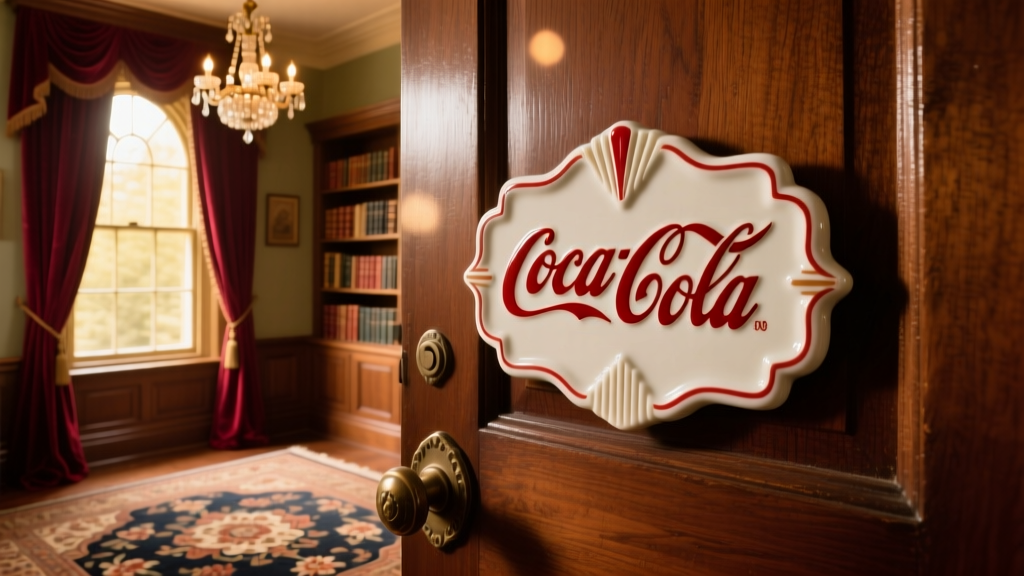
Coca-Cola Door Push Porcelain Plaque: A 1930s Advertising Artifact Measuring 13 × 3 Inches
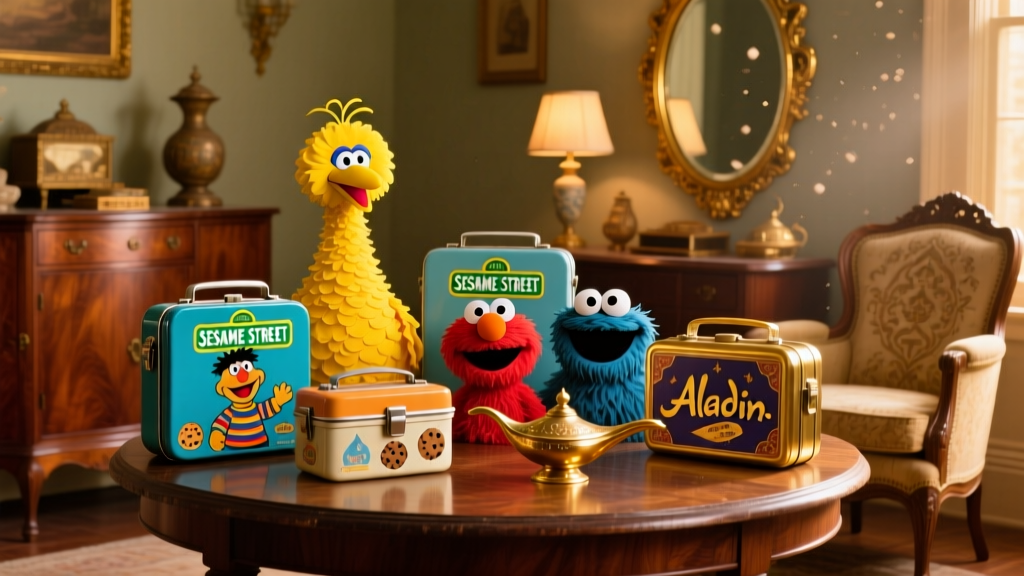
Sesame Street Lunch Boxes of 1984: Big Bird, Bert & Ernie, Elmo, Cookie Monster, and the Aladdin Tie-In — A Collector’s Reference Guide
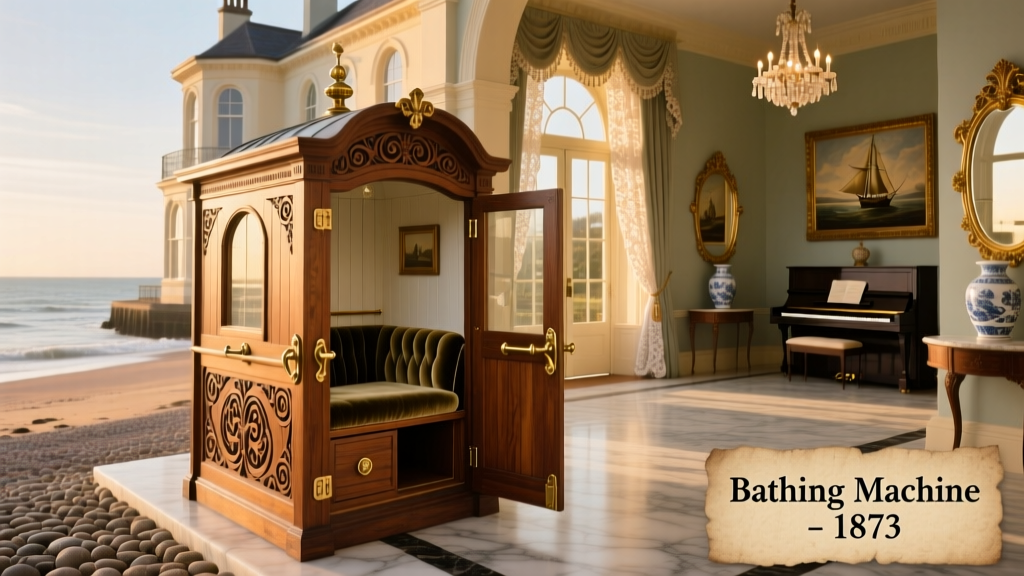
Bathing Machines: Engineering Modesty and Maritime Leisure in the Georgian and Victorian Eras

The Cut-Glass Champagne Pitcher: Decoding the Feathered Pinwheel Crosshatch with Scalloped Edge (14-Inch)

Kaitlyn Julian: A Contemporary Voice in Antique Furniture Restoration and Ethical Design Practice

Mother and Child: A Close Examination of Charles Campbell’s Ink-on-Paper Drawing (12 × 9 Inches)
The Lone Ranger Figurine by Hartland: A Collector’s Guide to History, Identification, and Value

Opalescent Glass Spanish Lace Barber Bottle: Cranberry Opalescent Northwood, 9-Inch Collector’s Profile