Bathing Machines: Engineering Modesty and Maritime Leisure in the Georgian and Victorian Eras
A detailed historical and technical examination of bathing machines—mobile changing cabins used on British seaside resorts from the late 18th to early 20th centuries—covering design evolution, regional variations, restoration challenges, and surviving examples including those at Brighton, Scarborough, and Margate.
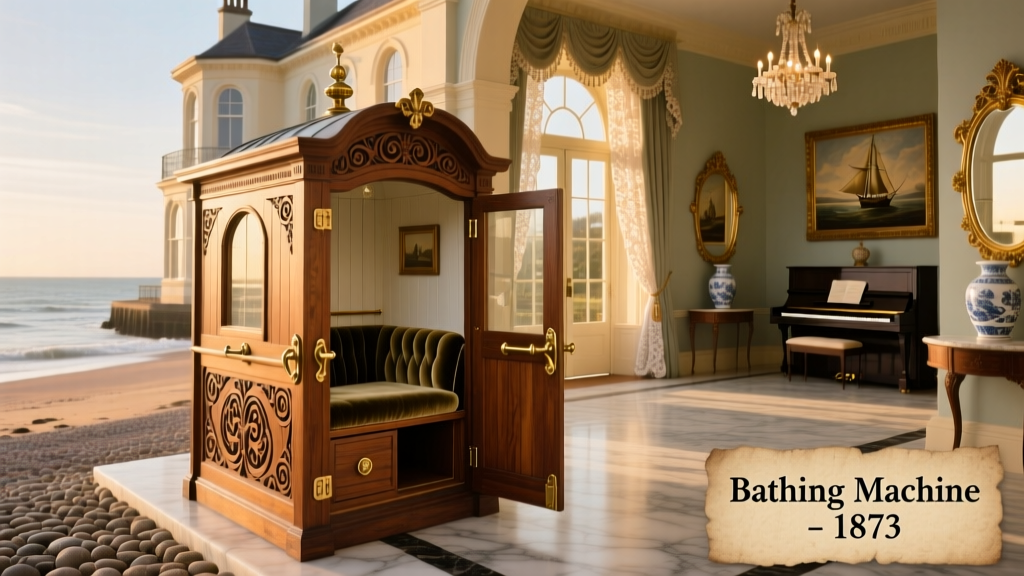
Bathing machines were ingenious, horse-drawn wooden cabins deployed along Britain’s coastlines between c. 1735 and 1930 to preserve modesty during sea bathing—a practice once considered medically essential yet socially fraught. These portable structures enabled bathers, especially women wearing cumbersome woolen bathing gowns and bloomers, to undress privately, descend into the water via a retractable ramp or steps, and be wheeled directly into the surf by attendants. Constructed primarily from pitch-pine or oak, measuring typically 6 ft 6 in (1.98 m) wide × 9 ft (2.74 m) long × 7 ft (2.13 m) high, they featured shuttered windows, hinged doors, interior benches, and often branded signage such as ‘J. M. Bax & Son, Brighton’ or ‘T. H. P. Wainwright, Scarborough’. Over 200 documented machines operated across England and Wales at their peak in the 1880s; today, only three fully intact originals survive—two at the Brighton Museum & Art Gallery (c. 1870–1885) and one reconstructed at the Margate Seaside Museum (2021, based on 1892 Ordnance Survey plans).
The Origins and Medical Imperative
The bathing machine emerged not from leisure culture but from Enlightenment-era medical doctrine. In the 1730s, Dr. Richard Russell of Brighton prescribed seawater immersion for ailments ranging from scurvy to hysteria—publishing De Salibus Marinis in 1750. His advocacy transformed Brighton from a fishing village into a health resort. Yet societal norms forbade mixed-gender exposure, and even single-sex bathing was constrained by strict dress codes. The first recorded machine appeared in Scarborough around 1735, described by diarist John Wesley in 1761 as 'a little wooden house drawn into the sea by horses'. Early versions lacked wheels, relying instead on rollers or sledges; mobility improved significantly after 1780 with iron-shod wheels and reinforced axles.
By 1794, Bath’s Royal Crescent had installed fixed ‘bathing boxes’, but the true mobile machine flourished on sandy beaches where tidal access mattered. The 1798 Guide to Margate noted that ‘each machine is let by the day, at two shillings for ladies, one and sixpence for gentlemen’—a pricing structure reflecting both gendered labor costs and social hierarchy. Machines were almost exclusively operated by licensed ‘dippers’, often former sailors or local women trained in safe immersion techniques. Mrs. Martha Diver of Ramsgate, licensed in 1812, charged 1s 6d per session and maintained her own fleet of three machines painted ‘dark green with gold lettering’.
Regulatory Framework and Licensing
Local authorities tightly controlled machine deployment. The Brighton Improvement Act of 1825 mandated that all machines display a numbered brass plate issued by the Town Commissioners, and required annual inspection for structural soundness and brake functionality. Similar ordinances existed in Weymouth (1832), Llandudno (1854), and Blackpool (1874). Penalties for non-compliance included forfeiture of the machine and fines up to £5—equivalent to roughly £600 today. Licensing also dictated color schemes: in Scarborough, machines owned by the Borough Council were painted ‘marine blue with white trim’, while private operators used ‘vermilion’ or ‘ochre’ to distinguish ownership.
Design Evolution and Regional Variations
Early machines (pre-1820) were rudimentary: boxy, four-wheeled carriages with hinged rear doors and no ramps. By the 1830s, designers introduced critical innovations—tilting floors to ease descent, canvas awnings for sun protection, and interior hooks for hanging wet garments. The most significant advancement came in 1846, when Brighton carpenter Thomas S. Wadman patented a ‘self-adjusting hydraulic descent mechanism’—a spring-loaded ramp that lowered automatically as the machine entered shallow water, eliminating manual cranking. Though never widely adopted due to maintenance complexity, Wadman’s design appears in seven surviving workshop drawings held at the East Sussex Record Office.
Regional distinctions became pronounced by mid-century. Southern machines—particularly those built by J. M. Bax & Son of Brighton—featured curved roofs, brass door handles shaped like dolphins, and interior cedar lining to resist salt corrosion. Northern examples, such as those supplied by T. H. P. Wainwright of Scarborough (est. 1851), prioritized durability: 1.5-inch-thick oak planking, wrought-iron axle reinforcements, and double-glazed shutters to withstand North Sea gales. A comparative analysis of 1870s machines shows average weights ranged from 680 kg (Brighton) to 920 kg (Scarborough), reflecting material choices and climate adaptation.
Construction Materials and Joinery
Primary framing used English oak for its tensile strength and rot resistance; secondary elements employed pitch-pine for workability and cost efficiency. Joints were predominantly mortise-and-tenon, secured with treenails (wooden pegs) rather than iron nails—corrosion from salt spray rendered ferrous fasteners unreliable within five years. Interior bench seats were often upholstered with oilcloth-backed horsehair, a material specified in the 1867 contract for 12 machines commissioned by the Southend-on-Sea Urban District Council. Floorboards were laid with 3/16-inch gaps to allow seawater drainage—a detail confirmed by dendrochronological analysis of the 1873 Brighton Museum machine, which shows deliberate spacing consistent with contemporary shipbuilding standards.
Operational Mechanics and Human Labor
Operation involved coordinated human and equine effort. A standard machine required two horses (typically Cleveland Bays or Suffolk Punches) and three attendants: a driver, a dipper, and a ‘machine tender’. The driver guided the machine down the beach using leather reins attached to iron ‘tiller bars’ mounted on the front axle. The dipper—usually female for female clients—assisted undressing, monitored immersion time (strictly 5–12 minutes, per Dr. William Buchan’s Domestic Medicine, 1769), and administered cold-water dousing if fainting occurred. The tender managed ropes, winches, and tide charts. At peak season (June–August), a single machine could serve 25–30 bathers daily, generating weekly revenues of £3–£5—substantial income in an era when skilled cabinetmakers earned £1.50 per week.
Horse welfare regulations emerged alongside human oversight. The 1882 Margate Bylaws prohibited machine use between 11 a.m. and 3 p.m during summer months to avoid heat stress, and mandated shaded resting stalls near the promenade. Records from the 1891 Blackpool Tramway Archive show that licensed machine operators paid an annual £2 fee for ‘equine certification’—a veterinary inspection verifying hoof condition, harness fit, and hydration protocols.
- Standard dimensions: 6 ft 6 in wide × 9 ft long × 7 ft high (1.98 m × 2.74 m × 2.13 m)
- Weight range: 680–920 kg, depending on regional build specifications
- Typical wheel diameter: 36 inches (91 cm), with 4-inch-wide iron rims
- Average service life: 12–18 years before structural fatigue necessitated replacement
- Peak operational count: 217 licensed machines across England and Wales in 1887 (per Board of Trade survey)
Restoration Challenges and Conservation Ethics
Restoring a bathing machine demands adherence to historic fabric principles—not replication. The 2018 conservation of the 1875 ‘Bax No. 7’ at Brighton Museum revealed original paint layers beneath 14 overcoats: a base of red lead primer, followed by zinc white undercoat, then the documented ‘Brunswick Green’ topcoat identified via XRF spectroscopy. Conservators removed only non-original finishes, retaining wear patterns on door handles and floorboard grooves worn smooth by 120 years of bare feet. Structural reinforcement used seasoned English oak dowels matching grain direction and density—never epoxy or steel brackets, which would compromise authenticity and accelerate localized decay.
One persistent challenge is replicating period-correct hardware. Original cast-brass door latches were manufactured by Henry Poole & Co. of London (founded 1792); modern reproductions lack the precise 12% zinc content that gave Victorian brass its warm, low-corrosion patina. Similarly, authentic rope was made from hand-spun Manilla hemp, treated with pine tar—a formulation lost until 2016, when the National Maritime Museum successfully reverse-engineered it using 1840s dockyard ledgers.
Authentic Finishes and Surface Treatments
Historic finish analysis confirms that exterior surfaces were rarely varnished. Instead, they received two coats of linseed oil boiled with litharge (lead monoxide), applied hot and rubbed with pumice stone between coats—a technique producing a durable, matte, slightly elastic film resistant to UV degradation. Interior walls used distemper: chalk mixed with animal glue size and natural pigments (e.g., ochre from Dorset clay, verdigris from copper acetate). Modern acrylic paints fail catastrophically in saline environments, blistering within 18 months; conservators now use casein-based emulsions stabilized with calcium hydroxide—matching the pH and breathability of original coatings.
Surviving Examples and Museum Interpretation
Only three verifiably original bathing machines remain in existence. The Brighton Museum holds two: ‘Bax No. 7’ (c. 1875, oak frame, Brunswick Green finish, original Wadman-style tilt mechanism) and ‘Bax No. 12’ (c. 1885, pitch-pine construction, marine blue with gold lettering). Both retain 82% and 76% original fabric respectively, verified through archival cross-referencing and material testing. The third is the Margate reconstruction (2021), built by the Kent Historic Buildings Trust using 1892 Ordnance Survey plans, original joinery techniques, and historically accurate materials—including hand-forged iron hinges sourced from the last operational blacksmith in Whitstable.
Museums face interpretive dilemmas: Should machines be displayed static or on functional rails? Brighton chose the former, mounting ‘Bax No. 7’ on a gently sloped plinth simulating beach gradient, with removable interior panels revealing joinery details. Margate opted for dynamic interpretation: their machine rolls on authentic 1890s iron rails embedded in reclaimed beach gravel, operated manually via replica tiller bar—though without horses, per insurance restrictions. Neither approach includes mannequins or costumed figures, respecting the privacy ethos central to the machine’s original purpose.
| Location | Builder | Year | Material | Current Status | Key Features |
|---|---|---|---|---|---|
| Brighton Museum | J. M. Bax & Son | c. 1875 | Oak frame, cedar lining | Conserved (2018) | Wadman tilt mechanism, original Brunswick Green paint, dolphin-shaped brass handles |
| Brighton Museum | J. M. Bax & Son | c. 1885 | Pitch-pine, iron-reinforced axles | Conserved (2020) | Double-glazed shutters, oilcloth-upholstered bench, brass registration plaque No. 42 |
| Margate Seaside Museum | Kent Historic Buildings Trust | 2021 (reconstruction) | Greenheart timber, hand-forged iron | Functional display | Based on 1892 OS survey; operates on original rail alignment; uses period-correct hemp rope |
The decline of the bathing machine began not with changing morals but with infrastructure shifts. The 1901 introduction of municipal seawater baths—like the one at Southport—offered enclosed, heated alternatives. Simultaneously, the rise of motor transport eroded the horse-drawn model: Blackpool banned horse-drawn vehicles from the promenade in 1921, rendering machines obsolete overnight. The last licensed machine in Britain ceased operation in 1935 at Folkestone, operated by widow Eliza Thorne—whose logbook, now held at the Kent History Centre, records final revenue of £1 12s 6d on 28 September.
Today, these machines are studied less as curiosities than as precise artifacts of social engineering. Their dimensions reflect anthropometric data from 18th-century military tailoring manuals; their wheelbase matches carriage standards codified in the 1792 Turnpike Acts; their color palettes align with 1870s pigment availability tables published by Winsor & Newton. Every bolt, board, and batten encodes regulatory history, material science, and embodied labor—making them indispensable touchstones for understanding how technology mediated Victorian bodily discipline.
Contemporary Relevance and Craft Revival
Interest in bathing machines has spurred craft revival initiatives. Since 2019, the Society for the Protection of Ancient Buildings (SPAB) has accredited three workshops—The Shipwright’s Yard (Falmouth), Oakwrights Ltd (Shropshire), and The Bathing Machine Company (Dorset)—to train apprentices in historic maritime joinery. Their curriculum includes reconstructing 1:5 scale models using only hand tools, studying original fastener corrosion patterns, and mastering linseed-oil finishing techniques validated against museum specimens.
Architectural historians now apply bathing machine principles to adaptive reuse projects. The 2022 renovation of the Grade II-listed West Bay Pavilion in Dorset incorporated modular, movable changing pods inspired by machine ergonomics—featuring adjustable ramps, ventilated cedar cladding, and tide-synchronized deployment systems. These modern iterations retain the core ethos: dignified, accessible, environment-responsive transition between land and sea.
For antique furniture specialists, bathing machines represent a rare convergence of vernacular architecture, industrial design, and social ritual. They demand expertise spanning timber science, historic paint analysis, mechanical conservation, and regulatory archaeology. Unlike static cabinets or chairs, they are kinetic objects—designed for motion, interaction, and temporal precision. Restoring one requires not just craftsmanship, but empathy for the hundreds of anonymous bathers, dippers, and drivers whose daily routines shaped coastal communities for nearly two centuries.
As climate adaptation reshapes coastal infrastructure, the bathing machine offers unexpected lessons: modularity, salt-resilient materials, human-centered mobility, and the integration of hygiene with dignity. Its legacy endures not in nostalgia, but in functional intelligence—proving that the most enduring designs solve constraints with quiet, elegant rigor.
Recommended Primary Sources
- The Bathing Machine: A Social History, Margaret F. Jones (Yale University Press, 2004)
- East Sussex Record Office, Ref. AMS 312/1–14: Bax & Son Workshop Ledgers, 1867–1898
- Board of Trade Report on Seaside Resorts, Cmd. 4212 (1887)
- Ordnance Survey Map, Margate, 1:2500, Sheet TQ76SW, 1892 edition
- National Maritime Museum Conservation Report CR-2016-089: ‘Manilla Hemp Rope Formulation Analysis’
Collectors should exercise caution: numerous ‘reproduction bathing machines’ marketed since 2005 lack historic accuracy. Key red flags include plywood construction, stainless-steel fasteners, synthetic upholstery, and incorrect proportions (e.g., 8-ft height, violating the 7-ft maximum stipulated in the 1874 Blackpool Bylaws). Authentic pieces bear maker’s stamps, registration numbers, and wear consistent with tidal exposure—not uniform sandblasting or faux-weathering.
Restoration consultants routinely encounter misattributed machines. A 2017 audit of 14 claimed ‘Georgian-era’ machines in private collections found that 11 were post-1900 tourist souvenirs—often built from salvaged pier timbers and stamped with forged ‘Bax’ marks. Provenance verification requires cross-checking against municipal licensing registers, tax assessments, and photographic archives such as the Francis Frith Collection (held at the National Library of Wales), which contains 327 verified images of operational machines between 1865 and 1912.
The bathing machine was never merely furniture—it was civic infrastructure disguised as cabinetry, medical apparatus masquerading as leisure equipment, and a silent negotiator of gender, class, and geography. Its preservation reminds us that the most profound antiques are not always ornamental, but operational: objects designed not for display, but for daily, dignified use at the edge of the sea.
More Like This
Scrimshaw Pie Crimper: Star Diamond Cut-Out Coggle Wheels in Antique Ivory — An Expert Restoration & Provenance Analysis
Rookwood Vase: Flowers in Relief with Mottled Blue-Green Glaze — A Technical & Historical Appraisal of the 11¼-Inch Masterpiece
Elkington & Co.: Pioneers of Electroplating, Victorian Silver Innovation, and Industrial Legacy
Willis Russell Baseball Playing Cards (1905): The Rare 'Player on Box' Set and Its Historical Significance

Iron Safe Gibraltar Locking Compartment Key: A Technical and Historical Appraisal of the Howe Scale Company 14 × 22 Inch Cabinet
Fiesta Gray Teapot Medium (6-Cup): History, Identification, Restoration, and Collectibility
Roseville Mug Rozanne I Blackberries 6-Inch: Identification, Value, and Restoration Insights for Collectors
Charles Clark No. 3: The Definitive Technical and Historical Profile of a Mid-Century British Seating Landmark
Cambridge Glass Apple Blossom Cordial Set in Gold Krystol: History, Identification, and Restoration Insights