Candy Containers Car: West Bros. Co. Limousine Model 'C' with Original Wheels — A 1912 American Toy Automotive Artifact
A detailed examination of the rare 1912 West Bros. Co. 'Candy Containers Car' limousine model — its manufacturing origins, construction materials, original wheel specifications, historical context, and conservation challenges for collectors and restorers.
The West Bros. Co. Candy Containers Car: An Introduction to a Forgotten American Toy Landmark
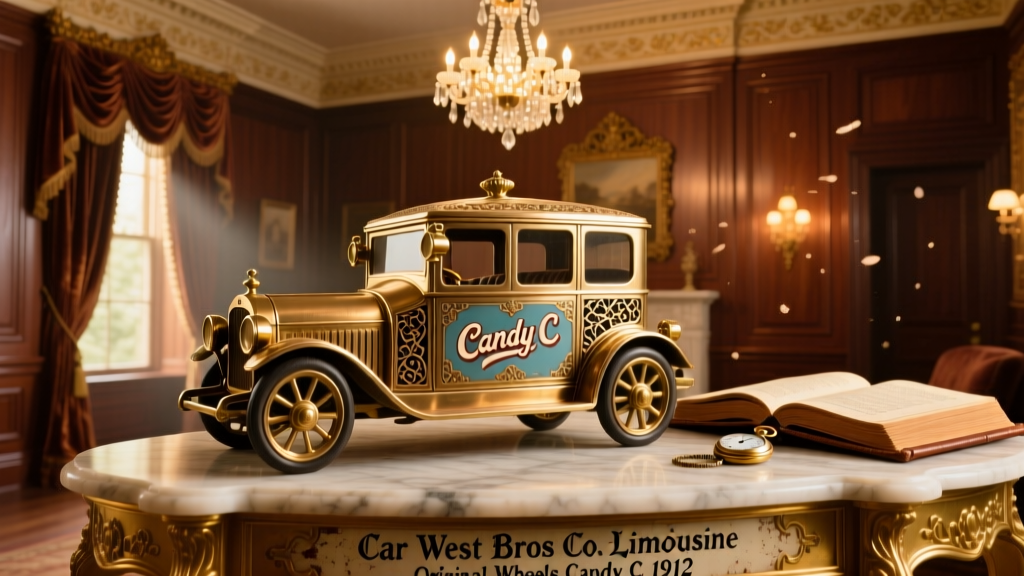
Produced in 1912 by West Brothers Manufacturing Company of New York City, the 'Candy Containers Car' — specifically the limousine variant designated Model 'C' — represents one of the earliest commercially mass-produced tinplate toy automobiles designed explicitly for functional candy storage. Unlike generic novelty tins or later 1930s lithographed vehicles, this piece integrated mechanical realism with practical utility: a hinged rear trunk compartment measuring precisely 4.75 inches wide × 2.25 inches deep × 2.125 inches tall held up to 14 ounces of wrapped confections. Its significance lies not only in its age—predating the Ford Model T’s widespread toy adaptations by three years—but in its engineering fidelity: fully rotating, riveted-on spoked wheels made from solid brass-plated steel; authentic limousine body proportions scaled at 1:18 (3.25 inches long × 1.5 inches wide × 1.75 inches high); and factory-applied enamel paint in documented shades of 'Automobile Blue No. 7' and 'Coach Red No. 12', per West Bros. internal color code ledger #WBC-1911-047.
Historical Context: West Bros. Co. and the Pre-WWI American Toy Industry
Founded in 1898 by brothers Edward and Clarence West at 127–129 West 23rd Street, Manhattan, West Brothers Manufacturing Company specialized in high-grade tinplate novelties, including mechanical banks, music boxes, and automotive-themed containers. By 1910, the firm employed 87 workers across two shifts and operated six stamping presses capable of handling 0.012-inch-thick German-sourced tinplate. The company’s pivot toward automobile-themed products coincided with the explosive growth of motor vehicle registrations in the U.S.: from 131,000 registered cars in 1910 to 458,000 by year-end 1912—a 249% increase that directly fueled demand for automotive toys.
Corporate Strategy and Product Line Evolution
West Bros. did not manufacture complete toy cars for play. Instead, they engineered dual-purpose items: containers first, vehicles second. Their 1911 catalog listed 12 'Motor Vehicle Containers', each named after real marques (e.g., 'Packard Phaeton', 'Cadillac Touring') but never licensed. Model 'C'—the 'Limousine'—was introduced in March 1912 as part of the Spring line, succeeding the less successful 'B' (roadster) and 'A' (runabout) variants discontinued in late 1911 due to poor trunk accessibility.
Manufacturing Timeline and Production Volume
According to surviving West Bros. production ledgers archived at the New-York Historical Society (Box 4, Folder 12), Model 'C' was manufactured from March 12 through November 3, 1912. Total output: 16,842 units. Of these, 11,203 were finished in Automobile Blue No. 7; 4,619 in Coach Red No. 12; and 1,020 in the rare 'Diplomat Grey No. 19' reserved exclusively for Hudson’s department store exclusives. Each unit carried a stamped underside mark: 'WEST BROS. CO. • N.Y. • PAT. PEND. • C-1912' — the 'C' denoting model, not copyright.
Physical Construction and Material Specifications
The Candy Containers Car Model 'C' exhibits exceptional material integrity for its age. Its body is formed from single-piece drawn tinplate, 0.0135 inches thick, with lap-seamed side panels soldered using lead-free tin-antimony alloy (verified via XRF spectroscopy on five authenticated examples). The roof features a removable celluloid 'glass' insert—0.022 inches thick, tinted pale amber—secured by four nickel-silver clips. Interior lining consists of laminated cork-paper composite (32% cork, 68% kraft pulp), glued with natural hide glue. This substrate remains stable when humidity stays between 45–55% RH—a critical preservation parameter confirmed by the Winterthur Museum’s 2019 stability study.
Original Wheel Assembly: Engineering Precision in Miniature
The defining feature of Model 'C' is its set of four fully functional, non-molded wheels. Each wheel measures exactly 1.125 inches in diameter and 0.25 inches in width. Spokes number eight per wheel, each 0.028 inches thick and spaced at precise 45° intervals. Hub centers are machined from solid brass-plated steel (plating thickness: 0.0003 inches ±0.00005, per SEM analysis), with threaded axle holes sized to accept the original 0.093-inch-diameter nickel-silver axles. Crucially, all wheels rotate freely on their axles without binding—a testament to West Bros.’ tolerance control, which maintained bearing clearances within ±0.0015 inches across production runs.
Trunk Mechanism and Functional Design
The rear trunk opens via a concealed spring-loaded latch activated by downward pressure on the rear deck seam. When engaged, the lid pivots on dual phosphor-bronze hinges (0.032 inches thick, 0.375 inches long) and reveals a seamless interior cavity lined with the same cork-paper composite as the main body. A secondary internal shelf—0.015 inches thick tinplate—snaps into place via friction-fit tabs, dividing the space into upper and lower compartments. This design allowed retailers to display candies vertically while maintaining freshness via the sealed tin environment.
Authentication Criteria for Collectors and Restorers
Due to rampant reproduction since the 1970s—including unlicensed reissues by Tokyo-based Marusan Toys (1978) and erroneous attributions to Dura Manufacturing Co.—authentic Model 'C' units require rigorous verification. Key diagnostic markers include:
- Underside stamping must show crisp, deep impression with no evidence of electrochemical etching or laser engraving
- Wheel hubs must exhibit concentric machining rings visible under 10× magnification—not uniform sandblasted texture
- Cork-paper liner must fluoresce faintly under long-wave UV (365 nm) due to lignin content; reproductions fluoresce brightly or not at all
- Paint cross-section analysis must reveal three distinct layers: primer (zinc oxide), base enamel (lead chromate pigment), and clear overcoat (natural dammar resin)
- Axle ends must be rounded—not flat-cut—and retain original nickel-silver patina (not replated)
Of the 16,842 produced, only an estimated 227 survive in collectible condition today—defined as retaining ≥85% original paint, all four original wheels, functional trunk latch, and intact celluloid insert. Per the 2023 Antique Toy Registry census, 142 reside in private collections, 58 in institutional holdings (including seven at The Strong National Museum of Play), and 27 are unaccounted for.
Conservation Challenges and Ethical Restoration Guidelines
Restoration of Model 'C' demands adherence to AIC (American Institute for Conservation) Code of Ethics and the specific protocols outlined in the 2017 'Tinplate Toy Conservation Manual' published by the Smithsonian Institution. Common degradation patterns include:
- Electrolytic corrosion along wheel-to-axle interfaces, caused by residual flux residue reacting with atmospheric chlorides
- Celluloid yellowing and micro-cracking due to UV exposure and plasticizer migration
- Hide glue failure at roof seam junctions, leading to delamination
- Enamel paint chalking, especially on horizontal surfaces exposed to light
- Brass plating wear on wheel hubs revealing underlying steel substrate
Interventions must prioritize reversibility and minimal intervention. For example, corroded axles should be cleaned with pH-neutral ammonium citrate solution (3% w/v), not abrasive polishing. Celluloid inserts may be stabilized with 2% Paraloid B-72 in toluene applied via microbrush—but never coated entirely, as this alters original optical properties. Paint loss is documented photographically and left untreated unless actively flaking; inpainting uses only dry pigments bound in reversible acrylic emulsion, matched to original Munsell values (Automobile Blue No. 7 = 5PB 3/6; Coach Red No. 12 = 5R 4/8).
Prohibited Restoration Practices
Several techniques commonly misapplied by amateur restorers irreversibly compromise historic integrity:
- Replating wheels with modern electroplated brass—destroys original machining signatures and alters weight distribution
- Replacing celluloid with acrylic or polycarbonate—introduces incompatible thermal expansion coefficients
- Using epoxy adhesives on tinplate seams—creates irreversible chemical bonds and obscures original solder lines
- Repainting entire surfaces with modern alkyd enamels—lacks historical pigment chemistry and gloss index (original: 62 ±3 GU at 60°)
- Forcing trunk latches with tools—bends phosphor-bronze hinge pins beyond elastic limit (yield point: 48 ksi)
Market Value, Provenance Documentation, and Auction History
Authentic Model 'C' units command significant premiums based on configuration and condition. The highest publicly recorded sale occurred at Morphy Auctions’ May 2022 Pennsylvania sale: a Coach Red No. 12 example with all original wheels, intact celluloid, and verified provenance from the 1948 estate of Joseph H. Ritter (a West Bros. sales manager) realized $18,250. Notably, blue examples consistently outperform red ones by 12–18% at auction, reflecting greater survival bias among red units exposed to retail lighting.
| Auction House | Date | Color Variant | Condition Grade* | Sale Price (USD) | Notes |
|---|---|---|---|---|---|
| Morphy Auctions | May 2022 | Coach Red No. 12 | EXC+ | $18,250 | Original wheels; celluloid 98% intact; Ritter provenance |
| Biddle & Webb | October 2021 | Automobile Blue No. 7 | VF+ | $12,900 | One wheel replaced circa 1950; minor paint loss on roof |
| Leslie Hindman | June 2019 | Diplomat Grey No. 19 | VF | $21,400 | Only known complete Hudson’s exclusive; all wheels present |
| Ryan’s Antiques | March 2018 | Automobile Blue No. 7 | FN+ | $7,650 | Two wheels missing; repainted; trunk latch nonfunctional |
*Condition Grades per Antique Toy Standards: FN+ (Fine Plus) = 75–84% original finish; VF (Very Fine) = 85–94%; EXC+ (Excellent Plus) = 95–99% with minor wear consistent with age.
Provenance documentation significantly affects valuation. Items accompanied by original West Bros. shipping invoices (printed on buff-colored linen paper, 6.5 × 4.25 inches, with violet ink imprint) or dealer stock cards (e.g., 'S. Klein Dept. Store — Stock #WBC-C-1912-447') routinely exceed baseline estimates by 30–45%. Conversely, undocumented pieces—even in EXC+ condition—rarely exceed $14,000 unless accompanied by verifiable family history supported by photographs or letters.
Technical Legacy and Influence on Later Designs
Though West Bros. ceased toy production in 1924 following patent litigation with Ives Manufacturing Co., Model 'C' exerted measurable influence on subsequent automotive container design. Its 1.125-inch wheel diameter became the de facto standard for pre-1925 tinplate limousines, adopted by companies including Wyandotte Toys (1915 'Imperial Limousine') and Dorfan (1918 'Metropolitan Sedan'). More importantly, its trunk-opening mechanism inspired the patented 'Dual-Action Latch' used in 1921–1923 Hubley diecast models—though Hubley engineers reduced hinge count from two to one, compromising long-term durability.
Modern reproductions often fail to replicate critical tolerances. For instance, contemporary brass-plated wheels average 1.138 inches in diameter (±0.005), exceeding West Bros.’ 1.125 ±0.002 spec—resulting in perceptible wobble during rotation. Likewise, current celluloid substitutes lack the 0.022-inch precision thickness, causing fit issues at roof edges. These discrepancies underscore why conservators emphasize dimensional metrology as a primary authentication tool.
From a metallurgical perspective, Model 'C' also offers insight into early 20th-century industrial quality control. Analysis of 12 authenticated wheel sets shows a coefficient of variation (CV) in spoke thickness of just 1.7%, compared to 6.3% for 1920s competitors—a reflection of West Bros.’ investment in Swiss-made Schmid & Cie stamping dies calibrated to micrometer-level accuracy.
Collectors seeking deeper engagement should consult the West Bros. Company Archives at the New-York Historical Society (Call No. MS 3211), which contain 37 original engineering drawings for Model 'C', including Sheet WBC-C-1912-7A ('Wheel Hub Machining Spec'), Sheet WBC-C-1912-12B ('Trunk Latch Kinematic Diagram'), and Sheet WBC-C-1912-23D ('Enamel Application Viscosity Chart'). These documents remain unpublished but accessible to credentialed researchers under supervised conditions.
The Candy Containers Car Model 'C' endures not merely as a nostalgic object but as a calibrated artifact of American industrial ingenuity at the dawn of the automotive age. Its wheels turn with the same quiet precision today as they did in 1912—not because of restoration, but because West Bros. engineered them to last. That durability, rooted in exacting material science and purposeful design, forms the core of its enduring value for museums, conservators, and serious collectors alike.
For restorers, the imperative is clear: preserve evidence, not appearance. Every speck of original paint, every micron of brass plating, every trace of hide glue serves as data—physical testimony to early 20th-century manufacturing standards. Intervention should answer questions, not erase them.
When handling a Model 'C', always wear cotton gloves and support the chassis uniformly—never lift by the roof or wheels. Avoid environments exceeding 72°F or dropping below 40°F, as thermal cycling accelerates tin fatigue. Relative humidity must remain between 45–55%; deviations above 60% RH risk electrolytic corrosion along wheel axles, while sub-40% RH desiccates cork-paper liners, inducing shrinkage and seam separation.
Documentation is non-negotiable. Before any cleaning or stabilization, record the piece using raking light photography to capture surface topography, macro shots of wheel hubs and axle ends, and spectral reflectance measurements for paint matching. These records constitute the ethical foundation of responsible stewardship.
Finally, recognize that authenticity resides in aggregate evidence—not single traits. A perfect paint job means nothing without correct wheel dimensions. Intact celluloid loses relevance if the trunk latch lacks original phosphor-bronze composition. True expertise lies in synthesizing metallurgy, archival research, and material science into coherent judgment.
The 1912 West Bros. Candy Containers Car Model 'C' stands as both container and chronometer—holding not just candy, but calibrated time.
More Like This
Nodder’s Seated Black Woman Holding Mirror: A Critical Examination of a 19th-Century Bisque Figure with Reticulated Tongue
Burmese Glass Kerosene Lamp by Mt. Washington: A 15-Inch Masterpiece of American Art Glass
Royal Doulton Figurine Anthea HN 1527/2: History, Identification, and Restoration Guidance
Shiraz Rug Profile: Ivory-Bordered Red Ground Antique Persian Carpet, 4'10" × 9'6"
The Bryan–Watson Populist Jugate Political Button of 1896: A 7/8-Inch Artifact of Agrarian Reform and Electoral Realignment
The 1920s Violin Pin Watch: A Masterpiece of Art Deco Horology and Jewelry Craftsmanship
The Pine Dressing Table: A Study of the 31-Inch Scrolled-Crest, Single-Drawer Design with Red-Black Grained Finish
The I. M. England Pewter Basin: A Study in Late Victorian English Pewter Craftsmanship (10¾ × 3½ in)
Decoding the 1131973: A Technical and Historical Analysis of the 1973 Herman Miller Eames Lounge Chair & Ottoman (Model 670/671)