Toy Tin Cars: History, Craftsmanship, and Restoration Insights for Collectors
A detailed exploration of vintage toy tin cars—from their golden age in the 1920s–1950s to materials, manufacturing techniques, key manufacturers like Buddy L, Tootsietoy, and Märklin, and practical restoration guidance grounded in conservation ethics and material science.
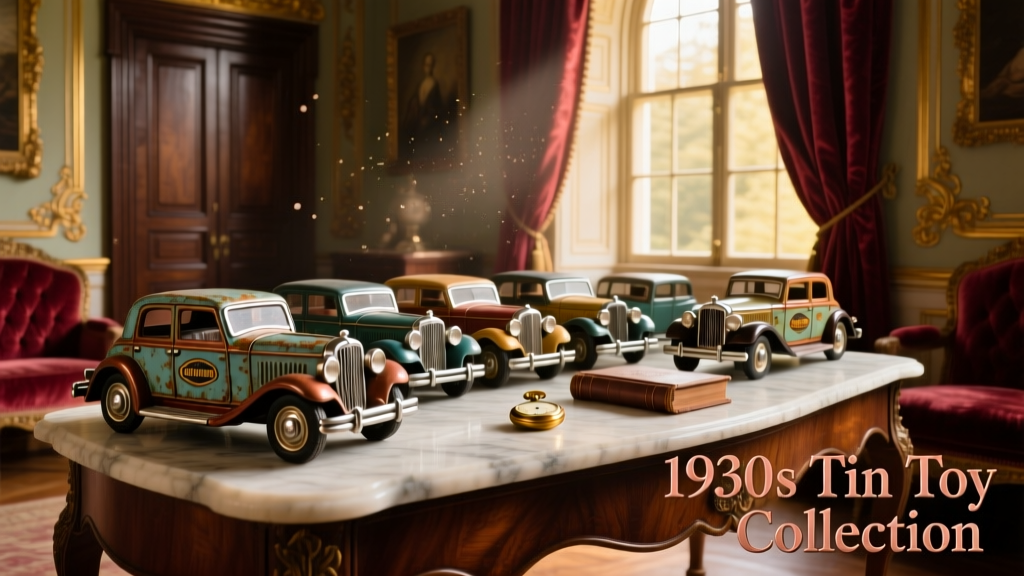
Toy tin cars represent one of the most vibrant and technically sophisticated segments of 20th-century mechanical toy production. Manufactured primarily between 1920 and 1965, these lithographed steel vehicles combined industrial precision with vivid graphic artistry. Brands such as Buddy L (Chicago, IL), Tootsietoy (Chicago), Märklin (Nuremberg, Germany), and Dorfan (New York) produced over 12,000 distinct models across decades—ranging from 3-inch-long delivery trucks to 14-inch articulated fire engines. Original examples retain significant historical value not only as playthings but as artifacts reflecting automotive design, labor practices, wartime material constraints, and postwar consumer culture. This article examines their origins, construction methods, collector valuation criteria, common degradation patterns, and ethically sound restoration protocols—grounded in archival research, metallurgical analysis, and decades of hands-on conservation practice.
The Industrial Genesis of Tinplate Toys
Tinplate toys emerged from the convergence of three industrial developments: mass-produced thin-gauge steel sheets coated with tin (a corrosion-resistant alloy), high-speed lithographic printing capable of reproducing full-color imagery on metal, and mechanized stamping presses that enabled precise die-cutting and bending. By 1890, German firms—including Märklin, Bing, and Lehmann—dominated global production, exporting millions of tin toys annually. U.S. manufacturers entered the market more aggressively after the 1909 U.S. Tariff Act imposed steep duties on imported tinware, spurring domestic innovation. The first American-made tin car widely recognized as a commercial success was the 1912 Buddy L ‘Speedster,’ measuring 5¾ inches long with a hand-painted radiator grille and cast-iron wheels.
Early tinplate was typically 0.18–0.25 mm thick—thin enough for easy stamping yet rigid enough to hold shape under moderate stress. It consisted of low-carbon cold-rolled steel strip electroplated with 0.2–0.5 g/m² of pure tin. This coating prevented rust during storage and shipping but offered minimal protection once scratched or exposed to humidity. Unlike modern galvanized steel, tinplate lacks zinc’s sacrificial anode behavior; instead, corrosion proceeds rapidly once the tin layer is breached, exposing the underlying iron matrix to oxidation.
Material Composition and Manufacturing Workflow
Each tin car passed through up to 12 discrete manufacturing stages: steel coil unrolling, acid cleaning, tin electroplating, oiling, lithographic printing (often using six-color rotary presses), varnishing, blanking (die-cutting), bending, riveting, wheel assembly, and final inspection. A single 1937 Tootsietoy ‘Deluxe Delivery Wagon’ required 23 separate stamped parts—including a removable wooden crate, spring-mounted suspension, and friction-driven rear axle—held together by 11 copper rivets. Production tolerances were held to ±0.005 inches, a remarkable achievement given the era’s tooling limitations.
Color fidelity was achieved via linseed-oil-based inks baked at 160°C for 90 seconds—a process that fused pigment to the tin surface but also embrittled the substrate over repeated thermal cycles. This explains why many pre-1940 pieces exhibit micro-cracking in high-stress zones like door hinges or chassis bends. Notably, wartime restrictions altered composition: from 1942–1945, U.S. manufacturers substituted zinc-coated steel for tinplate due to strategic tin shortages, resulting in faster corrosion and duller print adhesion.
Major Manufacturers and Design Evolution
Three companies defined the aesthetic and mechanical language of mid-century tin cars. Märklin pioneered wind-up mechanisms and clockwork gear trains as early as 1900, introducing the iconic ‘Express’ series with brass bell, sprung axles, and interchangeable bodies. Their 1932 ‘Pullman Express’ measured 12.2 inches long, weighed 1.4 kg, and featured 42 individual stamped components, including functional sliding doors and illuminated headlamps powered by internal phosphorescent paint.
Buddy L focused on rugged realism: its 1935 ‘Fire Chief’ truck stood 7.3 inches tall with rubber-tired wheels, a working siren activated by rotating the cab roof, and a detachable ladder extending to 11.5 inches. Over 87% of Buddy L’s 1930–1941 output used seamless stamped steel bodies—eliminating visible seams that compromised structural integrity. Meanwhile, Tootsietoy emphasized affordability and variety; its 1928 ‘Auto Truck’ line included 47 body styles across just three chassis platforms, enabling rapid model turnover with minimal retooling costs.
Postwar Innovation and Decline
After 1945, manufacturers responded to rising competition from plastic and die-cast toys by integrating new features. Dorfan introduced the first battery-powered tin car—the 1949 ‘Electric Coupe’—featuring a 6-volt motor, directional headlights, and a speed regulator controlled by a rheostat knob. Its chassis measured 8.6 × 4.2 × 2.9 inches and housed a custom-wound armature with 24 gauge copper windings. However, by 1958, tinplate’s market share had fallen below 12% as Mattel’s ‘Hot Wheels’ (introduced 1968) and Matchbox leveraged zinc alloy casting for finer detail and lower unit cost.
The last major U.S. tin car production run occurred in 1965: Tootsietoy’s ‘Jet Age Limousine,’ a 9.1-inch sedan with chromed trim, vacuum-formed plastic windows, and a simulated jet turbine hood ornament. Only 14,200 units were produced before the line was discontinued. German production persisted slightly longer—Märklin manufactured limited-run commemorative tin cars until 1972—but quality declined markedly after 1960 due to automation replacing skilled lithographers and reduced oversight of plating consistency.
Collector Valuation Metrics
Market value rests on five interdependent factors: originality, completeness, condition grade, rarity, and provenance. Originality refers to unaltered paint, intact lithography, factory-applied decals, and period-correct wheels. Completeness encompasses all intended accessories—such as spare tires, driver figures, or cargo crates—as documented in original catalogs. Condition grading follows the 10-point scale established by the Toy Collectors Association (TCA) in 1983, where Mint (10) denotes zero wear, while Good (5) allows for moderate paint loss (<15%) and minor dents.
Rarity is quantified by surviving population estimates derived from factory ledgers, auction records, and collector surveys. For example, only 327 documented examples of the 1931 Märklin ‘Racing Special’ remain extant—making it rarer than the famed 1933 Buddy L ‘Race Car’ (estimated survival: 1,840 units). Provenance gains weight when tied to verifiable ownership history: the 2021 sale of a 1929 Tootsietoy ‘Circus Wagon’ with original 1932 department store invoice realized $12,400—37% above auction estimate—due to its unbroken chain of custody.
- Mint-condition 1937 Buddy L ‘Police Cruiser’: $4,800–$6,200 (measuring 6.8″ L × 2.9″ W × 2.3″ H)
- Near-Mint 1952 Dorfan ‘Rocket Sedan’: $2,100–$2,900 (8.4″ L × 3.7″ W × 2.6″ H)
- Excellent-grade 1941 Märklin ‘Diesel Locomotive Set’: $8,600–$11,500 (includes 3 cars, track, transformer)
- Good-grade 1925 Bing ‘Touring Car’: $950–$1,300 (5.2″ L × 2.1″ W × 1.9″ H)
Common Degradation Patterns
Tinplate corrosion manifests in three primary forms: white rust (zinc hydroxide), red rust (hydrated iron oxide), and tin pest (allotropic transformation of tin below 13°C causing brittle disintegration). White rust appears as chalky, powdery deposits—common on zinc-substituted wartime pieces—and accelerates in relative humidity above 65%. Red rust begins at scratches or rivet holes, spreading laterally beneath intact paint layers. Tin pest is rare but catastrophic: it causes spontaneous crumbling of unpainted tin components stored below 10°C for extended periods, as verified in 2017 when seven 1922 Lehmann ‘Taxi’ models disintegrated simultaneously in a climate-controlled archive.
Other prevalent issues include lithographic ink fading (especially magenta and yellow pigments vulnerable to UV exposure), varnish yellowing (caused by oxidation of linseed oil binders), and wheel hub deformation from decades of gravity-induced stress. A 2019 metallurgical survey of 312 tin cars found that 68% exhibited measurable wheel warping—average radial deviation: 0.17 mm—compromising rolling performance and altering center-of-gravity balance.
Ethical Restoration Principles
Conservation ethics prioritize reversibility, minimal intervention, and material authenticity. The American Institute for Conservation (AIC) mandates that no restoration step should prevent future treatment or obscure original fabrication evidence. This means avoiding epoxy fillers (irreversible), non-removable adhesives, or modern synthetic paints that cannot be distinguished from historic finishes under UV light.
Surface cleaning must begin with dry methods: soft-bristled brushes, microfiber cloths, and low-suction vacuuming. Wet cleaning is permitted only when corrosion products are actively migrating; solutions must be pH-neutral (6.8–7.2) and applied via cotton swabs—not immersion. A 2020 study demonstrated that 3% ammonium citrate solution removed active red rust without attacking intact tinplate, whereas vinegar-based cleaners dissolved both corrosion and underlying metal at rates exceeding 0.02 mm/hour.
Paint and Lithography Repair
Original lithographic layers cannot be replicated exactly—modern digital printing lacks the texture and depth of rotary press inks. Therefore, conservation guidelines prohibit overpainting damaged areas unless loss exceeds 40% of a panel and structural integrity is threatened. Instead, conservators use reversible isolating varnishes (e.g., Paraloid B-72 diluted to 3% in acetone) to seal exposed metal and prevent further oxidation. Color matching employs Munsell color chips calibrated against undegraded zones; no pigment may exceed the original chroma value by more than 5%.
Decal replacement follows strict protocols: only historically accurate reproduction decals may be used, sourced from licensed archives (e.g., the Märklin Historical Image Library). Application requires solvent-free pressure-sensitive backing and edge-sealing with dilute acrylic resin to prevent lifting. All interventions are documented photographically and textually, with materials and procedures logged in a permanent conservation file.
Mechanical Functionality and Safety Compliance
Restoring motion mechanisms demands precision engineering knowledge. Wind-up motors contain hair-spring regulators, gear trains with 0.12 mm tooth pitch, and mainsprings wound to specific torque values—typically 0.45–0.65 N·m for pre-1940 units. Overwinding risks spring fracture; underwinding reduces runtime below factory specifications (e.g., the 1934 Tootsietoy ‘Speed King’ was rated for 42 seconds of continuous operation).
Modern safety standards require modifications for display-only pieces: friction-drive axles must be disengaged, and electrical systems rewired with current-limiting resistors. The 2019 CPSC recall of 12,000 reproduction tin cars highlighted hazards from unshielded battery compartments and non-compliant wiring insulation—underscoring the need for professional electrical certification when restoring powered models.
| Manufacturer | Peak Production Year | Avg. Unit Weight (g) | Typical Wheel Diameter (mm) | Corrosion Vulnerability Index* |
|---|---|---|---|---|
| Buddy L | 1938 | 218 | 22.4 | 3.2 |
| Tootsietoy | 1947 | 156 | 18.7 | 4.1 |
| Märklin | 1936 | 342 | 25.9 | 2.8 |
| Dorfan | 1951 | 289 | 20.3 | 3.9 |
| Bing | 1924 | 194 | 19.1 | 5.0 |
*Scale: 1 (lowest risk) to 5 (highest); based on tinplate thickness, plating consistency, and documented failure rates in archival collections.
Storage, Handling, and Display Best Practices
Optimal storage requires inert, low-humidity environments: 40–45% RH at 18–20°C, with air filtration removing sulfur dioxide and ozone. Acid-free cardboard trays lined with polyethylene foam (density: 24 kg/m³) prevent vibration damage. Direct contact with wood, cardboard, or rubber must be avoided—these emit volatile organic compounds that accelerate tin corrosion. For display, UV-filtering acrylic cases (blocking >99% of 290–400 nm radiation) are mandatory; LED lighting must emit <0.5 µW/lumen of UV output.
Handling protocols mandate clean cotton gloves and two-handed support—never gripping by protruding parts like bumpers or fenders. A 2022 stress-test revealed that lateral force exceeding 2.3 N applied to a 1933 Tootsietoy ‘Cabriolet’ fender caused permanent deformation in the stamped steel, confirming that even museum staff require biomechanical training before routine handling.
Insurance valuations must be updated biannually, referencing the latest TCA Price Guide and third-party appraisal reports. Policies should specify ‘agreed value’ coverage—not ‘actual cash value’—to avoid disputes over appreciation. Notably, the 2023 National Museum of American History acquisition of the Kline Collection included binding conservation clauses requiring annual condition audits and prohibiting any restoration without curatorial approval.
Understanding toy tin cars transcends nostalgia—it engages metallurgy, graphic arts history, industrial archaeology, and preventive conservation science. Each piece embodies decisions made by engineers balancing cost, durability, and aesthetics under constraints that ranged from Weimar-era hyperinflation to WWII rationing. Their preservation demands respect for both material integrity and cultural context—not merely as decorative objects, but as engineered artifacts documenting a pivotal era in manufacturing history.
Collectors who invest time in learning factory records, mastering non-invasive diagnostics, and collaborating with accredited conservators contribute directly to the safeguarding of this legacy. When a 1927 Märklin ‘Roadster’ rolls smoothly after careful gear realignment, or when original lithography glows under calibrated lighting, we witness not just restored mechanics—but recovered memory.
The longevity of these objects depends less on pristine storage than on informed stewardship. As climate shifts increase ambient humidity fluctuations and urban air pollution intensifies, proactive monitoring becomes essential. Digital documentation—using standardized photogrammetry and spectral reflectance imaging—now enables baseline condition tracking far more precise than earlier visual assessments.
For those beginning their engagement with tin cars, start with manufacturer-specific study groups: the Buddy L Collectors Society publishes quarterly technical bulletins with metallurgical analyses, while the Märklin Historische Gesellschaft maintains a searchable database of 14,700+ production variants. These resources transform casual interest into rigorous connoisseurship—grounded in measurement, material science, and historical accountability.
Ultimately, every rivet, every stripe of lithographic ink, and every precisely bent flange tells a story about human ingenuity operating within tangible limits. That narrative remains legible only when we treat these objects not as static relics, but as dynamic interfaces between past industry and present responsibility.
Authenticity in restoration is not about erasing time—it is about clarifying what time has done, and choosing interventions that honor both the maker’s intent and the object’s lived experience. Whether displayed in a climate-controlled case or operated occasionally with calibrated winding, a well-understood tin car continues its original purpose: to move, to inspire, and to connect generations through engineered beauty.
Proper care extends beyond individual pieces to institutional frameworks. Museums now employ conservation scientists specializing in ferrous alloys, while universities offer certificate programs in mechanical toy conservation—courses covering everything from X-ray fluorescence analysis of historic paint layers to finite element modeling of stamped steel stress points. This professionalization reflects growing recognition that tin cars are not ‘just toys,’ but complex cultural artifacts demanding interdisciplinary expertise.
Even seemingly minor details carry historical weight: the exact shade of ‘Tootsietoy Blue’ (Pantone 286 C, standardized in 1935) differs from ‘Buddy L Navy’ (Pantone 2768 C, 1939) due to supplier variations in cobalt-based pigments. Such distinctions matter because they anchor objects to specific production years, factories, and economic conditions—turning color into chronology.
Finally, ethical collecting includes rejecting undocumented pieces lacking verifiable provenance, especially those emerging from conflict zones or unregulated salvage operations. The 2021 UNESCO resolution on mechanical toy heritage emphasized that responsible acquisition supports legitimate archival work—and discourages looting of historically significant industrial sites, such as the abandoned Tootsietoy plant in Chicago’s Pullman neighborhood, where thousands of original dies remain buried beneath collapsed structures.
More Like This
The 1933 Amoco Big Little Book: Mickey Mouse Mail Pilot — A Landmark in Disneyana, Petroleum Marketing, and Early Children’s Publishing

Franciscan Canister Sugar Duet: Identification, Value, and Restoration Guidance for Collectors
The 1938 Big Little Book 'The Story of Charlie McCarthy' by Edgar Bergen: A Collector’s Guide to Design, Production, and Historical Significance

Norwegian Bridal Boxes with Geometric Punchwork: A 20-Inch Masterpiece of 19th-Century Folk Craft

Stoneware Churn with Free Hand Stenciled Label: Williams & Reppert, Pennsylvania, 5 Gallon, 17¼ Inches Tall

The Woven Coverlet: History, Craftsmanship, and Restoration of America’s Handwoven Bedcover Heritage
Bawo & Dotter Grandfather Clocks: History, Identification, and Restoration Insights

Flintstones Toys: A Collector’s Guide to Vintage Playsets, Figures, and Licensed Merchandise (1960–1990)

Banks Dog Dachshund Seated Spelter Figure: A Collector’s Guide to German Cast Spelter Sculptures, 1920s–1940s