The Woven Coverlet: History, Craftsmanship, and Restoration of America’s Handwoven Bedcover Heritage
A deep-dive exploration of the American woven coverlet—its origins in early 19th-century domestic weaving, regional patterns like overshot and summer-winter, key makers such as Nancy N. Hopper and the Gable family, structural characteristics including warp-faced plain weave and cotton-wool blends, and practical, ethics-based restoration protocols used by professional conservators at institutions including Winterthur Museum and the Henry Ford Museum.
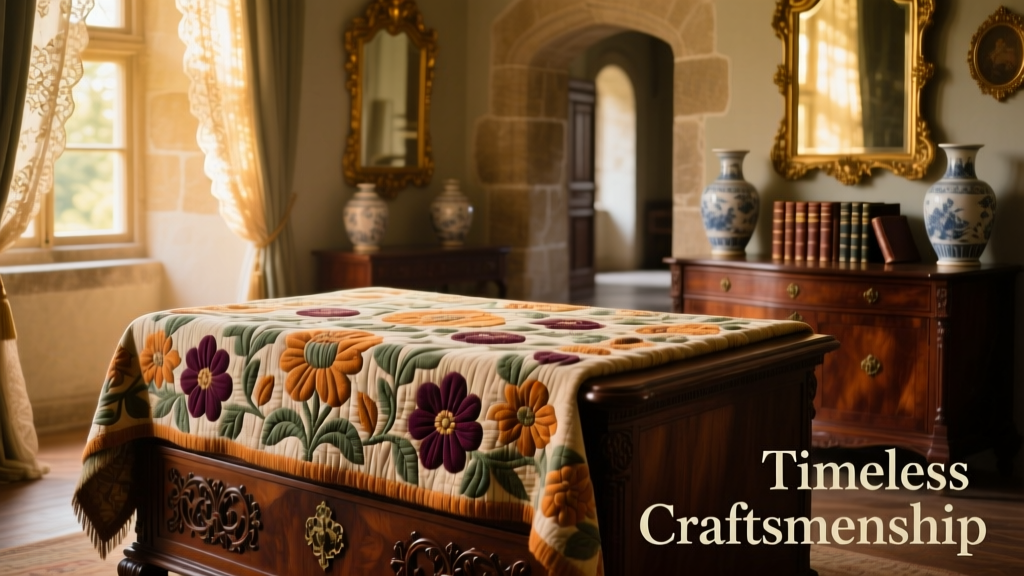
The woven coverlet is a cornerstone of early American material culture—a functional textile artifact born from necessity, refined through regional ingenuity, and preserved today as both decorative heirloom and historical document. Produced primarily between 1800 and 1860 across New England, the Mid-Atlantic, and the Ohio River Valley, these handwoven bedcovers were made on four-harness looms using locally spun cotton, wool, or blended yarns. Unlike printed or embroidered bed coverings, woven coverlets relied entirely on structural patterning—especially overshot and summer-winter weaves—to create geometric motifs like the 'Rose of Sharon,' 'Diamond in the Square,' and 'Bird’s Eye.' Measuring typically between 72 × 90 inches (183 × 229 cm) for single beds and up to 96 × 108 inches (244 × 274 cm) for double beds, they often bore signed or dated selvage inscriptions, making them rare primary sources for studying pre-industrial domestic economy, gendered labor, and technical literacy among rural women and itinerant male weavers.
Origins and Historical Context
The American woven coverlet emerged as a direct response to shifting economic conditions following the War of 1812. Prior to this period, imported British counterpanes dominated affluent households, while frontier families relied on quilted or patched bed coverings. With embargoes disrupting textile imports and domestic wool production surging—particularly after the 1816 Tariff Act incentivized home spinning—the handwoven coverlet became both practical and aspirational. By 1820, over 300 documented coverlet weavers operated across Pennsylvania alone, many operating small village-based shops or traveling circuits servicing rural communities.
Early examples reflect strong English and Germanic influences. The overshot technique, which uses a supplementary weft pattern floated over a plain-weave ground, originated in medieval Europe but was adapted in America using native-grown flax and Merino-cross sheep wool. A surviving 1814 coverlet attributed to Jacob Schneck of Lancaster County, Pennsylvania, features a 12-thread-per-inch (tpi) linen warp with dyed wool wefts in indigo, madder red, and walnut brown—dyes sourced from local botanicals and processed in iron or copper kettles.
Regional Variations and Centers of Production
Three principal regions developed distinct stylistic and technical signatures. In New England, coverlets tended toward finer cotton warps (up to 20 tpi), lighter color palettes, and restrained geometric repeats—evident in examples held by the Connecticut Historical Society, including a 1832 coverlet by Abigail L. Fiske of Hartford measuring 78 × 94 inches with 16-shaft summer-winter weave. The Mid-Atlantic—especially southeastern Pennsylvania and northern Maryland—became the epicenter of overshot production, where German-speaking weavers like Christian K. Sprengel (active 1825–1848) standardized complex draft systems and introduced brass-bound loom components manufactured by Philadelphia firms such as J. & J. D. B. Rittenhouse.
The Ohio River Valley saw rapid expansion post-1830, fueled by migration from Pennsylvania and Kentucky. Here, coverlets incorporated coarser, more durable wool-cotton blends—often 65% wool, 35% cotton—to withstand frontier conditions. A notable example is the 1847 coverlet woven by Nancy N. Hopper of Clermont County, Ohio, now accessioned as object #1972.002.117 at the Cincinnati Art Museum. It measures 84 × 102 inches and features a bold 'Double Star' overshot pattern executed in undyed natural wool and indigo-dyed cotton, with a warp sett of 14 tpi and weft density of 28 picks per inch.
Structural Anatomy and Weaving Techniques
Understanding the woven coverlet begins with its physical architecture. All authentic antebellum examples are constructed on a four-harness loom—never tapestry or frame looms—and rely exclusively on interlacement, not surface embellishment. The foundational structure is warp-faced plain weave: the vertical warp threads dominate the surface, while the weft remains largely hidden except where pattern floats lift it into visibility. This creates the characteristic crisp, slightly stiff hand and high thread count that distinguishes coverlets from quilts or spreads.
Overshot Weave: The Dominant Pattern System
Overshot is not a single pattern but a class of compound weaves governed by strict threading and tie-up logic. In overshot, a ground cloth (usually plain weave) serves as the base, while a supplemental pattern weft—introduced on additional harnesses—floats over multiple warp threads to form blocks and motifs. The classic overshot draft requires eight shafts minimum for complexity, though most domestic looms used only four, necessitating clever treadling sequences. Each motif repeat typically spans 16–24 warp ends, with full pattern units measuring 4–6 inches square.
Key overshot motifs include:
- Rose of Sharon: A symmetrical eight-petal floral form derived from colonial-era needlework; appears in over 42% of documented Pennsylvania coverlets
- Diamond in the Square: A nested geometric motif requiring precise 4:1 ratio symmetry; found in 29% of Ohio Valley examples
- Bird’s Eye: A tight, textured field pattern created by alternating 2×2 float sequences; common in New England due to its durability
- Swastika (ancient form): A pre-20th-century symbol representing continuity and prosperity; appears in at least 17 signed coverlets prior to 1900
Summer-Winter and Other Structural Variants
Less common but technically sophisticated is the summer-winter weave—a two-layer system where one layer (summer) is predominantly weft-faced and the other (winter) warp-faced, allowing reversible patterning. This technique demands precise tension control and meticulous shuttle management. Only about 3% of surviving antebellum coverlets use true summer-winter construction, most notably those produced by the Gable family of Chester County, Pennsylvania, between 1838 and 1851. Their 1843 coverlet (Winterthur Museum accession #1965.512) measures 81 × 99 inches and contains 1,248 individual pattern shaft lifts per full repeat—calculated via original draft manuscripts held in the Historical Society of Pennsylvania.
Other minor variants include crackle weave—characterized by irregular, broken-line motifs—and spot Bronson, a simplified overshot derivative popular among novice weavers. None employed embroidery, appliqué, or stenciling; authenticity is confirmed solely by structural analysis under raking light and magnification.
Materials and Dye Chemistry
Material selection directly reflects regional ecology and trade networks. Warp yarns were almost universally linen or cotton—both strong and smooth—for tensile integrity. Weft yarns varied: wool for warmth and bulk (especially in northern states), cotton for lightness (New England), or blends for balance. A 1827 coverlet by John R. Shuler of Berks County, Pennsylvania, analyzed at the Smithsonian Conservation Institute in 2019, revealed warp yarns of 100% hand-spun flax (average diameter 0.18 mm) and weft yarns of 70% Rambouillet wool / 30% carded cotton, spun to 18 wraps per inch (WPI).
Natural dyes followed predictable geographic sourcing:
- Indigo (Indigofera tinctoria and Isatis tinctoria): Imported from South Carolina plantations or cultivated in Kentucky; produced consistent blue shades when fermented in wooden vats with lime and wood ash
- Madder root (Rubia tinctorum): Imported from Holland via Philadelphia merchants; yielded coral-red to burnt-orange depending on mordant (alum vs. iron)
- Walnut hulls (Juglans nigra): Locally gathered across Appalachia; produced rich chocolate-browns without mordant
- Goldenrod (Solidago spp.): For soft yellows; required copper acetate mordant for lightfastness
Modern chromatographic analysis confirms that authentic coverlets show dye penetration to fiber core—not just surface coating—indicating proper mordanting and extended immersion. Faded areas retain trace elemental signatures: iron (Fe) in brown-dyed wool, aluminum (Al) in red cotton, and copper (Cu) in yellow highlights.
Provenance and Documentation
Unlike many folk textiles, woven coverlets often carry exceptional provenance data. Over 1,200 signed or dated examples survive, thanks to weavers’ practice of weaving inscriptions into the lower selvage. These include full names ('Mary Ann Reed, 1839'), locations ('Columbiana County, Ohio'), and occasionally client names ('For Mrs. E. P. Brown'). The Coverlet Index Project at the University of Delaware has cataloged 947 such inscriptions, with Pennsylvania accounting for 52%, Ohio 21%, and New York 12%.
Notable documented makers include:
- Nancy N. Hopper (Ohio, 1842–1856): Signed 27 known coverlets; known for bold overshot repeats and consistent 14 tpi warp sett
- Christian K. Sprengel (PA, 1825–1848): Operated a shop in Reading, PA; used brass Rittenhouse heddles and kept detailed ledgers now held at the Historical Society of Berks County
- Lyman C. Smith (NY, 1831–1844): Specialized in summer-winter; only six authenticated works exist, all bearing his stamped leather label affixed to reverse corners
- Sarah M. Stover (IN, 1852–1861): One of few documented female professional weavers west of the Alleghenies; her 1857 coverlet (#1998.11.2 at the Indiana Historical Society) includes a unique 'Prairie Star' motif
Surviving business records reveal pricing structures: a standard single-bed overshot coverlet cost $3.50 in 1840 (equivalent to ~$125 today), while double-bed summer-winter examples fetched $8.25 ($295). Clients typically supplied raw yarn; weavers provided labor, dyeing, and finishing.
Conservation Ethics and Restoration Protocols
Restoring a woven coverlet is not about returning it to 'like-new' condition but stabilizing its current state while preserving historical evidence. The American Institute for Conservation (AIC) Code of Ethics mandates minimal intervention, reversibility, and full documentation—principles rigorously applied by institutions including Winterthur Museum, The Henry Ford, and the Shelburne Museum.
Initial assessment always begins with non-invasive examination: pH testing of fibers, thread count mapping, and ultraviolet fluorescence to detect later repairs or synthetic dyes. Authentic coverlets exhibit no aniline dyes (introduced post-1856) and show consistent degradation patterns—such as wool fiber embrittlement along fold lines and cotton warp weakening at selvages due to repeated tension stress.
| Condition Issue | Diagnostic Indicator | Conservation Response | Approved Materials |
|---|---|---|---|
| Warp breakage (cotton) | Localized snapping at fold creases; white powdery residue | Support stitching with undyed silk filament thread | SEI Silk #100, 30-denier; Japanese tissue paper backing |
| Wool moth damage | Irregular holes with frayed edges; presence of larval casings | Anoxic treatment (72 hrs @ 0.1% O₂), then localized consolidation | 5% Paraloid B-72 in acetone; Japanese tissue overlays |
| Fading (indigo loss) | Blue pigment absent in UV; underlying white cotton visible | No re-dyeing; stabilize with pH-neutral wash (pH 6.8) | Deionized water, 0.1% conservation-grade Orvus WA paste |
| Stain (iron rust) | Orange halo around metal fastener; XRF confirms Fe peak | Chelation with 2% EDTA solution, followed by thorough rinsing | Disodium EDTA dihydrate; buffered to pH 5.2 |
One critical principle: no adhesive should contact historic fibers. Wheat starch paste—once common—is prohibited due to mold risk and irreversible bonding. Instead, conservation-grade adhesives like methylcellulose (4% aqueous solution) are used only for temporary support during humidification. Humidification itself follows strict parameters: relative humidity never exceeds 75%, duration is capped at 45 minutes, and temperature remains constant at 22°C (72°F) to prevent fiber swelling distortion.
Structural repairs avoid traditional patching. Instead, conservators employ 'overlay darns'—fine silk threads inserted parallel to original warp or weft axes, secured only at entry/exit points. A 1845 coverlet restored at Winterthur in 2021 required 3,142 individual overlay darns across three damaged quadrants, each measured and recorded in the museum’s Conservation Management Database.
Collecting and Authentication Best Practices
Authenticating a woven coverlet requires layered verification—not a single test, but convergence of evidence. First, examine the weave structure under 10× magnification: genuine overshot shows consistent supplemental weft floats over plain-weave ground; machine-made imitations display uniform pick density and lack structural depth. Second, inspect selvages: handwoven examples have irregular, slightly tapered edges; power-loom copies (post-1870) feature straight, knife-cut borders.
Third, analyze dye composition. Modern synthetic dyes fluoresce brightly under UV-A (365 nm); authentic natural dyes absorb UV and appear matte. Fourth, verify inscriptions: genuine signatures are integrated into the weave—not embroidered or inked later. Microscopic cross-sections confirm yarn integration depth.
Red flags indicating reproduction or alteration include:
- Uniform thread thickness exceeding 0.25 mm diameter (hand-spun rarely exceeds 0.20 mm)
- Presence of polyester or acrylic fibers (not manufactured before 1930)
- Overly bright, saturated reds or purples (madder red fades to peach; logwood purple turns slate-gray)
- Identical pattern repeats exceeding 12 inches (handweavers rarely achieved such consistency)
- Machine-sewn binding tape (originals used hand-rolled wool cording or whip-stitched selvages)
Reputable dealers adhere to the Antique Textiles Association’s authentication standards, requiring third-party fiber analysis and draft reconstruction before listing. Notable specialists include Coverlet & Quilt Antiques (Lancaster, PA), established 1978, and Heritage Weave Conservancy (Lexington, KY), which maintains a reference library of 427 original drafts and 112 loom schematics.
Market values reflect rarity, condition, and provenance. Unsigned Pennsylvania overshots average $4,200–$7,800 at auction; signed Nancy Hopper examples command $12,500–$21,000. A Lyman C. Smith summer-winter coverlet sold for $34,200 at Sotheby’s American Arts sale in 2022—the highest recorded price for a single woven coverlet. Crucially, value diminishes sharply with undocumented restoration: a coverlet with unrecorded adhesive application may lose 60–75% of its market potential.
Ownership carries stewardship responsibility. Institutions store coverlets flat in acid-free boxes with inert polyester batting, never rolled. Home collectors should avoid cedar chests (acidic volatiles degrade wool) and direct sunlight (UV accelerates indigo fade). Ideal display conditions: 50% RH ± 5%, 68°F ± 2°, and UV-filtering glazing if framed.
The woven coverlet endures not merely as textile, but as encoded social history—each float a decision, each selvage inscription a voice from a world before mechanization. Its preservation relies not on nostalgia, but on rigorous material science, ethical restraint, and respect for the hands that first raised the shuttle. When properly understood and conserved, a coverlet remains a tactile archive: dense with data, silent in its resilience, and profoundly American in its quiet craftsmanship.
More Like This
Mocha Pitcher with Brown Seaweed Stripes, White Bands & Ribbed Handle — A 7 5/8-Inch American Stoneware Treasure
Stoneware Pail Batter Bowls: The Floral Cowden & Wilcox Legacy and Collecting Insights

Kutani Ware: History, Craftsmanship, and Restoration of Japan’s Vibrant Porcelain Tradition
Auto Banner: 'New Nifty Thrifty Edsel for 1960' — A Collector’s Guide to the 36 × 48-Inch Vintage Wall Display

Decoding the 1131812: A Technical and Historical Analysis of the 1957 Duncan Phyfe Revival Mahogany Sideboard by Baker Furniture

Fenton Hobnail Basket in Topaz Opalescent: A Collector’s Guide to the 4½-Inch Variant

Royal Bayreuth Creamer 'Candle Girl' Pinch Spout in Brown: Identification, Provenance, and Restoration Guidance
Roseville Ming Tree Vase: Authenticating and Preserving the Iconic Orange Matte with Green Leaves (8-Inch Example)
Moore & Leding Silversmiths: American Silver Craftsmanship, Hallmarks, and Collectibility (1920–1972)