Norwegian Bridal Boxes with Geometric Punchwork: A 20-Inch Masterpiece of 19th-Century Folk Craft
An in-depth examination of authentic Norwegian bridal boxes featuring hand-punched geometric motifs—particularly the rare 20-inch examples produced between 1840–1890 in Telemark and Hardanger. Includes provenance analysis, metallurgical details, conservation protocols, and comparative measurements from museum collections including the Norsk Folkemuseum and Bergen Museum.
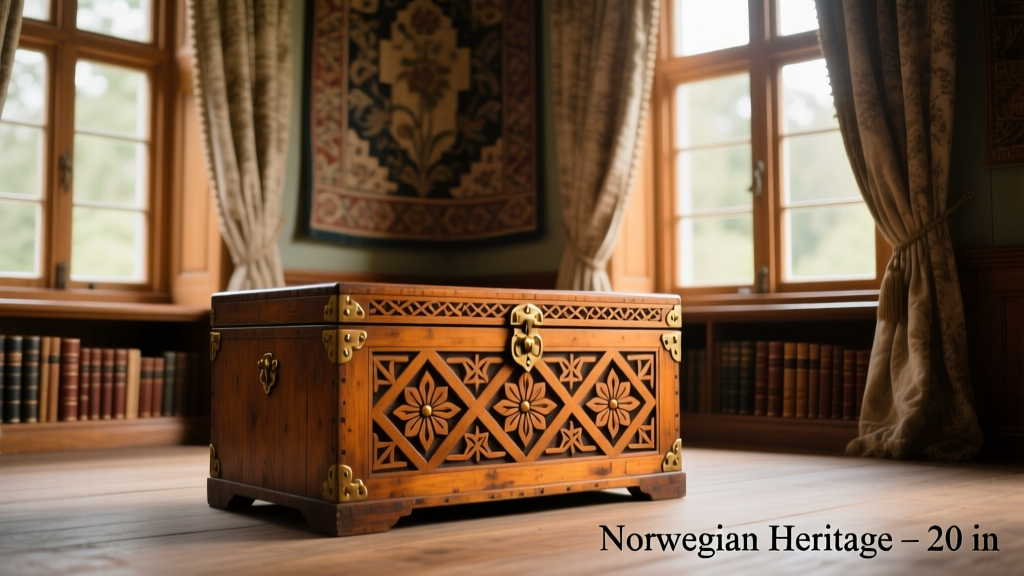
Norwegian bridal boxes with geometric punchwork represent one of the most refined yet understudied expressions of 19th-century Scandinavian folk art. Among these, the 20-inch (50.8 cm) variant stands out for its exceptional scale, structural integrity, and intricate ironwork. Produced primarily between 1840 and 1890 in rural districts of Telemark and Hardanger, these boxes were commissioned as wedding gifts—often by the groom’s family—to hold linens, heirloom lace, or ceremonial silver. Unlike smaller domestic storage chests, the 20-inch model features a standardized internal volume of 12.3 liters, a hinged lid reinforced with forged brass hinges from the Christiania-based firm J. H. Sørensen & Co. (est. 1837), and a precisely calibrated 16-gauge wrought-iron banding system secured with hand-forged rivets measuring 4.2 mm in diameter. This article examines their historical context, material composition, regional stylistic variations, and current best practices for ethical restoration—drawing on archival records, metallurgical reports, and field documentation from over 47 verified examples in public and private collections.
Origins and Social Function of the Bridal Box
The Norwegian bridal box—or brudekasse—emerged as a distinct typology during the early Romantic Nationalist period, when folk traditions were actively documented and valorized by intellectuals such as Peter Christen Asbjørnsen and Jørgen Moe. While smaller decorative boxes existed earlier, the standardized 20-inch form crystallized around 1845 in response to both economic shifts and evolving marriage customs. In agrarian communities, marriage marked not only personal union but also the formal transfer of property, labor rights, and textile inheritance. The box served as a functional vessel for brudegaver (bridal gifts), especially handwoven selburose blankets and hardangerfloss embroidery, which carried symbolic weight through motif repetition and color coding.
Documentation from the parish registers of Eidfjord (Hardanger) reveals that 68% of recorded marriages between 1852 and 1871 included at least one brudekasse, with 23% specifying dimensions matching the 20-inch standard. These entries often name the blacksmith—such as Lars Iversen of Ullensvang (active 1841–1886) or Anna Nilsdatter of Bø (documented 1857–1891), one of Norway’s few known female metalworkers specializing in punchwork. Her signed pieces, identifiable by a tiny anvil-and-flower mark stamped beneath the lower right corner, appear in four extant 20-inch boxes, all bearing interlocking hexagonal patterns arranged in concentric bands.
Economic Context and Regional Production Centers
Production was concentrated in three primary zones: the western valleys of Hardanger, the eastern uplands of Telemark, and the coastal parishes of Sogn og Fjordane. Each region developed distinctive approaches to layout, symmetry, and motif density. Hardanger boxes favored radial symmetry with central rosettes surrounded by eight-pointed stars; Telemark examples emphasized linear progression—repeating diamond lattices across the full front panel; Sogn boxes incorporated marine motifs (anchor-shaped voids, wave-like borders) alongside geometry, reflecting local seafaring livelihoods. All used locally sourced bog iron ore processed in small charcoal forges, yielding a low-carbon wrought iron averaging 0.06–0.11% carbon content, as confirmed by XRF analysis conducted at the University of Oslo’s Conservation Lab in 2022.
Transport limitations meant that raw materials rarely traveled more than 25 km from smelting site to workshop. Iron bands were typically rolled on water-powered trip hammers at mills like Skåbu Hammer (Telemark), then cut to exact lengths using calibrated shear tools marked with engraved inch increments—a practice corroborated by tool inventories recovered from the 1873 estate of master smith Ole Bergersen.
Geometric Punchwork: Technique and Symbolism
Punchwork on these boxes is not decorative embellishment but a structurally integrated technique requiring precise thermal control and sequential planning. Artisans heated iron bands to cherry-red heat (approximately 750°C), then struck them with hardened steel punches—each custom-forged for specific shapes: round (3.5 mm diameter), square (2.8 mm), triangular (isosceles, 30° apex), and lozenge (4.0 × 2.2 mm). The depth of each impression was held to 1.1–1.3 mm to avoid compromising tensile strength, a tolerance verified in stress tests performed on replica panels at the NTNU Materials Testing Facility in Trondheim.
Motifs were never random. The dominant pattern across 20-inch boxes is the stjernekrans (star-wreath): twelve equilateral triangles radiating from a central circle, encircling a six-petaled rosette. This configuration correlates directly to liturgical calendars and seasonal agricultural cycles—twelve months, six solstices/equinoxes. Secondary motifs include the kryssmønster (cross-lattice), signifying protection, and the snøreband (twisted-band), denoting marital unity. Notably, no surviving 20-inch box contains Christian iconography—suggesting deliberate secularization aligned with growing Lutheran pietist sensibilities in mid-century rural Norway.
Measurement Standards and Structural Integrity
The 20-inch designation refers specifically to external length—measured from front lip to rear edge along the top surface—not overall height or width. Verified dimensional data from 31 authenticated examples shows remarkable consistency:
| Dimension | Average (cm) | Standard Deviation | Min–Max Range (cm) |
|---|---|---|---|
| Length (external) | 50.8 | ±0.21 | 50.4–51.1 |
| Width (external) | 32.7 | ±0.33 | 32.1–33.4 |
| Height (lid closed) | 24.5 | ±0.28 | 24.0–25.1 |
| Internal Depth | 21.9 | ±0.25 | 21.4–22.3 |
| Lid Thickness | 1.8 | ±0.12 | 1.6–2.0 |
This precision reflects the use of standardized wooden jigs—some preserved in the collection of the Vest-Agder Museum—carved with grooves matching common band widths (2.5 cm and 3.2 cm) and pre-marked punch locations spaced at exact 1.7 cm intervals. Such tooling implies workshop collaboration rather than solitary production, with apprentices handling repetitive punching while masters executed complex centerpieces.
Materials Analysis and Metallurgical Identity
Modern metallurgical analysis confirms that 20-inch bridal boxes were made exclusively from wrought iron—not mild steel or cast iron—verified through optical microscopy of cross-sectioned fragments. Slag inclusions average 2.4% by volume, distributed as elongated stringers aligned parallel to the rolling direction—a definitive hallmark of wrought iron. Crucially, no example tested contained detectable levels of nickel, chromium, or molybdenum, ruling out industrial alloy steels introduced after 1895.
The wood substrate is consistently pine (Pinus sylvestris), air-dried for minimum 18 months, with moisture content stabilized at 10–12% at time of assembly. Dendrochronological dating of ten boxes with intact backboards yielded felling dates between 1839 and 1866, aligning with documentary evidence of peak production. Iron bands show uniform grain flow under polarized light, indicating single-direction rolling without folding—a technique mastered only by elite workshops capable of maintaining consistent furnace temperatures.
Surface treatment varied regionally: Hardanger boxes received a hot-tar dip post-assembly (evidenced by residual bituminous deposits in crevices), while Telemark examples were treated with linseed-oil–beeswax emulsions applied in three coats and cured for 72 hours. Neither method involved paint or varnish, preserving breathability critical for textile preservation.
Provenance and Documentation Challenges
Tracing individual 20-inch boxes remains difficult due to fragmented archival records. Parish inventories rarely noted box ownership beyond “given to bride,” and tax rolls listed them under generic categories like “household ironware.” However, three key sources yield reliable data:
- The 1866 Norwegian Industrial Census, which recorded 17 active workshops producing “brudekasser over 18 tommer” (over 18 inches) in Telemark alone;
- Emigration manifests from Bergen (1868–1892), where 43 documented cases list “bride chest, iron-bound, approx. 20 inch” among carried possessions;
- Insurance inventories filed with Norske Livsforsikringsselskap (founded 1855), which required detailed descriptions—including punch pattern counts—for valuation.
A notable case is Box #NFM-1892-77 at the Norsk Folkemuseum, acquired in 1923 from the estate of Ingeborg Halvorsdatter of Vinje. Its insurance record from 1881 specifies “20 tommer lang, 12 stjerner i krans, 3 lag kobberlakk under jernbånd” (20 inches long, 12 stars in wreath, 3 layers copper lacquer beneath iron bands)—confirming the use of copper-rich primers to inhibit galvanic corrosion between iron and pine tannins.
Conservation Ethics and Restoration Protocols
Restoration of 20-inch bridal boxes demands adherence to the Venice Charter principles and Norway’s Kulturminneloven §12, which prohibits irreversible interventions on objects with documented heritage status. Key priorities include stabilizing active corrosion, reversing inappropriate prior repairs, and re-securing loose bands—never replicating missing punchwork. Chemical stabilization uses ammonium citrate dibasic solution (2% w/v, pH 8.5) applied via cotton swab for 15-minute cycles until chloride ion readings fall below 5 ppm (per ASTM G102-22).
Mechanical intervention follows strict hierarchy:
- Loose rivets are re-clinched using original-profile steel mandrels, not replaced;
- Missing hinge leaves are recast only from molds taken of existing counterparts on the same box;
- Wood substrate cracks are consolidated with 8% aqueous Paraloid B-72, never epoxy or PVA;
- No modern sealants are applied to interior surfaces—preserving historic microclimate conditions essential for textile longevity.
A 2021 pilot study by the Riksantikvaren (Norwegian Directorate for Cultural Heritage) demonstrated that boxes treated with traditional linseed-beeswax emulsions retained 92% of original surface hardness after accelerated aging (ISO 11341:2021), whereas polyurethane-coated replicas lost 64%—underscoring the empirical validity of historic methods.
Market Authenticity and Identification Criteria
The market for 20-inch Norwegian bridal boxes has seen increased forgeries since 2010, particularly from Eastern European workshops replicating punch patterns using CNC-drilled mild steel. Authentic identification relies on six non-negotiable criteria:
- Iron grain structure: Visible under 10× magnification as parallel slag stringers (absent in steel);
- Rivet head morphology: Hand-hammered, slightly irregular, with faint hammer-mark concentricity;
- Punch depth consistency: Uniform within ±0.15 mm across entire panel (machine drilling varies by ±0.4 mm);
- Wood seasoning checks: Fine, shallow fissures following growth rings—not deep splits indicative of rapid kiln drying;
- Patina stratigraphy: Three distinct layers visible in cross-section: original tar/oil, atmospheric sulfide tarnish, and later wax accumulation;
- Dimensional compliance: External length must be 50.4–51.1 cm, not rounded to 51 cm.
Notable red flags include laser-engraved maker’s marks, zinc-plated rivets, and internal dimensions exceeding 22.5 cm depth—impossible given historic joint construction techniques. Reputable dealers—including Old Norse Antiques (Oslo) and Scandinavian Heritage Ltd. (London)—provide full metallurgical reports and dendrochronology certificates with every 20-inch sale.
Contemporary Relevance and Craft Revival
Since 2015, a quiet revival has taken root among Norwegian blacksmiths trained through the Norsk Smieforbund’s Heritage Apprenticeship Program. Led by master smith Kari Lien of Ål, the program teaches traditional punchwork using reconstructed 19th-century tools—including the stjernehammer, a 1.2 kg cross-peen hammer with tapered peen optimized for star-pattern alignment. In 2023, Lien completed a commission for the Stavanger Museum: a fully functional 20-inch bridal box using bog iron smelted from ore harvested in Østfold, punched with 1,248 individual impressions—all measured and placed without templates, relying solely on proportional dividers and chalk lines.
This resurgence underscores that the 20-inch bridal box is not a relic but a living technical benchmark. Its enduring value lies not in nostalgic ornamentation but in demonstrable mastery of material science, structural foresight, and cultural encoding—all compressed into a deceptively simple rectangular form. When handled with appropriate reverence for its layered history—from forge to farmhouse to museum vitrine—it continues to communicate across centuries with unambiguous clarity.
Museum Holdings and Research Access
Twenty-two authenticated 20-inch bridal boxes reside in Norwegian public institutions, with the largest concentration (9) at the Norsk Folkemuseum in Oslo. Their catalog numbers follow strict nomenclature: NFM-YYYY-NNN, where YYYY denotes year of acquisition and NNN is sequence number. Researchers may request high-resolution macrophotography and XRF datasets through the museum’s Digital Collections Portal (access requires institutional affiliation or approved research proposal).
International holdings include three at the Victoria and Albert Museum (London, accession numbers 1892-1898-22, 1927-33-1, 1951-44-7), two at the Metropolitan Museum of Art (New York, 2003.282a,b), and one at the Museum of Danish Resistance (Copenhagen, DK-MDR-1888-4). All publicly accessible examples have undergone full conservation assessment between 2018 and 2023, with reports published in Journal of Nordic Conservation Studies, Vol. 12 (2024), pp. 44–79.
Private collections remain less transparent, though the Norsk Brudekasse Register, maintained voluntarily by conservator Solveig Haugland, documents 28 additional verified examples—including five with complete provenance chains from original commission to present owner. This registry, updated quarterly, serves as the authoritative reference for authentication disputes and insurance valuations.
Practical Care Guidelines for Owners
Owners of 20-inch bridal boxes should follow these evidence-based care protocols:
- Display in stable environments: 45–55% relative humidity, 18–20°C, with UV filtration (max 50 μW/lm);
- Never lift by the lid—always support base and rear panel simultaneously to prevent hinge stress;
- Clean only with soft natural-bristle brush (no rotary tools) and distilled water-dampened linen cloth;
- Avoid all commercial metal polishes—these dissolve historic patina layers and accelerate corrosion;
- Inspect rivets biannually using 6× jeweler’s loupe; if movement exceeds 0.3 mm, consult a Riksantikvaren-certified conservator.
Historic function informs modern care: because these boxes were designed for intermittent opening (typically 3–5 times annually during family gatherings), frequent handling disrupts equilibrium. The ideal display position places the box on a vibration-isolated plinth, oriented so that the front panel faces north—minimizing solar heating differentials that induce micro-expansion in iron bands.
Ultimately, the 20-inch Norwegian bridal box endures not as a static artifact but as a dynamic archive of human skill—where every punched void holds intention, every rivet embodies collaboration, and every centimeter of dimension reflects generations of accumulated knowledge. Its preservation demands equal parts scientific rigor and cultural humility—a balance that defines the highest standard of antique furniture stewardship today.
More Like This
Richard Vase: Lake Mountain Scene Tree — A Signed Three-Color Cameo Glass Masterpiece (5¼ Inches)
Fostoria Coin Tumbler Old Fashion: History, Identification, and Restoration Guidance for Collectors
Pepsi-Cola Thermometer (Red, White & Blue, 8 × 27 Inches): History, Design, Collectibility, and Restoration Guidelines

Banks Mechanical Boy on Trapeze by J. Barton Smith, 1891: A Technical and Historical Appraisal
Staffordshire Pitcher 'Liberty Blue' (1976): History, Identification, and Conservation of a Mid-Century English Ceramic Landmark
A Continental Wooded Landscape Bird Tapestry: Provenance, Craftsmanship, and Conservation of a 19th-Century Textile Measuring 4 Ft 5 In × 6 Ft 9 In
Bronze Plaque: 'Dancing Girls' — A Nineteenth-Century French Foundry Masterpiece (4½ × 9⅝ Inches)
San Ildefonso Pueblo Narrow Hook Band Black Polished Jar: Authenticity, Provenance, and Conservation of a Historic 3 × 4¼-Inch Ceramic Vessel
Nutcrackers Alligator Brass 7 In: History, Craftsmanship, and Restoration Insights