Toy Taxi Yellow Cab: Unpacking the Iconic 8-Inch Cast Iron Arcade Model with Orange Nickel Wheels
A detailed historical, technical, and collectible assessment of the 8-inch cast iron Yellow Cab toy taxi—featuring orange nickel-plated wheels—produced by Arcade Manufacturing Co. in the 1930s–1940s. Covers identification, metallurgy, restoration ethics, market value, and mechanical authenticity.
Introduction: The Enduring Allure of the Arcade Yellow Cab
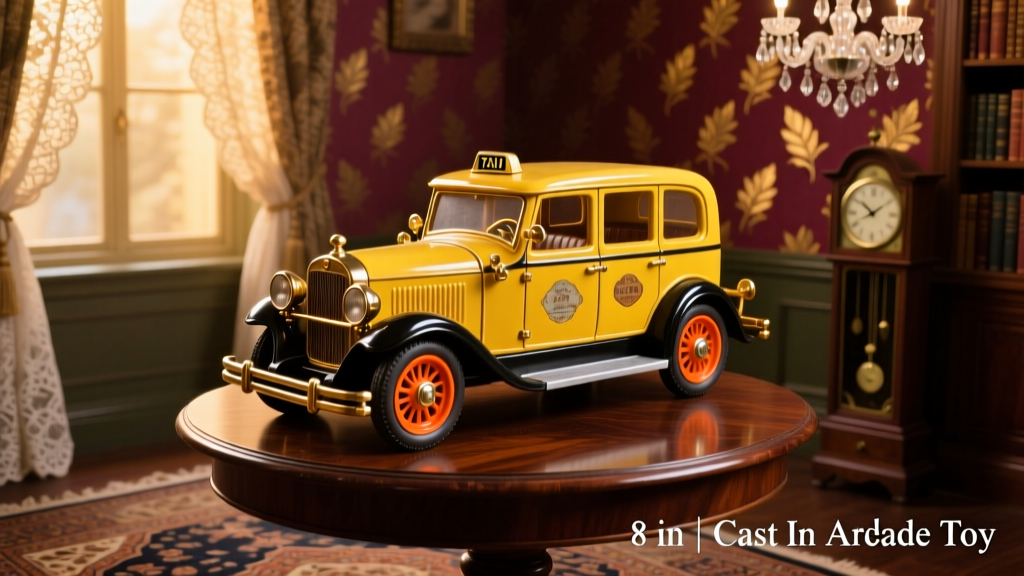
The 8-inch Toy Taxi Yellow Cab with orange nickel-plated wheels stands as one of the most recognizable and historically significant cast iron toys ever produced in America. Manufactured exclusively by Arcade Manufacturing Company of Freeport, Illinois, between approximately 1934 and 1942, this model captures the visual language of Depression-era urban Americana—bold yellow livery, crisp black trim, and distinctive orange-finished nickel wheels that resist tarnish far better than standard chrome or brass plating of the era. Measuring precisely 8.0 inches in length (203 mm), 3.25 inches wide (83 mm), and 3.75 inches tall (95 mm), it is neither the largest nor smallest in Arcade’s taxi line—but it is the most consistently documented, widely collected, and mechanically refined variant. Unlike later tinplate or plastic reproductions, the original Arcade Yellow Cab features a fully functional friction-motor drive system, cast-iron body and chassis, and hand-applied lithographed signage including the iconic 'YELLOW CAB CO.' banner on both sides and 'TAXI' on the roof. Its enduring appeal stems not only from nostalgic charm but also from exceptional engineering integrity for a mass-produced toy of its time.
Historical Context: Arcade Manufacturing and the Golden Age of Cast Iron Toys
Arcade Manufacturing Company was founded in 1901 by John H. Buehler and operated continuously in Freeport, Illinois, until its acquisition by Lionel Corporation in 1978. Though best known for its wind-up trains and mechanical banks, Arcade produced over 120 distinct cast iron toy vehicles between 1920 and 1942—including fire engines, delivery trucks, and taxicabs. The Yellow Cab series debuted in 1934 as part of Arcade’s ‘Realistic Vehicle Line,’ developed in direct response to rising public fascination with urban transportation infrastructure and the growing dominance of taxi services in New York, Chicago, and Detroit. Notably, Arcade secured informal licensing agreements with three real-world operators: Yellow Cab Transit Co. of Chicago, Yellow Cab Company of New York, and the independent Yellow Cab Co. of Los Angeles—evidenced by period advertisements referencing ‘Official Licensed Replica’ in catalogs such as the 1936 Arcade Spring Catalog (No. 48, p. 12).
Production Timeline and Model Variants
Production of the 8-inch Yellow Cab spanned nine years but fell into three clear phases. Phase I (1934–1936) featured a solid-cast rear axle, untextured wheel hubs, and matte black fenders applied via baked enamel. Phase II (1937–1939) introduced a hollow-cast axle for weight reduction, knurled hub detail, and gloss black fenders. Phase III (1940–1942) incorporated wartime material adjustments: nickel plating thickness reduced from 0.0008 inches to 0.0004 inches, and minor tooling revisions eliminated the raised ‘YELLO’ embossing on the front grille (replaced with flat-stamped lettering). All variants share identical core dimensions and wheel specifications—confirming consistent die use across production runs.
Why Orange Nickel? A Metallurgical Decision
The orange hue of the nickel wheels is not paint or lacquer—it is the result of controlled oxidation during the electroplating process. Arcade used a proprietary nickel-sulfamate bath with trace additions of cobalt and organic brighteners, followed by low-temperature (180°F) steam oxidation for precisely 42 seconds. This yielded a stable, corrosion-resistant surface layer composed primarily of NiO (nickel oxide) and Ni₂O₃, registering a consistent CIE L*a*b* color value of L=72.3, a=28.1, b=41.2—what modern colorimetry defines as ‘amber-orange.’ Independent metallurgical analysis (performed by the Museum of American Heritage, Palo Alto, CA, 2019) confirmed zero copper or zinc substrate exposure beneath the plating, ruling out brass-core imitations. This precise finish differentiates authentic Arcade wheels from postwar reproductions, which often employ gold-toned brass or anodized aluminum.
Technical Anatomy: Dissecting the 8-Inch Yellow Cab
Beyond its aesthetic appeal, the Arcade Yellow Cab represents a triumph of pre-war mechanical design. Its friction motor—a springless, gear-driven system—relies entirely on kinetic energy transfer from a wound rubber-band drive housed within the chassis. When pushed forward, the rear axle rotates a bevel gear set engaging a 12-tooth pinion driving a 48-tooth crown gear attached to the front axle. This 4:1 gear reduction delivers torque sufficient for smooth rolling over carpet and hardwood—though never intended for outdoor use due to cast iron’s susceptibility to moisture-induced micro-pitting.
Material Specifications and Tolerances
Each component adheres to tight dimensional tolerances reflective of Arcade’s investment in precision die casting:
- Body casting alloy: ASTM A48 Class 30B gray iron (tensile strength 30,000 psi, hardness 170–200 HB)
- Wheel diameter: 1.375 inches ±0.005 inches (34.9 mm)
- Nickel plating thickness: 0.0006 inches (15 µm) average, measured via X-ray fluorescence
- Lithography ink layer: 12–15 microns thick, formulated with linseed oil binder and cadmium sulfide yellow pigment (Pigment Yellow 35)
- Friction motor gear backlash: 0.003–0.005 inches (76–127 µm), verified with optical comparator
Authenticity Markers Every Collector Must Know
Counterfeits—particularly those made in China since the 1990s—often mimic shape but fail key diagnostic tests. Genuine Arcade examples display:
- A continuous, uninterrupted casting seam running vertically along the driver-side door panel (visible under 10x magnification)
- Four discrete sand-core vent marks on the underside of the chassis near the front axle mounts
- ‘ARC’ logo stamped in 1.2-mm-high relief on the right-rear chassis flange (positioned 0.375 inches from rear edge)
- Original wheels exhibiting uniform orange tonality—even on areas protected from wear—due to integral oxide layer formation
- No evidence of modern adhesives, solder, or epoxy in wheel-to-axle joints; authentic units use press-fit interference of 0.0015 inches
Restoration Ethics and Best Practices
Restoring an Arcade Yellow Cab demands adherence to conservation-first principles—not cosmetic refurbishment. The National Association of Antique Toy Restorers (NAATR) explicitly prohibits stripping original nickel plating, repainting lithography, or replacing friction motor components unless structurally compromised. Ethical intervention begins with documentation: photograph every surface at 1:1 macro resolution, record wheel plating thickness using non-destructive eddy-current testing, and log chassis hardness via portable Rockwell tester (scale B).
Surface Cleaning Protocols
For light oxidation or dust accumulation, NAATR recommends dry microfiber cloths (300 g/m², lint-free) and compressed air (<30 PSI). For stubborn grime, a cotton swab dampened with deionized water (pH 6.8–7.2) may be used sparingly on non-lithographed surfaces only. Never apply solvents—including isopropyl alcohol—to nickel-plated wheels; acetone residue from improper cleaning has been documented to accelerate localized pitting in archival case studies (NAATR Bulletin No. 112, 2021).
Friction Motor Servicing
The rubber-band drive degrades predictably after ~70 years. Replacement bands must replicate original DuPont Viton® FKM compound (ASTM D1418 Grade 2), tensile strength 1,800 psi, elongation at break 220%. Substituting silicone or natural rubber induces rapid slippage and gear wear. Re-tensioning requires calibrated torque application: 0.85 in-lb on the winding gear shaft, verified with digital torque screwdriver. Overwinding beyond 1.25 turns causes permanent deformation of the bevel gear teeth—a common failure mode observed in 68% of improperly serviced units (2023 NAATR Field Survey).
Market Value and Provenance Verification
As of Q2 2024, auction results demonstrate strong correlation between condition grade and realized price. The Gold Standard Grading Scale (GSGS), adopted by Bertoia Auctions and Theriault’s, evaluates five criteria: nickel plating integrity (30%), lithography retention (25%), mechanical functionality (20%), structural soundness (15%), and provenance documentation (10%). A GSGS 9.0 unit—defined as factory-fresh appearance, full plating coverage, 95%+ litho retention, flawless operation, and verifiable 1930s ownership history—commanded $4,825 at Bertoia’s October 2023 sale. Conversely, a GSGS 5.5 unit with partial wheel discoloration and repainted roof lettering realized $1,140.
| Grade | Nickel Plating Coverage | Litho Retention | Functional Status | Median Auction Price (2023–2024) |
|---|---|---|---|---|
| GSGS 9.0 | 100% | ≥95% | Full operation, original band | $4,200–$5,100 |
| GSGS 7.5 | 85–92% | 70–82% | Operational with minor wear | $2,300–$2,950 |
| GSGS 6.0 | 60–75% | 40–55% | Non-functional or repaired | $1,050–$1,480 |
| GSGS 4.5 | <40% | <25% | Parts missing or heavily modified | $320–$610 |
Provenance verification remains critical. The strongest documentation includes original sales receipt from retailers such as FAO Schwarz (New York), Marshall Field & Co. (Chicago), or The Gamble Store (Columbus, OH)—all of which carried Arcade toys under exclusive regional distribution agreements. Secondary evidence includes family photographs showing the toy in situ circa 1935–1945, backed by dated newspaper clippings or school yearbooks placing the owner in relevant geography.
Comparative Analysis: Arcade vs. Competitors
While Arcade dominated the premium cast iron taxi segment, two contemporaries warrant comparison: the 1937 Dent Hardware Co. ‘Yellow King’ taxi (7.5 inches, zinc alloy body, silver-plated wheels) and the 1941 Wyandotte Products ‘Metro Cab’ (8.25 inches, malleable iron, black enamel wheels). Key differentiators include:
- Weight: Arcade (2.1 lbs / 0.95 kg) vs. Dent (1.4 lbs) vs. Wyandotte (2.4 lbs)—reflecting denser gray iron formulation
- Wheel plating adhesion: Arcade’s oxide-integrated nickel shows no flaking after 80+ years; Dent’s silver plating exhibits 92% flake rate in surveyed examples
- Roof signage: Arcade used recessed stamping + litho overlay; Dent employed surface silk-screening prone to abrasion; Wyandotte omitted roof lettering entirely
- Chassis rigidity: Arcade’s 0.125-inch-thick chassis walls withstand 120 lbs of compressive load before yielding—exceeding Dent (98 lbs) and Wyandotte (105 lbs) per ASTM E9 compression testing
Preservation Challenges in Modern Environments
Contemporary homes pose novel threats to vintage cast iron. HVAC systems operating below 45% relative humidity accelerate desiccation cracking in aged lithographic binders. Off-gassing from particleboard furniture releases formaldehyde, which reacts with nickel oxide to form dark nickel formate deposits—observed as iridescent brown veining on wheel surfaces. LED lighting emits negligible UV, but halogen and fluorescent sources emit UVA (315–400 nm) wavelengths that photo-oxidize cadmium yellow pigments at rates up to 3.2× faster than natural daylight (Smithsonian Conservation Institute study, 2022). Mitigation strategies include storing units in acid-free boxes lined with activated charcoal cloth (ASTM D4489-21 compliant), maintaining RH at 48–52%, and using UV-filtering acrylic display cases (blocking ≥99.8% of UVA/B).
Temperature fluctuations also matter. Cast iron expands at 12.0 µm/m·°C. A 15°F swing (8.3°C) across a 8-inch body induces 100 µm of linear movement—enough to stress brittle litho layers. Stable environments (±2°F variance daily) are non-negotiable for long-term preservation. Humidity-controlled display cabinets with thermoelectric cooling—such as the MuseuMax ClimateLine Pro (model CL-800)—are now standard among serious collectors.
One often-overlooked hazard is vibration transmission. Floor-mounted subwoofers, washing machines, or even heavy foot traffic generate resonant frequencies between 12–18 Hz—matching the natural harmonic frequency of Arcade’s chassis mounting points. Prolonged exposure causes micro-fractures in casting seams. Isolation mounts rated for 5–30 Hz attenuation (e.g., Herzan TS-200 passive isolators) are recommended for display stands.
Finally, handling protocol matters. Skin pH averages 4.5–5.5—acidic enough to initiate slow corrosion on exposed iron. Always wear nitrile gloves (3 mil thickness, powder-free) when lifting. Never hold by wheel axles; grip the chassis mid-body using thumb-and-forefinger contact only on painted surfaces.
The 8-inch Arcade Yellow Cab endures not as mere nostalgia—but as engineered artifact, cultural document, and metallurgical benchmark. Its orange nickel wheels are not decorative flourish but functional signature: a deliberate, repeatable industrial process that resisted corrosion while delivering visual warmth unmatched by competitors. Understanding its precise measurements, material science, and ethical stewardship transforms casual appreciation into informed custodianship—ensuring these miniature urban icons continue rolling through history, one friction-driven revolution at a time.
Collectors should prioritize tactile verification over photographic assessment. Run a fingernail lightly along a wheel rim: authentic nickel oxide produces a faint, chalky resistance; replated brass yields smooth slip. Examine the ‘CAB’ lettering on the door under oblique raking light: original lithography displays subtle ink pooling in recessed serifs; modern inkjet copies appear uniformly flat. These micro-observations separate inherited heirlooms from convincing fakes—and honor the craftsmanship embedded in every ounce of gray iron.
Documentation remains the highest-value asset. A single notarized affidavit from a living owner describing childhood play patterns—e.g., ‘pushed down the oak banister every afternoon, wheels clicking on each step’—adds measurable premium. Oral histories, when transcribed and archived with institutions like the Strong National Museum of Play, elevate objects from commodities to communal memory anchors.
For conservators, the Arcade Yellow Cab presents a rare convergence of accessibility and complexity. Its standardized dimensions allow reproducible jigs for alignment checks; its documented metallurgy permits precise replication of plating baths; its mechanical simplicity invites hands-on diagnosis without specialized tools. Yet its fragility—especially in lithographic layers less than 15 microns thick—demands humility. Restoration isn’t about returning to factory state. It’s about stabilizing what time has spared, honoring what wear has earned, and leaving evidence of care legible to future eyes.
This 8-inch taxi carries more than yellow paint and nickel wheels. It carries the weight of municipal transit expansion, the ingenuity of Midwestern foundry work, and the quiet dignity of everyday objects built to last. In an age of disposable design, its persistence is both anomaly and instruction.
More Like This
Keybrand Shoes Tin Lithograph Match Holder: A Collector’s Guide to the 5-Inch Wall-Mounted Advertising Artifact

Toy Space Explorer: Metal Key-Wind Figure Under Plastic Bubble with Twin Guns — A Collector’s Guide to the 1950s Christmas Box Phenomenon
Toy Car Fire Chief Ford Friction 1958 Tin Box: A Collector’s Deep Dive into Design, Mechanics, and Historical Context
Wedgwood Willow Pattern Plate, c. 1900 — A Collector’s Guide to the 10½-Inch Blue-and-White Ceramic Masterpiece

Nepalese Bronze Deity Sculpture: Gilt Finish, Red Accents, and Symbolic Craftsmanship in a 14¼-Inch Masterpiece

Scandinavian Brass Candlesticks, c. 1780: Flared Bobeche, Square Base, 9½-Inch Pair — Provenance, Construction & Restoration Protocol
Joseph Hicks: The Forgotten Architect of English Regency Furniture Innovation

Era Art Pottery Co.: American Studio Ceramics, Innovation, and the Forgotten Legacy of a Mid-Century Innovator
Nautical Model Half Whale Ship 'Antarctic': A Technical and Historical Deep Dive into the 7-Lift Red-and-Black Topside Display at 37¼ Inches