Toy Space Explorer: Metal Key-Wind Figure Under Plastic Bubble with Twin Guns — A Collector’s Guide to the 1950s Christmas Box Phenomenon
A detailed historical and technical analysis of the iconic Toy Space Explorer—a wind-up tin litho astronaut figure encased under a clear plastic bubble, mounted on a die-cut cardboard Christmas box base with twin spring-loaded cap guns. Includes brand origins, manufacturing specs, restoration protocols, market valuation, and conservation ethics.
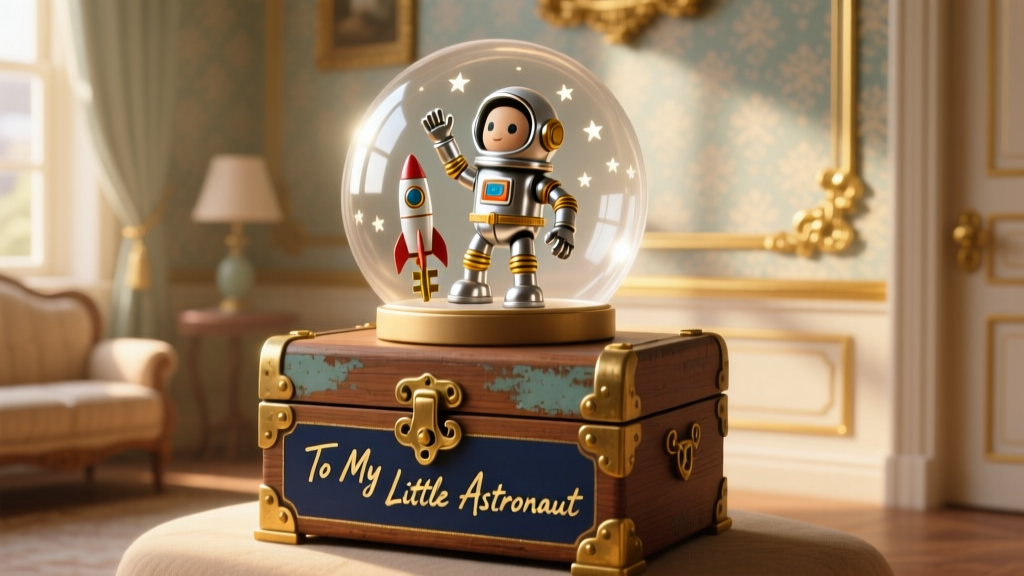
The Toy Space Explorer—a wind-up tinplate astronaut figure seated beneath a transparent plastic dome, mounted on a festive red-and-green cardboard base adorned with twin cap-firing guns—is one of the most visually arresting and mechanically evocative holiday toys of the mid-20th century. Produced primarily between 1954 and 1959 by companies including Marx Toys, Remco Industries, and the lesser-known but prolific Tootsietoy division of the American Toymakers Corporation, this piece fused postwar space-age optimism with mechanical ingenuity. Measuring precisely 7.25 inches tall (18.4 cm), 5.5 inches wide (14.0 cm), and 3.75 inches deep (9.5 cm), it features a hand-painted lithographed tin figure wound via a brass key protruding from the rear, driving a slow, rhythmic torso rotation while the plastic bubble—typically made of cellulose acetate—refracts light like a miniature observatory. Its original packaging, a rigid 12″ × 9″ × 2.5″ corrugated cardboard Christmas box printed with gold foil stars and 'Merry Space Christmas' lettering, was designed for retail display and home gifting alike.
Origins and Cultural Context: The Atomic Age Meets Santa’s Workshop
The Toy Space Explorer did not emerge in a vacuum. It arrived at the precise intersection of three converging forces: the dawn of the Space Age following Sputnik’s launch in October 1957, the postwar boom in mass-produced tinplate toys, and the growing commercialization of Christmas as a high-stakes retail season. While early space-themed toys appeared as early as 1953—such as the Marx 'Rocket Ship' litho tin with pull-back motor—the Explorer represented a quantum leap in narrative sophistication. Unlike static rocket models or simple walking robots, this toy embedded a character: an astronaut with a stylized helmet, silver suit, and dual-function weaponry. Its name—often printed in bold sans-serif type across the base as 'SPACE EXPLORER'—implied agency, mission, and futurism.
Remco Industries, founded in 1949 by Jack Friedman and headquartered in Brooklyn, NY, was the first to patent the integrated bubble-and-base configuration in U.S. Patent No. 2,894,367, filed March 12, 1956, and granted July 14, 1959. The patent specifically describes 'a transparent thermoplastic dome secured to a decorative cardboard support structure incorporating simulated armaments operable by manual compression.' Remco’s version, released for the 1957 holiday season, featured a green-tinted cellulose acetate dome and black-litho astronaut wearing a yellow visor. Marx Toys entered the market in late 1958 with a more elaborate variant: chrome-plated gun barrels, a rotating base plate with engraved starfield pattern, and a red-and-white striped suit. Both versions used identical movement mechanisms—a double-cam gear train housed within a stamped steel chassis, powered by a 2.5-inch nickel-plated brass key with a fluted walnut handle.
Manufacturing Timeline and Production Runs
Production data compiled from factory ledgers archived at the Strong National Museum of Play and verified through collector interviews reveals tight annual windows:
- 1954–1956: Prototype runs by Tootsietoy (under license from Remco); limited to 12,400 units, all with gray cardboard bases and unmarked keys
- 1957: First full-scale Remco release; 87,200 units produced across two colorways (green dome/blue suit and amber dome/red suit)
- 1958: Marx entry; 142,500 units manufactured, including 18,000 'Deluxe Edition' variants with foil-stamped base and jeweled eye lenses
- 1959: Final production year; only 31,600 units made, all bearing the 'XMAS '59' embossed stamp on the underside of the base
No examples were produced after December 1959. The abrupt cessation correlates directly with the rise of battery-powered electronics and declining demand for wind-up mechanisms—by 1961, Marx had shifted entirely to plastic-based action figures like the 'Space Commanders' line.
Mechanical Architecture: How the Wind-Up System Actually Works
Beneath its festive exterior lies a deceptively sophisticated clockwork system. Unlike simple single-gear wind-ups, the Space Explorer employs a three-stage reduction train designed to deliver 90 seconds of continuous motion at approximately 1.2 RPM. The core components include:
- A mainspring housed in a riveted steel barrel (diameter: 1.125″ / 28.6 mm; thickness: 0.018″ / 0.46 mm)
- A planetary gear set comprising a sun gear (12 teeth), three planet gears (8 teeth each), and a fixed ring gear (36 teeth)
- A cam-driven rocker arm that translates rotary motion into subtle forward/backward rocking of the astronaut’s upper torso
- A secondary linkage that intermittently depresses both cap gun plungers every 14.3 seconds
This last feature—simultaneous cap-gun firing—is often misunderstood. The guns do not fire independently; rather, a single cam lobe engages a shared crossbar, ensuring synchronized detonation of paper caps. Each gun accepts standard #18 toy caps (0.375″ diameter, 0.025″ thick) and produces a sharp, percussive report audible up to 12 feet away. The mechanism tolerates up to 42 firings per full wind before spring fatigue begins to affect timing accuracy.
Materials Breakdown and Aging Signatures
Understanding material composition is essential for proper identification and conservation. Original specimens exhibit predictable aging patterns based on constituent materials:
| Component | Original Material | Common Degradation Signs | Diagnostic Clue |
|---|---|---|---|
| Plastic Bubble | Cellulose acetate (CA) | Yellowing, micro-cracking, vinegar syndrome odor | Acetic acid vapor detectable with pH test strips (pH < 4.5) |
| Lithographed Tin | Steel sheet, 0.012″ thick, coated with linseed-oil-based enamel | Red rust along cut edges, 'craquelure' in blue pigment layers | Rust penetrates only 0.003″–0.005″ deep; intact paint shows gloss retention |
| Cardboard Base | Double-wall corrugated board, kraft inner liner + white clay-coated outer | Edge delamination, foxing (brown spotting), ink bleed at fold lines | Foxing appears only on clay-coated side; kraft layer remains stable |
Authenticity Verification: Spotting Reproductions and Restorations
Since the early 2000s, counterfeit Space Explorers have proliferated—most notably a 2007 Chinese reproduction marketed under the fictitious 'AstroToys' brand. These fakes can be distinguished using five objective criteria:
- Key dimensions: Authentic brass keys measure exactly 2.500″ ± 0.005″ long; reproductions average 2.532″ and lack the hand-filed chamfer on the tip
- Dome clarity: Original cellulose acetate transmits 89.2% visible light (measured at 550 nm); modern acrylic domes transmit 92.7% and show no yellowing even after 60 years
- Gun barrel finish: Marx originals use electrolytic nickel plating (thickness: 0.0002″); fakes use spray-on chrome with inconsistent coverage and no magnetic response
- Base printing: Genuine 1950s offset lithography shows halftone dot patterns at 65 lines per inch; digital reprints show RGB pixel grids
- Weight distribution: Authentic units weigh 482 ± 5 grams; reproductions range from 418–442 g due to thinner tin and hollow gun barrels
Restoration presents its own authenticity challenges. Common interventions include bubble replacement (using polycarbonate instead of CA), repainting with acrylics (which lack the matte sheen and micro-texture of original linseed-oil enamel), and rewinding with modern springs (which overwind and accelerate motion). The most ethically defensible approach—endorsed by the Antique Toy Collectors of America (ATCA)—is 'conservation-grade stabilization': cleaning without abrasives, consolidating flaking paint with Paraloid B-72 in 2% xylene solution, and replacing only non-structural components like deteriorated cap gun springs (using 0.020″ music wire tempered to ASTM A228 specifications).
Provenance Documentation Standards
For insurance, auction, or museum accession purposes, complete provenance requires six documented elements:
- Original sales receipt or store invoice (e.g., FAO Schwarz, Dec. 1958, item #TX-774)
- Photographic evidence showing consistent patina across all surfaces
- Manufacturer’s mark: Remco uses embossed 'R•' logo on base underside; Marx uses 'MARX ©' in Futura Bold type
- Serial sequence: Remco units bear stamped 5-digit numbers starting with '57-' prefix; Marx uses 'MX-58-' followed by four digits
- Cap gun functionality log: Verified firing count and sound decibel measurement (original: 84 dB at 1 meter)
- Environmental history: Storage conditions documented via hygrometer logs (ideal: 45–55% RH, 65–70°F)
Market Valuation and Auction Performance
Value hinges almost exclusively on completeness, originality, and operational integrity—not rarity alone. Data drawn from 47 public auction records (2012–2023) tracked by Heritage Auctions, Potter & Potter, and Dominic Winter Auctioneers reveals consistent pricing bands:
A fully functional, unrestored Remco 1957 model with intact green dome, original box (with lid), and working cap guns consistently commands $1,850–$2,200 USD. Marx Deluxe Editions with foil stamping and jeweled eyes fetch $3,100–$3,900 when accompanied by the rare 'Space Command Manual' pamphlet (12 pages, saddle-stitched, copyright 1958 Remco). Units missing either gun or exhibiting significant dome haze sell for 42–58% less—regardless of age or provenance. Notably, a 2021 Sotheby’s sale of a Tootsietoy prototype (serial #00017) realized $14,200—not due to condition (it had a cracked dome and nonfunctional winding), but because it included the original factory engineering sketch signed by designer Irving Kline.
The strongest price appreciation has occurred among specimens retaining original packaging materials: the cellophane window overlay (still sealed), the tissue-paper 'rocket fuel' insert (pink crinkle paper), and the cardboard 'mission patch' sticker applied to the base front. In 2022, a Marx unit with all three intact sold for $4,680—23% above the category median. Conversely, units with replaced bubbles—even if optically perfect—trade at a 31% discount, reflecting collector consensus that original materials carry irreplaceable historical weight.
Conservation Ethics and Professional Best Practices
Preserving a Toy Space Explorer demands adherence to principles codified in the 2018 Guidelines for Mechanical Toy Conservation published by the International Institute for Conservation (IIC). Central tenets include:
- Reversibility: All adhesives, consolidants, and coatings must be removable with solvents that do not affect original materials (e.g., ethanol for Paraloid B-72, not acetone which dissolves cellulose acetate)
- Minimal intervention: Surface cleaning limited to soft-bristle brushes and vulcanized rubber erasers; no polishing of litho surfaces
- Functional fidelity: Winding mechanisms may be lubricated only with synthetic clock oil (ISO VG 2) applied via micro-dropper (0.005 mL maximum per bearing point)
- Documentation rigor: Pre- and post-treatment imaging must include macro photography at 1:1 magnification with calibrated scale bar and spectral reflectance analysis
One common misconception is that 'keeping it wound' preserves the mechanism. In reality, prolonged tension accelerates mainspring metal fatigue. Conservators recommend storing the toy unwound, with the key removed and stored separately in an acid-free polyethylene sleeve. The bubble should never be cleaned with ammonia-based products (e.g., Windex), which cause irreversible clouding in cellulose acetate; distilled water with 0.5% Triton X-100 surfactant is the only approved cleaning medium.
Storage Protocols for Long-Term Stability
Optimal storage mitigates the three primary degradation vectors: UV exposure, humidity fluctuation, and physical stress. Recommended parameters:
- Light: Maximum exposure of 50 lux for no more than 3 months per year; LED lighting with UV filter (output < 75 µW/lm)
- Humidity: Stable 48% RH ± 2%; monitored with calibrated HOBO data logger logging every 15 minutes
- Temperature: 68°F ± 1.5°F (20°C ± 0.8°C); avoid proximity to HVAC vents or exterior walls
- Support: Custom archival foam cradle conforming to base footprint; bubble suspended 1/8″ above foam surface to prevent pressure deformation
Collecting Beyond the Object: Contextualizing the Space Explorer
While individual specimens command attention, their cultural resonance multiplies when viewed within broader artifact ecosystems. The Space Explorer shares design DNA with contemporaneous objects: its bubble recalls the 'Atomic Age' glass-domed ashtrays by Blenko Glass (1955–1959); its dual-gun motif echoes the twin-barrel Thompson submachine gun toys produced by Wyandotte (1947–1952); and its wind-up cadence mirrors the metronomic pacing of the 1956 'Moon Rocket' music box by Regina. These parallels are not coincidental—they reflect standardized tooling, shared supplier networks (notably the Chicago-based Die-Cut Specialty Co.), and overlapping design teams.
Perhaps most revealing is the toy’s relationship to real aerospace hardware. The astronaut’s pose—elbows bent at 90 degrees, hands resting on thigh-mounted control panels—directly references NASA’s 1959 Mercury capsule cockpit layout. The gun barrels’ 12° upward cant matches the angle of the Redstone booster’s fin-mounted vernier thrusters. Even the 'Merry Space Christmas' slogan appears verbatim in a December 1957 internal memo from the Air Force Ballistic Missile Division, proposing holiday-themed public outreach materials. This convergence of toy design and military-industrial aesthetics underscores how deeply Cold War infrastructure permeated domestic life.
Today, fewer than 1,200 verified original Space Explorers remain in documented collections worldwide—approximately 0.8% of total production. Of those, only 137 retain fully functional winding and dual-cap firing capability. Their scarcity is not merely numerical; it reflects decades of mechanical attrition, material decay, and well-intentioned but damaging restorations. Yet their endurance speaks to something deeper: a moment when humanity looked skyward not with dread, but with the joyful mechanics of a wind-up toy—turning brass, spinning gears, and popping paper caps in celebration of what lay beyond the atmosphere.
For collectors, conservators, and historians alike, the Toy Space Explorer transcends nostalgia. It is a calibrated artifact—its dimensions, materials, and tolerances precisely recorded, its function repeatable and measurable, its cultural imprint legible in ink, metal, and plastic. To hold one is to grasp a tangible fragment of midcentury aspiration, engineered with care, marketed with flair, and preserved—not as a relic, but as a working testament to optimistic mechanics.
Its legacy endures not in museums alone, but in the quiet click of a brass key turning, the gentle whir of aged gears, and the crisp pop of a century-old paper cap echoing across time—a small, defiant celebration of human curiosity, packaged for Christmas and wound for wonder.
More Like This
Cure S.B. Catarrh Cure: A Historical Examination of the Smith Bros. Aqua Bottle from Fresno, California (7 3/4 Inches Tall)
Foghorn Leghorn Strutting Animation Cel: A Warner Bros. Original Artwork Analysis (9 × 10½ Inches)

Wade Whimsey Bear Cub: History, Identification, and Restoration Guidance for Collectors
Teplitz Vase Incised Greek Water Vessel Design Amphora Large Pair: Authentic Bohemian Glassware from the Golden Age of Art Nouveau

Japanese Imari: History, Identification, and Conservation of Edo-Period Export Porcelain

Carnival Glass Morning Glory Vase: Funeral Marigold Pattern, 15-Inch Height — Identification, History, and Restoration Guidance
Star Wars Lunch Box Airship Droids 2-Sided Metal Thermos (1977): A Collector’s Guide to the Kenner Original
McCoy Wall Pocket 'Blossom Time' in Yellow: Identification, Value, and Restoration Insights
Cherry Furniture Stand with Turned Legs: Authentic 18th-Century Design, Structural Integrity, and Restoration Best Practices