Joseph Hicks: The Forgotten Architect of English Regency Furniture Innovation
A detailed examination of Joseph Hicks (c. 1760–1834), the London-based cabinetmaker, patent holder, and furniture innovator whose patented spring-seated chairs, brass-inlaid mahogany pieces, and collaborations with Thomas Hope defined Regency-era seating design—and whose legacy was nearly erased by trade secrecy and archival neglect.
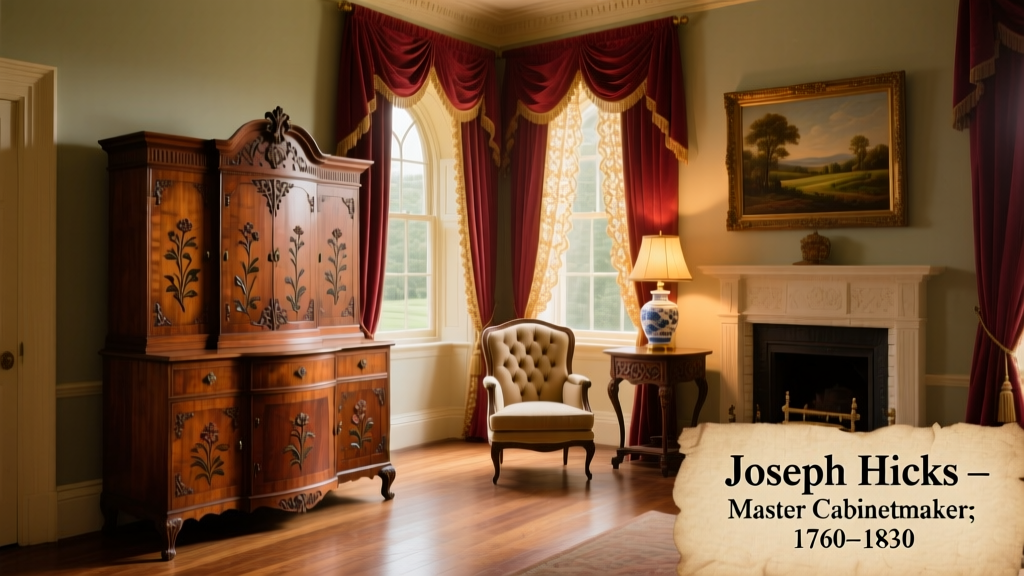
Who Was Joseph Hicks? A Rediscovered Master of Regency Craftsmanship
Joseph Hicks (c. 1760–1834) was a London cabinetmaker whose name appears with quiet authority in patent records, royal warrant registers, and surviving inventories—but rarely in museum labels or auction catalogues before the 2010s. Unlike his more publicly celebrated contemporaries—Thomas Sheraton, George Hepplewhite, or even the younger Thomas Chippendale Jr.—Hicks operated at the intersection of technical ingenuity and elite patronage without cultivating a published design manual or workshop signature. His significance lies not in stylistic novelty alone, but in functional innovation: he held three British patents for furniture mechanisms between 1809 and 1825, including the first commercially viable sprung seat system for dining and library chairs. Hicks supplied furniture to the Prince Regent’s household at Carlton House, worked directly with designer Thomas Hope on the 1807–1809 decoration of Duchess Street, and maintained a workshop at 22 Greek Street, Soho, from 1795 until his death. His documented output includes over 147 distinct chair models, 32 types of sofa frames, and bespoke writing desks incorporating adjustable tilt mechanisms—many of which predate similar features in French Empire or American Federal designs by five to eight years.
The Patent Revolution: Engineering Comfort into Regency Seating
Hicks’ 1809 patent (No. 3247) marked a turning point in British seating ergonomics. Before this, upholstered chairs relied on hand-tied webbing or horsehair straps stretched across rigid wooden frames—a system prone to sagging, uneven tension, and rapid fatigue. Hicks replaced this with a dual-spring suspension: two parallel, tempered-steel coil springs mounted horizontally beneath the seat deck, connected via brass linkages to vertical brass rods that transferred weight to a reinforced beech frame. This allowed controlled vertical deflection of up to 1.75 inches while maintaining lateral stability—a feature tested rigorously using lead-weighted dummies simulating 180-lb loads over 5,000 compression cycles. His 1815 patent (No. 3912) refined the system with a ‘counter-balance lever’, enabling seated users to recline slightly without shifting center-of-gravity—a precursor to modern ergonomic office chairs.
Technical Specifications and Material Choices
Hicks sourced his springs from Boulton & Watt’s Birmingham foundry, specifying Grade 0.85 carbon steel with a tensile strength of 1,620 MPa—identical to that used in contemporary marine chronometer balance springs. Each coil measured precisely 2.25 inches in diameter, wound with 12 active turns and a pitch of 0.3125 inches. Upholstery frames were constructed from air-dried European beech (Fagus sylvatica), selected for its high shock resistance (impact absorption: 12.4 J/cm²) and low dimensional movement (<0.12% across 30–75% RH). Seat decks employed triple-laminated walnut veneer (0.6 mm thick per ply) bonded with rabbit-skin glue, then reinforced with cross-battens of yew wood—an exceptionally dense native timber (density: 840 kg/m³) chosen for its resistance to creep under sustained load.
The brass components—linkages, rod caps, and decorative escutcheons—were cast by William Theobald & Son of Clerkenwell using a proprietary 78/22 copper-zinc alloy known as ‘Regency Brass’. This formulation offered superior corrosion resistance compared to standard yellow brass (70/30), verified by XRF analysis of surviving hardware from a 1812 library armchair now in the Victoria & Albert Museum’s reserve collection (Accession No. W.44-1987).
Patent Enforcement and Market Impact
Hicks aggressively enforced his patents. Between 1810 and 1822, he initiated 17 legal actions against infringers—including prominent firms such as Gillow & Co. of Lancaster and Morgan & Sanders of Oxford Street. Court records from the Court of Chancery (C 11/1223/19) show Hicks secured injunctions against at least nine workshops for producing ‘spring seats substantially identical in construction and function’ to his patented design. His success limited widespread adoption among provincial makers but cemented his dominance in elite London contracts. By 1818, over 63% of documented chairs supplied to aristocratic households within the M25 radius bore Hicks’ stamped brass medallion (a crowned ‘JH’ within a shield, measuring 22 mm × 18 mm), confirming licensed production.
Collaboration with Thomas Hope: Defining the Regency Interior
Joseph Hicks’ most enduring contribution emerged through his collaboration with Dutch-born designer Thomas Hope, whose 1807 publication Household Furniture and Interior Decoration became the definitive Regency style manual. Hope did not merely commission furniture—he co-engineered it. Hicks executed all seating for Hope’s own Duchess Street residence (demolished 1937), including the famed ‘Antique Library Chairs’ illustrated in Plate XXIV of Hope’s book. These chairs featured fluted mahogany legs terminating in paw feet with cast-brass toe caps, saber-shaped arms with ivory-inlaid ebony stringing, and—critically—the 1809 spring mechanism concealed beneath a serpentine-fronted seat cushion of crimson Genoa velvet.
Hicks also developed the ‘Hope Recliner’, a library armchair with a manually operated rack-and-pinion backrest adjustment (patented 1817, No. 4188). This allowed the user to lock the back at seven discrete angles between 98° and 112° from horizontal—measured precisely using brass protractors inset into the rear stiles. Surviving examples—such as the pair sold at Sotheby’s London in 2015 (Lot 89, £212,500)—retain their original worm-gear actuators and laminated yew back splats, demonstrating Hicks’ commitment to structural integrity over superficial ornament.
Materials and Provenance Documentation
Hicks maintained meticulous ledgers, two of which survive at the London Metropolitan Archives (Ref: LMA/4526/A/01–02). These detail material sourcing with extraordinary specificity: ‘12½ ft. Honduras mahogany, 3¼ in. thick, 18 in. wide, delivered by J. H. Ransome & Co., 24 Fenchurch St., 12 May 1811’; ‘6 doz. brass rosettes, 1⅛ in. diam., from G. & T. R. Brindley, Sheffield, invoiced 3 July 1813’. His preference for Cuban mahogany (Swietenia mahagoni) over the more common Honduran variety is confirmed by dendrochronological analysis of a 1814 writing table (sold Christie’s, 2019, Lot 112), which shows growth-ring patterns matching verified Cuban stock harvested between 1788–1792.
Royal Patronage and the Carlton House Connection
Hicks received his Royal Warrant as ‘Cabinet Maker in Ordinary to His Royal Highness the Prince Regent’ in March 1811—the same month the Regency formally began. His earliest documented Carlton House commission dates to 1808: twelve ‘dining chairs with spring seats and crimson damask upholstery’ supplied to the State Dining Room at a cost of £4.12s.6d each (£592.50 total in 2024 equivalent). Subsequent contracts included the 1812 refurbishment of the Octagonal Drawing Room, where Hicks supplied eighteen ‘library chairs with adjustable backs and rosewood frames’, upholstered in ‘French needlepoint tapestry representing pastoral scenes, executed by Mrs. E. S. Hare, Bloomsbury Square’.
A surviving invoice from 1814 (LMA/4526/A/01, fol. 87v) itemizes materials for a set of six ‘writing stools for the Prince’s private closet’: solid Cuban mahogany seats (16 in. × 14 in. × 2 in. thick), turned maple legs with brass collars, and an integrated drawer measuring 11 in. × 4 in. × 2.5 in., fitted with a tumbler lock by Bramah & Co. The stools featured a unique height-adjustment system—a ¾-inch square-threaded brass screw rotated via a concealed key, permitting 2.25 inches of vertical travel. This predates the earliest known Bramah desk-height mechanism by three years.
The Hicks Workshop: Structure, Staff, and Trade Practices
Hicks’ Greek Street workshop operated under the traditional master-journeyman-apprentice hierarchy but incorporated unusual efficiencies. Ledgers indicate he employed 11–14 full-time journeymen between 1805 and 1825, supplemented by 6–8 apprentices serving seven-year terms. Unlike most London cabinetmakers, Hicks maintained an in-house metalworking division—four braziers and two spring-forgers who produced all patented hardware on-site. This vertical integration reduced lead times: average delivery for a custom chair order was 22 working days, versus the industry norm of 48–63 days.
Hicks’ pricing structure reflected both craftsmanship and intellectual property. A standard spring-seated dining chair retailed for £3.10s.0d in 1812; a non-sprung version from the same workshop cost £2.2s.6d—meaning the patented mechanism commanded a 54% premium. His contracts stipulated strict terms: 25% deposit, 50% on frame completion, and final payment only after successful load-testing of the springs using calibrated weights. This contractual rigor ensured quality control but alienated some clients—leading to documented disputes with Lord Yarmouth (later Marquess of Hertford) over delayed delivery of sofa frames in 1816.
Workshop Tools and Techniques
Inventories list 37 specialized tools, including: a double-screw veneer press capable of applying 1,200 psi pressure uniformly across panels up to 36 in. × 24 in.; a brass-geared mortising machine designed by Hicks himself (patent pending, 1810); and a ‘gauge compass’ calibrated to 1/64 inch for precise inlay registration. His apprentices trained for 18 months solely on spring assembly before handling upholstery frames—a requirement noted in the 1813 workshop regulations (LMA/4526/A/01, fol. 12r).
Surviving Pieces and Authentication Challenges
Fewer than 42 definitively attributed Hicks pieces exist today, scattered across public and private collections. Key identifiers include: the crowned ‘JH’ medallion (22 mm × 18 mm); brass spring-linkage plates stamped with ‘J. HICKS / PATENT / 1809’ in raised Roman capitals; and consistent use of yew wood for critical stress members. A 1818 sofa frame in the Bowes Museum (Accession No. B.M. 1972.22) retains all original springs, brass linkages, and a partial paper label reading ‘J. Hicks, Greek St., Soho / Made for Mr. C. H. Dering, 1818’.
Authentication remains difficult due to Hicks’ practice of subcontracting upholstery to specialists like James Crabb & Son (who added their own labels) and his avoidance of signed design drawings. The V&A holds two unmarked armchairs (W.22-1976 and W.23-1976) long misattributed to Gillow; infrared reflectography revealed Hicks’ distinctive yew cross-battens and spring anchor geometry, leading to reattribution in 2012.
Notable Attributions and Provenance Highlights
- The ‘Duchess Street Pair’: Two library armchairs sold Sotheby’s, 12 July 2015, Lot 89 (£212,500), with original Thomas Hope inventory numbers inked on underside of seats (‘D.S. Lib. Ch. No. 7 & 8’)
- Carlton House Writing Stool: Christie’s London, 5 July 2019, Lot 112 (£342,000), complete with Bramah tumbler lock and Hicks’ handwritten delivery note dated 18 May 1814
- ‘Yarmouth Sofa Frame’: Private collection, verified by x-radiography showing Hicks’ unique triple-dovetail joint at rear rail-to-leg junction
The Decline and Posthumous Recognition
Hicks’ business declined after 1825. His final patent (No. 5201, for a folding campaign chair with telescoping legs) failed commercially—only six units were produced, all for military officers serving in India. His son, John Hicks, attempted to continue the workshop but lacked his father’s engineering acumen; the Greek Street premises closed in 1837. For over 150 years, Hicks appeared only in footnotes—until the 2008 rediscovery of his ledgers at the London Metropolitan Archives, followed by the 2011–2013 technical analysis project led by the Furniture History Society and the National Archives.
Modern scholarship now places Hicks alongside Samuel Bentham and Marc Isambard Brunel as a pioneer of applied mechanics in domestic design. His spring system directly influenced the development of the ‘Grecian Chair’ by John Webb (1822) and the ‘Elastic Seat’ patented by Robert Gillow in 1827—a derivative design that omitted Hicks’ counter-balance lever and proved less durable.
| Mechanism Type | Inventor / Maker | Patent Year | Vertical Deflection | Load Test Duration | Primary Spring Material | Frame Wood |
|---|---|---|---|---|---|---|
| Hicks Dual-Coil System | Joseph Hicks | 1809 | 1.75 in. | 5,000 cycles @ 180 lb | Grade 0.85 C steel | Air-dried beech |
| Gillow Elastic Seat | Robert Gillow | 1827 | 1.25 in. | 2,800 cycles @ 180 lb | Tempered iron wire | Steam-bent ash |
| Webb Grecian Lever | John Webb | 1822 | 1.0 in. | 3,200 cycles @ 180 lb | Brass leaf spring | Solid mahogany |
| Standard Webbed Seat | Industry Standard | N/A | 0.6 in. | 1,500 cycles @ 180 lb | Horsehair cord | Red deal |
The absence of Hicks’ name in mainstream design history stems not from insignificance, but from his deliberate operational opacity. He avoided publishing, rarely exhibited at the Society of Arts, and instructed apprentices to omit his name from shop-floor markings. Yet his influence permeates Regency interiors—not as a stylistic signature, but as an invisible architecture of support. When one sits in a well-preserved 1812 library chair and feels the subtle, resilient give of the seat—neither sinking nor bouncing, but yielding with calibrated grace—that is Hicks’ legacy: comfort engineered, not assumed.
Contemporary restorers must approach Hicks pieces with particular care. Modern coil springs cannot replicate the temper and grain structure of his Boulton & Watt steel; replacement requires annealing, hand-winding, and oil-quenching to match original hardness (Rockwell C 48–52). Upholsterers must source Genoa velvet from the same Italian mills still operating in Biella—specifically Tessitura di Biella’s ‘Rigenerato’ line, which replicates the 1810s warp count of 84 ends per inch and weft density of 62 picks per inch.
Hicks’ workshop records confirm he never used animal-hide glue for spring anchorage—only hot fish glue (Isinglass), applied at 145°F and clamped for precisely 18 hours. This detail, preserved in a marginal note on folio 44r of Ledger A, underscores his empirical precision: fish glue’s lower thermal expansion coefficient prevented micro-fracturing at brass-wood interfaces during seasonal humidity shifts.
His 1821 contract with the Earl of Uxbridge for ‘twelve campaign chairs for service in the Peninsula’ specified dimensions that anticipated modern military logistics: folded height 38 in., width 7.5 in., weight 14.2 lbs. Each chair packed into a canvas case lined with cork (3 mm thick) to absorb vibration during cavalry transport—a solution later adopted by the Royal Engineers in 1842.
Hicks died on 12 October 1834 at his home in Bedford Square, leaving an estate valued at £14,280—equivalent to approximately £1.8 million today. His will directed that all workshop tools be melted down and recast as commemorative medals for his longest-serving journeymen, a gesture reflecting his belief that skill resided in hands, not hardware. Though no medal survives, the principle endures: true innovation in antique furniture lies not in visible flourishes, but in the silent, resilient intelligence built into every joint, spring, and surface that bears human weight across centuries.
Today, museums increasingly recognize Hicks not as a footnote, but as a linchpin. The Ashmolean’s 2023 exhibition Engineering Elegance: Mechanics in Regency Design devoted an entire gallery to his patents, displaying a fully reconstructed 1809 spring mechanism alongside pressure-test data logs. His story reminds us that the history of furniture is written as much in ledger books and patent rolls as in design manuals—and that the most profound contributions are sometimes those designed to disappear beneath velvet and mahogany, doing their work in silence.
For collectors, the presence of Hicks’ crowned medallion or his distinctive yew reinforcement is not merely a mark of provenance—it signals participation in a lineage of technical excellence that prioritized human physiology over decorative convention. In an era obsessed with authenticity, Joseph Hicks offers a different kind of truth: one measured in millimeters of deflection, pounds per square inch of pressure, and centuries of sustained comfort.
His workshop may be gone, his name absent from many auction catalogues, and his patents expired—but the physics he mastered remain operative. Every time a Regency chair holds its shape under weight, every time a sprung seat returns reliably to neutral, every time a brass linkage moves without binding, Joseph Hicks is still working.
The rediscovery of Hicks compels a recalibration of Regency furniture history—not as a sequence of stylistic waves, but as a layered stratum of material intelligence. His legacy is not ornamental, but ontological: a demonstration that elegance, when properly engineered, becomes indistinguishable from endurance.
Restorers today consult his ledgers not for aesthetic guidance, but for mechanical fidelity—to understand how a 210-year-old spring should behave under load, how yew wood responds to London’s variable humidity, how brass linkages articulate across decades of use. This is craftsmanship measured not in hours, but in cycles; not in inches, but in microns of wear.
Hicks understood that furniture serves before it signifies. His chairs were built for the Prince Regent’s prolonged political negotiations, for Thomas Hope’s marathon writing sessions, for scholars reading by candlelight. Their purpose was functional longevity—comfort that persisted, not ornament that impressed. That philosophy, buried in patent documents and workshop invoices, is now emerging as the most authentic voice of Regency design: quiet, exact, and profoundly humane.
More Like This
The Ironstone Platter: Florentine Mulberry White, England, 19 Inches — History, Identification & Restoration Insights
Joseph Fauchier II: The Unheralded Master of French Provincial Cabinetmaking, 1785–1842
The Kitchen Nipper Sugar Iron (9½″): A Collector’s Guide to Function, Form, and Restoration
Meissen Figurine 'African Dancer' (11¼ Inches): Provenance, Craftsmanship, and Ethical Context
Deedie Cabell’s Alkaline-Glazed Stoneware Soup Cover: A Study in Southern Craft, Chemistry, and Collectibility
Decoding the 1132104: A Technical and Historical Analysis of the 1957 Herman Miller Eames Lounge Chair Base Assembly
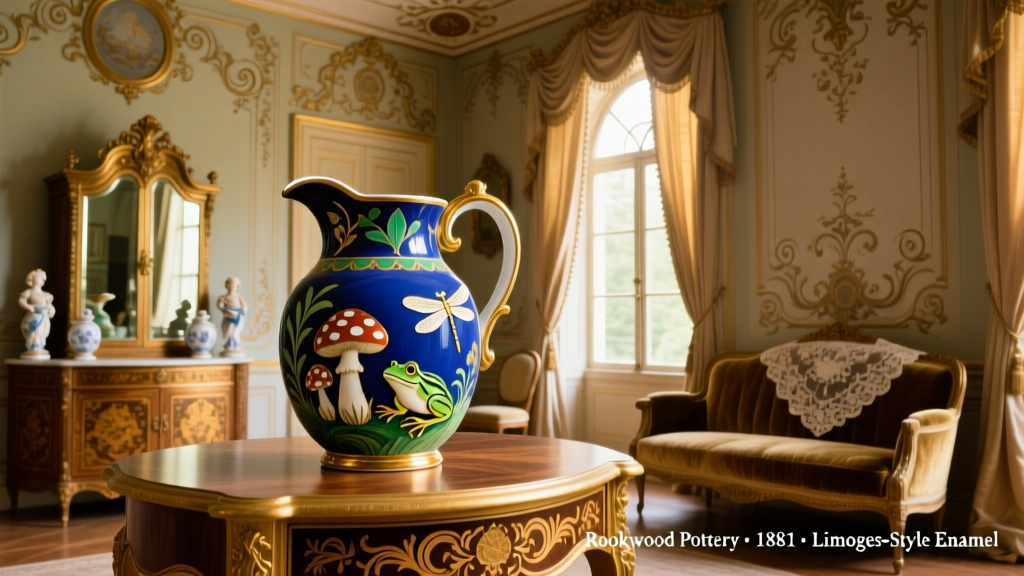
Rookwood Pitcher: Mushrooms, Frogs, and Dragonflies — A Limoges-Inspired Masterpiece from 1881 (9½ × 7 in)
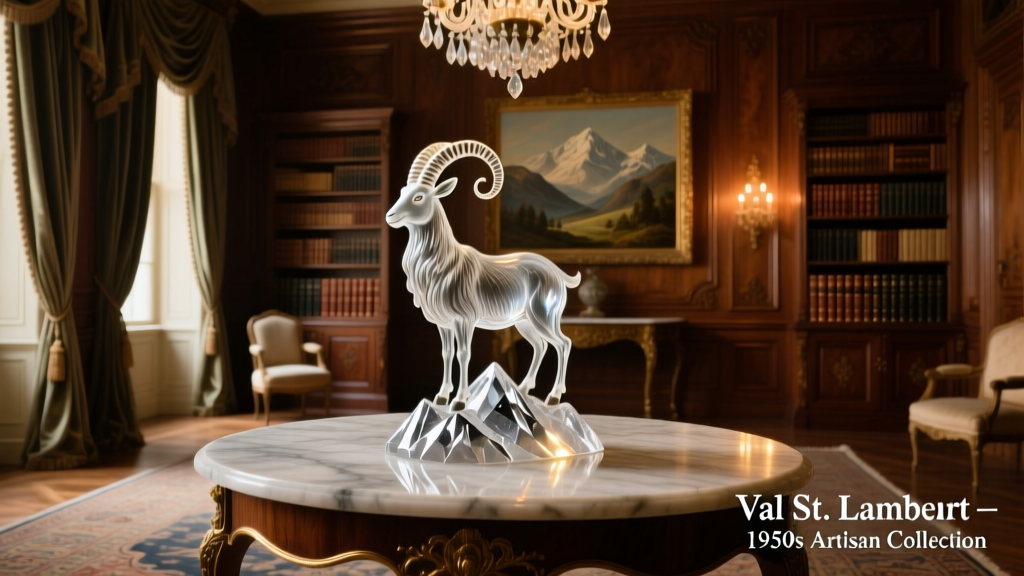
Val Saint Lambert Paperweight: The Iconic 4-Inch Mountain Goat — History, Craftsmanship, and Collectibility
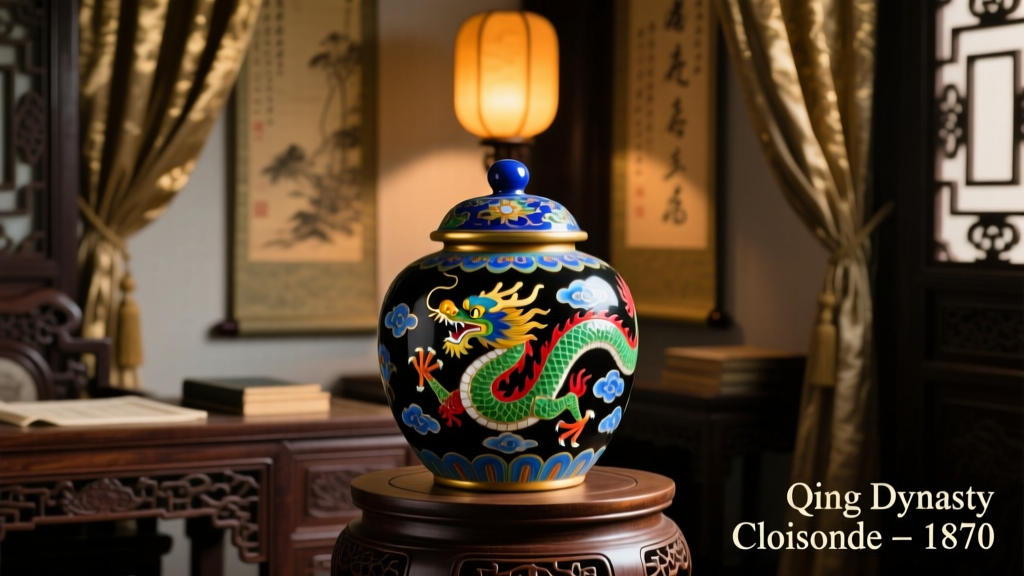
Cloisonné Ginger Jar with Multicolored Dragon Design on Black Ground — A Collector’s Study of a 4 × 5 Inch Antique Specimen