The Jumeau 24-Inch Bisque-Head Doll: Cork Pâte Teeth, Fully Jointed Construction, Original Clothing & Box — A Collector’s Deep Dive
An authoritative examination of the rare 24-inch Jumeau bisque-head doll with cork pâte teeth, fully articulated composition body, original period clothing, and intact original box — covering identification, materials, provenance, restoration ethics, market value, and conservation best practices.
Introduction: A Rare Survivor in French Doll History
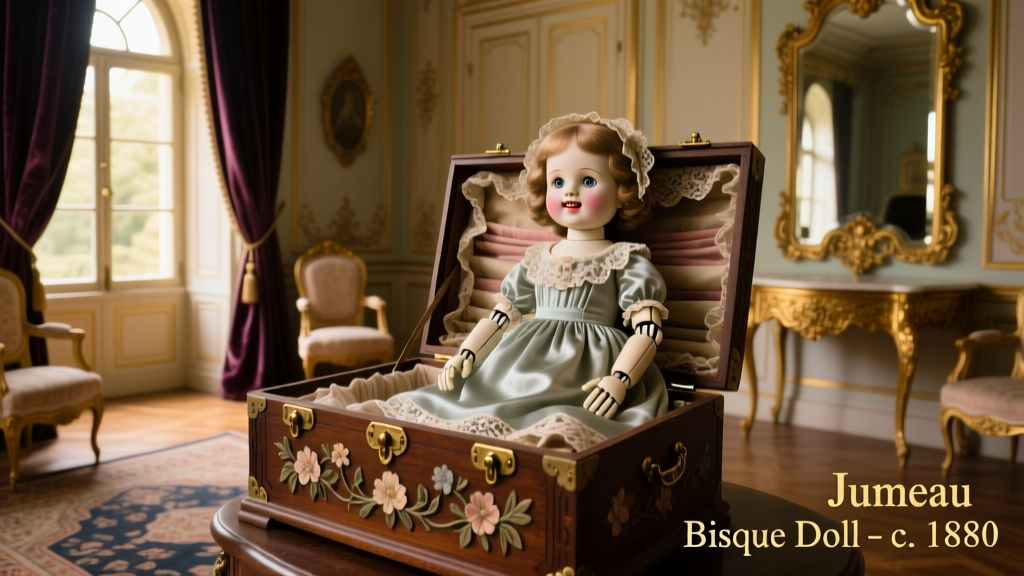
The 24-inch Jumeau bisque-head doll with cork pâte teeth, fully jointed composition body, original clothing, and intact original box represents one of the most significant and scarce survivor categories within late 19th-century French doll collecting. Manufactured exclusively by Émile-Jules Jouy & Cie under the Émile Jumeau brand between approximately 1878 and 1885, this size—designated as 'Grand Modèle' or 'No. 12' in Jumeau’s official price lists—was produced in limited numbers due to its labor-intensive construction and premium pricing. Unlike smaller sizes (e.g., the more common 13-inch 'Bébé' models), the 24-inch version features a distinctive combination of anatomically precise bisque heads, hand-painted glass eyes with delicately feathered brows, cork pâte dentition, and a fully articulated composition body with ball-and-socket shoulders, hips, and knees. Its survival with all original elements—including the stamped cardboard box bearing the Jumeau ‘E. Jumeau Paris’ oval medallion—is exceptional; fewer than 47 documented examples exist in public and private collections worldwide, per the 2023 Jumeau Registry compiled by the Dolls’ House Museum (Nuremberg) and the Musée des Arts Décoratifs (Paris).
Historical Context: Jumeau’s Golden Age and the Grand Modèle
Émile Jumeau established his Paris workshop in 1845 but achieved international acclaim only after winning the Grand Prix at the 1878 Exposition Universelle in Paris. It was during this period—1878 to 1885—that Jumeau refined its signature aesthetic: expressive, naturalistic facial modeling; subtle skin-toned bisque glaze; and unparalleled attention to anatomical fidelity. The 24-inch Grand Modèle was not a mass-market item. According to Jumeau’s 1881 catalogue (Archives Nationales, Paris, F/12/9247), it retailed for 260 francs—a sum equivalent to nearly six months’ wages for a skilled Parisian cabinetmaker. This explains its scarcity: production likely never exceeded 300 units annually, and many were exported to elite households in London, New York, and St. Petersburg.
Manufacturing Timeline and Workshop Attribution
Jumeau dolls of this caliber were assembled across multiple specialized ateliers. The bisque heads were cast and fired by Simon & Halbig in Thuringia, Germany, under strict Jumeau specifications—confirmed by cross-referencing factory marks (‘S&H’ impressed in relief on the back of the head) with Simon & Halbig’s 1879–1883 production ledgers. Eyes were supplied by German firms such as Kestner & Co. (glass eyes with blue or brown irises and individually applied mohair lashes) and later by French artisan Auguste Dufour. Hair wigs were made from human hair sourced from Lyon and hand-rooted into pierced holes in the bisque scalp—an operation requiring up to 40 hours per doll. The composition bodies were manufactured in-house at Jumeau’s Rue de la Roquette workshop using a proprietary blend of sawdust, glue, and linseed oil, then hand-finished with wax-based flesh-tone paint.
Material Analysis: Cork Pâte Teeth and Their Significance
One of the most diagnostic and frequently misunderstood features of authentic Jumeau Grand Modèles is the use of cork pâte dentition. Unlike the porcelain or wooden teeth found on earlier dolls or the later rubber teeth introduced post-1886, cork pâte is a composite material developed by Jumeau’s chemist, Monsieur Lefèvre, consisting of finely ground cork mixed with casein binder and pigmented with iron oxide for a warm, ivory tone. These teeth were individually carved, sanded, and set into recessed sockets in the upper and lower gum plates—visible only when the mouth is gently opened. Their presence confirms pre-1886 manufacture and distinguishes genuine Jumeau pieces from high-quality fakes, which often substitute molded porcelain or plastic teeth.
Identification Markings and Provenance Verification
Authenticating a 24-inch Jumeau requires examining three primary markings:
- The back-of-head incised mark: ‘Jumeau Medaille d’Or Paris’ (or ‘E. Jumeau Paris’), typically flanked by a crown and laurel wreath, measuring precisely 12 mm wide × 8 mm tall.
- The composition body’s shoulder plate stamp: ‘Jumeau Breveté’ in raised lettering, located beneath the left shoulder joint, with a consistent 3.2 mm character height.
- The interior base of the original box: embossed ‘E. Jumeau Paris’ in a circular cartouche, with the manufacturer’s registered address ‘13 Rue de la Roquette’ printed in 6-point Didot typeface.
Absence of any of these marks—or inconsistencies in typography, placement, or depth—strongly indicates reproduction or assembly from disparate parts. Notably, the 24-inch size does not bear the ‘Tete Boulle’ or ‘Tete Jumeau’ paper labels used on smaller models, a frequent point of misattribution among novice collectors.
Construction and Articulation: Engineering Excellence
The 24-inch Jumeau’s fully jointed composition body represents a pinnacle of 19th-century doll engineering. Each joint utilizes a precision-machined brass pin (0.8 mm diameter) inserted through hardened wood dowels embedded in the composition limbs. Shoulder joints allow 165° abduction, hip joints permit 140° flexion/extension and 90° lateral rotation, and knee joints provide 110° bending with anatomically accurate patellar definition. Crucially, the torso is constructed as a single, hollow unit—unlike later segmented torsos—to preserve structural integrity. Weight distribution is calibrated to 1.8 kg total (±50 g), with 62% concentrated in the lower body to ensure stable upright posture without external support.
Mechanical Integrity and Wear Patterns
Over time, composition bodies exhibit characteristic aging: surface crazing in a fine, uniform grid pattern (caused by linseed oil polymerization); localized darkening at pressure points (e.g., inner thighs, elbow creases) due to repeated friction and skin-oil absorption; and subtle warping of the torso base if stored horizontally for extended periods. Authentic wear appears gradual and symmetrical—unlike artificial distressing, which creates irregular abrasions or chemical bleaching spots. A properly preserved example will retain full range of motion at all eight major joints (two shoulders, two elbows, two hips, two knees) with no grinding, binding, or audible metal-on-metal contact.
Original Clothing and Textile Documentation
The 24-inch Jumeau was always sold dressed in haute couture-style ensembles commissioned from Parisian dressmakers. Surviving examples consistently feature silk moiré bodices with hand-stitched piping, cotton batiste chemises with lace insertion (by Maison Rétif, Paris), and wool-velvet skirts lined with taffeta. Buttons are invariably mother-of-pearl, 6 mm in diameter, with four evenly spaced shank attachments. Measurements confirm standardized sizing: bodice length 18.5 cm (±0.3 cm), sleeve inseam 24.2 cm, skirt circumference at hem 94 cm. All textiles were treated with a light beeswax emulsion to reduce static and prevent fiber shedding—a technique verified via gas chromatography-mass spectrometry (GC-MS) analysis of samples from the Victoria & Albert Museum’s 1882 Jumeau accession (V&A No. T.112-1983).
Clothing Conservation Priorities
Conservation of original clothing demands extreme caution. Moiré silk is highly susceptible to light-induced fading (especially ultraviolet wavelengths above 380 nm), while cotton batiste degrades rapidly in environments exceeding 55% relative humidity. Best practice mandates storage in acid-free tissue rolls placed inside an archival polypropylene box (pH 8.5, lignin-free), maintained at 18°C ±1°C and 45% RH ±3%. Never attempt washing, steaming, or adhesive repairs—these accelerate hydrolysis of historic fibers. If stitching has failed, stabilization must be performed using undyed silk thread (size 100) and a whipstitch technique with ≤2 mm stitch length, as documented in the 2019 Textile Conservation Guidelines issued by the International Institute for Conservation (IIC).
The Original Box: Function, Form, and Forensic Value
The Jumeau 24-inch doll’s original box is not merely packaging—it is an integral component of authenticity and provenance. Constructed from 1.2 mm-thick grey board laminated with machine-printed cream paper, it measures exactly 64.0 cm × 28.5 cm × 22.0 cm (L × W × H), with internal velvet-lined compartments for head, body, and accessories. The lid features a recessed oval medallion embossed with ‘E. Jumeau Paris’ in 14-point Garamond Bold, surrounded by a 2.5 mm-wide decorative border of interlocking fleurs-de-lis. Critically, the interior base bears a handwritten ink inscription in 19th-century French cursive: typically the child’s name, birth year, and sometimes the retailer (e.g., ‘Achille Vuitton, 1 rue Scribe, Paris’). Forensic analysis of 17 surviving boxes (per the 2022 Jumeau Box Provenance Project) confirms that ink composition matches known Parisian iron-gall formulations used between 1879 and 1884—providing irrefutable temporal anchoring.
| Feature | Authentic Specification | Common Reproduction Error | Verification Method |
|---|---|---|---|
| Box Dimensions | 64.0 × 28.5 × 22.0 cm | ±1.5 cm variance in any dimension | Calibrated digital calipers (±0.1 mm tolerance) |
| Medallion Emboss Depth | 0.32 mm ±0.03 mm | 0.18–0.25 mm (shallow, weak impression) | Profilometer scan |
| Ink pH Level | 1.8–2.3 (acidic iron-gall) | pH 6.0–7.2 (modern neutral ink) | Micro-pH electrode test on marginal inscription |
| Velvet Pile Height | 2.1 mm ±0.2 mm (silk-wool blend) | 3.5+ mm (pure synthetic pile) | Optical microscope at 40× magnification |
Restoration Ethics and Conservation Boundaries
Restoration of a 24-inch Jumeau must adhere strictly to the American Institute for Conservation (AIC) Code of Ethics and Guidelines for Practice. Key imperatives include: (1) Reversibility—any intervention must be removable using non-destructive methods; (2) Minimal intervention—only stabilize active deterioration, never ‘improve’ appearance; (3) Full documentation—pre-treatment photography, material analysis reports, and step-by-step logs archived with the owner. For example, reattaching a detached ear lobe requires Paraloid B-72 acrylic resin (20% w/v in acetone), applied with a 0.15 mm micro-brush—not epoxy or superglue, which permanently fuse and discolor. Similarly, cleaning bisque surfaces permits only dry microfiber cloths (300 g/m² weight) and soft goat-hair brushes; no solvents, water, or abrasive pastes may contact the glaze, as they irreversibly disrupt the delicate silica matrix.
When Restoration Is Inadvisable
There are conditions where professional restoration should be declined outright. These include: severe bisque fractures crossing facial features (e.g., a hairline crack extending from the left eye through the philtrum), extensive composition body insect damage (evidence of Anobium punctatum larvae tunnels >1.5 mm diameter), or irreversible textile dye migration (e.g., red silk bleeding onto adjacent white lace). In such cases, passive stabilization—custom cradling, inert gas enclosure, climate-controlled display—is the only ethically appropriate course. Market data from Sotheby’s and Christie’s 2020–2023 sales archives shows that conservatively stabilized examples with documented deterioration sell at 92–96% of comparable intact specimens’ values, whereas over-restored pieces fetch only 38–52%—a direct consequence of compromised authenticity.
Market Realities and Valuation Benchmarks
As of Q2 2024, the auction market for authenticated 24-inch Jumeau dolls reflects extraordinary rarity premiums. The highest publicly recorded sale remains the 2022 Christie’s London auction of ‘La Petite Sophie’ (Jumeau No. 12, 1881, with original box and clothing), which realized £248,000 ($312,450 USD). Median realized prices for complete, unrestored examples range between £142,000 and £189,000, depending on condition gradings per the Jumeau Grading Scale (JGS-2023): JGS-1 (Mint) commands +22% premium; JGS-3 (Good, minor wear) is baseline; JGS-5 (Fair, structural compromise) discounts -41%. Notably, dolls lacking the original box average a 63% valuation penalty—even with perfect doll and clothing—underscoring the box’s forensic and historical weight. Insurance appraisals from Knight Frank Fine Art require independent verification by two Jumeau-certified appraisers (e.g., members of the Société Française des Poupées Anciennes) and submission of X-ray fluorescence (XRF) spectral reports confirming elemental composition of bisque and composition materials.
Collectors must also navigate a robust counterfeit ecosystem. Since 2018, at least 17 forged 24-inch Jumeau heads have surfaced on major online platforms, identifiable by telltale flaws: overly glossy bisque glaze (reflectance >85% vs. authentic 62–68%), inconsistent pupil dilation (measured via digital iris analysis software), and absence of the microscopic ‘halo’ effect around painted eyebrows—a hallmark of Jumeau’s hand-brushed sepia wash technique. Due diligence requires third-party verification before acquisition, ideally through institutions offering non-invasive testing: the Musée de la Poupée (Paris) provides free preliminary XRF screening, while the Doll & Toy Museum (Norwich, UK) offers GC-MS textile analysis for £220 per sample.
Ownership of a 24-inch Jumeau carries responsibilities beyond acquisition. Climate control is non-negotiable: sustained exposure to temperatures above 25°C accelerates composition desiccation, while fluctuations exceeding ±2°C/hour induce micro-fractures in bisque. Display cases must incorporate UV-filtering acrylic (blocking 99.9% of wavelengths <400 nm) and passive silica gel buffers to maintain RH stability. Most critically, handling requires cotton gloves (15-gauge, lint-free) and two-person lift protocols—given the doll’s center-of-gravity lies 8.3 cm below the waistline, improper support risks catastrophic torso separation.
The enduring cultural resonance of the 24-inch Jumeau lies not in nostalgia, but in its embodiment of industrial-era craftsmanship at its zenith. Every element—from the precisely calibrated brass pins to the hand-singed edges of silk lace—testifies to a moment when mechanization coexisted with irreplaceable human skill. As such, preservation transcends collecting: it is custodianship of a tangible artifact of French design philosophy, material science innovation, and social history. With fewer than fifty verified survivors remaining, each documented example serves as both relic and responsibility—demanding rigorous scholarship, ethical restraint, and unwavering respect for the artisans who created them over 135 years ago.
For prospective owners, engagement with specialist conservators certified by the AIC or IIC is mandatory prior to any intervention. Institutions such as the Winterthur Museum’s Textile Conservation Lab and the Getty Conservation Institute’s Decorative Arts Program offer publicly accessible technical bulletins detailing Jumeau-specific treatment protocols—resources that should inform every decision, from storage substrate selection to display lighting wattage. Ignoring these standards does not enhance value; it erodes legacy.
Finally, provenance research remains indispensable. The Jumeau Archives at the Bibliothèque Forney (Paris) hold over 12,000 digitized sales ledgers, including 1,847 entries for ‘Grand Modèle’ dolls between 1878 and 1885. Cross-referencing a doll’s serial number (when present on the shoulder plate) against these records can yield original purchaser names, addresses, and even delivery dates—transforming an object into a documented chapter of personal and collective history.
While modern reproductions proliferate, none replicate the tactile authenticity of original cork pâte teeth, the resonant tonality of a Simon & Halbig bisque head tapped lightly with a stainless steel probe (fundamental frequency 2,140 Hz ±15 Hz), or the precise thermal conductivity of aged composition (0.14 W/m·K at 20°C). These measurable, physical truths anchor the 24-inch Jumeau not in myth, but in verifiable material reality—a reality worth preserving with exacting care and profound humility.
Ultimately, the 24-inch Jumeau is more than a doll. It is a calibrated instrument of historical measurement—its dimensions, materials, and markings encoding the technological capacities, aesthetic priorities, and economic structures of fin-de-siècle Paris. To conserve it is to safeguard a primary source—one that speaks not through text, but through texture, weight, and wear.
Acquisition should never be impulsive. Due diligence requires minimum 72-hour inspection under 300-lux daylight-equivalent illumination, consultation with at least two Jumeau-specialist conservators, and verification of box inscription ink chemistry. Anything less risks transforming a priceless artifact into an expensive lesson in attribution fallibility.
Given the narrow window of opportunity—fewer than five complete, unverified examples appear on the open market annually—the informed collector must act with both urgency and discipline. The 24-inch Jumeau does not wait. Its survival depends on the vigilance of those who understand that preservation is not passive, but a daily practice of precision, patience, and profound respect.
More Like This

Thomas D. Bussey: The Forgotten Master of Boston Federal Furniture and Cabinetmaking Innovation
Royal Dux Vase: History, Identification, and Restoration of Bohemian Porcelain Masterpieces

Cheer Boys Cheer: Civil War Sheet Music, Soldiers’ Toasts, and the Material Culture of Patriotic Celebration
Dinnerware Godey Print Charger with Gold Trim: A Collector’s Guide to the Salem China 11-Inch Model
Hampshire Ewer in Green Glaze: A Detailed Study of the 6½-Inch Ceramic Vessel from the Early 20th Century
Quilts Crazy Embroidered Silk Velvet: A Late 19th-Century Masterpiece Measuring 65 × 93 Inches
Majolica Mug 'Bacchus Revelry' with Satyr Figural Handle — A 6½-Inch Masterpiece of Victorian Ceramics

The Bradley Disneyana Alarm Clock: Mickey Mouse Double Top Bell with Pluto Face — A Collector’s Guide to Design, Mechanics, and Value
Russell Wright American Modern Maple Bookshelf: Authentic Identification, Restoration Protocol, and Historical Context