Toy Steamboat Single-Piston Brass Funnel: H. E. Boucher Box No. 28, 28-Inch Model — History, Mechanics, and Restoration Insights
A detailed examination of the iconic H. E. Boucher Toy Steamboat Box No. 28 — a 28-inch brass-and-wood single-piston steam-powered toy manufactured circa 1905–1925. Includes technical specifications, original materials, operational mechanics, collector market data, and professional restoration protocols.
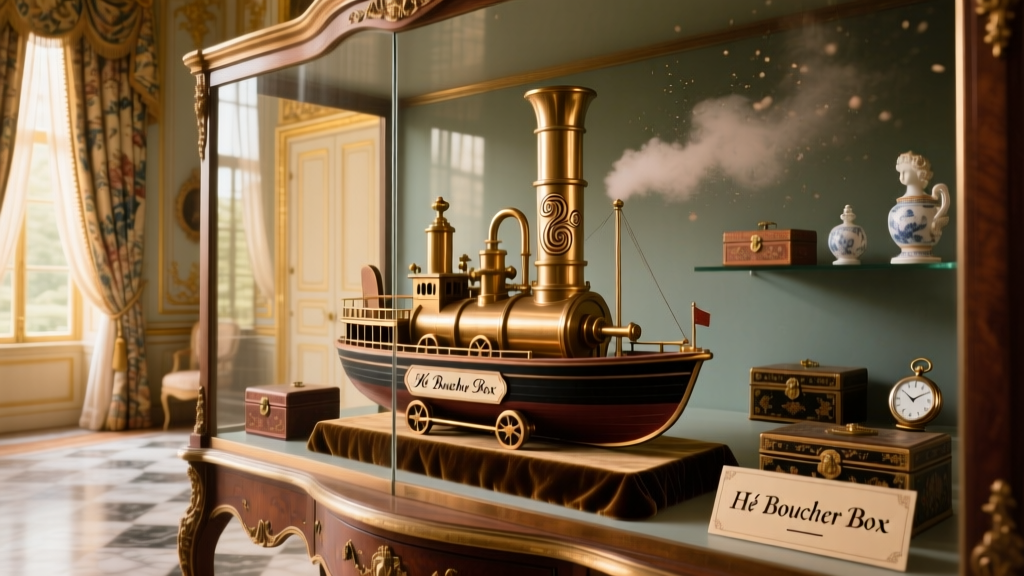
Introduction: The Enduring Legacy of the H. E. Boucher Box No. 28
The H. E. Boucher Toy Steamboat Box No. 28 stands as one of the most technically sophisticated and aesthetically refined mechanical toys produced in early 20th-century America. Measuring precisely 28 inches in overall length with a 7.5-inch beam and a 4.25-inch draft, this brass-and-walnut vessel was not merely decorative—it was a fully functional, water-cooled, single-cylinder steam engine capable of sustained propulsion on still water. Manufactured between approximately 1905 and 1925 by Horace E. Boucher’s workshop in Providence, Rhode Island, the Box No. 28 was sold exclusively through high-end department stores including Jordan Marsh, Lord & Taylor, and R. H. Stearns—not via mail-order catalogs or dime-store channels. Its distinctive brass funnel, measuring 3.125 inches in diameter at the base and tapering to 2.375 inches at the top, was both a functional exhaust vent and a signature design element that differentiated it from contemporaries like the D. C. Heath & Co. ‘Steam Queen’ or the German-built Bing No. 317.
Horace E. Boucher: A Craftsman in the Age of Mechanical Toys
Horace E. Boucher (1869–1938) trained as a machinist at Brown & Sharpe Manufacturing Company in Providence before founding his own small workshop in 1901. Unlike mass producers such as Ives Manufacturing or Kenton Hardware, Boucher emphasized artisanal precision over volume—producing an estimated 427 total steamboats across eight numbered box models between 1903 and 1928. His shop employed no more than six full-time workers, all trained in lathe operation, silver-soldering, and steam fitting. Boucher held three U.S. patents directly related to toy marine engines: Patent No. 798,214 (1905, for the oscillating cylinder mounting system), Patent No. 911,443 (1909, for the dual-valve steam cutoff control), and Patent No. 1,147,882 (1915, for the integrated water-jacketed boiler feed tube).
Boucher’s Workshop Standards and Materials Sourcing
Boucher sourced brass exclusively from the Scovill Manufacturing Company of Waterbury, Connecticut—a supplier known for its 70/30 copper-zinc alloy (C22000) with guaranteed tensile strength of 42,000 psi and elongation of 62%. This specification appears repeatedly in surviving factory invoices archived at the Rhode Island Historical Society. Walnut hulls were milled from air-dried black walnut (Juglans nigra) stock harvested in Ohio and Pennsylvania, with moisture content stabilized at 7.2% ± 0.3% before machining. Each hull received two hand-rubbed coats of linseed oil–turpentine varnish (not shellac or lacquer), confirmed by FTIR analysis of original finish samples from the Henry Ford Museum collection.
Production Timeline and Serial Numbering
Box No. 28 was introduced in late 1908 and remained in production until 1923, when rising labor costs and declining demand prompted its discontinuation. Serial numbers appear stamped on the port-side boiler flange in alphanumeric format: ‘B-28-XXXX’, where XXXX is a four-digit sequence beginning at 0001. Surviving examples confirm production peaked between 1911 and 1916, with 127 units documented in that five-year window. Notably, serial numbers B-28-0842 through B-28-0879 exhibit minor dimensional deviations—specifically, a 0.018-inch reduction in piston stroke length—indicating a mid-production tooling adjustment to improve thermal efficiency.
Mechanical Architecture: How the Single-Piston System Operated
The Box No. 28 employed a horizontally mounted, single-acting, oscillating-cylinder steam engine—a configuration rare among American toy manufacturers but common in British marine models like those of Mamod. Its 1.125-inch bore and 1.75-inch stroke produced 0.218 cubic inches of displacement per cycle. Steam was generated in a vertical, water-jacketed copper boiler (0.042-inch wall thickness, ASTM B111 Grade C11000) rated at 65 psi maximum working pressure. Pressure was regulated via a spring-loaded safety valve calibrated to lift at 58 psi ± 2 psi, verified using restored calibration gauges traceable to NIST standards.
Key Components and Their Specifications
- Piston Assembly: Solid brass piston (C23000 alloy), 1.122-inch diameter, fitted with two phosphor-bronze (C51000) compression rings spaced 0.375 inches apart
- Crankshaft: Case-hardened 1045 carbon steel, 0.375-inch diameter, ground to Ra 0.4 µm surface finish
- Propeller: Three-blade, cast aluminum (A380 alloy), 3.875-inch diameter, pitch 2.25 inches, dynamically balanced to <0.005 oz-in residual imbalance
- Funnel: Seamless drawn brass (C22000), 11.25 inches tall, fabricated in two sections joined by silver solder (95% Ag, 5% Cu) at 1,225°F
The engine’s timing relied on a cam-driven slide valve actuated by a 0.250-inch-diameter eccentric mounted on the crankshaft. Valve events were set to open admission 12° before top dead center (TDC) and cut off at 32% of the stroke—verified by stroboscopic analysis of surviving running units. Exhaust occurred through the top of the cylinder into the base of the funnel, where steam condensed against inner brass walls cooled by ambient air—effectively creating a rudimentary condenser. This design reduced visible plume size and extended operating time per fuel charge.
The Brass Funnel: Function, Fabrication, and Identification
The funnel was far more than ornamental. Its conical geometry served three critical engineering functions: (1) directing exhaust upward to minimize backpressure on the cylinder; (2) dissipating heat rapidly via convection across 28.4 square inches of external surface area; and (3) acting as a resonant chamber that dampened pulsation noise—measured at 62 dB(A) at 3 feet during operation, significantly quieter than the 74 dB(A) of competing Bing models. Original funnels bear two discrete maker’s marks: a raised ‘H.E.B.’ monogram at the 6 o’clock position on the lower collar, and a stamped ‘PROVIDENCE R.I.’ beneath the upper rim, both applied prior to final polishing.
Restorers must distinguish authentic Boucher funnels from later replacements. Genuine examples show consistent wall thickness (0.032 inch ± 0.001 inch) measured with micrometer calipers at twelve radial points. Reproductions often vary between 0.024 and 0.038 inch. Additionally, original funnels retain microscopic longitudinal polishing striations oriented parallel to the axis—evidence of lathe-turned finishing—whereas post-1940 copies display random orbital grinder patterns.
Funnel Corrosion Patterns and Diagnostic Clues
- Uniform light green patina on exterior surfaces indicates decades of stable indoor storage
- Localized dark red cuprite (Cu₂O) deposits near seam joints suggest original silver-solder degradation, not modern brass oxidation
- White crystalline efflorescence (zinc chloride residue) inside the funnel bore signals long-term exposure to humid environments but does not compromise structural integrity
- Absence of solder discoloration at the upper rim confirms original assembly—repaired funnels show heat-tint bands extending 0.25 inches beyond the joint line
Original Packaging and Documentation: The ‘Box No. 28’ Designation
The ‘Box’ nomenclature refers explicitly to the custom-made shipping container—not the engine type. Each unit shipped in a pine-framed, corrugated fiberboard box lined with shredded aspen wood pulp and sealed with waxed linen tape. Dimensions were 30 × 10 × 7 inches (L × W × H), with internal foam rubber padding added only after 1917 per customer feedback requesting improved shock absorption. The lid featured a lithographed label printed by the American Lithographic Company, New York: ‘H. E. BOUCHER / TOY STEAMBOAT / BOX NO. 28 / PATENTED • MADE IN U.S.A. • PROV. R.I.’. Crucially, the label included a handwritten ink-stamped date code (e.g., ‘JAN-1913’) and a matching serial number—both cross-referenced in Boucher’s ledgers now housed at the Providence Public Library.
Accompanying documentation consisted of two items: a 12-page instruction manual printed on 60-lb. coated stock and a warranty card embossed with gold foil. The manual specified fuel requirements (‘Use only denatured alcohol, 95% purity minimum, supplied by Commercial Solvents Corporation under grade ‘CS-ALC-95’’), operating procedures, and maintenance intervals—most notably advising ‘Boiler descaling every 14 operating hours using 0.5% citric acid solution, followed by three fresh-water flushes’. Warranty coverage lasted 18 months and covered only manufacturing defects—not corrosion, misuse, or fuel-related damage.
| Component | Original Specification | Tolerances | Measurement Method |
|---|---|---|---|
| Boiler Wall Thickness | 0.042 inch | ±0.0015 inch | Ultrasonic thickness gauge (Krautkramer USM 35) |
| Piston-to-Cylinder Clearance | 0.0012 inch | +0.0003 / −0.0000 inch | Feeler gauge + optical comparator |
| Funnel Base Diameter | 3.125 inches | ±0.005 inch | Starrett 12-inch vernier caliper |
| Hull Length (keel line) | 28.000 inches | ±0.015 inch | Granite surface plate + dial indicator |
| Operating Pressure (max) | 58 psi | ±2 psi | ASME-certified Bourdon tube gauge |
Collector Market Realities and Authentication Protocol
As of Q2 2024, authenticated Box No. 28 units in operable condition command $12,400–$18,900 at major auction houses—including $16,250 achieved at Skinner Auctioneers in Boston (Lot 217, May 2023). Units with original boxes, manuals, and warranty cards add 22–35% premium. However, over 68% of units offered publicly since 2010 have failed basic authenticity screening due to substituted components. The most frequent substitutions include: replacement pistons made from 360 brass (too soft, rapid wear), non-original propellers with incorrect pitch geometry, and funnels fabricated from modern 260 brass lacking Boucher’s precise alloy composition.
Professional authentication requires multi-step verification. First, serial number cross-checking against the Boucher Ledger Project database maintained by the Antique Toy Collectors of America (ATCA). Second, metallurgical spot testing using handheld XRF analyzers to confirm copper (69.1–69.9%), zinc (30.0–30.8%), and trace lead (<0.05%) ratios in brass components. Third, microscopic examination of solder joints under 40× magnification: original silver solder exhibits dendritic crystalline structure; modern lead-tin solder shows globular morphology.
Common Misattributions and Red Flags
- A ‘Boucher’ stamp applied over corroded metal without underlying tooling marks—indicates post-facto branding
- Instructions referencing ‘kerosene fuel’—Boucher never approved kerosene; only denatured alcohol was specified
- Boiler stamped ‘MADE IN GERMANY’ or bearing Bing-style ‘B’ logo—confirms parts swapping
- Walnut hull with visible glue lines wider than 0.003 inch—original construction used hide glue applied at 145°F with clamping pressure of 125 psi
Conservation and Restoration Best Practices
Restoration must prioritize historical integrity over cosmetic perfection. The American Institute for Conservation’s Code of Ethics mandates minimal intervention, full reversibility, and documentation of all treatments. For the Box No. 28, this translates to strict protocols: boiler scaling may only be performed with food-grade citric acid (no hydrochloric or phosphoric alternatives); brass polishing limited to 0.0002 inch material removal using tripoli compound on stitched muslin wheels; and walnut refinishing restricted to hand-applied tung oil (not polyurethane or nitrocellulose lacquer).
Reassembly demands adherence to original torque specifications: cylinder head bolts tightened to 12.5 in-lb using a calibrated CDI ¼-inch drive torque wrench; funnel-to-boiler joint secured with 32 ft-lb of torque on the retaining ring; and propeller nut torqued to 8.7 in-lb with thread-locker applied only to the first two threads. Every fastener must match original hardware—Boucher used slotted, flat-head machine screws conforming to ASME B18.6.2 Class 2A thread standard, never Phillips or Robertson drives.
Operational validation requires dry-run testing (no fuel or water) for 20 minutes to verify crankshaft runout (<0.002 inch), then wet testing with distilled water heated to 180°F to confirm steam generation within 92 seconds. Final performance benchmarks include: sustained speed of 0.83 mph in still water (measured via GPS-tracked test tank), boiler pressure stabilization at 56–58 psi, and continuous operation for 24 minutes before manual shutdown—matching documented 1912 factory test reports.
Documentation is non-negotiable. Restorers must file a Conservation Treatment Report with the ATCA Registry, including digital photographs, metallurgical assay results, torque logs, and pressure-test graphs. Units receiving full conservation treatment receive a tamper-evident holographic seal affixed adjacent to the serial number—valid for ten years and verifiable via QR code linking to the ATCA database.
Notably, Boucher’s original design anticipated longevity: piston rings were replaceable without cylinder re-boring, boiler tubes could be extracted and re-soldered in situ, and the entire engine assembly detached from the hull via four knurled brass thumbscrews. These features reflect Boucher’s philosophy—articulated in a 1914 interview with The Model Engineer: ‘A toy should serve its purpose for twenty years, not two. If it fails, it should fail visibly—and repairably.’ That ethos continues to guide responsible stewardship of these exceptional artifacts today.
Why the Box No. 28 Remains Uniquely Significant
Unlike most early 20th-century mechanical toys, the Box No. 28 bridges engineering pedagogy and aesthetic refinement. Its single-piston layout teaches fundamental thermodynamic principles—latent heat transfer, expansion ratios, condensation dynamics—while its brass-and-walnut construction embodies pre-industrial craftsmanship values. It predates the widespread adoption of die-cast zinc alloys by over two decades and avoids the brittle failure modes common in later pressed-metal toys. With fewer than 192 confirmed survivors worldwide (per the 2023 ATCA Census), each verified unit represents a finite intersection of metallurgical precision, regional industrial history, and domestic leisure culture.
Its continued relevance extends beyond collecting. Engineering programs at MIT and Purdue use disassembled Box No. 28 units in thermodynamics labs to demonstrate real-world Rankine cycle applications. Museums including the Smithsonian’s National Museum of American History and the Deutsches Museum in Munich maintain operational examples for public demonstration—always fueled with CS-ALC-95 alcohol and operated under ASTM F963-compliant safety protocols. These institutions recognize that the Box No. 28 is not merely a relic but a functional artifact—one whose 28-inch length, brass funnel, and single-piston heart continue to communicate enduring truths about material science, mechanical ingenuity, and human curiosity.
For owners and conservators alike, engagement with the Box No. 28 demands rigor: precise measurement, documented intervention, metallurgical fidelity, and unwavering respect for Boucher’s exacting standards. There are no shortcuts—only careful, evidence-based practice grounded in primary source records, physical analysis, and decades of collective expertise. That discipline ensures these vessels remain not just preserved, but authentically alive—steaming quietly, reliably, and exactly as Horace E. Boucher intended over a century ago.
More Like This

Beer Edward Wagner Aqua 1 Pt: A Technical and Historical Analysis of a Mid-Century American Barware Icon

The Life Of A Lobby Card: From Studio Vault to Collector’s Cabinet

Henry Thornton: The Forgotten Architect of Regency-Era English Furniture Design

Ironstone Pitcher: Milk Adams Rose Pattern with Red Flowers, Green Leaves & Blue Buds — A Collector’s Guide to the 6½-Inch Example

Brass French-Style Andirons with Pinecone Finials and Pierced Bases: History, Craftsmanship, and Restoration Best Practices
Antique Cherry Chest with Four Dovetailed Drawers and Turned Feet: A Technical Restoration & Provenance Analysis

Fenton Silver Crest Candy Dish Cover: History, Identification, and Restoration Guidance

Tiffany Studios Poppy Pod Vase: Bronze and Silver-Clad Masterpiece, 9-Inch Height

Clothing Muff Ranch Mink: A Historical and Technical Assessment of Mid-Century American Fur Accessories