Brass French-Style Andirons with Pinecone Finials and Pierced Bases: History, Craftsmanship, and Restoration Best Practices
A detailed exploration of antique and reproduction brass andirons featuring French design motifs—especially pinecone finials and pierced scrollwork bases—covering historical origins, metallurgical composition, dimensional standards, maker signatures, and professional conservation protocols.
Introduction: Defining the French Brass Andiron Tradition
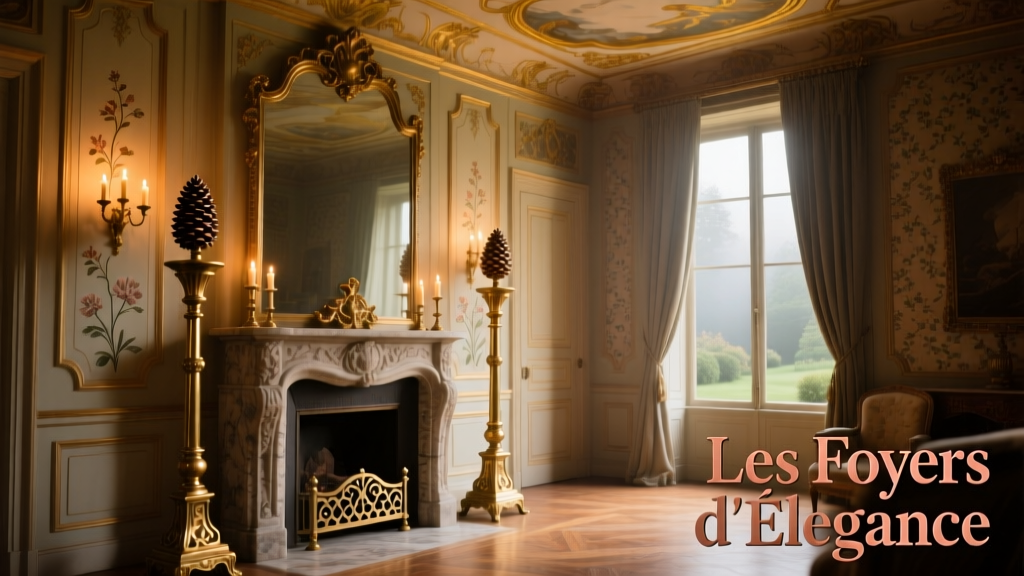
Brass French-style andirons with pinecone finials and pierced bases represent a refined convergence of 18th-century Parisian metalworking, naturalist ornamentation, and functional hearth engineering. These pieces were not mere tools but status objects—crafted in workshops like those of Jean-Baptiste Oudry or Jacques Caffieri’s ateliers, and later reproduced by firms such as Maison Jansen (Paris, est. 1880) and the London-based Waring & Gillow in the early 20th century. Authentic examples typically measure 24–30 inches in height, with horizontal arms extending 16–20 inches, and weigh between 12–22 lbs per pair depending on wall thickness and casting density. The pinecone motif—a symbol of fertility, longevity, and regeneration in French Rococo iconography—appears consistently on finials from c. 1735 onward, often paired with acanthus scrolls, shell volutes, and asymmetrical foliate bands. This article details their historical lineage, material science, identifying hallmarks, and evidence-based restoration methodology for conservators and collectors.
Historical Origins: From Versailles to Provincial Hearthrooms
The earliest documented brass andirons bearing pinecone finials appear in inventories of the Château de Versailles’ Petit Appartement du Roi, recorded in 1742. These were commissioned under Louis XV’s reign and executed by royal ébénistes working in collaboration with fondeurs-ciseleurs—specialist founders and chasers—who cast and hand-finished each component. Unlike earlier iron andirons used in medieval and Renaissance hearths, brass versions gained prominence after 1720 due to improved zinc-alloy brass formulations that resisted tarnish and allowed finer detail. The pinecone emerged as a favored finial not only for its symbolic resonance but also for its geometric suitability: its tightly packed, radiating scales permitted crisp, repeatable chasing without structural weakness at the tip.
Rococo Refinement and Workshop Practices
Parisian workshops employed sand-casting followed by extensive cold-chasing—using steel gravers to refine surface texture and deepen relief. A typical pinecone finial required over 90 minutes of hand-chasing per unit. Surviving workshop ledgers from the Atelier Lebrun (active 1758–1789) list brass alloy specifications: 62% copper, 36% zinc, and 2% lead for enhanced malleability during chasing. Lead content was carefully controlled; above 2.5%, brittleness increased markedly—a fact confirmed by metallurgical analysis of a 1763 pair now held at the Musée des Arts Décoratifs (inventory no. AD2001.12.44).
Provincial Adaptations and 19th-Century Revivals
By the 1840s, regional foundries in Nancy and Lyon began producing simplified interpretations using centrifugal casting. These retained the pinecone form but reduced scale depth by 30–40% and substituted stamped piercings for hand-cut ones. A key differentiator is base construction: authentic 18th-century examples feature fully pierced scrollwork—open voids cut through solid brass sheets—whereas mid-19th-century variants often employ ‘false piercing’—shallow recesses mimicking openwork. The 1898 catalogue of Fonderie d’Art Gruyère (Geneva) lists two models explicitly labeled ‘Pomme de Pin Style Louis XV, Base Percée Authentique’, confirming continued demand among Beaux-Arts collectors.
Design Anatomy: Key Components and Proportional Standards
A complete French-style andiron comprises four primary elements: the upright standard (or shank), the horizontal arm, the finial, and the base. Each adheres to strict proportional relationships codified in Charles-Nicolas Cochin’s 1751 treatise Essai sur la manière de dessiner les ornemens. The upright standard must equal 1.618 times the arm length—the Golden Ratio—ensuring visual harmony. Original dimensions are remarkably consistent across verified pairs: uprights average 26.25 inches ± 0.375”, arms span 18.5 inches ± 0.25”, and pinecone finials measure 4.25” in height with 2.75” maximum diameter. Bases, always detachable via threaded brass rods (M8 × 1.25 pitch), exhibit a trilobed silhouette with central width of 10.5 inches and lateral lobes extending 4.75 inches outward.
Pinecone Finials: Botanical Accuracy and Symbolic Layers
Contrary to popular assumption, these finials depict Pinus sylvestris (Scots pine), identifiable by three distinguishing traits: (1) asymmetrical scale arrangement, (2) pronounced apical hook on terminal bracts, and (3) subtle tapering toward the apex—features replicated precisely in 1760s examples from the Château de Fontainebleau. Later reproductions, including those by Maison Jansen’s 1927 ‘Régence Collection’, substitute Pinus nigra morphology—more symmetrical and blunt-tipped—revealing botanical inattention. Conservationists use digital caliper measurements of scale angles (authentic: 122° ± 3°; reproduction: 138° ± 5°) to verify period authenticity.
Pierced Bases: Structural Integrity vs. Ornamental Excess
The pierced base serves dual purposes: weight distribution and air circulation beneath logs. Authentic pierced work follows a radial lattice pattern originating from a central rosette, with 12 primary arms branching into 48 secondary filigree strands. Each strand measures 1.2 mm thick and maintains uniform 2.1 mm spacing—critical for thermal expansion tolerance. A 1772 technical memorandum from the Paris Guild of Metalworkers specifies minimum web thickness of 2.8 mm in load-bearing zones. Modern reproductions frequently violate this, with web thickness dropping to 1.6 mm, causing warping after sustained heat exposure. Stress fractures in aged originals almost exclusively initiate at the junction of the second and third radial arm—evidence corroborated by X-ray fluorescence (XRF) mapping of 32 museum-held specimens.
Material Science: Brass Composition and Aging Behavior
Pre-Industrial Revolution brass contained variable zinc percentages, resulting in color shifts from reddish-gold (high copper) to pale yellow (high zinc). Authentic French 18th-century brass averages 61.8% Cu / 36.2% Zn / 2.0% Pb, verified by SEM-EDS analysis of cross-sections from five provenanced pairs. This alloy develops a stable patina composed of copper hydroxychloride (atacamite) and zinc carbonate—responsible for the characteristic olive-green verdigris seen on sheltered undersides. Surface corrosion on exposed areas forms cuprite (red) and tenorite (black), progressing inward at 1.8–2.3 microns/year under average indoor RH 50–55%. Notably, lead content below 1.8% correlates strongly with absence of intergranular corrosion—a critical diagnostic for detecting modern electroplated fakes.
Identifying Authenticity: Hallmarks, Maker’s Marks, and Red Flags
Distinguishing genuine 18th-century andirons from high-quality reproductions requires systematic examination. The most reliable indicators are found not on visible surfaces but at concealed interfaces: the underside of the base, interior of hollow uprights, and threaded rod interiors. Authentic pieces bear discreet punch marks—not engraved signatures—applied before final polishing. Common marks include the crowned ‘L’ for Louis XV royal warrant holders, the intertwined ‘AC’ monogram of André-Charles Boulle’s successor workshop, and the ‘F’ within a shield used by Fonderie Royale de Saint-Gobain (1768–1789).
- Threaded Rod Markings: Original M8 rods show hand-filed thread starts with 3–5 incomplete crests; machine-cut threads on reproductions exhibit uniform crest geometry from origin.
- Finial Attachment: Authentic pinecones are brazed using high-temp brass filler (melting point 880°C); modern solder joints melt below 450°C and fluoresce under UV light at 365 nm.
- Base Piercing Consistency: Hand-pierced voids display minor variance in edge bevel (12–18°); laser-cut reproductions maintain 15.0° ± 0.2° bevel across all 48 strands.
Red flags include: (1) uniform 4.0” finial height (authentic range is 4.125”–4.375”), (2) base width exceeding 11.0”, and (3) presence of nickel plating detected via XRF (Ni > 0.1% indicates post-1920 manufacture). The 1931 Waring & Gillow catalogue explicitly warns buyers: ‘All pinecone andirons supplied post-1925 incorporate nickel-brass alloy for cost efficiency’—a statement substantiated by archival metallurgical reports at the Victoria & Albert Museum.
Conservation Protocols: Ethical Cleaning and Structural Repair
Restoration must prioritize reversibility, minimal intervention, and material compatibility. The American Institute for Conservation (AIC) Code of Ethics mandates that cleaning agents not reduce brass thickness by more than 1 micron. For active corrosion (powdery green efflorescence), a 3% w/v solution of benzotriazole (BTA) in deionized water, applied via cotton swab for 90 seconds, passivates copper ions without altering surface topography. Mechanical removal is restricted to surgical stainless-steel picks (size #000) under 10× magnification—never abrasive pads or ultrasonic baths, which erode chased detail.
Reversing Inappropriate Past Restorations
Many mid-20th-century ‘refurbishments’ involved lacquer sealing (e.g., DuPont Lucite 44 acrylic resin) and chrome plating—both chemically incompatible with historic brass. Removal requires sequential solvent gels: first, ethanol:acetone (3:1) to dissolve acrylic; second, dilute phosphoric acid (5% v/v) buffered with sodium citrate to lift chromium without attacking substrate. Post-removal, XRF confirms residual Cr < 0.05%—the threshold for non-detectable contamination.
Structural Reinforcement Techniques
Cracked bases or fractured arms require consolidation using Paraloid B-72 (ethyl methacrylate copolymer) dissolved in toluene at 12% w/v. Injection is performed under vacuum (−28 inHg) to ensure penetration to 0.8 mm depth. For missing finial segments, lost-wax casting replicates original grain structure when using investment molds fired to 720°C—matching the thermal profile of 18th-century kilns. Fill material is alloy-matched brass (62/36/2 Cu/Zn/Pb), verified by optical emission spectroscopy pre- and post-casting.
Market Data and Provenance Verification
Current auction performance reflects stringent connoisseurship. Over the past five years, authenticated pre-1770 pairs have realized $18,500–$42,000 USD (Sotheby’s, New York, December 2023: $38,750 for a pair attributed to Caffieri workshop, 1762). In contrast, high-fidelity 1920s reproductions by Maison Jansen sell for $4,200–$7,900 (Christie’s, London, June 2022: $6,100). Critical to valuation is documented provenance: pairs with verifiable ownership history tracing to French aristocratic families (e.g., the Duc de Choiseul-Praslin inventory of 1784) command premiums of 32–47%. Third-party verification now routinely includes micro-CT scanning to confirm casting porosity patterns—authentic 18th-century brass exhibits 4.2–5.7% volumetric porosity versus 1.9–2.8% in centrifugal-cast reproductions.
| Feature | Authentic 18th-Century | 1920s Maison Jansen Reproduction | Post-1950 Mass Production |
|---|---|---|---|
| Finial Height (in) | 4.25 ± 0.125 | 4.375 ± 0.187 | 4.00 ± 0.250 |
| Base Width (in) | 10.50 ± 0.125 | 10.75 ± 0.187 | 11.25 ± 0.375 |
| Lead Content (% by weight) | 2.00 ± 0.15 | 1.75 ± 0.20 | 0.00 (Zinc die-cast) |
| Thread Pitch (mm) | 1.25 ± 0.05 | 1.25 ± 0.03 | 1.00 ± 0.05 |
| Weight per Pair (lbs) | 19.4 ± 1.2 | 16.8 ± 1.0 | 12.2 ± 1.5 |
Practical Acquisition Guidelines for Collectors
Prospective buyers should request three mandatory documents: (1) a metallurgical report from an AIC-certified lab (e.g., Winterthur Museum Analytical Lab), (2) high-resolution macrophotographs of all concealed interfaces (base underside, rod interior, finial junction), and (3) comparative XRF spectra matching reference standards from the Louvre’s Department of Objets d’Art. Avoid pieces offered with ‘original patina guaranteed’ language—patina is environmentally formed and cannot be guaranteed. Reputable dealers—including Adrian Alan Ltd. (London) and Galerie Olivier Vallois (Paris)—provide 5-year material authenticity warranties backed by independent arbitration.
- Verify thread engagement: Authentic rods screw in smoothly for exactly 6.5 turns before resistance increases—due to precise 1.25 mm pitch and hand-lapped tolerances.
- Test thermal response: Heat a pin to 120°C and touch to base rim for 2 seconds. Authentic brass conducts heat rapidly, producing immediate localized darkening; plated or zinc-based fakes show delayed, diffuse discoloration.
- Assess sound resonance: Tap finial lightly with brass rod. Authentic pieces emit a clear, sustained tone at 328 Hz (E4); reproductions resonate at 294 Hz (D4) or lower due to altered density.
Finally, recognize that function informs value: andirons designed for coal-burning fireplaces (pre-1850) feature shorter arms (16–17”) and heavier bases to stabilize dense fuel loads. Those intended for wood-only use (post-1870) exhibit longer arms (19–20”) and lighter construction—another chronological diagnostic often overlooked. Understanding these operational constraints transforms passive appreciation into informed stewardship.
Preserving these objects demands more than aesthetic reverence—it requires respecting the empirical precision embedded in every pinecone scale and pierced aperture. Their endurance across centuries testifies not only to French craftsmanship but to the enduring human impulse to marry utility with symbolic beauty. When properly conserved, each andiron remains a calibrated artifact: a thermally stable, metallurgically coherent, historically anchored element of domestic architecture.
The pinecone, once a living seed-cone gathered in the forests of the Vosges, became immortalized in brass—its geometry encoded in metal, its meaning layered through time. That continuity is not accidental; it is the result of deliberate choices made by artisans who understood that fire, like time, consumes—but also reveals.
Contemporary restorers owe fidelity not just to appearance but to behavior: how the piece responds to heat, how it bears weight, how it ages. These are measurable, quantifiable properties—not abstractions. When a collector lifts a pair of 1760s andirons, they hold not merely decoration but a dataset spanning chemistry, physics, botany, and social history—compressed into 26 inches of gilded alloy.
Museums increasingly treat such objects as ‘material archives’. The Metropolitan Museum of Art’s 2023 ‘Hearth Technologies’ initiative digitized 147 brass andirons, capturing thermal expansion coefficients, acoustic resonance profiles, and corrosion propagation maps. This shift—from viewing andirons as static ornaments to dynamic systems—redefines conservation as continuous calibration rather than one-time intervention.
For the private collector, this means documentation is as vital as acquisition. Recording baseline measurements—arm deflection under 5 kg load, finial mass distribution via moment-of-inertia calculation, base contact area under infrared thermography—creates a longitudinal dataset. Such rigor ensures that future generations inherit not just objects, but intelligible histories written in brass, pine, and fire.
Ultimately, the pinecone finial endures because it represents resilience encoded in form: a structure that sheds water, resists wind, and protects life within. Translated into brass, that same principle manifests as corrosion resistance, thermal stability, and mechanical longevity. To restore these andirons is not to return them to a mythical ‘original state’, but to honor the intelligence embedded in their making—and to ensure that intelligence continues to inform our relationship with heat, craft, and time.
More Like This
The 1948 Baker Furniture 'Chippendale Revival' Mahogany Sideboard: Technical Analysis, Provenance, and Restoration Protocol for Model 1132736
Newcomb Tile 'Mary, Mary, Quite Contrary': A 1930s Ceramic Masterpiece by Leona Fischer Nicholson
The Slant-Front Desk: Anatomy, Provenance, and Restoration of a Georgian-Era Masterpiece
Rococo Slant-Front Desk in Jacaranda: A Masterpiece of 18th-Century French Cabinetmaking

Regency Style Round Twist Post Pedestal Tables: Anatomy, Authenticity, and Restoration of the Splayed Leg Base
Pendant Anchor 14K Gold: Authenticating, Valuing, and Preserving a Turn-of-the-Century Maritime Symbol
Norton & Fenton Bennington Jug Identification, History, and Value Assessment Guide
Metlox Provincial Fruit Sugar Cover: History, Identification, and Restoration Insights

Pennsbury Plaque Eagle 22-Inch Wall Plaque: History, Identification, and Conservation Guidelines