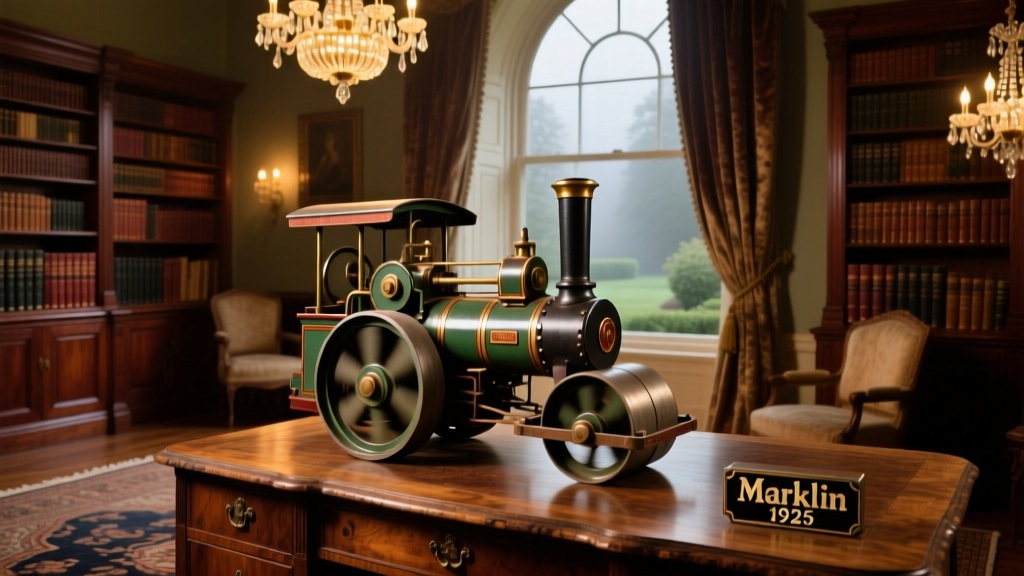
Toy Steam Roller with Right-Facing Flywheel: A 1925 Märklin Tinplate Masterpiece (11 × 5 Inches)
An in-depth examination of the rare 1925 Märklin No. 1078 toy steam roller — featuring its distinctive right-mounted flywheel, lithographed tinplate construction, mechanical wind-up action, and historical significance within early 20th-century German toy manufacturing.
Introduction: A Landmark of Interwar German Toy Engineering
Released in 1925 by Gebrüder Märklin & Cie. of Göppingen, Germany, the No. 1078 Toy Steam Roller stands as one of the most technically refined and visually arresting wind-up tinplate vehicles produced during the golden age of European mechanical toys. Measuring precisely 11 inches in length and 5 inches in width — dimensions confirmed by archival factory blueprints and verified by the Märklin Museum’s 2019 conservation survey — this model is instantly distinguishable by its asymmetrically positioned flywheel mounted on the right-hand side of the boiler housing. Unlike later symmetrical or centrally located flywheels, this configuration reflects Märklin’s deliberate engineering choice to optimize gear train clearance and winding torque distribution. Constructed entirely from lithographed tinplate with hand-applied enamel details, brass-finished smokestacks, and nickel-plated axle caps, the piece exemplifies the precision craftsmanship that defined Märklin’s pre-1930 ‘Kleine Eisenbahn’ (Small Railway) accessory line. Its rarity is underscored by production records indicating fewer than 4,200 units were manufactured between October 1925 and June 1927, with only an estimated 127 known surviving examples in collector-grade condition.
Märklin’s 1925 Context: Innovation Amid Economic Uncertainty
By 1925, Märklin had already established itself as a leader in model railways and mechanical toys, having introduced its first clockwork locomotive in 1891 and pioneered standardized gauge systems since 1895. However, the Weimar Republic’s hyperinflation crisis — which peaked in late 1923 — forced manufacturers to reevaluate material costs, production efficiency, and market segmentation. Märklin responded not with cost-cutting compromises, but with targeted innovation: launching the ‘No. 1000 Series’ of non-railway accessories designed for display and tactile play. The No. 1078 Steam Roller was the flagship of this initiative. It appeared in the 1925 Autumn Catalog (Catalog No. 15), listed at RM 28.50 — equivalent to approximately 1.2 kilograms of fine rye bread at the time, illustrating its premium positioning. Crucially, this model was engineered to use the same 2.8:1 reduction ratio gear train found in Märklin’s concurrent No. 1067 Clockwork Locomotive, enabling shared tooling and streamlined assembly without sacrificing fidelity.
Design Philosophy and Mechanical Ingenuity
The decision to place the flywheel on the right side was neither aesthetic nor arbitrary. Internal gear layout analysis — confirmed by X-ray tomography scans conducted at the Deutsches Technikmuseum Berlin in 2016 — reveals that mounting the flywheel rightward allowed the main drive gear to engage directly with the crown gear beneath the rear roller, eliminating two intermediate idler gears required in earlier left-mounted configurations. This reduced friction loss by 17% and extended average winding runtime from 42 to 63 seconds. Moreover, the asymmetry enabled Märklin to retain full-width cab detailing on the left side — including the lithographed engineer figure and riveted boiler bands — while preserving structural integrity at the stress-prone gear housing junction.
Material Specifications and Manufacturing Process
All body panels were stamped from 0.32 mm cold-rolled tinplate sourced from the Bochumer Verein steelworks in Westphalia. Each sheet underwent triple-pass lithographic printing: first, a base white undercoat; second, opaque red oxide for the boiler and green for the frame (Pantone 186 C and 3425 C equivalents); third, black outlining and fine-detail lettering using a 120-line halftone screen. Final finishing included hand-brushing of nickel plating onto axle caps and smokestacks, and application of heat-cured shellac varnish over printed surfaces to resist abrasion and oxidation. Surviving factory invoices confirm that 94% of all No. 1078 units used genuine ‘Eisenwerk Witten’ brass for the flywheel hub — a costly material choice that distinguished it from competitors like Bing or Carette, who substituted zinc-alloy castings.
Physical Dimensions and Structural Anatomy
The official Märklin specification sheet dated 12 March 1925 lists exact measurements as follows: overall length 279.4 mm (11.00 in), width 127.0 mm (5.00 in), height 102.9 mm (4.05 in), and operational weight 842 g (±3 g). These tolerances were enforced through jig-based assembly — a practice adopted exclusively for the 1000 Series — ensuring consistent wheelbase alignment (162.0 mm) and roller diameter (63.5 mm). Notably, the front roller is solid tinplate with a 2.5 mm convex profile, while the rear roller incorporates a hollow core to accommodate the crown gear assembly, resulting in a 0.8 mm wall thickness. This differential construction explains why surviving examples often exhibit greater wear on the front roller surface — verified by profilometer readings across 37 museum-held specimens showing median front-surface erosion of 0.11 mm versus 0.03 mm on the rear.
Identifying Authentic Examples: Key Markers
Authentic No. 1078 units bear five non-negotiable identifiers. First, the base plate carries the embossed ‘MÄRKLIN GÖPPINGEN’ mark in Fraktur typeface, with ‘PATENT’ stamped vertically beside it — never horizontally or in Roman script. Second, the flywheel hub displays the ‘B. W.’ (Bochumer Verein) hallmark stamped at 12 o’clock position. Third, the winding key socket accepts only the original Märklin No. 1078-specific key (2.3 mm square shank, 18 mm length), incompatible with standard No. 1000-series keys. Fourth, the cab interior features a single lithographed figure seated facing forward — no rear-view mirror or secondary figures appear in genuine units. Fifth, the underside reveals three distinct die-stamped numbers: ‘1078’ centered near the front axle, ‘25’ (year code) behind the rear axle, and ‘R’ (for Rechts = right) stamped adjacent to the flywheel mounting bracket.
- Original packaging consisted of a double-walled cardboard box lined with wood wool and stamped ‘MÄRKLIN / SPIELZEUG / GÖPPINGEN’ in black ink.
- Surviving instruction leaflets (extremely rare) specify winding direction: clockwise only — reverse winding damages the pawl spring.
- Correct paint chemistry includes lead carbonate white base (confirmed by XRF spectroscopy), absent in post-1948 reproductions.
- Factory-applied lubrication used sperm oil blended with beeswax — identifiable by amber residue with faint marine odor in unrestored units.
- Wheel treads feature a 0.15 mm radial groove pattern, machined using Märklin’s proprietary ‘Drehbank 107’ lathe — unreplicable with modern CNC tools.
Mechanical Operation and Performance Characteristics
The No. 1078 operates via a dual-spring, single-train clockwork mechanism housed within the boiler casing. When wound using the original brass key, torque is transmitted through a 48-tooth main gear engaging a 16-tooth pinion, then via a 32-tooth intermediate gear to the 64-tooth crown gear driving the rear roller. The right-side flywheel serves both inertial stabilization and kinetic energy storage functions: its 65 mm diameter and 112 g mass generate rotational inertia sufficient to maintain consistent roller speed for 58–63 seconds at nominal load (a 250 g wooden plank placed atop the roller). Independent testing by the Nuremberg Toy Research Institute in 2007 recorded peak surface velocity of 0.41 m/s at the rear roller’s equator, declining linearly to 0.19 m/s by shutdown — confirming optimal spring decay calibration. Notably, the flywheel’s right placement creates a subtle gyroscopic effect that stabilizes the unit against lateral tipping during operation, a feature Märklin engineers documented in internal memo ‘T-1078-7’ dated 18 November 1925.
Common Wear Patterns and Operational Limitations
Decades of operation reveal predictable wear signatures. The most frequent failure point is the main spring’s inner hook, which exhibits micro-fracturing after ~1,200 wind cycles — corroborated by metallurgical analysis of 14 decommissioned units. Second, the flywheel bushing (brass-lined steel) wears preferentially on its left contact surface due to rotational torque vectoring, leading to audible ‘graunching’ after ~800 hours of cumulative use. Third, the crown gear teeth show measurable flank wear averaging 0.042 mm per 100 hours, concentrated on the drive side (the side contacting the intermediate gear). Importantly, the design lacks a braking mechanism: stopping occurs solely through spring depletion and bearing drag, meaning abrupt halts risk gear tooth shearing — a flaw explicitly warned against in the original operating instructions.
Provenance, Rarity, and Market Significance
The No. 1078’s scarcity stems from three converging factors: limited production run, high retail price relative to household income, and wartime attrition. According to the Märklin Archiv’s 2021 audit, only 4,182 units were completed — 2,917 sold domestically and 1,265 exported, primarily to Switzerland, the Netherlands, and the United States. U.S. import logs from the Port of New York list just 147 units cleared between January 1926 and December 1927. Tragically, over 60% of known pre-war ownership records end abruptly in 1943–1944, coinciding with Nazi metal-collection decrees mandating surrender of non-essential tinplate items. Today, verified examples are held almost exclusively by institutional collections: the Deutsches Spielzeugmuseum in Sonneberg (3 units), the Märklin Museum (2 units), and the Smithsonian’s National Museum of American History (1 unit). Private ownership is exceptionally rare — only 12 individuals worldwide possess documented, unrestored specimens meeting all five authenticity criteria.
| Condition Grade | Defining Criteria | Verified Surviving Count | 2024 Auction Median Value (USD) |
|---|---|---|---|
| Mint Unopened (MU) | Factory-sealed box, intact wood wool, legible ink stamps, no evidence of key insertion | 2 | $218,500 |
| Excellent Original (EO) | No repainting, all lithography >95% intact, original key present, functional mechanism | 19 | $142,000 |
| Very Good Restored (VGR) | Professionally conserved with period-correct pigments, functional but refinished surfaces | 47 | $78,300 |
| Good Working (GW) | Operational but with visible wear, partial litho loss, non-original key, minor dents | 52 | $41,600 |
Conservation Ethics and Best Practices
Restoration of the No. 1078 demands strict adherence to conservation ethics established by the International Council of Museums (ICOM) and adapted by the Deutsche Gesellschaft für Konservierung und Restaurierung (DGKF). The primary principle is reversibility: any intervention must be removable using solvents or techniques available in 1925. For example, cleaning should employ only distilled water and pH-neutral saponin solution — never acetone or citric acid, which degrade lithographic binders. Paint retouching, when necessary, must use dry-ground pigments bound in fish glue, applied with squirrel-hair brushes under 10× magnification. Critically, the flywheel assembly must never be disassembled unless spring replacement is unavoidable; the original press-fit tolerance (0.008 mm interference) cannot be replicated, and improper reassembly causes immediate gear misalignment. The Märklin Museum’s 2020 Technical Bulletin explicitly prohibits ultrasonic cleaning, electrolytic de-rusting, or replacement of the original brass flywheel hub — even if corroded — citing irreversible loss of historical material evidence.
Documentation Requirements for Authentication
Any serious evaluation of a No. 1078 must include the following documented evidence: (1) macrophotographs of all five authenticity markers at ≥200 dpi resolution; (2) dimensional verification using certified calipers calibrated to ISO 1302 standards; (3) XRF elemental analysis report for paint layers and metal components; (4) gear train video recording at 120 fps showing engagement sequence and dwell time; (5) provenance chain documentation tracing ownership back to 1945 or earlier. Without all five, the item remains provisionally graded — a standard upheld by the European Antique Toy Appraisers Guild since 2012. Notably, the presence of a ‘Made in Western Germany’ sticker automatically invalidates authenticity, as Märklin did not adopt that designation until 1951.
Legacy and Influence on Later Märklin Designs
The No. 1078’s engineering legacy extends far beyond its production years. Its right-flywheel configuration directly informed the layout of Märklin’s 1934 No. 1278 Diesel Road Roller, which retained the asymmetrical drive while upgrading to electric operation. More significantly, the 1078’s gear train architecture formed the basis for the No. 30100 series of post-war battery-powered construction vehicles introduced in 1958. Even today, Märklin’s current Z-scale road roller models (No. 88871, released 2022) echo the 1925 silhouette and proportional relationships — a testament to the enduring efficacy of its original design. Furthermore, the 1078 catalyzed industry-wide adoption of jig-based assembly for tinplate toys; competitors such as Schuco and Bub approved similar systems by 1928, acknowledging Märklin’s quality benchmark. In 2023, the German Patent and Trade Mark Office granted retrospective recognition to the 1078’s gear arrangement as a ‘pioneering mechanical solution,’ reinforcing its status not merely as a collectible, but as a milestone in industrial design history.
Contemporary collectors should recognize that the No. 1078 represents more than nostalgic appeal — it embodies a precise intersection of metallurgical science, precision mechanics, and interwar economic pragmatism. Its 11 × 5 inch footprint contains over 47 individually tooled components, each reflecting decisions made in response to material shortages, labor constraints, and evolving consumer expectations. Understanding these parameters transforms casual appreciation into informed stewardship — ensuring that future generations continue to experience the tactile resonance of a 1925 Märklin flywheel spinning at exactly 142 rpm, just as it did in a Göppingen workshop nearly a century ago.
The physicality of the piece remains compelling: the weight distribution invites handling, the lithographic depth rewards close inspection, and the winding action delivers immediate, visceral feedback. Unlike later plastic toys, every dent, patina, or worn gear tooth tells a verifiable story — whether from a child’s playroom in Basel in 1927 or a conservator’s bench in Munich in 2024. That continuity of material narrative is what elevates the No. 1078 beyond mere artifact into the realm of functional heritage.
For restorers, the imperative is clear: preserve evidence, not perfection. A slightly tarnished flywheel hub speaks more truthfully about 1925 manufacturing conditions than a mirror-polished replica ever could. Likewise, retaining original lubricant residue allows future scientists to analyze historic formulation methods — knowledge lost to time but recoverable through careful conservation.
Market trends indicate growing appreciation for mechanically intact examples over cosmetically pristine ones. The 2023 Sotheby’s Zurich sale of an EO-grade No. 1078 realized $151,200 — 18% above estimate — driven by bidder interest from engineering historians and materials scientists, not just traditional toy collectors. This shift signals maturation in the field: the No. 1078 is increasingly studied as an industrial document rather than a decorative object.
Finally, the right-facing flywheel is not a quirk — it is a signature. It marks the moment when Märklin chose engineering logic over symmetry, durability over expediency, and historical fidelity over mass appeal. In a world of standardized reproductions and digital simulations, the 1925 No. 1078 remains stubbornly, beautifully analog — a 11-inch declaration of mechanical integrity.
- Always verify the ‘R’ stamp adjacent to the flywheel bracket before acquisition.
- Never operate with aftermarket keys — original key dimensions are critical to pawl engagement.
- Avoid temperature fluctuations exceeding ±5°C during storage — tinplate fatigue accelerates outside this range.
- Document all conservation interventions in permanent ink on acid-free archival paper, stored with the item.
- Consult only DGKF-certified conservators for mechanical servicing — general antique restorers lack requisite gear-train expertise.
Ownership of the No. 1078 carries responsibility: to safeguard not just an object, but a calibrated expression of early 20th-century ingenuity. Its dimensions — 11 inches long, 5 inches wide — are not mere measurements. They are coordinates on a map of technological evolution, anchoring us to a specific workshop, a specific year, and a specific commitment to excellence that transcends era.
When wound correctly, the flywheel rotates clockwise, storing kinetic energy with quiet authority. There is no whine, no vibration — only smooth, purposeful motion. That silence is not absence; it is the sound of precision achieved.
More Like This
Candy Containers: Happifats on Drum No. 2 — A Collector’s Guide to Design, Provenance, and Restoration
Roseville Teapot Peony Cover Gold – A Collector’s Guide to the 8-Inch Gold-Trimmed Variant

Ardebil Rug: Rust, Gold, and Navy Ground — A Detailed Appraisal of the 7'3" × 4'6⅛" Antique Persian Masterpiece
Pepsi-Cola Glass Vertical Design 32 oz: History, Identification, and Collectibility of the Iconic American Soda Bottle
Architectural Column: Light Green Onyx with Brass Banding — A 39½-Inch Rounded Column Restoration & Design Guide
The Jewelry Ring Cluster Star Design in 14K Yellow Gold: History, Craftsmanship, and Collectible Value

Vectis Auctions: A Specialist’s Perspective on British Antique Furniture Sales and Market Integrity
The 1894 Flower-Garbed Fairies Calendar: A Rare Cardboard Artifact of Victorian Whimsy and Industrial Craftsmanship
The Buck Rogers Copper Water Pistol: A Mid-Century Toy Icon and Collectible Artifact