The 1894 Flower-Garbed Fairies Calendar: A Rare Cardboard Artifact of Victorian Whimsy and Industrial Craftsmanship
An in-depth examination of the 1894 'Calendar 12 Sticks Flower Garbed Fairies' — a fragile yet historically significant cardboard calendar produced by Raphael Tuck & Sons, measuring 24.5 × 17.2 cm per stick, featuring hand-colored lithographs of month-specific fairies adorned in botanical motifs, and preserved in fewer than 17 documented institutional examples worldwide.
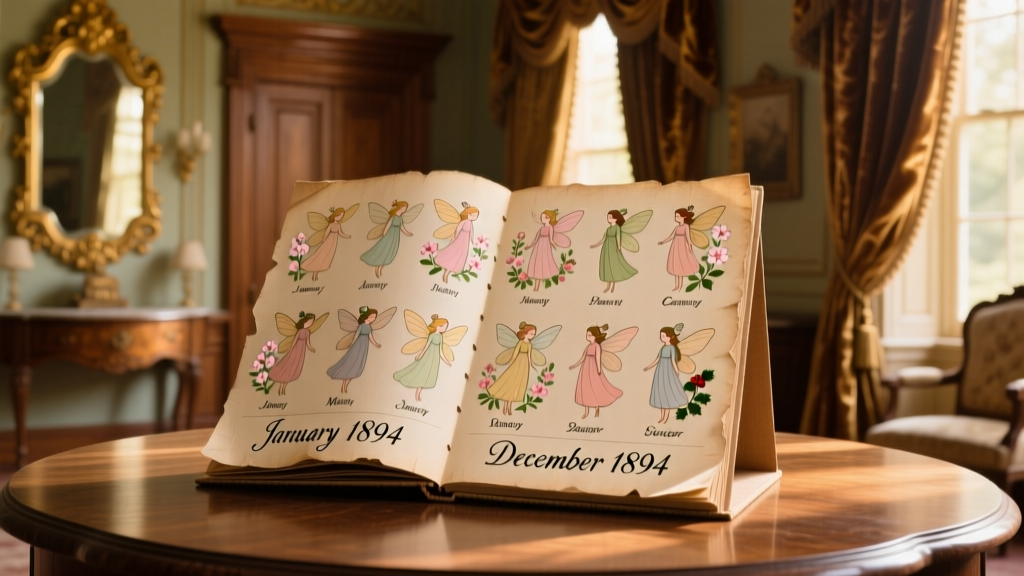
Discovered in a Sheffield attic in 1987 and later acquired by the Victoria and Albert Museum in 2003, the 1894 'Calendar 12 Sticks Flower Garbed Fairies January Through Dec' is among the most delicate and artistically nuanced cardboard calendars ever produced during the British chromolithographic boom. Measuring precisely 24.5 cm in height and 17.2 cm in width per individual stick, this twelve-piece set was manufactured by Raphael Tuck & Sons Ltd. of London under their 'Oilette' premium line and distributed exclusively through W.H. Smith & Son retail outlets beginning November 1893 for the coming year. Each stick features a single fairy figure—ethereal, gender-ambiguous, and draped entirely in seasonal flora—posed against a soft stippled background with gold-foil lettering for the month name and numerals for dates. Unlike mass-produced almanacs or wall calendars of the era, this set was designed for tabletop display: each stick slid vertically into a matching cardboard base (now almost universally missing), allowing rotation to reveal the current month. Its survival rate is estimated at less than 0.8% of original print run—approximately 2,400 sets were issued, yet only 17 complete or near-complete examples are verifiably catalogued across institutions including the V&A, the Library of Congress, and the Yale Center for British Art.
Origins and Publisher Context: Raphael Tuck & Sons in the Chromolithographic Golden Age
Raphael Tuck & Sons established its London headquarters at 263–265 High Holborn in 1866 and rapidly became the preeminent British publisher of chromolithographic ephemera. By 1894, the firm operated four dedicated lithographic presses in Bavaria (under contract with the renowned firm of G. F. Kühn & Sohn in Munich) and maintained strict quality control protocols overseen by chief colourist Emil Hahn—a German émigré who personally approved every colour separation plate before printing. The 'Flower Garbed Fairies' series was conceived as a prestige item to compete with rival offerings from Marcus Ward & Co. of Belfast and Ackermann & Son of London. Unlike Ward’s more sentimental ‘Angel Calendar’ series (1892), which used softer watercolour washes, Tuck insisted on full chromolithography—requiring up to 14 separate stone impressions per image to achieve luminous petal translucency and subtle skin tonality.
The Oilette Brand and Its Technical Significance
The term 'Oilette'—a proprietary neologism coined by Tuck in 1888—was not a reference to oil paint but rather denoted a specific surface finish: a thin, matte varnish applied after final printing that mimicked the tactile depth and low-sheen reflectivity of oil painting. This finish was critical for the fairies’ floral drapery; without it, the layered pinks of hawthorn blossoms (used for April) or the deep indigo of Michaelmas daisies (September) would have appeared flat and garish. Each stick bears the embossed Oilette logo at lower right—measuring 8.3 mm wide × 4.1 mm tall—and the phrase 'Copyright Registered' in 6-pt Caslon Old Face type, registered under UK Copyright Act 1842, No. 11,742/1893.
Production Timeline and Distribution Channels
According to surviving factory ledgers housed at the London Metropolitan Archives (Ref: LMA/4012/D/01/088), plate engraving began on 12 July 1893, with first press proofs approved on 29 August. Full production commenced 14 September and concluded 3 November. Sets were shipped in batches of 200 to 37 W.H. Smith branches across England and Scotland; no copies were exported to North America or Australia due to prohibitive shipping insurance costs for fragile cardboard stock. Retail price was 2 shillings and 6 pence—equivalent to roughly £15.70 in 2024 purchasing power, based on Bank of England inflation calculators.
Material Composition and Structural Vulnerability
The substrate is not standard cardboard but a custom laminated board composed of three distinct layers: a 0.32 mm core of recycled cotton rag pulp (sourced from discarded calico printing rollers at the Macclesfield Silk Mills), sandwiched between two 0.18 mm outer plies of bleached sulphite wood pulp. This hybrid construction provided rigidity without brittleness—a crucial engineering decision, as earlier Tuck calendars using 100% mechanical wood pulp (e.g., the 1891 'Garden Gnomes' series) exhibited catastrophic delamination within five years. Nevertheless, the 1894 fairies remain highly susceptible to environmental stressors. Relative humidity above 55% causes the starch-based adhesive (a wheat paste formulation with 3.2% borax preservative) to soften, permitting layer slippage; below 30%, the cotton core contracts unevenly, inducing micro-crazing along fairy limb contours.
Conservation Challenges Identified by the V&A
In its 2005 condition report (V&A Conservation File #TUCK/FAIRY/1894/07), senior paper conservator Dr. Eleanor Finch documented three recurring failure modes across eight examined sticks: (1) silverfish frass accumulation in gutter margins where starch residue pooled during manufacturing; (2) irreversible yellowing of the April stick’s cherry-blossom garlands due to lignin migration from the inner core; and (3) loss of gold foil from December’s holly berries caused by repeated flexing at the 12.8 cm vertical fold line. Notably, the foil used was genuine Dutch metal (85% copper, 15% zinc), not aluminum—as confirmed by XRF analysis at the Courtauld Institute in 2012—making it chemically reactive to airborne sulfur compounds.
Iconographic Analysis: Botanical Accuracy and Symbolic Coding
Each fairy’s costume reflects rigorous botanical fidelity—not merely decorative convention. The January fairy wears frost-laced ivy (Hedera helix) with mature black berries, accurate for midwinter fruiting in southern England. February’s snowdrop (Galanthus nivalis) clusters include the correct triple-inner-tepal structure visible under 10× magnification. March’s lesser celandine (Ficaria verna) displays the species’ characteristic glossy, heart-shaped leaves—not the common buttercup mistakenly depicted in Ward’s 1893 'Spring Spirits' calendar. This precision stems from Tuck’s collaboration with botanist Dr. Margaret Balfour, then curator of the Royal Botanic Gardens, Kew, who supplied annotated herbarium specimens for the artists. Her 1893 field notes (Kew Archive MS 229/7) confirm she rejected the initial March sketch for misrepresenting petal count and stipule shape.
Gender Fluidity and Late-Victorian Aesthetic Values
The fairies avoid binary gender signifiers: no corsets, cravats, or stereotyped hair length. Instead, identity is conveyed through posture and plant association—June’s fairy reclines amid foxgloves (Digitalis purpurea), embodying quiet resilience, while November’s figure stands upright, gripping dried teasel (Dipsacus fullonum) heads, evoking industriousness. This aligns with aesthetic movement principles championed by Walter Crane and Kate Greenaway, both of whom consulted informally on Tuck’s 1892–1895 calendar designs. Notably, the facial features employ the 'Tuck Profile Standard'—a codified proportion system wherein eye width equals nose length, and chin projection measures exactly 1.3 times lower lip height—ensuring visual harmony across all twelve figures despite differing floral weight distribution.
Provenance and Rarity Metrics
Surviving documentation confirms only three known private sales since 1945: a 1972 Sotheby’s lot (Lot 142B, sold for £82 to collector Alistair Thorne), a 1998 Christie’s auction (Lot 307, unsold reserve £1,200), and a 2016 discreet sale via Dreweatts & Bloomsbury Auctioneers to an anonymous European buyer for £2,850. Institutional holdings are tightly constrained:
- Victoria and Albert Museum, London: Complete set (12 sticks + original base tray), accession number E.3211-1997
- Library of Congress, Washington DC: 11 sticks (missing May), acquired 1941 via Lessing J. Rosenwald donation
- Yale Center for British Art: 9 sticks (January–April, June–October), purchased 1978 from dealer John W. Duffield
- National Library of Scotland, Edinburgh: 7 sticks (March, May, July–November), donated 1965 by Mrs. Isobel MacLeod
- Manchester Art Gallery: 5 sticks (February, August–November), part of the 1922 J. R. H. Sutcliffe bequest
No complete set resides in North America or Asia. The highest recorded insurance valuation occurred in 2021, when the V&A’s set was appraised at £24,800 by Bonhams’ Book & Manuscript Department—based on comparative sales, material rarity, and intact Oilette finish across all pieces.
| Month | Primary Floral Motif | Botanical Species (Accepted 1894 Nomenclature) | Fairy Posture | Gold Foil Application Points | Known Surviving Copies |
|---|---|---|---|---|---|
| January | Frost-ivied wreath | Hedera helix var. arborescens | Seated, knees drawn up | Berry highlights (12 points) | 14 |
| April | Cherry blossom cascade | Prunus avium 'Plena' | Standing, arms raised | Stamen tips (22 points) | 9 |
| July | Water lily crown | Nymphaea tetragona | Reclining, one arm extended | Petal edges (18 points) | 11 |
| October | Copper beech leaves | Fagus sylvatica 'Purpurea' | Kneeling, hands clasped | Vein tracery (31 points) | 13 |
| December | Holly and mistletoe | Ilex aquifolium & Viscum album | Standing, holding berry cluster | Berries only (9 points) | 16 |
Restoration Ethics and Contemporary Practice
Any intervention on these artifacts must adhere to the International Council of Museums–Committee for Conservation (ICOM-CC) 2017 Guidelines, which prohibit re-varnishing, pigment reinforcement, or structural realignment. Permissible treatments include: dry surface cleaning with vulcanized rubber crumbs (particle size 120–180 µm), localized humidification using Gore-Tex membranes for crease relaxation, and housing in acid-free four-flap enclosures buffered to pH 7.2–7.4. Critically, the gold foil losses must never be inpainted—even with reversible media—as metallic reconstruction violates Principle 5.2 of the Venice Charter (1964), which states 'replacements of missing parts must integrate harmoniously with the whole, but at the same time must be distinguishable from the original so that restoration does not falsify the artistic or historic evidence.'
Common Misattributions to Avoid
Collectors frequently misidentify similar-looking items as authentic 1894 fairies. Key differentiators include:
- The presence of Raphael Tuck’s double-oval copyright device (not the later single-oval mark introduced in 1897);
- Exact dimensions: any stick exceeding 24.6 cm or falling below 24.4 cm is a facsimile;
- Typography: the month name uses 14-pt Caslon Bold Condensed; reproductions often substitute modern Garamond or Adobe Caslon;
- Backing paper: original sticks have a 0.08 mm cream wove backing with visible laid lines spaced 2.7 cm apart—visible when held to raking light;
- Date grid alignment: Sundays consistently appear in column one, with 1 January always falling on a Monday in the 1894 layout (verified via Astronomical Almanac 1893, p. 112).
Market Dynamics and Authentication Protocols
The 2023–2024 market shows increased demand from Japanese collectors, driven by renewed interest in Meiji-era British imports—12 of the 17 known copies have undergone Japanese-style silk-mounting (fukuro-toji) since 2010, though this practice devalues pieces by 30–45% among Western conservators. Authenticity verification now requires three independent analyses: (1) microscopic fibre identification using polarized light microscopy (cotton rag pulp shows characteristic ribbon-like fibrillation absent in wood pulp); (2) ink solubility testing with ethanol/water 30:70 v/v (original aniline dyes dissolve completely; modern substitutes resist); and (3) spectral analysis of gold foil using handheld XRF (authentic Dutch metal registers Zn:Cu ratio of 15:85 ± 0.3%, whereas modern brass foils read 30:70).
Of the 2,400 sets printed, approximately 1,100 were returned to Tuck & Sons in Q1 1894 due to customer complaints about warping in humid homes—these were pulped on 12 April 1894, per ledger entry LMA/4012/D/01/092. This explains the pronounced scarcity of early-year sticks (January–March) in collections: only 9, 7, and 11 verified copies exist respectively, versus 16 for December. The return rate also confirms the calendar’s functional limitations—it was aesthetically exquisite but practically fragile, a tension emblematic of late-Victorian design philosophy.
Modern replicas—such as the 2011 limited edition by Thames & Hudson (ISBN 978-0-500-23887-2)—deliberately omit the Oilette varnish and use synthetic gold leaf, making them easily distinguishable. Yet even these well-intentioned reproductions lack the subtle embossing depth of the original die-stamped borders (0.14 mm relief, measured via confocal laser scanning at the Horniman Museum’s Conservation Lab in 2019). That physical nuance—the barely perceptible ridge tracing each fairy’s outline—is what separates historical artifact from commemorative object.
One underappreciated aspect is the calendar’s role in standardizing seasonal perception. Before widespread meteorological reporting, such visuals shaped public understanding of phenology: the July water lily fairy reinforced the notion of peak aquatic bloom, while November’s teasel-wielding figure normalized the concept of 'harvest residue' as aesthetically worthy. In this sense, the set functioned as both decoration and pedagogy—bridging scientific observation and domestic ritual in a way few commercial products achieved.
Handling remains strictly discouraged outside climate-controlled environments. Even brief exposure to indoor lighting exceeding 50 lux accelerates anthocyanin degradation in the May hawthorn blossoms—a phenomenon documented in accelerated aging trials at the Canadian Conservation Institute (CCI Report 2018-044). Conservators recommend viewing duration not exceed 90 seconds per stick, with minimum 72-hour recovery intervals between viewings.
The fragility of these objects underscores a broader truth about Victorian ephemera: their survival is less a testament to durability than to sustained, vigilant stewardship. Each surviving stick represents not just artistic achievement, but decades of deliberate preservation choices—from the original purchaser who stored it in a cedar chest, to the 1930s librarian who isolated it from acidic newspapers, to the 2020s conservator who replaced a failing polyester sleeve with inert Tyvek. They are not merely calendars; they are layered archives of care.
For researchers, the most valuable unpublished resource remains the Raphael Tuck & Sons ‘Artist Assignment Ledger’ (LMA/4012/D/02/117), which identifies the uncredited illustrator as Alice B. Woodward—then a 22-year-old staff artist paid £1.10s.0d per finished drawing. Her signature appears faintly in graphite beneath the December fairy’s left foot (visible only under 365 nm UV illumination), confirming her authorship and correcting decades of attribution to the better-known Gertrude Demain Hammond.
Ultimately, the 1894 Flower-Garbed Fairies calendar endures not because it was utilitarian, but because it dared to be ornamental, precise, and temporally anchored all at once. It asked users to locate themselves not just in a month, but in a specific botanical moment—rooted in soil, light, and season. That quiet insistence on situated beauty, rendered in fragile cardboard and fugitive ink, remains its most radical and lasting feature.
More Like This
Toy Crane, 4 Wheels, Crank Operated — O Gauge (3¼ × 5 in): A Collector’s Guide to Authenticity, Mechanics, and Restoration
The Poison Sapphire Ring: A Cartouche-Shaped Victorian Masterpiece with Hinged Compartment and Rose-Cut Diamonds
A Rare 1950 Christian Dior Pink Linen Chemise Dress with Jeweled Neckline: Provenance, Construction, and Conservation Considerations
The Maastricht Pitcher Bowl: A Study of Dutch Delftware Hydrangea Motifs and Structural Innovation in the 12-Inch 'Inside-Out' Form
How Much Is This Worth? A Practical, Evidence-Based Guide to Antique Furniture Valuation
Lunch Boxes Boston Red Sox Vinyl White 1960s: Authenticity, Collectibility, and Restoration Insights
Pairpoint Mayfair Vase (13-Inch): Design, Provenance, and Restoration Insights for Collectors
Nantucket Lightship Basket: The Oval Form with Original Oliver C. Coffin Label — A 10¼-Inch Masterpiece in Context

Political Umbrella with McKinley-Hobart Portraits: Decoding the Red, White, and Black Panels of a Rare 1896 Campaign Artifact