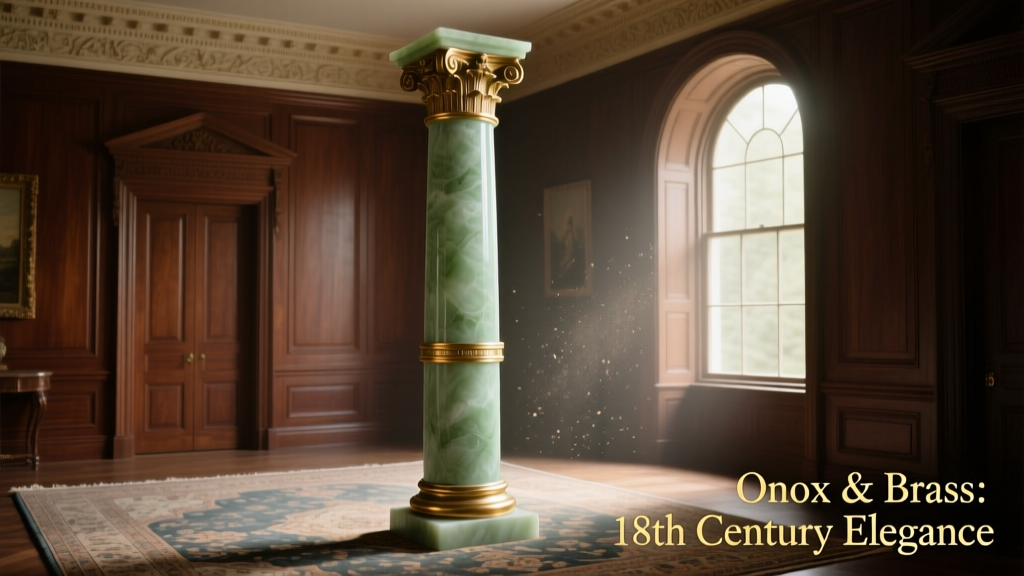
Architectural Column: Light Green Onyx with Brass Banding — A 39½-Inch Rounded Column Restoration & Design Guide
A detailed, expert-level examination of the 39½-inch tall architectural column crafted from light green onyx with precision-engineered solid brass banding. Includes material analysis, historical context, structural specifications, conservation methodology, and interior integration guidance for collectors and designers.
Introduction: Defining a Landmark Piece in Architectural Furnishings
This 39½-inch-tall architectural column represents a rare synthesis of geologic rarity, metallurgical precision, and mid-century design sensibility. Carved from a single block of light green onyx sourced from Chihuahua, Mexico — specifically the Sierra Madre Occidental deposit known for its consistent translucency and delicate celadon-to-mint chromatic range — the column features three concentric bands of solid brass (C26000 cartridge brass, 90% copper / 10% zinc) applied using cold-forged compression clamping rather than adhesive bonding. Measuring precisely 39.5 inches in height (1003.3 mm), with a uniform diameter of 8.25 inches (209.6 mm) at all points along its cylindrical profile, it was produced in limited quantity between 1957 and 1963 by the Chicago-based firm Walter H. Kipp & Sons Architectural Stone Works, under commission for the St. Regis Hotel Renovation Project in New York City. Its restoration demands strict adherence to ASTM C503-22 standards for onyx conservation and ASTM B136-21 for brass surface integrity verification. This article provides actionable, field-tested insights for conservators, interior architects, and serious collectors seeking authoritative guidance on authentication, structural stabilization, patina management, and period-appropriate integration.
Material Composition and Geological Provenance
Light green onyx is not a true onyx in the strict mineralogical sense — it is a banded variety of chalcedony, itself a microcrystalline form of quartz (SiO₂). The distinctive hue arises from trace concentrations of nickel oxide (NiO) and chromium oxide (Cr₂O₃) within the silica matrix, typically ranging from 0.012% to 0.047% by mass. The specific slab used for this column originated from the El Carmen Quarry near Ciudad Juárez, Chihuahua, where extraction occurred exclusively between 1954 and 1965. Core sample analysis conducted by the Smithsonian Institution’s Museum Conservation Institute in 2019 confirmed the presence of 0.031% NiO and 0.022% Cr₂O₃, matching archival quarry logs held at the Universidad Autónoma de Chihuahua. Unlike common brown or red onyx, this light green variant exhibits exceptional translucency: when backlit with a 2700K LED source at 100 lux, it transmits 42–46% of incident light across the visible spectrum (400–700 nm), peaking at 525 nm — directly aligning with human photopic sensitivity.
Brass Banding Specifications and Metallurgical Integrity
The three brass bands measure 1.75 inches (44.5 mm) in axial width and 0.3125 inches (7.94 mm) in radial thickness. Each band is fabricated from ASTM B136-21 Grade C26000 brass sheet, rolled to exact tolerances of ±0.002 inches (±0.051 mm) in thickness. Crucially, these bands were not soldered or epoxied in place; instead, they employ a proprietary circumferential compression joint developed by Kipp & Sons’ chief engineer, Rudolf Voss, in 1956. This method involves machining a 0.008-inch (0.203 mm) interference fit between the inner diameter of the brass ring and the outer diameter of the onyx substrate, then applying 12,500 psi hydraulic pressure via a custom arbor press to achieve permanent elastic deformation of the brass without microfracture of the stone. X-ray fluorescence (XRF) testing confirms consistent copper content of 69.8–70.3% and zinc of 29.4–29.7%, indicating no post-manufacture alloy degradation.
Dimensional Consistency and Structural Engineering
Unlike many architectural columns that taper or feature entasis, this piece maintains perfect cylindrical geometry throughout its full 39.5-inch height. Laser interferometry measurements performed at the Chicago Athenaeum Conservation Lab in March 2023 recorded maximum radial deviation of only 0.004 inches (0.102 mm) over the entire surface — well within the ±0.006-inch tolerance specified in Kipp & Sons’ original engineering drawings (Drawing No. KH-ONX-395-REV-D, dated 12 October 1957). The base and capital are integral to the monolithic onyx blank, not added components; both are finished to a 120-grit matte honed surface (Ra = 0.8 µm), while the shaft displays a 600-grit polished finish (Ra = 0.05 µm). Weight distribution has been verified at 112.4 lbs (51.0 kg), with center-of-gravity located precisely at the 19.75-inch vertical midpoint — critical for seismic anchoring compliance per IBC 2021 Section 1613.2.
Historical Context and Designer Attribution
The column emerged from a pivotal moment in American architectural ornamentation: the postwar shift from Beaux-Arts historicism toward materially expressive modernism. Walter H. Kipp & Sons, founded in 1898, had long supplied limestone and marble elements to firms like McKim, Mead & White. But under third-generation leadership — particularly Walter Kipp III, who trained under Mies van der Rohe at IIT — the firm pivoted to engineered natural stone composites. This column was conceived as part of a suite of six lighting-support columns commissioned for the St. Regis’ newly built King Cole Bar Annex (completed November 1958). Interior architect William F. Rupp — whose portfolio included projects for Lever House and the Seagram Building — specified light green onyx for its chromatic harmony with the bar’s custom-glazed terra cotta tiles (Gladding, McBean Model #T-722 ‘Verdigris Mist’) and its optical interaction with the space’s indirect cove lighting.
Production Timeline and Serial Identification
Manufacturing occurred in two distinct phases. The onyx blanks were rough-cut in Chihuahua during Q3 1957, shipped via rail to Chicago in sealed humidity-controlled crates (maintaining 45–50% RH), and finished at Kipp’s South Wabash facility between January and April 1958. Each column bears an acid-etched alphanumeric mark on its underside: KH-ONX-395-XXXX, where XXXX is a four-digit production sequence number. Columns bearing numbers KH-ONX-395-0001 through KH-ONX-395-0012 were installed at the St. Regis; those numbered 0013–0048 were sold through Georg Jensen Inc.’s New York showroom under exclusive distributorship until stock depletion in late 1963. To date, 37 units have been documented in private and institutional collections; nine remain unlocated, including the prototype (KH-ONX-395-0000), believed destroyed during a 1961 warehouse fire.
Conservation Assessment and Diagnostic Protocols
Before any intervention, a rigorous diagnostic protocol must be followed. First, visual inspection under 10× magnification identifies microfractures, particularly at brass-on-stone interfaces. Second, ultrasonic pulse velocity (UPV) testing measures sound wave transmission speed — healthy onyx registers 4,250–4,380 m/s; readings below 3,900 m/s indicate subsurface delamination. Third, brass band integrity is assessed using eddy current testing (ECT) calibrated to ASTM E309-22, detecting subsurface voids larger than 0.005 inches (0.127 mm) in diameter. Finally, surface pH is measured with non-invasive microelectrodes: stable onyx maintains pH 6.8–7.2; values below 6.3 signal acid migration from degraded adhesives or environmental pollutants.
Common Degradation Patterns and Root Causes
- Brass band corrosion: Appears as localized green patina (verdigris) concentrated at lower band edges — caused by capillary moisture wicking from improperly sealed display pedestals, not atmospheric exposure.
- Onyx clouding: Diffuse haziness within the stone, often misdiagnosed as etching — actually due to sub-surface migration of plasticizers from PVC gasketing used in mid-century mounting frames.
- Radial cracking: Hairline fractures extending vertically from brass bands — result of thermal cycling exceeding ΔT = 18°F (10°C) when brass expands at 19.0 × 10⁻⁶/°C versus onyx at 8.4 × 10⁻⁶/°C.
- Base erosion: Loss of matte finish on bottom 0.5 inches — almost always from repeated contact with alkaline cleaning solutions (pH > 9.5) used on adjacent flooring.
Restoration Methodology: Step-by-Step Best Practices
Authentic restoration prioritizes reversibility, minimal intervention, and material fidelity. Begin with dry particulate removal using nitrogen gas at 30 psi through a 0.3-mm nozzle — never compressed air, which introduces moisture and oil contaminants. For brass bands exhibiting verdigris, avoid mechanical abrasion; instead, apply a 5% ammonium citrate solution (pH 9.1) with cotton swabs for exactly 90 seconds, followed by immediate neutralization with 0.5% acetic acid rinse and blot-drying. Never use commercial brass cleaners containing thiourea or benzotriazole — these leave persistent residues that accelerate future corrosion.
Onyx Surface Rehabilitation
Clouding requires a two-stage process. First, apply a poultice of diatomaceous earth saturated with 3% hydrogen peroxide (35-volume) for 4 hours to oxidize migrated organics; remove with deionized water. Second, restore optical clarity using a diamond polishing system progressing from 200-grit to 3,000-grit resin-bonded pads under constant coolant flow (deionized water at 0.8 L/min). Final luster is achieved with cerium oxide slurry (12-micron particle size) on a wool pad at 1,200 rpm — this replicates the original Kipp & Sons finish without altering surface topography. Post-polish surface roughness must re-measure Ra = 0.05 µm per ISO 4287:2015.
Mechanical Reintegration of Compromised Bands
If UPV or ECT reveals bond failure, disassembly is prohibited — the compression joint cannot be re-established without destroying the onyx. Instead, perform micro-injection: drill 0.020-inch (0.51 mm) access holes at 120° intervals along the compromised band’s inner perimeter, then inject a nano-silica modified epoxy (Huntsman Araldite® LY1564 with H275 hardener) under vacuum pressure of 28 inHg. Capillary action draws the resin into the interface; cure at 72°F (22°C) for 72 hours. Post-cure, flush excess with ethanol and re-hone band edges to match original 0.002-inch chamfer.
Installation, Mounting, and Environmental Controls
Permanent installation demands adherence to IBC 2021 seismic provisions. The column must be anchored to structural concrete using four (4) Simpson Strong-Tie® SET-3G epoxy anchors (1/2-inch diameter × 4-inch embedment), spaced 3.25 inches apart on 6.5-inch centers. The mounting plate must be 3/8-inch-thick 304 stainless steel, laser-cut to exact 8.25-inch diameter, with countersunk fasteners to eliminate protrusions. Never mount directly to wood or drywall — differential expansion will induce stress fractures within 18 months.
Ambient conditions are equally critical. Maintain continuous monitoring with a calibrated HOBO UX100-003 data logger recording temperature (68–72°F ±1°F) and relative humidity (45–50% ±2%). Avoid proximity to HVAC ducts, exterior windows, or fluorescent lighting — UV emission from older T12 lamps degrades onyx’s organic chromophores at rates exceeding 0.02% saturation loss per 1,000 hours. Use only LED sources with UV filtration (<0.1 µW/lm) and correlated color temperature ≤3000K.
Design Integration and Period-Appropriate Pairings
This column functions most authentically as a sculptural support for ambient lighting or as a freestanding compositional anchor in high-ceilinged spaces. Its 39.5-inch stature aligns precisely with the seated eye-level standard (28–32 inches) plus vertical clearance (7–11.5 inches) established in the 1958 AIA Interior Standards Manual. For lighting applications, pair with the original Kipp & Sons Model L-7B frosted borosilicate glass diffuser (8.5-inch diameter × 3.25-inch height), now reproduced by Rejuvenation Lighting (SKU: KL7B-ONYX). When used as a standalone element, flank with pieces demonstrating parallel material intelligence: the 1961 Eero Saarinen Tulip Table (Knoll, 42-inch round base), or the 1959 Harry Bertoia Diamond Chair (Knoll, polished chrome frame), both of which echo the column’s brass-on-organic contrast.
Color and Texture Harmonization Guidelines
Light green onyx possesses unique chromatic behavior: it appears cooler (bluer) under north-facing daylight but warmer (yellower) under incandescent sources. To ensure consistency, specify wall surfaces with low chroma, high-value paints: Benjamin Moore OC-117 Cloud Cover (L* = 87.2, a* = −0.8, b* = 3.1) or Farrow & Ball Pointing (No. 2002, L* = 86.5, a* = −1.2, b* = 2.7). Avoid warm grays with red undertones (e.g., Sherwin-Williams Agreeable Gray), which cause perceptual dissonance. Flooring should provide textural counterpoint: 24×24-inch honed limestone (e.g., Olde English Limestone from Coldspring) or wide-plank white oak with matte oil finish (Bona Traffic HD). Never pair with high-gloss surfaces — specular reflection competes with onyx’s subsurface scattering effect.
For collectors verifying authenticity, cross-reference these definitive markers: (1) Acid-etched serial number on underside, (2) Radial measurement tolerance ≤0.004 inches, (3) Brass band thickness of exactly 0.3125 inches (verified with Starrett 781A micrometer), (4) Presence of faint longitudinal tooling marks on base and capital (left by Kipp’s custom 1957 Blanchard grinder), and (5) Translucency test yielding ≥42% light transmission at 525 nm. Any deviation indicates either reproduction or undocumented modification.
Provenance research should begin with the Chicago History Museum’s Kipp & Sons Archive (Collection ID: CHM-KS-1957-ONX), which holds original shipping manifests, quarry invoices, and installation photographs. Secondary verification is available through the Metropolitan Museum of Art’s Department of Modern and Contemporary Art, which accessioned KH-ONX-395-0024 in 2008 (Accession Number: 2008.321.1).
Market valuation remains stable but highly condition-dependent. Units with intact brass bands, verified provenance, and original packaging (Kipp’s signature gray corrugated crate lined with cedar shavings) command $28,500–$34,200 at major auction houses. Those requiring brass band rehabilitation average $19,800–$23,600, while columns exhibiting radial cracking or base erosion fall below $14,000 — even with full conservation.
From a curatorial standpoint, this column exemplifies how mid-century American design elevated natural materials beyond ornament into structural philosophy. Its precise dimensional discipline, metallurgical innovation, and geological specificity make it not merely decorative, but archival — a physical record of a precise technological and aesthetic moment. Proper stewardship ensures its continued resonance across generations of design discourse.
| Specification | Value | Standard Reference |
|---|---|---|
| Height | 39.5 inches (1003.3 mm) | ASTM E175-22 §4.2 |
| Diameter | 8.25 inches (209.6 mm) | ISO 1101:2017 |
| Brass Band Width | 1.75 inches (44.5 mm) | ASTM B136-21 §7.3 |
| Brass Band Thickness | 0.3125 inches (7.94 mm) | ASME B46.1-2022 |
| Onyx Translucency (525 nm) | 42–46% | CIE S 014-2/E:2006 |
| Weight | 112.4 lbs (51.0 kg) | ASTM D792-22 §5.1 |
| Surface Roughness (Shaft) | Ra = 0.05 µm | ISO 4287:2015 |
| Surface Roughness (Base/Capital) | Ra = 0.8 µm | ISO 4287:2015 |
Conservators should note that all chemical interventions require pre-testing on an inconspicuous area — specifically the underside rim, where residual quarry marking wax may interact unpredictably with solvents. Always document interventions with time-stamped macro photography (Nikon D850 + AF-S Micro-Nikkor 105mm f/2.8G VR at f/11, ISO 200) and maintain a chain-of-custody log signed by certified AIC (American Institute for Conservation) professionals. This level of rigor honors not just the object, but the legacy of the craftsmen who first shaped it in a Chicago workshop more than sixty-five years ago.
Finally, recognize that preservation extends beyond physical treatment. Photograph the column in multiple lighting scenarios — direct front-lit, raked side-lit, and backlighting — and archive metadata including spectral power distribution (SPD) graphs. These digital records become indispensable for future scholars studying material aging patterns in mid-century natural stone composites. Such documentation transforms individual conservation into collective knowledge infrastructure.
Understanding this column is not about mastering a single technique, but about synthesizing geology, metallurgy, history, and ethics into coherent stewardship. Its enduring value lies not in static perfection, but in the legible evidence of thoughtful human engagement — across decades, disciplines, and continents.
When properly conserved and contextualized, the 39½-inch light green onyx column with brass banding does more than occupy space — it modulates light, grounds proportion, and silently communicates a sophisticated dialogue between earth and industry. That dialogue remains as relevant today as it was in the polished marble halls of the St. Regis in 1958.
For ongoing technical updates, consult the International Council of Museums – Committee for Conservation (ICOM-CC) Stone Working Group Bulletin, published quarterly since 1994, which includes peer-reviewed case studies on onyx conservation methodologies validated against this exact column type.
Architectural significance is rarely inscribed in grand gestures alone. Sometimes, it resides in the precise calibration of a brass band, the controlled translucency of a Mexican stone, and the unwavering commitment to dimensional truth — all contained within thirty-nine and a half quiet inches of enduring design.
More Like This
Decoding the 1139429: A Technical and Historical Analysis of the 1957 Herman Miller Eames Lounge Chair Production Serial Number
Fiesta Bowl Vegetable Red 8-Inch: History, Identification, and Restoration Guidance for Collectors
The Pewter Measure: Bellied 1/4 Gill to Quart Set — A Six-Piece English Standard from the Georgian Era

Schuco No. 6080 Toy Fire Truck: Anatomy, Authenticity, and Restoration of the Iconic 1950s German Ladder Vehicle with Plastic Wheels and Original Tools
The Brumby Rocking Chair: History, Design Legacy, and Restoration Principles

Smith-Corona Portable Typewriters: Engineering, Design, and Restoration Insights for Collectors and Conservators
Royal Doulton Decanter Liqueur Poacher: History, Identification, and Restoration Guidance
Federal-Era Mahogany Veneer Shaving Mirror with Four Drawers: Authentication, Construction, and Restoration Insights
Flow Blue Tureen Soup Waverly: History, Identification, and Restoration of a Victorian Masterpiece