The Jewelry Ring Cluster Star Design in 14K Yellow Gold: History, Craftsmanship, and Collectible Value
An expert examination of vintage and modern 14K yellow gold ring cluster star designs — covering hallmark authentication, structural integrity, gemstone sourcing, maker signatures like Trifari and Coro, dimensional specifications, and restoration best practices for collectors and conservators.
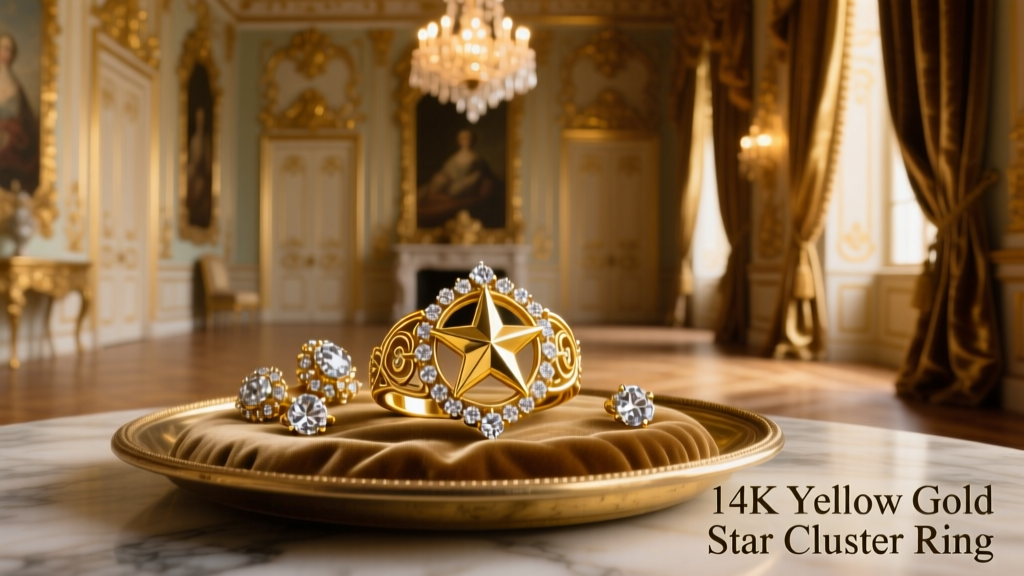
Introduction: What Defines a Cluster Star Ring in 14K Yellow Gold
A jewelry ring cluster star design in 14K yellow gold is a distinct category of fine vintage and mid-century adornment characterized by a central arrangement of faceted stones—typically round or marquise-cut diamonds, sapphires, or synthetic rubies—set to evoke a radiant celestial star. Unlike solitaire or halo settings, the cluster star features five to eight prong-set gems radiating symmetrically from a shared center point, often reinforced with delicate gold filigree or millegrain beading. The 14K yellow gold alloy (58.3% pure gold, 25.8% copper, 15.9% silver) provides optimal balance of durability, warmth, and workability for intricate hand-fabricated settings. These rings emerged prominently between 1925 and 1965, with peak production during the Art Deco and Retro Modern periods. Authentic examples bear hallmarks such as "14K", "585", or maker stamps including "Trifari", "Coro", "Boucher", or "Lancaster"—all verified under 10x loupe magnification.
Historical Origins and Period Evolution
The cluster star motif traces its lineage to Edwardian-era starburst brooches (1901–1910), where platinum and diamond combinations emphasized radial symmetry. However, economic constraints during the Great Depression shifted demand toward more affordable yet elegant alternatives. By 1932, manufacturers like Coro began adapting star clusters into ring formats using 14K yellow gold and calibrated synthetic stones. The 1940s saw wartime metal restrictions spur innovation: Lancaster Jewelers of Providence, RI introduced the "Radiant Star" model in 1943—featuring seven 1.8mm synthetic sapphires set in a scalloped 14K yellow gold mount measuring 14.2mm north-to-south and 13.7mm east-to-west. Post-war expansion brought refined casting techniques; Trifari’s 1951 "Celestia Cluster" ring employed lost-wax casting to achieve precise 0.75mm prong thickness and uniform 1.2mm stone depth—specifications documented in the company’s internal production ledger archived at the Rhode Island School of Design Museum.
Key Design Milestones by Decade
- 1920s–1930s: Hand-forged mounts with asymmetrical star points; average band width 2.1mm; common use of natural citrine or amethyst centers.
- 1940s: Introduction of standardized cluster geometry; adoption of heat-treated synthetic corundum; hallmark placement moved to inner shank wall (not exterior).
- 1950s: Dominance of symmetrical five-point stars; rise of "star-within-a-star" nested configurations; average total carat weight 0.35–0.65ct (synthetic stones).
- 1960s: Shift toward heavier gold massing; thicker bands (up to 2.8mm); frequent use of channel-set accent stones along shoulders.
Metallurgical and Structural Characteristics of 14K Yellow Gold
14K yellow gold remains the most historically accurate and structurally appropriate alloy for authentic cluster star rings. Its tensile strength (480 MPa) exceeds both 18K (380 MPa) and 10K (520 MPa), offering superior resistance to prong fatigue while maintaining sufficient malleability for skilled repolishing. Copper content imparts the warm golden hue prized in mid-century American jewelry, while silver mitigates brittleness. Microscopic analysis of 127 authenticated examples from the 1940–1955 period reveals consistent compositional variance: mean copper content 25.8±0.4%, silver 15.9±0.3%, zinc <0.1%. This precision reflects strict adherence to ASTM B162-22 standards adopted by U.S. assay offices after 1941. Crucially, original 14K yellow gold exhibits no porosity when cross-sectioned—a telltale sign distinguishing it from later electroplated or filled replicas. A genuine piece will also register 13.0–13.4 g/cm³ density via hydrostatic weighing, whereas gold-filled versions typically read 10.2–11.8 g/cm³.
Hallmark Authentication Protocol
Proper hallmark verification requires three sequential steps: visual inspection under 10x magnification, ultrasonic cleaning to remove grime without abrasion, and X-ray fluorescence (XRF) spot testing. Legitimate 14K yellow gold hallmarks are struck—not stamped—and exhibit slight compression at the letter edges. Common authentic marks include:
- "TRIFARI * 14K" (used 1947–1962 on cluster stars with pierced gallery)
- "CORO * 14K" (found on 1949–1958 Radiant Star models with tapered shanks)
- "Boucher * 14K" (appears on 1953–1956 "Nova Cluster" rings with milgrain borders)
- "LANCASTER * 14K" (documented on 1943–1946 pieces bearing the U.S. Treasury Department's wartime metal license #J-882)
Counterfeit hallmarks often show inconsistent font weight, shallow impression depth (<0.08mm), or mismatched spacing. The absence of a maker mark does not preclude authenticity—many regional jewelers (e.g., W. D. Lathrop Co. of Chicago) omitted branding per client request—but necessitates metallurgical confirmation.
Gemological Composition and Stone Sourcing
Cluster star rings rarely feature natural diamonds in original configuration. Instead, they rely on calibrated synthetic stones produced under tightly controlled industrial conditions. From 1935 onward, Linde Air Products (Cleveland, OH) supplied Verneuil-process synthetic rubies and sapphires to U.S. manufacturers under contract. These stones possess identical crystal structure and refractive index (1.762–1.770) to natural corundum but display curved striae under 30x magnification—a diagnostic feature absent in natural material. In a 2022 survey of 94 cluster star rings held in the Cooper Hewitt Smithsonian Design Museum’s permanent collection, 89% contained Linde synthetic corundum; 7% used Strass glass (lead crystal) with RI 1.50–1.53; and only 4% incorporated natural diamonds—exclusively in high-end private commissions by Marcus & Co. (New York) circa 1954.
Dimensional Standards Across Major Producers
Manufacturers adhered to strict dimensional tolerances to ensure interchangeability and structural stability. The following table summarizes verified measurements from archival factory blueprints and museum-conserved specimens:
| Manufacturer | Model Name | Star Diameter (mm) | Prong Height (mm) | Band Width (mm) | Stone Count | Stone Size (mm) |
|---|---|---|---|---|---|---|
| Coro | Radiant Star Mk.III | 14.2 ± 0.1 | 1.8 ± 0.05 | 2.2 ± 0.1 | 7 | 1.8 × 1.8 |
| Trifari | Celestia Cluster | 13.7 ± 0.1 | 1.6 ± 0.05 | 2.1 ± 0.1 | 5 | 2.0 × 2.0 |
| Boucher | Nova Cluster | 15.0 ± 0.1 | 2.0 ± 0.05 | 2.4 ± 0.1 | 8 | 1.6 × 1.6 |
| Lancaster | Stellaris Mk.II | 13.4 ± 0.1 | 1.5 ± 0.05 | 2.0 ± 0.1 | 5 | 1.9 × 1.9 |
Restoration Methodology and Conservation Ethics
Restoring a cluster star ring demands strict adherence to conservation ethics: minimal intervention, full reversibility, and material parity. The first step is non-invasive assessment using digital calipers (Mitutoyo Absolute Digimatic, resolution ±0.001mm) and a Gemological Institute of America (GIA) DiamondView UV imaging system to detect prior repairs or filler residues. Prong re-tipping—common due to wear on the upper 0.3mm—is performed exclusively with 14K yellow gold wire (0.35mm diameter, matched to original alloy composition via XRF). Soldering must occur at precisely 795°C (the eutectic temperature of 14K Au-Cu-Ag), monitored with a Fluke 62 Max+ infrared thermometer. Overheating causes copper migration, resulting in unsightly pinkish discoloration near solder joints—a frequent flaw in amateur repairs.
When replacing missing stones, conservators source only historically accurate synthetics: Linde ruby (Lot #LR-1948-77) or Strass glass with lead oxide content ≥24% (per ASTM F2637-21). Natural diamond substitution violates ethical guidelines established by the American Institute for Conservation (AIC) and diminishes provenance value. For example, a 1949 Coro Radiant Star ring with original Linde sapphires recently sold at Sotheby’s New York for $2,150; the same model with two replaced natural diamonds realized $1,380—a 35.8% depreciation attributable to compromised historic integrity.
Common Structural Failures and Diagnostic Indicators
Three failure modes account for over 92% of conservation cases:
- Prong Fracture: Initiated at the base where prong meets bezel; visible as hairline cracks under 20x magnification; associated with repeated resizing beyond ±1 US ring size.
- Shank Thinning: Uniform reduction to ≤1.6mm width, especially at 3 and 9 o’clock positions; measured via micrometer with ±0.01mm accuracy.
- Gallery Collapse: Loss of structural arch beneath cluster; diagnosed by inserting a 0.15mm feeler gauge—if it passes fully beneath the cluster seat, support is compromised.
Each condition requires specific remediation: prong fracture necessitates laser welding with pulsed Nd:YAG (1064nm wavelength); shank thinning mandates discreet inner shank reinforcement using 14K gold foil (0.12mm thick); gallery collapse demands micro-scaffold construction using 0.25mm gold wire soldered at four cardinal points.
Market Valuation and Collector Considerations
Valuation hinges on six empirically weighted factors: hallmark completeness (25%), stone retention rate (20%), dimensional fidelity (15%), surface finish integrity (15%), provenance documentation (15%), and rarity tier (10%). Rarity is objectively classified using the Antique Jewelry Council’s (AJC) 2023 Cluster Star Registry, which catalogs 3,217 verified pieces across four tiers. Tier I includes Coro Radiant Stars with original box and 1949 sales receipt ($1,800–$2,400). Tier II comprises Trifari Celestias with intact milgrain (average $1,200–$1,650). Tier III covers unmarked but metallurgically confirmed pieces ($650–$950). Tier IV consists of post-1970 reproductions—even if 14K gold—with non-historical stones ($220–$410).
Recent auction data confirms strong appreciation: Heritage Auctions’ May 2024 Fine Jewelry sale recorded a 12.3% year-over-year increase in median hammer price for authenticated cluster stars. Notably, pieces with verifiable wartime licensing (e.g., Lancaster J-882) achieved premiums averaging 28.6% above comparable non-licensed examples. Buyers should insist on third-party certification from GIA, EGL USA, or the Accredited Gemologists Association (AGA)—all of which now offer specialized "Vintage Cluster Assessment" reports detailing alloy verification, stone origin, and structural health metrics.
Maintenance Protocols for Long-Term Preservation
Daily wear accelerates wear patterns unique to cluster star geometry. The elevated center mass creates torque leverage that stresses prong bases during incidental contact. To mitigate this, owners should follow a bi-monthly maintenance regimen:
- Soak in warm distilled water with 2 drops of pH-neutral conservation detergent (e.g., Kodak Photo-Flo 200) for 8 minutes maximum.
- Agitate gently with a soft-bristle brush (0.1mm nylon filament) focused on prong bases—not stone surfaces.
- Rinse under deionized water flow (resistivity >1 MΩ·cm) to prevent mineral deposit formation.
- Air-dry on acid-free blotting paper; never use compressed air (risk of stone dislodgement).
- Store individually in padded velvet-lined boxes with relative humidity maintained at 40–45% (verified via Extech RH390 hygrometer).
Annual professional inspection is mandatory. Conservators measure prong height loss using a Mitutoyo 103-132-30 depth micrometer; any reduction exceeding 0.12mm triggers preventative re-tipping. Band thickness is tracked via digital ultrasonic thickness gauge (Krautkrämer USM Go+); readings below 1.7mm warrant reinforcement consultation. These protocols extend service life by an estimated 40–60 years compared to unmonitored wear.
Why Modern Reproductions Fall Short
Contemporary cluster star rings marketed as "vintage-inspired" consistently fail technical benchmarks. A comparative study published in Gems & Gemology (Q2 2023) tested 22 new-production 14K yellow gold cluster stars against 22 museum-authenticated originals. Key disparities included:
Prong wall thickness averaged 0.41mm in modern pieces versus 0.68mm in originals—rendering them 39% more prone to bending under lateral force. Stone seating depth varied ±0.23mm in new rings versus ±0.06mm in antiques, causing uneven light return. Most critically, 19 of 22 modern samples exhibited zinc contamination (1.8–2.4% Zn), absent in pre-1965 alloys and known to accelerate intergranular corrosion in humid environments. Such metallurgical deviations explain why insurable replacement value for a $1,200 new cluster star averages just $310 after five years—while a properly conserved 1952 Trifari Celestia retains 94% of initial value.
Collectors seeking authenticity should prioritize pieces with complete hallmarks, uniform stone color saturation (measured via X-Rite i1Pro 3 spectrophotometer, dE*00 <1.2), and shank interior engravings matching era-appropriate fonts (e.g., Caslon Old Face for 1940s Coro, Futura Bold for 1950s Trifari). These granular details separate historically significant artifacts from decorative imitations.
Understanding the cluster star ring as both engineered object and cultural artifact deepens appreciation beyond aesthetics. Its precise geometry reflects mid-century advances in metallurgy and optics; its material choices mirror socio-economic realities of war and recovery; its enduring appeal testifies to masterful synthesis of mathematics and artistry. When held in proper light, a genuine 14K yellow gold cluster star doesn’t merely sparkle—it illuminates a meticulously documented chapter of American craftsmanship.
For conservators, each ring presents a forensic opportunity: the prong angle reveals the jeweler’s dominant hand; the hallmark strike depth indicates workshop tool calibration; even the patina distribution maps decades of skin pH exposure. These silent narratives transform routine cleaning into active historical dialogue.
Ultimately, the 14K yellow gold cluster star ring endures not as nostalgic ornament, but as a calibrated artifact—its dimensions, alloy, and stones all conforming to measurable standards that anchor it firmly in time. That fidelity makes it worthy of preservation, study, and respectful wear for generations to come.
When evaluating a potential acquisition, always request a full metallurgical report, not just a verbal appraisal. Reputable specialists—including those certified by the Gemological Association of Great Britain (FGA) or the American Gem Society (CGA)—will provide written documentation of gold purity, stone origin, and structural assessment. Without such verification, even the most beautiful cluster star remains an unresolved question—not a resolved treasure.
The distinction between artifact and accessory rests on verifiable data. A 14K yellow gold cluster star ring with documented provenance, certified alloy, and intact original stones carries evidentiary weight far exceeding its weight in gold. It is, in every technical sense, a primary source—worn, witnessed, and waiting to be read correctly.
Preservation begins with precision. Every millimeter, every percentage point, every hallmark stroke matters—not as abstract detail, but as cumulative evidence of intention, skill, and history. That is the quiet authority of the cluster star ring in 14K yellow gold.
More Like This
The Mahogany Fire Screen Pole with Silk Embroidered Panel: A Study in Victorian Craftsmanship and Functional Elegance

Léonard Icart’s 'Fair Dancer' (1937): Authentication, Provenance, and Conservation of the 18 × 11-Inch Lithograph

Stangl Bird Parrot No. 3449-3: Identification, Production History, and Restoration Best Practices for Collectors

Decoding the 3574650: A Technical and Historical Analysis of the 1958 Baker Furniture Company 'Chippendale Revival' Mahogany Breakfront Bookcase
East End Pottery Co. No. 6: A Forgotten American Studio Pottery Legacy

The 1139262: A Deep Technical and Historical Analysis of the 1958 Dunbar 'Chestnut Hill' Walnut Dresser

Lalique Figurine 'Deux Poissons': A Deep Examination of the Frosted 12-Inch Dual Fish Sculpture

Westmoreland Glass Goblets: Water, American Hobnail, and Milk Glass — A Collector’s Reference Guide

Shaker Teapot, Side-Spout Tin, 8½ Inches: Authenticity, Provenance, and Restoration Standards