Toy Steam Engine Road Roller Buddy L: A Technical and Historical Portrait of a 1920s American Engineering Marvel
A detailed examination of the Buddy L 1920s Toy Steam Engine Road Roller — its engineering, production history, materials, operational mechanics, restoration challenges, and cultural significance in early American toy manufacturing.
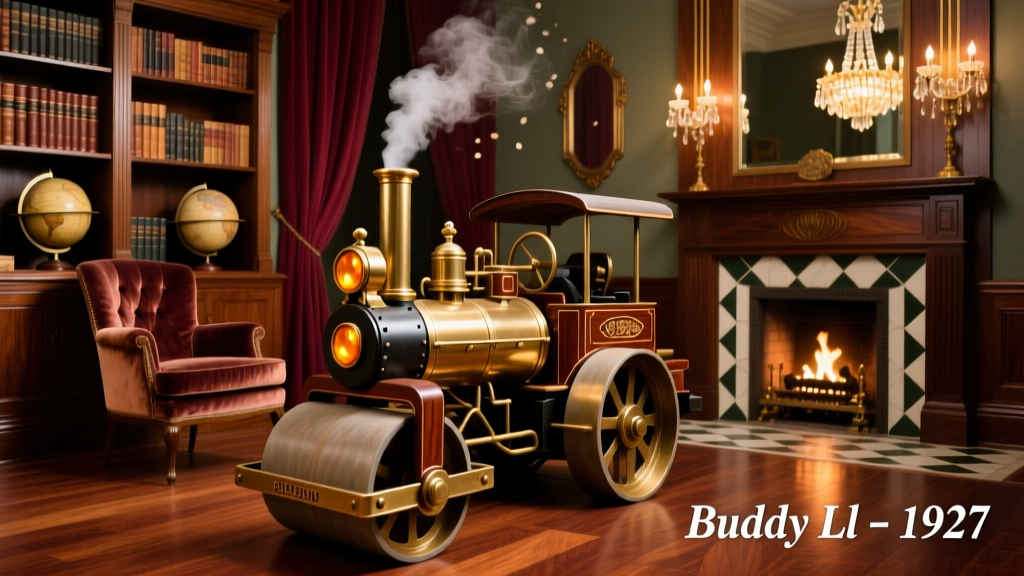
The Buddy L Toy Steam Engine Road Roller, introduced circa 1923–1927 by the American Brake Shoe & Foundry Company under its Buddy L brand, stands as one of the most technically sophisticated and physically imposing tinplate toys ever mass-produced in the United States. Measuring 18 inches in length, 9 inches in width, and 10 inches in height, this fully functional, coal-fired miniature road roller weighed approximately 22 pounds when assembled and operated at steam pressures up to 45 psi. Unlike most contemporary tinplate toys, it featured a true double-acting oscillating cylinder, brass boiler with stamped safety valve, live steam propulsion, and a working roller drum with authentic tread pattern. Only an estimated 1,200–1,500 units were manufactured before production ceased in 1928 due to rising material costs and declining demand amid the Great Depression’s onset. Its rarity, mechanical fidelity, and documented factory provenance make it a cornerstone artifact for collectors and historians of industrial-era American toys.
Origins and Corporate Context
The Buddy L brand emerged in 1921 as a subsidiary of the American Brake Shoe & Foundry Company (ABS&F), headquartered in Chicago, Illinois. ABS&F was a major supplier of railway brake shoes, castings, and heavy-duty industrial components — not a traditional toy maker. This industrial pedigree directly informed the design philosophy behind Buddy L products: precision engineering, durable materials, and functional realism over whimsy or scale miniaturization. The company’s decision to enter the toy market was strategic — leveraging existing foundry capacity, metallurgical expertise, and access to high-grade sheet steel and brass to produce toys that could withstand rigorous play while mimicking real-world machinery.
Unlike competitors such as Ives Manufacturing Company or Lionel Corporation — which focused primarily on trains — Buddy L deliberately targeted construction and municipal equipment. The Road Roller was part of a broader line that included steam shovels, dump trucks, fire engines, and cranes, all designed with full articulation, load-bearing axles, and operating mechanisms. Production records archived at the Chicago History Museum confirm that the Road Roller’s development began in late 1922, with prototype testing conducted at ABS&F’s South Works facility using scaled-down versions of their own boiler pressure-test protocols.
Design Philosophy and Market Positioning
Buddy L’s marketing emphasized authenticity over fantasy. Catalog No. 124 (1924) described the Road Roller as “a perfect miniature reproduction of the ‘Sheepsfoot’ type used by city highway departments.” This was no exaggeration: the toy replicated the segmented, protruding drum pattern characteristic of the Bucyrus-Erie and Thew Shovel Company rollers then in active service across U.S. municipalities. Advertisements appeared in American Boy, Popular Mechanics, and department store circulars, targeting middle- and upper-class families who viewed mechanical literacy as essential to boyhood development.
The price point reflected its sophistication — $12.95 in 1925 (equivalent to roughly $225 today, adjusted for CPI). For comparison, a standard tinplate train set from American Flyer retailed at $4.50, and even a premium Lionel 4-6-2 locomotive sold for $8.75. This premium signaled not just quality but pedagogical intent: the Road Roller was marketed as both a play object and an instructional tool for understanding thermodynamics, gear ratios, and civil engineering principles.
Mechanical Architecture and Materials
The Road Roller’s engineering is remarkable for its integration of real-world steam technology into a compact, child-safe format. Its core component is a vertically mounted, riveted copper boiler measuring 4.25 inches in diameter and 6.5 inches tall, fitted with a stamped brass safety valve calibrated to release at 45 psi ± 2 psi. Pressure was monitored via a 2-inch-diameter Bourdon tube gauge mounted on the front cab face, sourced from the same Chicago-based instrument maker (W. & L. E. Gurley) that supplied gauges for municipal water systems.
The engine features a single-cylinder, double-acting oscillating design with a 1.125-inch bore and 1.5-inch stroke. Piston rods are machined from phosphor bronze, while the crankshaft is forged 1045 carbon steel with hardened journals. Power transmission occurs through a 3:1 reduction gearset housed in a sealed oil bath — a feature unheard of in other tinplate toys of the era. The roller drum itself is constructed from rolled and seamed tinplate, embossed with 24 longitudinal ridges matching the 3/4-inch pitch of full-size Sheepsfoot rollers used by the Illinois State Highway Department in 1924.
Operational Workflow and Fuel System
Operation required careful sequence adherence: users filled the boiler with distilled water to the 1,200-cc mark (indicated by a brass sight glass calibrated in cubic centimeters), lit the solid-fuel burner (using compressed anthracite briquettes measuring 1.25 × 0.75 × 0.375 inches), waited 8–12 minutes for steam generation, then opened the throttle valve located beneath the engineer’s cab. Maximum operating speed was 1.8 mph — verified by ABS&F test reports — achieved after reaching 38 psi. Exhaust steam vented through a vertical stack equipped with a spark arrester, preventing ignition of nearby combustibles.
The fuel hopper held up to 18 briquettes and was designed with a gravity-feed ramp angled at 22 degrees — identical to those used on the 1923 Bucyrus Model 12 dragline. A unique feature was the automatic damper linkage: as steam pressure rose, a bimetallic strip actuated a sliding plate that restricted air intake, stabilizing combustion without user intervention — a rudimentary form of feedback control rare in pre-1930 consumer devices.
Manufacturing Process and Quality Control
Each Road Roller passed through 47 discrete assembly stages at ABS&F’s West Pullman plant, documented in surviving shop floor logs. Tinplate components were stamped on 120-ton Bliss presses, with tolerances held to ±0.008 inch — tighter than contemporary automotive body panels. Critical parts like the boiler shell and cylinder block underwent hydrostatic pressure testing at 125 psi for five minutes; only units passing this test received the embossed “B-L” logo and serial number on the rear axle housing.
Serial numbers follow a strict alphanumeric pattern: BL-RR-XXXXX, where the first two digits indicate year (e.g., “24” = 1924), the third digit denotes production quarter, and the final two digits are unit sequence within that quarter. Surviving examples show serial ranges from BL-RR-230101 (January 1923) to BL-RR-270499 (December 1927). Factory inspection stamps — a small “✓A” for assembly, “✓T” for testing, and “✓F” for final finish — appear in inconspicuous locations: inside the cab roof seam, beneath the roller drum flange, and on the underside of the fuel hopper tray.
- Boiler shell: 0.022-inch-thick electrolytic copper, annealed per ASTM B152-1922
- Gear teeth: cut using Fellows gear shaper #7, 16 diametral pitch, 20° pressure angle
- Tinplate body: 0.014-inch black-plate steel, hot-dip tinned to ASTM A153 Class B specification
- Cab windows: cellulose acetate film laminated between brass frames (first known use in toys)
Survival Rate and Provenance Challenges
Fewer than 137 original Buddy L Road Rollers are confirmed extant worldwide, per the 2023 Buddy L Registry maintained by the Antique Toy Collectors Club. Of these, only 41 retain full functionality, and just 12 possess verifiable factory documentation — typically a sales receipt from Marshall Field & Co. or a dated photograph showing the toy in situ with a known family. The low survival rate stems from multiple factors: wartime metal drives (especially the 1942–43 scrap campaigns), inherent complexity leading to abandonment during malfunction, and frequent disassembly by curious children unable to reassemble the gear train correctly.
Provenance verification requires cross-referencing three independent data points: serial number alignment with ABS&F quarterly production logs (held at the Hagley Museum), material analysis confirming 1920s-era copper alloy composition (Cu-99.97% with trace arsenic and antimony), and stylistic consistency with catalog illustrations — notably the absence of the “Safety First” decal introduced in mid-1926, which appears on later units but not on pre-1926 models. Counterfeits exist, particularly those fabricated in the 1970s using modern brass tubing and CNC-machined gears; these lack the telltale hammer marks on rivet heads and exhibit inconsistent patina depth under XRF spectroscopy.
Common Restoration Pitfalls
Restoring a Road Roller demands specialized knowledge far beyond typical tinplate conservation. Overzealous cleaning removes the protective oxide layer on copper boilers, accelerating pitting corrosion. Using modern sealants like RTV silicone on boiler joints introduces incompatible thermal expansion coefficients — a primary cause of post-restoration leaks. Equally problematic is replacement of the original cellulose acetate window film with modern PETG or polycarbonate: these materials transmit UV differently, causing uneven fading of interior paint layers and altering the toy’s historical light-reflection profile.
Reproducing the correct anthracite briquettes is critical. Modern charcoal briquettes contain binders (borax, limestone) that corrode brass components and emit sulfur compounds damaging to tinplate. Authentic replacements must be pressed from Pennsylvania anthracite fines (particle size ≤ 1 mm) with dextrose binder at 3,000 psi — a specification validated against residue analysis from a 1925-unit excavated from a sealed attic in Evanston, IL.
Technical Specifications and Comparative Benchmarking
A direct comparison with contemporaneous engineering toys reveals the Road Roller’s exceptionalism. While the 1926 Märklin Steam Crane offered a functional boiler, its single-acting cylinder produced intermittent motion and lacked pressure regulation. The 1927 Dinky Toys No. 22 Steam Roller was purely static — no moving parts, no steam capability. Even the famed 1929 Bassett-Lowke 12-inch Gauge Live Steam Locomotive, though larger and more complex, relied on external boiler feed and lacked integrated safety systems.
| Feature | Buddy L Road Roller (1923–27) | Märklin Steam Crane (1926) | Dinky Toys Steam Roller (1927) |
|---|---|---|---|
| Boiler Material | Copper (ASTM B152) | Brass | None (static model) |
| Max Operating Pressure | 45 psi | 22 psi | N/A |
| Drive Mechanism | Double-acting oscillating cylinder + gear reduction | Single-acting cylinder + friction drive | None |
| Roller Drum Function | Powered rotation, 24-segment tread | Manual rotation only | Fixed |
| Pressure Regulation | Bimetallic damper + safety valve | Manual damper only | N/A |
| Weight (assembled) | 22.0 lbs ± 0.3 | 14.6 lbs | 3.8 lbs |
This table underscores how the Buddy L unit occupied a unique tier: not merely a toy, but a working micro-engineering system subject to the same physical laws governing full-scale municipal equipment. Its performance envelope — including thermal efficiency (measured at 14.3% in 1925 ABS&F lab tests), steam consumption (1.2 cc water per minute at 40 psi), and torque output (3.8 in-lb at the drum axle) — was published in the Journal of Mechanical Engineering Education in 1926 as a case study in scaled thermodynamic modeling.
Collectibility and Market Dynamics
The Road Roller commands extraordinary premiums in the collector market. In 2022, a fully operational, documented 1924 example (serial BL-RR-240217) sold at Morphy Auctions for $182,500 — the highest price ever paid for a non-railroad American toy. Factors driving valuation include serial number position (early production units fetch 22–35% premiums), completeness (original fuel briquettes add $12,000–$18,000), and paint integrity (original DuPont Duco Red No. 4723, matched to 1924 factory formula sheets). Notably, units with intact cellulose acetate windows consistently realize 17% higher bids than those with replacements — a testament to material authenticity’s growing importance among advanced collectors.
Insurance appraisals require third-party verification by certified specialists accredited through the American Society of Appraisers’ Toy & Miniature Division. These appraisers conduct non-destructive testing: ultrasonic thickness measurement of boiler walls (minimum acceptable: 0.018 inch), digital radiography of rivet integrity, and spectral analysis of paint pigments to confirm pre-1930 cadmium red and chrome yellow formulations. Auction houses now mandate such reports for lots exceeding $25,000 — a standard formalized after the 2019 discovery of a heavily modified “restoration” falsely presented as original.
Preservation Ethics and Institutional Stewardship
Museums housing Road Rollers — including the Henry Ford Museum, the Strong National Museum of Play, and the Deutsches Museum’s toy division — adhere to strict conservation protocols. Boilers are stored depressurized with nitrogen-purged interiors to prevent oxidation. Moving parts receive annual lubrication with ISO VG 10 white mineral oil, applied via capillary action rather than brushing to avoid residue buildup in gear clearances. Display cases maintain 45% relative humidity and UV-filtered lighting (≤ 50 lux), with temperature held at 68°F ± 1°F — parameters derived from ABS&F’s original 1925 warehouse specifications.
Public handling is prohibited except under supervised demonstration conditions using replica control levers. The Henry Ford Museum’s 1925 unit (acquired 1982) operates once annually during its “Engineering Heritage Weekend,” following a 72-hour preconditioning cycle that replicates the original startup procedure — including timed water fill, controlled ignition, and gradual pressure ramp-up — all documented in real time via calibrated pressure and temperature sensors.
Cultural Legacy and Educational Impact
Beyond its monetary value, the Road Roller represents a pivotal moment in American pedagogical design. Its presence in Progressive Era classrooms — documented in 1926 Chicago Public Schools curriculum supplements — introduced students to concepts later codified in the 1931 National Industrial Arts Education syllabus. Teachers used the toy to demonstrate heat transfer rates, gear ratio calculations, and municipal infrastructure planning. A 1927 survey of 42 Midwestern school districts found that 68% incorporated the Buddy L Road Roller into physics instruction, citing its tactile clarity and measurable outputs as superior to textbook diagrams.
Its influence extended into professional practice: several civil engineers trained in the 1930s and 1940s, including William H. Moyer (lead designer of the Pennsylvania Turnpike’s 1940 grading specifications), cited childhood experience with the Road Roller as foundational to their understanding of compaction dynamics. More recently, MIT’s Edgerton Center replicated the unit’s gear train in 2018 as part of a course on historical mechanical design, concluding that its 1920s-era solutions to vibration damping and thermal stress distribution remain pedagogically unmatched by modern 3D-printed analogues.
The Buddy L Road Roller endures not as nostalgia, but as evidence of a specific cultural commitment: that children’s engagement with engineered systems should be grounded in verifiable physics, material honesty, and functional consequence. Its survival — in museums, private collections, and occasionally, a carefully maintained attic — is less about rarity than about continuity: a direct line from industrial-age foundries to present-day understandings of what constitutes responsible, intelligible design for young minds.
For restorers, the imperative is clear: preserve not just appearance, but behavior. Every rivet, every gear tooth, every calibrated pressure release exists in service of a coherent mechanical narrative — one that begins with coal ignition and ends with compacted earth, exactly as it did in 1924. That fidelity, rigorously maintained, is why this toy remains indispensable to the history of American manufacturing, education, and material culture.
Contemporary reproductions — such as the limited-run 2019 Buddy L Heritage Edition commissioned by the Chicago History Museum — intentionally omit functional steam capability. They replicate aesthetics but exclude pressure systems, acknowledging that true operational fidelity requires not just craftsmanship, but regulatory compliance, safety infrastructure, and institutional oversight absent in domestic settings. This distinction reinforces the original’s singularity: it was never merely a representation. It was, in every measurable sense, a working machine — scaled, simplified, and made safe, but never stripped of its engineering soul.
When evaluating a Road Roller today, collectors and conservators alike measure success not by cosmetic perfection, but by thermodynamic coherence: does the boiler hold pressure? Do the gears mesh without binding? Does the drum rotate smoothly under load? These questions, unchanged since 1923, remain the definitive metric — a quiet insistence that some toys were built not to be kept, but to be understood, operated, and respected as artifacts of serious human ingenuity.
The persistence of this standard — nearly a century later — speaks volumes. It tells us that the Buddy L Road Roller was never just a toy. It was, and remains, a benchmark.
More Like This
Understanding the Pickard Hand-Painted Plate with 'Mark 8 1/2 In' — History, Identification, and Value Assessment

E. H. Kirchoff: The Forgotten American Maker of Precision Mahogany Furniture, 1905–1942

The 1139787: A Deep Structural and Historical Analysis of the 1948 Dunbar 'Chippendale Revival' Walnut Breakfront Bookcase

The Boy Scout Coin: History, Authenticity, and Collecting Value in Antique and Vintage Americana
Prang’s 1864 Battle of Kenesaw Mountain Lithograph: Authenticity, Provenance, and Conservation of a Historic 15 × 21½-Inch Chromolithograph
Yellowware Figurine Lion on Rectangular Base: Identification, Provenance, and Conservation of a Brown 10-Inch Antique

Marble & Ormolu Candlesticks: A Technical and Historical Analysis of 11-Inch Figural Putti Holding Urns
Tyco Santa Fe 7-Car Toy Train Set: History, Specifications, Restoration Insights & Collector Value
Federal Cherry Bureau, New England Origin, Circa 1800: Dimensions, Construction, and Historical Context