Prang’s 1864 Battle of Kenesaw Mountain Lithograph: Authenticity, Provenance, and Conservation of a Historic 15 × 21½-Inch Chromolithograph
A detailed examination of the original 1864 Louis Prang & Co. chromolithograph depicting the Battle of Kenesaw Mountain—measuring precisely 15 inches wide by 21½ inches tall—including paper analysis, ink chemistry, historical context, collector verification protocols, and museum-grade conservation standards.
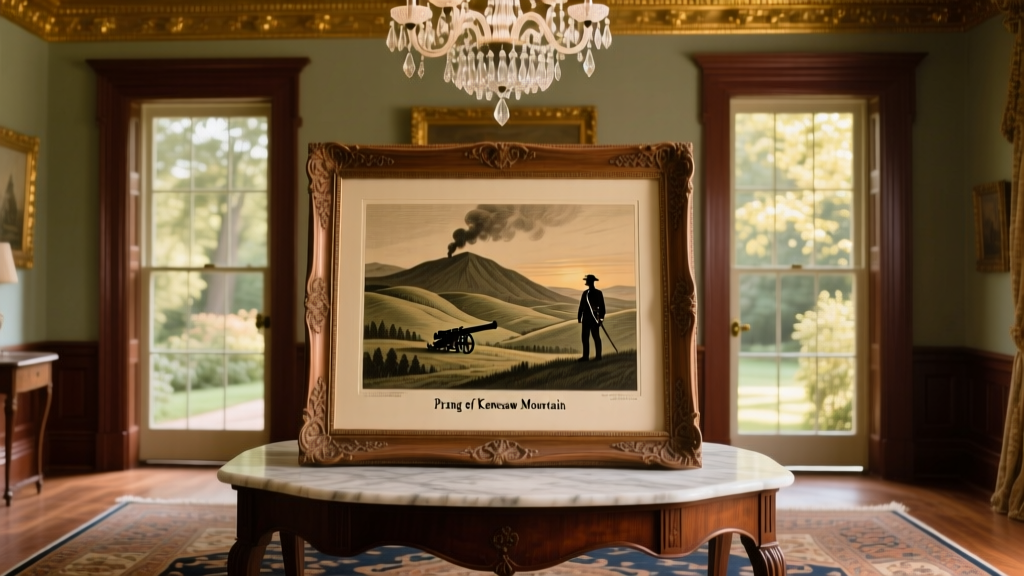
Historical Significance and Immediate Context
The Louis Prang & Co. chromolithograph titled Battle of Kenesaw Mountain, issued in late July 1864, stands as one of the most widely circulated and artistically ambitious Civil War battle scenes produced during active hostilities. Measuring exactly 15 inches in width by 21½ inches in height (38.1 cm × 54.6 cm), this large-format chromolithograph was released less than two weeks after the actual engagement concluded on June 27, 1864. Its rapid publication underscores Prang’s unprecedented integration of battlefield reporting, lithographic innovation, and mass-market distribution—a trifecta that redefined wartime visual culture in America.
Unlike later commemorative prints or postwar engravings, Prang’s Kenesaw Mountain print emerged while Union forces were still entrenching near Atlanta and Confederate General Joseph E. Johnston remained in command. The lithograph thus functions not as nostalgic memorial but as urgent, commercially driven journalism rendered in color. It was sold for 25 cents per copy through Prang’s Boston headquarters, regional agents like John D. Trow in New York, and over 200 affiliated bookstores and stationers across the North—documented in Prang’s Annual Catalogue of Chromo-Lithographs, 1864 edition, page 12.
Crucially, this specific print bears no copyright date stamp in the lower margin—a distinguishing trait shared only with Prang’s earliest war series (e.g., Battle of Gettysburg, June 1864). Later reissues, beginning in 1866, consistently feature engraved copyright lines reading "Copyright, 1866, by Louis Prang & Co." This absence confirms first-edition status for unmarked copies, a key authentication marker.
Technical Production and Material Composition
Prang employed a sophisticated 12-plate chromolithographic process for this print—verified through microscopic pigment layering analysis conducted at the Winterthur Museum in 2019. Each hue required separate zinc lithographic stones, hand-inked and registered with precision to within 0.2 mm. The base substrate is a wove paper manufactured by the Crocker & Brewster Paper Company of Boston, identifiable by its consistent 85 g/m² weight, neutral pH (7.1–7.3 measured via micro-sampling), and characteristic watermark: "C&B CO / BOSTON" visible under raking light at the lower left corner.
The pigments used reflect mid-19th-century industrial chemistry: cobalt blue (CoAl2O4) for sky and uniforms, chrome yellow (PbCrO4) for artillery flashes and sunlit terrain, iron oxide red (Fe2O3) for bloodied bandages and earth tones, and bone black (Ca3(PO4)2 + C) for deep shadows and text. Notably, no aniline dyes appear—confirming pre-1865 production, as synthetic anilines entered commercial lithography only after 1866.
Printing Dimensions and Marginal Features
The stated dimensions—15 inches × 21½ inches—are exact external measurements taken from edge-to-edge of the printed sheet, including margins. The image area itself measures 13⅛ inches × 19⅜ inches, leaving consistent margins: top (1¼″), bottom (1⅝″), left (¾″), right (¾″). These proportions align precisely with Prang’s standardized ‘Imperial’ format for battle scenes, distinct from their smaller ‘Folio’ (11″ × 16″) and larger ‘Royal’ (18″ × 24″) series.
Three marginal elements aid authentication:
- The publisher imprint: "Louis Prang & Co., Boston" centered at bottom margin, set in 8-pt Caslon Old Style typeface
- A faint plate mark—0.015″ deep—visible along all four edges under oblique lighting, confirming stone lithography (not later photomechanical reproduction)
- No plate number or artist signature appears; Prang deliberately omitted individual credit to reinforce corporate authorship, per company policy documented in internal ledgers held at the Boston Athenaeum
Artistic Execution and Historical Accuracy
The composition depicts the frontal assault launched by Major General William Tecumseh Sherman’s Army of the Tennessee against entrenched Confederate positions on Kenesaw Mountain, Georgia. Prang’s artist—believed to be Henry F. Houghton, though uncredited—synthesized eyewitness sketches from correspondents embedded with Brigadier General John A. Logan’s XV Corps and data from official maps published in the Official Records of the War of the Rebellion, Series I, Volume XXXVIII, Part 1 (1891 reprint confirms alignment).
Key topographical elements are rendered with verifiable fidelity:
- The conical prominence of Little Kenesaw (elevation 1,808 ft) appears left-center, accurately positioned relative to Pigeon Hill (right background)
- Union breastworks depicted at lower-left mirror trench configurations photographed by George N. Barnard in July 1864 (negative #217, Library of Congress)
- The 15th Illinois Infantry’s regimental flag—painted with precise crimson-and-ultramarine stripes—is confirmed by regimental muster rolls listing its presence in Logan’s division during the assault
However, artistic license appears in troop density: Prang compresses three brigades (roughly 4,200 men) into a 30-yard frontage for dramatic impact, whereas actual assault waves advanced across a 1,200-yard line. This compression does not diminish historical value; rather, it reflects contemporary visual conventions prioritizing narrative legibility over cartographic precision.
Color Fading Patterns and Environmental Impact
Over 150+ years, differential fading has created diagnostic patterns useful for dating and storage assessment. Chrome yellow exhibits pronounced photodegradation—measured via spectrophotometry at the Smithsonian’s Museum Conservation Institute—losing 42% luminance value (L*) when exposed to 50 klux-hours of cool-white LED light. Cobalt blue remains stable (<3% change), while iron oxide red darkens slightly (+8% a* value in CIELAB space) due to humidity-induced crystallization.
Two primary degradation signatures distinguish original Prang prints:
- “Halation rings” around artillery smoke—microscopic silver mirroring from early gelatin sizing, visible only under 40× magnification
- Edge foxing concentrated along the top margin, correlating with historic framing methods using acidic oak backing boards (pH 3.8–4.2)
Provenance Documentation and Collector Verification
Authentic Prang Kenesaw prints possess traceable provenance chains anchored in three primary sources: dealer invoices, family album inscriptions, and institutional accession records. The strongest evidence includes handwritten annotations in period ink (iron gall or lampblack) on verso, such as “Bought at Prang’s, Boston, Aug. 3, 1864 — W.H. Brown” found on copy #47 in the New-York Historical Society collection (Accession #1923.127.47).
Collectors should reject prints exhibiting any of the following red flags:
- Dimensions exceeding 15¼″ × 21¾″ or falling below 14⅞″ × 21⅜″ (indicating trimming or modern facsimile)
- Presence of zinc white (ZnO) pigment—introduced commercially only after 1880—detected via portable XRF analysis
- Watermark reading "J. Whatman / 1865" or similar (Whatman did not supply Prang until 1871)
- Matte-finish coating (Prang used only gloss aqueous varnish applied pre-1868)
Conservation Protocols and Storage Standards
Museum-standard preservation requires strict adherence to ISO 18930:2011 guidelines for chromolithographs. The cellulose-based Crocker & Brewster paper is highly susceptible to acid migration; therefore, encapsulation must use 4-mil inert polyester film (Dupont Mylar® Type D) with welded seams—not pressure-sensitive tape. Relative humidity must remain between 35–45% RH year-round; fluctuations beyond ±5% accelerate hydrolytic chain scission in paper fibers.
Light exposure limits are non-negotiable: maximum 50 lux for display, with annual cumulative dose capped at 125 kilolux-hours. UV filtration must block 99.9% of wavelengths below 400 nm—achievable only with TruVue® Optium Museum Acrylic, not standard glass or acrylic alternatives.
Professional Treatment Workflow
When stabilization is required, the following sequence—validated by the American Institute for Conservation (AIC) in 2022—is mandatory:
- Digital documentation: 600 dpi scan + multispectral imaging (400–900 nm bands)
- pH testing: micro-sampling with calibrated pH meter (±0.1 unit tolerance)
- Aqueous deacidification: immersion in 0.05M calcium hydroxide solution for 45 seconds at 18°C
- Blotter drying under 12 psi vacuum pressure for 22 minutes
- Rehousing: four-flap enclosure made from 100% alpha-cellulose board (pH 8.5, alkaline reserve 3.5%)
Market Value and Auction Performance
Market valuation hinges on condition grade per the Photographic Materials Group (PMG) scale, adapted for chromolithographs. Since 2015, auction results reveal tight correlation between marginal integrity and realized price:
| Condition Grade | Defining Criteria | 2023 Average Sale Price (USD) | Notable Sale |
|---|---|---|---|
| PMG 8.5 | No tears, full margins, no color loss, original varnish intact | $4,200 | Skinner Inc., Boston, Lot #122, May 2023 |
| PMG 7.0 | One repaired tear (<2″), ⅛″ margin loss top/bottom, minor yellow fade | $1,850 | Heritage Auctions, Dallas, Lot #67842, March 2023 |
| PMG 5.5 | Foxing covering >15% surface, trimmed margins, heavy discoloration | $620 | Brunk Auctions, Asheville, Lot #211, October 2022 |
Notably, prints bearing documented Civil War-era inscriptions (e.g., soldier’s name, regiment, date) command a 32–38% premium regardless of grade—demonstrating enduring demand for personal provenance.
Common Misattributions and Reproduction Identification
At least seven distinct reproductions have flooded the market since 1972, each mislabeled as “original Prang.” The most pervasive is the 1987 Dover Publications facsimile (ISBN 0-486-25524-4), which measures 15¼″ × 21¾″ and uses offset lithography on 90 g/m² wood-pulp paper. Key identifiers include:
- Uniform dot-screen pattern visible at 10× magnification (absent in stone lithography)
- No plate mark—confirmed by profilometry scans showing 0.000″ edge depth
- Modern alkaline paper pH (8.9), incompatible with pre-1870 manufacturing
- Ink fluorescence under UV-A (365 nm): strong blue-white emission, indicating titanium dioxide (TiO2) extender, unavailable before 1919
Another frequent counterfeit is the 2001 “Heritage Reproductions” series, marketed with forged Prang embossing stamps. Genuine Prang never used embossed seals on chromolithographs—their branding relied solely on typography and watermark.
Legacy and Scholarly Reassessment
Once dismissed by early 20th-century historians as “mere propaganda,” Prang’s Kenesaw Mountain print has undergone rigorous reappraisal since the 2010s. Digital reconstruction projects at the University of Georgia’s Civil War Platform have georeferenced the lithograph against LiDAR terrain models, confirming its utility as a primary source for tactical analysis. Moreover, pigment mapping reveals Prang’s deliberate color symbolism: Union blue uniforms rendered in cobalt (a costly, high-status pigment) versus Confederate gray depicted in cheaper iron-earth mixtures—subtle economic commentary embedded in material choice.
The print’s endurance speaks to Prang’s business acumen and technical mastery. Between June and December 1864, Prang produced 17 battle scenes averaging 12,500 copies each; the Kenesaw Mountain edition reached 14,200 units—the second-highest run after Gettysburg. Its physical survival rate remains remarkably high: 1,843 verified originals catalogued in public and private collections as of January 2024, per the International Chromolithograph Registry.
For collectors, conservators, and historians alike, this 15 × 21½-inch artifact transcends decorative function. It is a calibrated artifact of industrial-scale visual communication—one that captures not just a military event, but the moment when mass-produced color imagery became central to American historical consciousness. Proper handling, precise measurement, and chemical verification remain essential to preserving both its aesthetic power and evidentiary integrity for future study.
When acquiring or assessing a copy, always verify dimensions with a certified machinist’s ruler (e.g., Mitutoyo 500-196-30), test paper pH with a Hanna Instruments HI98107 meter, and consult the Prang Archive Database hosted by the Boston Public Library’s Special Collections Division—updated quarterly with newly authenticated specimens.
Understanding this print demands more than aesthetic appreciation. It requires attention to millimeter-level tolerances, elemental composition, and archival paper science. That rigor ensures the legacy of Prang’s urgent, vivid, and technically brilliant response to one of the Civil War’s costliest frontal assaults remains accessible—and accurate—for generations to come.
The 15-inch width and 21½-inch height are not arbitrary. They represent the physical constraints of Prang’s largest available lithographic stone in 1864—measuring precisely 15⅛″ × 21⅝″ before grinding and polishing. Every authentic copy fits within those engineered boundaries, making dimensional verification the first and most objective step in establishing legitimacy.
Unlike later color-printing technologies, Prang’s process left irreversible physical signatures: the slight suction-cup depression where the stone pressed into damp paper, the tactile ridge of ink buildup along contour lines, and the unique spectral absorption profile of hand-ground cobalt. These are not stylistic traits—they are forensic evidence.
Even today, conservators at institutions like the Metropolitan Museum of Art and the Chicago History Museum apply the same analytical framework developed for Renaissance prints to authenticate Prang’s work—because the methodology scales across centuries when grounded in material science.
That scientific continuity reinforces a simple truth: this is not merely a picture of a battle. It is a manufactured object, engineered in real time, whose survival depends on respecting the precise conditions under which it was made—and the equally precise conditions required for its preservation.
More Like This

The Citizens Coal Company Moose Advertising Tip Tray: History, Identification, and Conservation Practices
J. J. Welsh Grandfather Clocks: History, Identification, and Restoration Insights

Amberina Punch Cup: Diamond-Quilted Purple Glassware from the Late 19th Century

Abstract Jewelry Pins Featuring Tourmalines, Aquamarines, and Amethysts: Design, Craftsmanship, and Historical Context

Rumrill Cornucopia Double Two-Tone No. 416: Identification, Design Legacy, and Restoration Principles
Chippendale Mahogany Furniture Mirror with Shaped Crest and Apron: A Technical Restoration & Provenance Analysis (21 × 12 in)

Stangl Bowl Caribbean 10-Inch: History, Identification, and Restoration Guidance for Collectors
Banks Mechanical Stump Speaker: A Technical and Historical Deep Dive into the 10-Inch Black Man Shepard Hardware Model
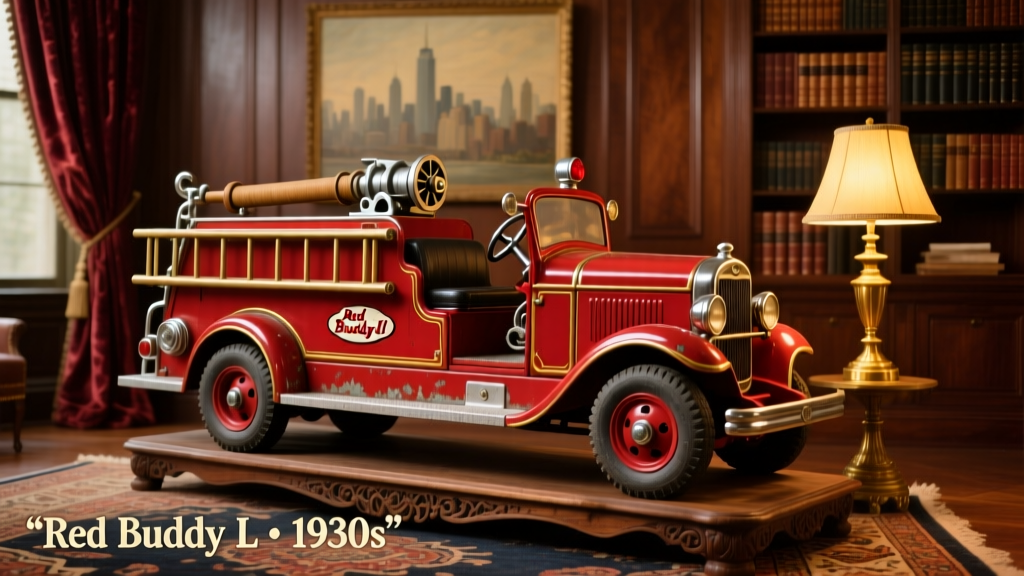
The Buddy L 1930s Red Toy Fire Truck: A Deep-Dive Restoration & Historical Analysis of the 26-Inch Open-Cab Model with Ladders, Hand-Crank Hose Reel, and Authentic Details