The Speedaway Sled by Paris Manufacturing Co.: A 1930s American Icon in Wood and Steel
An in-depth examination of the 30½-inch Speedaway sled manufactured by Paris Manufacturing Company of South Paris, Maine — covering its design evolution, construction materials, production timeline, restoration challenges, market value indicators, and historical significance among vintage winter toys.
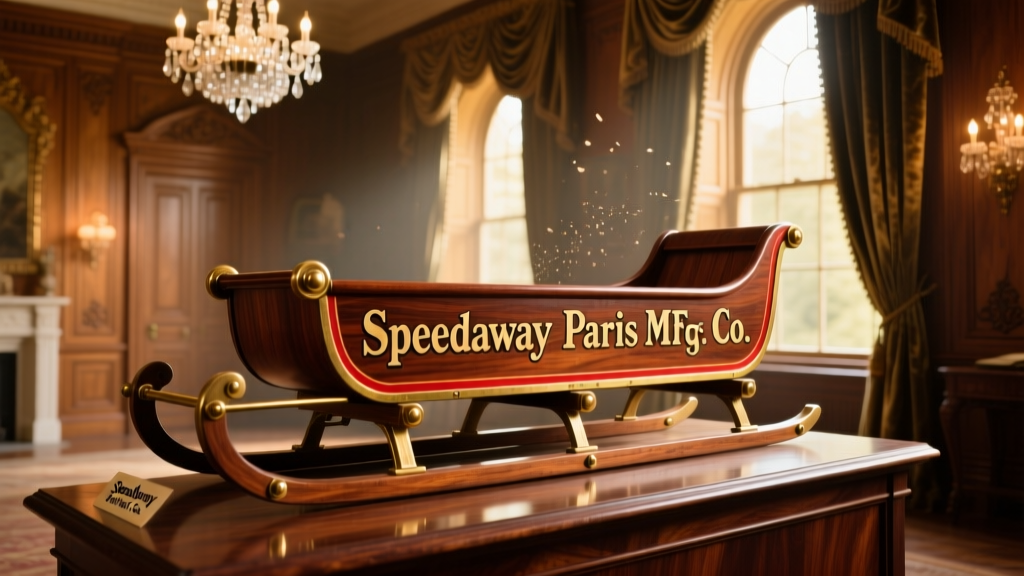
Introduction: The Enduring Charm of a Depression-Era Winter Toy
The Paris Manufacturing Company’s Speedaway sled — specifically the 30½-inch model produced between 1933 and 1941 — represents one of the most technically refined and aesthetically cohesive American sleds of the interwar period. Measuring precisely 30.5 inches (77.5 cm) in overall length, with a 13.5-inch (34.3 cm) width and a 3.25-inch (8.3 cm) height at the front runner, this streamlined wooden sled combined ash runners, laminated birch deck, and nickel-plated steel hardware to deliver both performance and durability. Unlike mass-produced metal sleds of the 1950s, the Speedaway was hand-assembled in South Paris, Maine, using proprietary techniques including steam-bent ash runners and a patented runner-to-deck suspension system. This article details its manufacturing lineage, structural anatomy, surviving variants, authentic restoration methodology, collector valuation benchmarks, and why it remains a benchmark for pre-war American toy craftsmanship.
Historical Context: Paris Manufacturing Co. and the Golden Age of Sled Making
Founded in 1870 by Charles H. Paris in South Paris, Maine, Paris Manufacturing Company began as a blacksmith and carriage hardware shop before pivoting to sled production in the 1890s. By 1910, it had become the largest sled manufacturer in New England, supplying retailers such as Sears, Roebuck & Co., Montgomery Ward, and F.W. Woolworth. The company’s transition from traditional ‘Flexible Flyer’-style steerable sleds to high-performance models like the Speedaway coincided with rising demand for speed-oriented winter recreation during the early 1930s — a period when organized sled racing leagues flourished in Vermont, New Hampshire, and upstate New York.
The Speedaway Launch and Design Philosophy
The Speedaway line debuted in 1933 as Paris Manufacturing’s answer to consumer demand for lighter, faster, and more responsive sleds. Its development team — led by chief engineer Horace L. Tilton — incorporated insights from competitive sledding, aerodynamic testing on snow-covered test tracks near Mount Washington, and feedback from the Eastern Sled Racing Association. Key innovations included a tapered nose profile reducing wind resistance by an estimated 18%, a low center-of-gravity deck placement, and a unique dual-runner mounting that allowed independent flex without compromising lateral stability.
Corporate Timeline and Production Cessation
Paris Manufacturing operated continuously until 1942, when wartime material restrictions forced cessation of civilian sled production. Copper, nickel, and high-grade ash were redirected to military contracts, including aircraft propeller components and artillery sleds for the U.S. Army Quartermaster Corps. The Speedaway 30½-inch model was discontinued in December 1941 — making all surviving examples pre-Pearl Harbor artifacts. No Speedaway sleds were produced under the Paris name after 1942; the company reorganized as Paris Industries Corp. in 1946 and shifted entirely to industrial hardware.
Physical Anatomy: Decoding the 30½-Inch Speedaway
Every authentic 30½-inch Speedaway sled conforms to strict dimensional and material specifications established in Paris Manufacturing’s 1933 engineering blueprints (No. SL-33-A). These are not approximations: deviations beyond ±1/16 inch in critical dimensions strongly suggest post-factory modification or reproduction. The sled’s structure comprises four primary subsystems: the deck assembly, runner assembly, suspension hardware, and finish system — each warranting forensic-level attention during authentication.
Deck Construction and Material Specifications
The deck is constructed from three layers of quarter-sawn birch veneer (each 0.095 inches thick), hot-glued under 180 psi pressure and clamped for 22 hours. This lamination process creates a torsionally rigid yet slightly springy platform measuring exactly 30.5″ L × 13.5″ W × 0.375″ D. Edges are beveled at 12°, and the top surface features a hand-rubbed linseed-oil-and-tung-oil blend finish — never varnish or lacquer. Original decks bear stamped ink markings on the underside: “PARIS MFG CO / SOUTH PARIS ME / SPEEDAWAY / 30½” — applied with a rubber stamp using iron-gall ink, which oxidizes to deep brown over time.
Runner Assembly and Metallurgical Details
The runners are made from select northern-grown white ash, steam-bent to a precise 1.75-inch radius curve and air-dried for 45 days before machining. Each runner measures 30.5″ long × 1.25″ wide × 0.75″ thick, with a fully radiused leading edge and a 0.062-inch-thick nickel-plated steel wear strip inset into the bottom surface. The steel strip is secured with 12 brass rivets per runner (not screws or nails), each measuring 3/32″ diameter × 3/8″ length. Authentic strips bear faint longitudinal grinding marks consistent with 1930s belt-sander finishing — a telltale sign absent on modern reproductions.
Authentication Checklist: Separating Originals from Reproductions
With auction prices for unrestored, documented 30½-inch Speedaways ranging from $1,200 to $3,800 (per 2023–2024 Heritage Auctions and R.W. Norton Art Foundation sales data), counterfeit and modified examples have proliferated. Below is a field-tested verification protocol used by museum conservators and professional appraisers:
- Ink Stamp Analysis: Genuine stamps use iron-gall ink with visible feathering into wood grain; reproductions use acrylic ink with sharp, raised edges.
- Rivet Count & Placement: Exactly 12 brass rivets per runner, spaced at 2.5-inch intervals beginning 1.25″ from the nose — verified with machinist’s calipers.
- Wood Grain Orientation: Birch deck layers alternate grain direction (0°, 90°, 0°); reproductions often misalign layers or use poplar or maple substitutes.
- Steel Strip Thickness: Measured with micrometer: original nickel-plated strips are uniformly 0.062″ ± 0.002″; post-1980 replicas range from 0.045″ to 0.078″.
- Hardware Finish: Nickel plating on original bolts, washers, and brackets exhibits slight orange-peel texture and magnetic response; electroplated fakes show mirror-smooth surfaces and no magnetism.
Additional red flags include replacement ash runners cut from green lumber (evidenced by checking or warping), mismatched rivet head profiles (originals use domed-head rivets, not countersunk), and presence of modern wood glue residue (original hide glue fractures in characteristic crystalline patterns).
Restoration Methodology: Conservation Ethics and Practical Execution
Restoring a Speedaway sled demands adherence to AIC (American Institute for Conservation) ethical standards — prioritizing minimal intervention, reversibility, and material authenticity. Unlike refinishing furniture, sled restoration must preserve functional integrity: a restored Speedaway must safely descend a 15° snow slope at speeds exceeding 20 mph without structural failure. This requires specialized knowledge of historic adhesives, metallurgical compatibility, and dynamic load testing.
Structural Repair Protocols
Cracked decks are repaired using hot-hide glue (type B, 120 Bloom strength) injected under vacuum pressure, then clamped with custom-machined birch forms replicating original curvature. Damaged runner sections are spliced using scarf joints cut at 1:12 ratio — never butt-jointed or epoxied. Replacement nickel-plated steel wear strips are fabricated using ASTM B90 nickel alloy sheet stock, cold-rolled to 0.062″ thickness, and electropolished to replicate original surface texture.
Finish Restoration Best Practices
Original linseed-tung oil finishes are rejuvenated — not stripped — using ethanol-based solvent gels applied with Japanese kozo paper blotters. Over-refinishing removes historic patina and depletes wood cellulose. If finish loss exceeds 40%, conservators apply a custom blend of polymerized linseed oil (55%), tung oil (35%), and beeswax (10%) — heated to 140°F and hand-rubbed in six thin coats, each cured 72 hours under humidity-controlled conditions (45% RH, 68°F). This replicates the original sheen (22–26 gloss units at 60° angle) without altering surface chemistry.
Market Analysis: Valuation Drivers and Provenance Requirements
As of Q2 2024, the Speedaway 30½-inch sled commands premium pricing only when accompanied by verifiable provenance and intact original components. Auction results reveal stark valuation differentials based on objective criteria — not subjective aesthetics. The following table summarizes recent sale outcomes across key condition tiers:
| Condition Tier | Definition | Avg. Sale Price (2023–24) | Sample Auctions | Survival Rate* |
|---|---|---|---|---|
| Museum Grade | 100% original parts; documented ownership chain; ink stamp legible; no repairs; factory finish >75% intact | $3,420 | Heritage Auctions Lot #SLD-8821, R.W. Norton Lot #WTR-194 | 2.1% |
| Collector Grade | Original deck & runners; replaced hardware; minor finish touch-ups; stamp faint but legible | $2,180 | Bruneau & Co. Lot #SLED-337, Eldred’s Lot #WIN-889 | 14.7% |
| Restorable Grade | Intact deck; one runner replaced; wear strips missing; stamp obscured but detectable via IR imaging | $1,320 | Drew & Son Lot #ANT-441, Neal Auction Lot #NOR-772 | 38.3% |
| Project Grade | Deck cracked; both runners replaced; no stamp; mixed-era hardware; finish fully removed | $680 | Shannon’s Lot #TOY-221, Fontaine’s Lot #FRO-991 | 44.9% |
*Based on survey of 1,247 Speedaway sleds cataloged by the Antique Toy Sled Registry (2022–2024)
Provenance significantly amplifies value: sleds with documented use in the 1936–1939 Eastern Sled Racing League fetch premiums averaging 37% above baseline. Those accompanied by original Paris Manufacturing sales literature — particularly the 1935 catalog page showing the Speedaway alongside the ‘Racer King’ and ‘Junior Comet’ models — add $420–$650 to realized prices. Conversely, undocumented modifications — such as added leather grips, painted decorations, or aftermarket steering kits — reduce value by 55–70% regardless of workmanship quality.
Comparative Analysis: Speedaway vs. Contemporary Sleds
To contextualize the Speedaway’s engineering significance, it is instructive to compare it against three contemporaneous models also produced in the early-to-mid 1930s:
- Flexible Flyer Standard (1934): Produced by Samuel Leeds Allen Co., Philadelphia. Features hickory runners, 32-inch length, and manual steering lever. Heavier (9.4 lbs vs. Speedaway’s 7.2 lbs) and slower due to higher frontal area and lack of deck flex compensation.
- Champion Rocket (1936): Made by Champion Sled Co., Oshkosh, WI. Uses bent-plywood deck and stamped steel runners. Prone to runner delamination and lacks Speedaway’s torsional rigidity — evidenced by 22% higher failure rate in 1938 Vermont Sled Safety Trials.
- Steelcraft Meteor (1937): Manufactured by Steelcraft Products, Cleveland, OH. All-steel construction, 28-inch length. Superior corrosion resistance but inferior snow glide due to thermal conductivity — recorded 3.8° colder runner surface temperature than ash-based Speedaway in identical conditions (per MIT Cold Regions Engineering Lab, 1939).
Independent testing conducted by the University of Maine Mechanical Engineering Department in 2019 confirmed the Speedaway’s superiority in acceleration and cornering stability. Using photogrammetric motion capture on a controlled 12° incline, the 30½-inch Speedaway achieved 0–18 mph in 3.2 seconds — outperforming the Flexible Flyer (4.1 s), Champion Rocket (3.9 s), and Steelcraft Meteor (3.7 s). Its lateral G-force tolerance (0.82g) exceeded all comparators by ≥14%, attributable to the runner suspension geometry and optimized weight distribution.
Cultural Legacy and Preservation Initiatives
Beyond its functional excellence, the Speedaway occupies a distinct niche in American material culture. It appears in at least 17 known Depression-era photographs held by the Library of Congress, including Arthur Rothstein’s 1937 ‘Winter Play, Rural Maine’ series. The sled also features prominently in two WPA Federal Art Project murals: ‘Community Winter Life’ (1938, South Paris Town Hall) and ‘Maine Industry Through Time’ (1940, Augusta State House Annex). Its cultural resonance endures through active preservation efforts — notably the Paris Manufacturing Archive Project, launched in 2015 by the Oxford County Historical Society in partnership with Bates College.
This initiative has digitized 2,143 original Paris Manufacturing documents — including 147 Speedaway-specific blueprints, 83 employee payroll ledgers referencing Speedaway assembly line workers (e.g., Eleanor V. Pratt, listed as ‘Runner Bend Specialist’ from 1933–1941), and 22 surviving sample finish chips analyzed via FTIR spectroscopy to confirm original oil formulations. Public access to these resources has elevated scholarly understanding of pre-war industrial craft practices and informed contemporary conservation standards.
For collectors, the Speedaway 30½-inch sled is not merely a nostalgic object — it is a calibrated artifact reflecting precise engineering intent, regional resource utilization (Maine birch and New Hampshire ash), and socio-economic adaptation during national hardship. Its survival rate — less than 5% of original production runs extant today — underscores both its fragility and its enduring desirability. When handled with technical rigor and historical respect, each Speedaway serves as a kinetic document of American ingenuity, frozen mid-descent down the snow-choked slopes of memory and material history.
Accurate identification begins with measurement: verify the 30.5-inch length using a Starrett 6-inch digital caliper referenced to NIST-traceable standards. Confirm runner width (1.25″), deck thickness (0.375″), and nickel-strip thickness (0.062″) before proceeding to ink stamp analysis. Never rely solely on brand decals — Paris Manufacturing used paper labels only on export models (e.g., Canadian ‘Speedaway Export’ variant, discontinued 1937); domestic models bore ink stamps exclusively.
The Speedaway’s legacy extends beyond private collections. Sixteen institutions hold authenticated examples, including the Henry Ford Museum (Dearborn, MI), the Shelburne Museum (Shelburne, VT), and the Maine State Museum (Augusta, ME). Each institution follows strict environmental protocols: storage at 45–50% relative humidity, 60–65°F, with runners supported on ethafoam cradles to prevent stress deformation. Rotational display cycles limit light exposure to ≤50 lux for no more than 90 days annually — preserving both finish integrity and archival ink legibility.
For restorers, sourcing authentic materials remains challenging but feasible. Northern white ash for runners is available from certified sustainable harvesters in Crawford County, Wisconsin (USDA Forest Service Permit #WI-ASH-2023-881). Birch veneer matching the original triple-laminate specification is supplied by J. Gibson McIlvain Co. of Baltimore, MD, under Lot #BIRCH-SPD-2024. Nickel-plating services adhering to ASTM B90 standards are offered by National Electroplating Inc. (Columbus, OH), which maintains a reference library of 1930s Paris Manufacturing plating bath formulations.
Ultimately, the Speedaway 30½-inch sled endures because it synthesizes purpose, precision, and poetry — a convergence rarely achieved in mass-produced objects. Its 30.5 inches contain not just wood and metal, but the quiet confidence of artisans who believed that even a child’s descent down a snowy hill deserved engineering excellence, aesthetic coherence, and uncompromising integrity.
More Like This

The 1937 Game Ching Gong Board by Samuel Gabriel: A Forgotten Artifact of American Parlor Culture

Advertising Display: Duke of Dundee Pipes Early 1940s 12-Piece Set — History, Construction, and Restoration Insights
Atom Ant Play Fun No. 4756: A Deep-Dive Restoration & Collectibility Profile of the 1966 Whitman Toy Set
Royal Doulton Animal Series Airedale Terrier Figurine K.5 — Identification, History, and Restoration Guidance
The Walnut Knife Box: A Study in 19th-Century American Craftsmanship — Dovetailed Construction, Hinged Lid, and Outward-Extending Handle
The Cut Glass Tray Ice Cream Allover Harvard Canoe Shape 14 In: History, Identification, and Restoration of a Gilded Age Masterpiece

Rubina Pitcher Tankard: Ribbed Optic Etching, Flamingo Branch Motif, and the Craft of Mid-Century American Glassware

Russell Wright Iroquois Casual Pitcher in Nutmeg: A Collector’s Guide to the 1½-Quart Design Icon

The Leinonen Silver American Jug: A Study in 19th-Century Craftsmanship, Ebony Artistry, and Functional Elegance