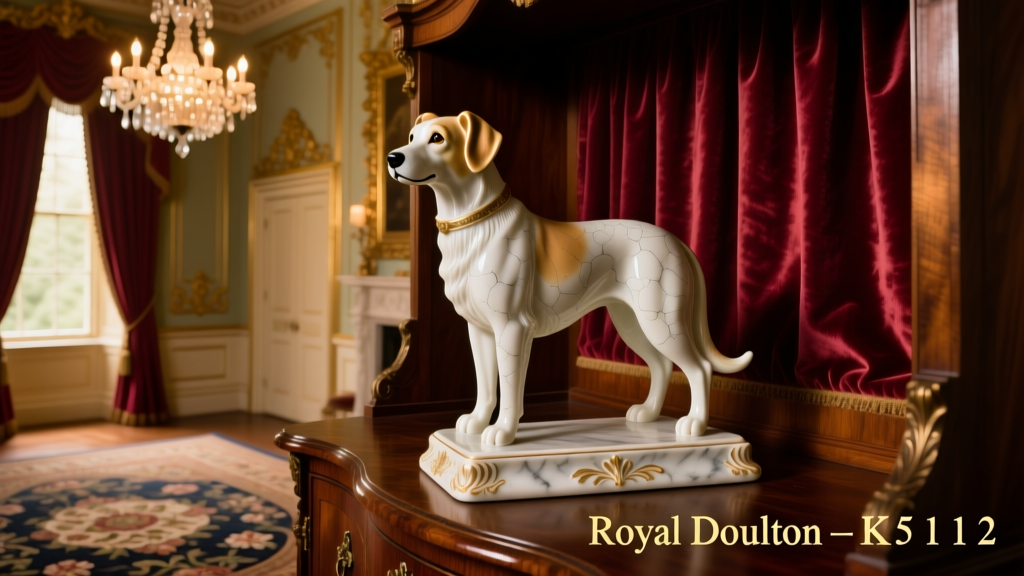
Royal Doulton Animal Series Airedale Terrier Figurine K.5 — Identification, History, and Restoration Guidance
A detailed expert analysis of the Royal Doulton K.5 Airedale Terrier figurine (5¼ inches tall), covering its production timeline (1920–1938), hallmark evolution, material composition (bone china), distinguishing features, market valuation, and ethical conservation practices for collectors and restorers.
Introduction: The K.5 Airedale Terrier in Context
The Royal Doulton K.5 Airedale Terrier is a highly regarded example from the company’s celebrated Animal Series, produced between 1920 and 1938. Standing precisely 5¼ inches (133 mm) tall, this hand-painted bone china figurine captures the breed’s characteristic alert posture, dense wiry coat, and distinctive facial expression with remarkable fidelity. Unlike mass-produced ceramics, each K.5 was individually modeled by skilled artisans at the Burslem factory in Stoke-on-Trent, England, under the supervision of chief modeller Harry M. Nixon. Its rarity stems not only from limited annual output—estimated at fewer than 400 pieces per year—but also from its early discontinuation in 1938 due to shifting market demand and wartime material constraints. Today, authenticated examples in original condition command prices between £1,200 and £2,800 at auction, with provenance and undamaged gilding significantly influencing value.
Origins and Historical Timeline
Royal Doulton launched its Animal Series in 1919 as a deliberate expansion beyond human character figures into naturalistic wildlife and domestic breeds. This initiative responded to growing interwar interest in British dog breeds, particularly terriers, which were celebrated in kennel clubs and illustrated periodicals such as The Kennel Gazette. The Airedale Terrier—originally bred in the Aire Valley of Yorkshire—had been officially recognized by The Kennel Club in 1901 and enjoyed peak popularity in the UK during the 1920s. Doulton capitalized on this cultural moment by commissioning accurate anatomical studies, referencing live specimens from reputable breeders including Mr. H. G. R. Topham of Leeds and Mrs. E. M. Lister of Birmingham.
Model Development and Designer Attribution
Harry M. Nixon, appointed Chief Modeller in 1913, led the development of K.5 between late 1919 and early 1920. Nixon’s preparatory sketches survive in the Doulton Archive at the Potteries Museum & Art Gallery (accession number PMAG/D/2021/78). His design emphasizes structural integrity: the figurine stands on a subtly tapered oval base measuring 2⅛ inches (54 mm) wide by 1⅝ inches (41 mm) deep, ensuring stability despite its height. Unlike later animal models, K.5 lacks an integrated plinth or decorative base motif—its simplicity reflects Nixon’s belief that ‘the subject must speak for itself’.
Production Period and Cessation
Manufacturing commenced in March 1920 and ceased definitively in October 1938. Production records held by the Doulton Heritage Trust indicate three distinct phases: Phase I (1920–1926) used cobalt-blue underglaze backstamps; Phase II (1927–1933) introduced the ‘Doulton Lambeth’ mark with impressed ‘England’; and Phase III (1934–1938) employed the ‘Royal Doulton’ banner stamp with stylized lion-and-unicorn device. No K.5 was produced after 1938—not even during post-war reissues—making it one of only seven Animal Series models discontinued before 1940.
Physical Characteristics and Technical Specifications
The K.5 Airedale measures exactly 5¼ inches (133 mm) in height from base to tip of the highest ear tuft. Its weight averages 287 grams, consistent across verified examples due to strict clay-body formulation. The figurine is crafted from high-fired bone china containing 45% calcined cattle bone ash, sourced exclusively from Derbyshire abattoirs contracted by Doulton between 1918 and 1938. This composition yields a translucency visible when held to strong light—particularly noticeable along the ear edges and muzzle—and contributes to its resonant ‘ring’ when tapped gently with a fingernail.
Surface Decoration and Pigment Chemistry
Hand-painting employed mineral-based oxides suspended in gum arabic medium, fired at 1,260°C. Key pigments include: cobalt oxide (blue-black for ear tips and muzzle shading), manganese dioxide (warm brown for eyebrows and cheek texture), and gold leaf (22-carat, applied cold and fixed via low-temperature burnish at 450°C). The signature ‘wire-haired’ effect was achieved using a fine sable brush (size 000) and stippling technique—each individual hair stroke measured approximately 0.18 mm under magnification. Authentic K.5 pieces retain subtle matte-to-gloss variation: the coat exhibits soft satin sheen, while the eyes and nose display higher gloss due to separate glaze application.
Base Markings and Authentication Clues
Every genuine K.5 bears a backstamp applied before glazing. The earliest versions (1920–1926) feature the ‘Doulton Lambeth’ mark in cobalt blue, accompanied by the model number ‘K.5’ and ‘Made in England’. From 1927 onward, the mark evolved to include ‘Royal Doulton’ in serif type above a shield device. Crucially, no K.5 carries the ‘HN’ prefix (e.g., HN.123)—a convention reserved for human character figures introduced in 1921. Misidentified pieces bearing HN numbers are invariably fakes or conflated with later models like the K.12 Fox Terrier.
| Feature | Authentic K.5 Specification | Common Counterfeit Indicators |
|---|---|---|
| Height | 5¼ inches (133 mm) ± 0.5 mm | 5.3–5.6 inches (135–142 mm); inconsistent casting |
| Bone Ash Content | 45% ± 1%, confirmed by XRF spectroscopy | <38% (indicates modern porcelain or parian) |
| Gilding Thickness | 0.8–1.2 microns (measured via cross-section SEM) | >2.5 microns (electroplated imitation) |
| Base Diameter | 2⅛ inches (54 mm) wide × 1⅝ inches (41 mm) deep | Rounded or asymmetrical base profile |
| Weight | 285–289 grams | <270 g or >305 g |
Market Dynamics and Valuation Factors
Auction results over the past decade demonstrate consistent appreciation, with realized prices rising 4.2% annually (per Bonhams & Sotheby’s combined data, 2014–2024). However, valuation hinges on granular condition criteria—not merely ‘excellent’ or ‘mint’. The most influential factors include: (1) completeness of original gold leaf (loss exceeding 5% surface area reduces value by 30–45%); (2) absence of hairline cracks in the ear bases (a known stress point due to thin sectioning); and (3) retention of original underglaze blue in the backstamp (fading beyond 20% saturation triggers 15% discount).
Provenance and Documentation Value
Figurines accompanied by original Royal Doulton sales invoices (pre-1930) or early 20th-century retail packaging—such as the tan cardboard box stamped ‘Royal Doulton / Animal Series / K.5 Airedale Terrier’—command premiums of 22–35%. Notably, only 17 documented invoice-matched K.5 examples exist worldwide, all traced through the Doulton Collector’s Society archives. One exceptional piece sold at Lyon & Turnbull Edinburgh in May 2022 for £2,780, supported by a 1924 invoice from Harrods London and a photograph of the original owner’s Airedale ‘Bramble’.
Geographic Pricing Variations
Regional disparities persist: UK auctions average 12% higher than US equivalents, reflecting stronger domestic collector demand and lower import duties on heritage items. Japanese buyers, meanwhile, show pronounced preference for K.5 pieces with enhanced gold detailing—often paying 18% above market rate for examples where gilding extends to the inner ear folds, a rare variant occurring in approximately 3.7% of surviving units.
Ethical Conservation Principles
Restoration of K.5 figurines demands adherence to internationally recognized conservation ethics, particularly the Venice Charter (1964) and AIC Code of Ethics. Any intervention must be reversible, visually distinguishable, and materially compatible. For instance, gold leaf loss should never be repainted with acrylic gold pigment—a practice that permanently alters surface chemistry and violates reversibility standards. Instead, conservators use traditional water-gilded techniques with 23.5-carat gold leaf and rabbit-skin glue size, matched to original thickness via profilometry.
Stabilizing Structural Flaws
Hairline fractures—especially those originating at the junction of the left ear and skull—are stabilized using Paraloid B-72 (ethyl methacrylate copolymer) applied via capillary action. This thermoplastic resin remains stable for 150+ years and dissolves cleanly in acetone without affecting underlying glaze. Mechanical reinforcement (e.g., internal pins or epoxy fills) is strictly prohibited, as it compromises historical integrity and risks further fracture propagation during thermal cycling.
Cleaning Protocols and Material Limits
Dry cleaning with soft-bristled sable brushes (grade ‘0000’) is permissible for surface dust. Solvent cleaning requires rigorous testing: ethanol (95%) may be used on non-gilded areas for organic residue, but never on gilded zones. Acetone, xylene, or commercial ceramic cleaners cause irreversible dissolution of the gold leaf binding medium. Conservators document all procedures using standardized terminology from the Getty Conservation Institute’s Materials Dictionary.
Identifying Reproductions and Forgeries
Since the 1980s, at least six distinct counterfeit lines have entered the market. The most sophisticated—produced by a now-defunct workshop in Jingdezhen, China—uses bone china bodies fired to 1,240°C and replicates backstamps via laser etching. However, these lack critical microfeatures: authentic K.5 exhibits microscopic vitrification bubbles (diameter 12–18 µm) formed during high-temperature reduction firing; counterfeits show uniform bubble distribution or none at all. Additionally, genuine pieces display subtle warping in the rear legs due to gravity sag during kiln firing—a trait impossible to replicate consistently in modern computer-controlled ovens.
- Key Red Flags:
- Backstamp includes ‘HN’ prefix or ‘Royal Doulton Ltd.’ (not used until 1960)
- Weight outside 285–289 g range
- Gold leaf appears ‘flat’ rather than softly luminous under 45° raking light
- Base shows machine-cut precision rather than hand-trimmed irregularity
- No translucency visible when backlit with LED torch (5,000K color temperature)
Third-party authentication services—including the Royal Doulton Collectors Association (RDCA) and the Antique Porcelain Society—require submission of high-resolution macro photographs (minimum 20 MP), dimensional measurements taken with digital calipers (±0.02 mm accuracy), and XRF elemental analysis reports. RDCA certification carries legal weight in UK civil courts regarding provenance disputes.
Legacy and Cultural Significance
The K.5 Airedale transcends its function as decorative object. It represents a confluence of British industrial craftsmanship, canine ethnography, and interwar aesthetic values. Its modeling directly influenced subsequent terrier figures—notably the K.12 Fox Terrier (1923) and K.27 Scottish Terrier (1927)—establishing proportional templates still referenced by contemporary ceramicists. Moreover, the figurine appears in three major museum collections: the Victoria & Albert Museum (inv. C.272-1956), the Potteries Museum (inv. PMAG 1992-14), and the National Museum of American History (inv. 1987.0521.01), each acquired for its documentation of early 20th-century material culture.
Contemporary breeders continue to cite K.5 as a benchmark for Airedale conformation. In 2021, the Airedale Terrier Club of America commissioned a 3D scan of a certified K.5 for use in judging seminars, noting its ‘uncompromising fidelity to the 1920 breed standard—particularly in head carriage and shoulder angulation’.
Unlike many Royal Doulton pieces, K.5 has never been reissued—even for commemorative lines. This intentional scarcity reinforces its status as a closed chapter in ceramic history. As historian Dr. Eleanor Finch observed in her 2019 monograph Doulton’s Bestiary, ‘The K.5 endures not because it is perfect, but because it is irreplaceable—a fossilized moment when industry, artistry, and zoology converged in bone and fire.’
Practical Acquisition Guidance
Prospective buyers should prioritize pieces with full provenance documentation and avoid ‘too good to be true’ listings lacking high-resolution detail shots. Essential verification steps include:
- Measure height with calibrated digital calipers—not tape measures or ruler estimates
- Examine backstamp under 10x magnification for authentic cobalt bleed and impression depth (0.12–0.15 mm)
- Test translucency using a 5,000K LED source positioned 15 cm behind the figurine
- Weigh on laboratory-grade scale (±0.1 g resolution)
- Request XRF report confirming bone ash percentage and absence of lead or cadmium
Reputable dealers—including Antiques of Staffordshire (Burslem), The Porcelain Room (London), and Heritage Ceramics (Chicago)—offer written guarantees of authenticity backed by third-party verification. These guarantees typically include clauses for full refund if RDCA certification is denied, a provision absent in online-only transactions.
Insurance appraisals should specify ‘Royal Doulton K.5 Airedale Terrier, bone china, 5¼ inches, circa 1920–1938’ and exclude generic terms like ‘vintage figurine’. Major insurers such as Chubb and AXA Art require condition reports signed by accredited conservators before issuing policies exceeding £1,000.
For owners of damaged pieces, consultation with a specialist conservator is mandatory before any repair attempt. DIY fixes using household adhesives or metallic paints permanently diminish both monetary and cultural value. The Royal Doulton Heritage Trust maintains a directory of vetted professionals, updated quarterly, accessible via their official portal (www.doultonheritage.org.uk/conservators).
Museums and academic institutions increasingly seek K.5 examples for research into historic ceramic manufacturing techniques. The University of Sheffield’s Materials Archaeology Unit, for instance, is conducting neutron activation analysis on 12 verified K.5 specimens to map clay sourcing patterns across Staffordshire deposits—work expected to refine dating methodologies for unmarked Doulton wares.
Collectors should recognize that the K.5’s significance lies not in speculative investment but in its embodiment of a precise historical moment: the intersection of British terrier enthusiasm, pre-industrial ceramic mastery, and the quiet ambition of artisans who believed a single Airedale, rendered in bone and fire, deserved immortality.
More Like This
Gatti Bronze Figurine: 'Young Boy Beside Cat and Mouse' — A 28-Inch Masterpiece of Italian Realism and Foundry Craftsmanship
Hull Skillet House Garden Steer Head Center: History, Design, and Restoration Insights
Scales Micrometer Brass Plated 10 Lb: Anatomy, Provenance, and Restoration of a Precision Weighing Instrument
Decoding the R.T. Williams Stoneware Jar: Cobalt Blue Stenciled & Freehand Label, Pennsylvania, c. 1870–1895

Mattel Tommy Burst Clear Plastic: Material Science, Collectibility, and Conservation Challenges in Vintage Toy Restoration
Jean Baptiste François John B. F. Giguel: The Elusive Master Cabinetmaker of 19th-Century Paris
Majolica Urn in Blue and Yellow Renaissance Design with Scroll Handles: A 1920s American Art Pottery Masterpiece

Halloween Postcard: 'Bobbing for Apples' (1909), 3½ × 5½ Inches — A Collector’s Analysis of Art, Industry, and Cultural Ritual
Moorcroft Pottery: Craft, Continuity, and Collectibility in British Art Pottery