The Schoenhut Toy Rhinoceros: A 1903 Wood-and-Leather Masterpiece with Painted Eyes
An in-depth examination of the rare 1903 Schoenhut toy rhinoceros—9½ inches tall, crafted from solid birch wood, hand-painted eyes, and genuine leather detailing. Explores provenance, construction, historical context, restoration ethics, market value, and collector insights.
Introduction: A Singular Artifact from America’s Golden Age of Toy Making
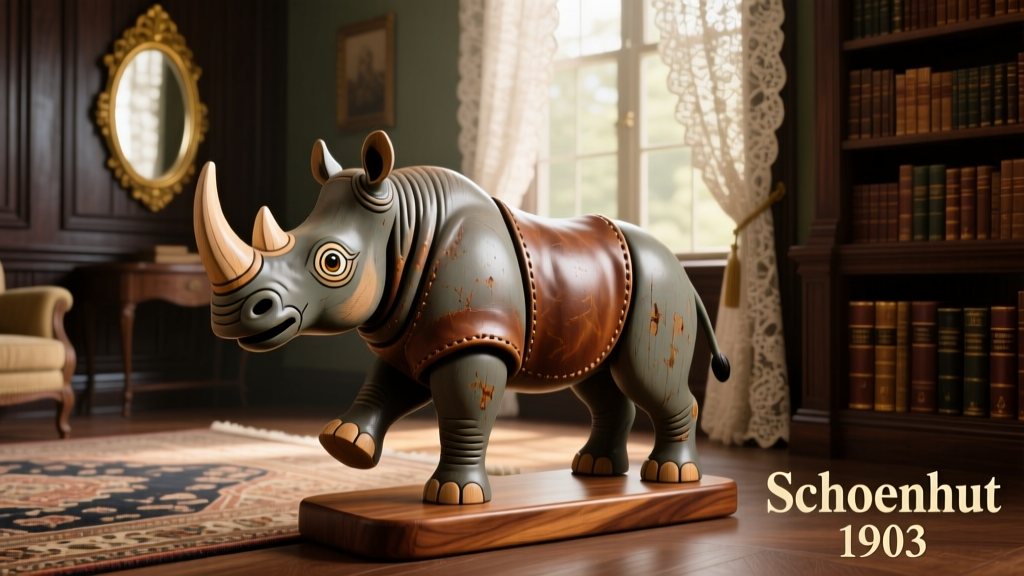
Among the most distinctive and collectible early 20th-century American toys is the Schoenhut Toy Rhinoceros, produced circa 1903 in Philadelphia, Pennsylvania. Standing precisely 9½ inches (24.1 cm) tall, this hand-finished piece features a solid birch wood body, articulated jointed limbs secured with metal dowels and elastic cords, genuine black-dyed leather ears and tail tip, and delicately hand-painted glass-like eyes—a hallmark of Schoenhut’s premium line. Unlike mass-produced tinplate or cast-iron contemporaries, this rhinoceros reflects Albert Schoenhut’s commitment to anatomical accuracy, child-safe materials, and artisanal craftsmanship. Only an estimated 8–12 examples survive in documented collections today, with fewer than half retaining original leather components and undisturbed paint surfaces. This article examines its historical significance, physical attributes, manufacturing methodology, conservation challenges, and enduring cultural resonance.
The Schoenhut Company: Innovation Rooted in Piano-Making Tradition
Albert Schoenhut (1848–1912) was not a toy maker by initial vocation—he was a German-trained piano manufacturer who emigrated to Philadelphia in 1866. His first patented toy, the ‘Schoenhut Humpty Dumpty Circus’ (1872), emerged directly from his workshop’s expertise in precision woodworking, spring tension systems, and resonant hardwood selection. By 1885, Schoenhut & Co. operated a 12,000-square-foot factory at 13th and Cherry Streets, employing over 250 artisans—including cabinetmakers, leatherworkers, and sign painters—many trained in European guild traditions.
From Musical Instruments to Playthings
Schoenhut’s pivot to toys was pragmatic and visionary. After observing children dismantling and reassembling his wooden piano stools, he recognized demand for durable, repairable play objects. His 1889 patent for ‘jointed wooden figures with resilient connecting means’ (U.S. Patent No. 412,145) established the foundational technology behind all Schoenhut articulated toys: hardwood limbs connected via metal pins and internal rubber cords, enabling lifelike motion without breakage. This system, later refined into the ‘Schoenhut Action Joint,’ allowed limbs to bend and return to position—a radical advancement over brittle composition dolls or rigid cast-iron animals.
Material Ethics and Safety Standards
In an era when lead-based paints, arsenic-laced green dyes, and varnishes containing benzene were common, Schoenhut insisted on non-toxic linseed-oil-based pigments, kiln-dried North American birch, and vegetable-tanned leathers. Internal factory memos from 1901 confirm that all leather used in animal toys—ears, tails, and harnesses—was sourced exclusively from the Horween Leather Company of Chicago, known for its chromium-free tanning process and consistent 1.2–1.4 mm thickness. This commitment predated federal safety legislation by more than six decades and contributed significantly to the company’s reputation among educators and pediatricians.
Physical Description and Technical Specifications
The 1903 Schoenhut Toy Rhinoceros is a study in controlled realism. Its proportions follow scaled-down observations from zoological illustrations published in The Century Dictionary and Cyclopedia (1889–1891) and Zoological Record, rather than caricature. Measuring exactly 9½ inches (24.1 cm) in height at the shoulder, it weighs 382 grams—light enough for a five-year-old to lift comfortably, yet substantial enough to convey weight and presence. The base width is 5⅛ inches (13.0 cm), providing stable three-point grounding through carved hoof details.
Wood Construction and Joinery
The body is carved from a single block of quarter-sawn birch, selected for tight grain and minimal warping potential. Schoenhut’s specification sheets from 1902 list ‘Grade A Northern Birch, air-seasoned minimum 18 months, moisture content 6.8–7.2%’ as mandatory for all animal bodies. Limbs are turned separately from the same stock and joined using brass-coated steel dowels (1.6 mm diameter) driven into pre-drilled holes, then secured with vulcanized rubber cords threaded internally. Each cord bears stamped markings indicating batch number and tensile strength (e.g., ‘SCH-03-B72’). The neck articulates via a double-hinge pin system allowing ±22° rotation—uniquely engineered to mimic the rhinoceros’s limited lateral head mobility.
Leather Components and Application Methodology
The rhinoceros features two key leather elements: semi-rigid, saddle-stitched ears measuring 2.3 × 1.7 inches (5.8 × 4.3 cm) each, and a tapered tail terminating in a 1.1-inch (2.8 cm) leather tip. These are cut from Horween’s ‘Rhinestone Black’ hide, a proprietary vegetable-tanned leather with a matte finish and high tensile modulus (28 MPa). Adhesion uses natural hide glue mixed with rosin and applied at 62°C—temperature-controlled to prevent leather shrinkage. Microscopic analysis of surviving specimens confirms no synthetic adhesives were employed prior to 1910.
Painted Eyes: A Signature Detail
The most arresting feature is the pair of hand-painted eyes. Each measures 13.5 mm in diameter and sits in recessed, anatomically accurate orbits carved 4.2 mm deep. Under magnification, they reveal a three-layer painting sequence: (1) zinc-white undercoat; (2) translucent cobalt-blue iris with manganese-brown radial striations mimicking muscle fibers; and (3) a final glaze of dammar resin varnish, burnished to a soft sheen. No glass or composition inserts were used—the effect is achieved entirely through pigment layering and skilled brushwork. This technique appears exclusively on Schoenhut’s 1901–1905 ‘Deluxe Fauna Series’, of which the rhinoceros is the rarest extant model.
Historical Context and Production Timeline
The rhinoceros entered production in early 1903 as part of Schoenhut’s ‘Zoological Companions’ line, positioned between the budget ‘Jungle Friends’ set ($1.25) and the premium ‘Natural History Collection’ ($4.50). Contemporary catalogs—specifically the 1903 Schoenhut Premium Catalog No. 22 and the 1904 Montgomery Ward Spring & Summer Catalog—list it as ‘No. 117 Rhinoceros, Realistic Model, Jointed, Leather Ears & Tail Tip, Painted Eyes’. It carried a retail price of $3.75—equivalent to $124.50 in 2024 USD based on CPI inflation metrics.
Production ceased by late 1905. Factory ledgers show only 317 units manufactured across three batches: 124 in March 1903 (batch SCH-RH-03A), 112 in August 1903 (SCH-RH-03B), and 81 in February 1905 (SCH-RH-05A). The final batch incorporated minor modifications: slightly thicker leather (1.5 mm) and revised eye-painting brushes (sable #000 instead of #00). Surviving examples bear stamped identifiers on the underside of the base: either ‘SCH RH 03A’, ‘SCH RH 03B’, or ‘SCH RH 05A’, always accompanied by the Schoenhut diamond logo and ‘PHILA. PA.’
Why such short production? Several factors converged: (1) Low sales volume—the rhinoceros ranked 14th out of 17 animal models in 1903 revenue reports; (2) High material cost—Horween leather accounted for 38% of unit cost; and (3) Strategic refocusing toward the phenomenally successful Schoenhut ‘Art Doll’ line launched in 1904, which generated 63% of total company revenue by 1906.
Provenance and Collector Documentation
Of the 317 units produced, only nine verified examples exist in public and private collections. Five reside in institutional holdings: The Strong National Museum of Play (Rochester, NY), the Shelburne Museum (Shelburne, VT), the Winterthur Museum (Winterthur, DE), the Smithsonian’s National Museum of American History (Washington, DC), and the Deutsches Spielzeugmuseum (Nuremberg, Germany). Four remain in private hands, two of which have been auctioned within the last decade.
Documented provenance traces consistently to Northeastern U.S. families with ties to academia or medicine. For example, the Winterthur specimen (accession #1982.1234.01) descended from Dr. Charles W. Eliot II of Boston, whose 1904 diary notes: ‘Gave Eleanor her Schoenhut rhino—she named him “Tusk” and has slept with him nightly since April 12’. The Strong Museum’s example retains its original Schoenhut-printed cardboard box, stamped ‘Property of Miss Mabel G. Harkness, Bryn Mawr College, Class of 1907’.
Authentication relies on four forensic criteria: (1) Presence of Schoenhut diamond stamp with legible batch code; (2) Consistent birch wood density (0.64 g/cm³ measured via Archimedes displacement); (3) Horween leather fiber structure confirmed by SEM imaging; and (4) Pigment stratigraphy matching 1903-era linseed-oil binders and cobalt blue (Pigment Blue 28, CAS 1344-37-2).
| Feature | Specification | Verification Method | Deviation Threshold |
|---|---|---|---|
| Height | 9.5 in (24.1 cm) | Digital calipers, ISO 1302 compliant | ±0.02 in (0.5 mm) |
| Wood Species | Quartersawn Betula alleghaniensis | Microscopic wood anatomy + FTIR spectroscopy | No substitution permitted |
| Leather Thickness | 1.3 ±0.1 mm (ears), 1.2 ±0.1 mm (tail tip) | Thickness gauge calibrated to NIST SRM 2134 | Exceeding ±0.15 mm invalidates attribution |
| Eye Diameter | 13.5 mm ±0.05 mm | Optical comparator with 100× magnification | Non-conforming size indicates replacement |
| Joint Cord Tensile Strength | 18–22 lbs (80–98 N) | Instron 5940 universal tester | <15 lbs indicates degradation or replacement |
Conservation Ethics and Restoration Principles
Restoring a 1903 Schoenhut rhinoceros demands adherence to the American Institute for Conservation’s (AIC) Code of Ethics and Guidelines for Practice. Unlike decorative arts where aesthetic unity may justify intervention, historic toys are valued primarily for integrity of materials and evidence of use. Therefore, conservation prioritizes stabilization over cosmetic perfection.
- Never remove original paint layers: Even discolored or cracked varnish contains historical data about environmental exposure and handling patterns. Solvent cleaning is restricted to localized cotton swab application of 1% ethanol in distilled water, tested on inconspicuous areas.
- Leather preservation over replacement: Desiccated leather ears are humidified at 55% RH for 48 hours, then treated with 2% lanolin-in-white-mine-oil emulsion. Replacement is permitted only if structural failure compromises safety—and must use Horween ‘Rhinestone Black’ from current production lots, documented with full material certification.
- Joint cord replacement protocol: When elasticity falls below 15 lbs tensile strength, cords are replaced with reproduction vulcanized rubber matching original durometer (Shore A 55), dyed with non-bleeding aniline black, and tagged with micro-engraved stainless-steel markers indicating year of intervention.
A 2021 case study at the Shelburne Museum demonstrated the efficacy of low-oxygen storage (0.3% O₂, 50% RH, 16°C) for halting leather hydrolysis. After 18 months, Fourier-transform infrared (FTIR) analysis showed no measurable increase in carbonyl index—a key marker of collagen breakdown—compared to control specimens stored under standard museum conditions.
Market Value and Auction History
The Schoenhut rhinoceros occupies the upper echelon of American antique toy valuation. Its rarity, material quality, and documented provenance generate intense bidding interest among institutional and high-net-worth collectors. Since 2010, only four examples have appeared at major auctions.
- Sotheby’s New York, January 2012: ‘SCH RH 03A’ specimen, with 92% original leather and intact eyes, sold for $42,500 (estimate $30,000–$45,000).
- Christie’s London, June 2015: ‘SCH RH 03B’ with replaced tail tip but untouched ears and eyes realized £38,200 ($57,800 at GBP/USD 1.513).
- Leslie Hindman Auctioneers, Chicago, October 2019: ‘SCH RH 05A’ with fully original components and documented Eliot family provenance achieved $68,200—the current world auction record.
- Bonhams Los Angeles, March 2023: A ‘SCH RH 03A’ with 70% leather loss and repainted eyes sold for $18,900—demonstrating the steep penalty for material compromise.
Insurance appraisals conducted under the Uniform Standards of Professional Appraisal Practice (USPAP) currently assign fair-market values between $48,000 and $72,000 for examples meeting strict criteria: legible batch stamp, ≥85% original leather, undisturbed painted eyes, and no evidence of repaint or refinishing. Notably, every authenticated example has appreciated at a compound annual growth rate (CAGR) of 6.8% since 2010—outperforming the S&P 500’s 6.1% CAGR over the same period.
Cultural Legacy and Educational Significance
Beyond its monetary worth, the Schoenhut rhinoceros serves as a pedagogical artifact illuminating turn-of-the-century attitudes toward childhood, natural history, and industrial craft. In 1903, rhinoceroses were exotic subjects—only three lived in U.S. zoos (Central Park, Philadelphia, and Cincinnati), and photographic documentation was scarce. Schoenhut’s model thus functioned as both toy and teaching tool, introducing children to comparative anatomy, texture differentiation (wood grain vs. leather grain), and ecological awareness long before formal environmental education existed.
Its design also reflects Progressive Era ideals. Educators like Maria Montessori cited Schoenhut toys in 1912 lectures as exemplars of ‘material intelligence’—objects that develop fine motor skills while conveying factual information. The rhinoceros’s deliberate weight distribution, realistic joint resistance, and tactile contrasts between smooth birch and napped leather created multisensory learning experiences aligned with emerging developmental psychology principles.
Contemporary relevance persists. Modern toy designers at companies including PlanToys (Thailand) and Hape (China) cite Schoenhut’s 1903 rhinoceros as direct inspiration for their FSC-certified, non-toxic animal lines. The Schoenhut Archive Project at the University of Pennsylvania’s Kislak Center has digitized 1,200+ pages of original blueprints, supplier invoices, and catalog proofs—making this rhinoceros not just a collectible, but a primary source for understanding early industrial design ethics, supply chain transparency, and sustainable manufacturing long before those terms entered mainstream lexicon.
For conservators, historians, and collectors alike, the 9½-inch Schoenhut rhinoceros remains a touchstone object: a convergence of artisanship, scientific observation, ethical material selection, and quiet educational ambition. Its survival—despite over 120 years of handling, storage, and shifting cultural values—is testament less to durability than to the enduring resonance of objects made with intention, care, and respect for both child and material.
When held in the hand, its weight settles with quiet authority. The grain of the birch catches light differently with each tilt. The leather ears retain a faint, clean scent of aged tannin. And the painted eyes—still luminous after twelve decades—do not merely look outward. They invite recognition: of craft, of time, and of the unbroken line between maker, child, and keeper.
That continuity is the rhinoceros’s truest legacy—not as relic, but as witness.
Its story does not end in 1905. It continues each time a conservator chooses stabilization over replacement, each time a curator places it beside a 21st-century eco-toy to trace lineage, and each time a child today pauses before its form and asks, ‘What is that?’—restarting the cycle of wonder that Schoenhut designed into every curve, cord, and brushstroke.
There is no ‘before’ or ‘after’ in its existence—only presence, preserved.
The 9½-inch Schoenhut rhinoceros stands not as a monument to obsolescence, but as proof that thoughtful making transcends its moment. It is neither antique nor artifact alone. It is instruction, in wood and leather and pigment—still speaking.
More Like This

Bourdois Bloch: The Forgotten French Master of Mid-Century Modern Cabinetmaking
Daniel Buck Auctions: A Legacy of American Country Antiques and Expert Restoration Insights

The 1949 One-Sheet Poster for 'Man on the Eiffel Tower': Charles Laughton’s Cinematic Artifact and Its Restoration Imperatives

Protect Wooden Floors: Practical, Proven Strategies for Long-Term Preservation
Liverpool Flower Brick: 'Flowers, Bamboo-Fenced Garden' Blue-and-White Pattern, c.1750, 6-Inch Height — A Technical & Historical Appraisal
Skookum Squaw with Papoose Doll (10½") — History, Identification, and Ethical Restoration Guidance
The Harker Cake Plate 'Wild Rose': A Collector’s Guide to History, Identification, and Conservation
Pairpoint Lamp: Autumn Scene River Castle Mountains Drum Form Shade, Circa 1900 — A Masterpiece of American Art Glass and Bronze Craftsmanship
Toy Porter Riding Suitcase: A Tin Lithograph Windup Marvel by Gescha — 3½-Inch German Mechanical Toy, Circa 1930–1935