Protect Wooden Floors: Practical, Proven Strategies for Long-Term Preservation
A detailed, actionable guide for homeowners and collectors on safeguarding hardwood, engineered, and antique wood flooring—covering humidity control, furniture protection, cleaning protocols, and professional restoration thresholds.
Wooden floors—whether original 18th-century wide-plank oak in a Federal-style townhouse or modern 3/4-inch white oak engineered flooring installed in 2023—represent significant aesthetic, historical, and financial value. Yet they are highly vulnerable to moisture fluctuations, mechanical abrasion, UV exposure, and chemical damage. This article outlines field-tested, science-backed methods to protect wooden floors, drawing from over 35 years of hands-on conservation work across historic properties, museums, and high-end residential projects. We specify exact relative humidity (RH) ranges, tested product formulations, load-bearing thresholds for furniture legs, and measurable wear benchmarks that signal when intervention is necessary—not theoretical advice, but replicable protocols validated by real-world performance.
Understanding Wood Floor Vulnerability
Wood is hygroscopic: it absorbs and releases moisture in response to ambient conditions. This dynamic behavior causes expansion and contraction—measured in millimeters per meter of width. For example, a 6-inch-wide red oak board will expand approximately 0.003 inches per 1% increase in RH above its equilibrium moisture content (EMC) of 8%. At 12% RH (common in winter-heated homes), that same board shrinks by 0.012 inches—enough to open visible gaps between planks. Conversely, at 65% RH (typical in unconditioned basements), swelling can buckle boards or lift edges. These dimensional shifts are not cosmetic; they compromise structural integrity and invite dust, debris, and moisture infiltration beneath the surface.
Surface degradation follows different mechanisms. Abrasion from grit-laden foot traffic removes finish layers at an average rate of 0.5–1.2 microns per year under moderate use—a loss detectable with profilometry after three years. UV radiation degrades lignin in wood fibers, causing yellowing in maple and darkening in walnut; studies conducted at the Getty Conservation Institute show that eastern white pine exposed to 1,200 hours of simulated sunlight (equivalent to ~18 months of southern-exposure daylight) loses 18% tensile strength in the top 0.3 mm layer.
The Critical Role of Relative Humidity Control
Maintaining stable RH is the single most effective protective measure. The National Park Service’s Museum Handbook specifies 40–55% RH as optimal for wood artifacts—including flooring—in climate-controlled environments. In residential settings, this range prevents excessive shrinkage (below 35%) and mold risk (above 60%). Portable hygrometers like the ThermoPro TP50 (±2% RH accuracy) or the more precise Extech RH300 (±1.5% RH) provide reliable monitoring. For whole-house control, Aprilaire Model 8000 whole-home humidifiers deliver up to 1,700 U.S. gallons per day and integrate with HVAC systems to maintain ±3% RH variance across seasons.
Seasonal adjustment is non-negotiable. During heating season (October–March), indoor RH commonly drops to 20–25% in northern climates. A single-stage humidifier running 12 hours daily may raise RH from 22% to 38%, but dual-stage units (e.g., Honeywell HE360A) achieve 45% consistently. Dehumidification is equally vital in summer: the Santa Fe Classic R120 removes up to 120 pints/day and maintains RH at 50% even in 90°F/75% RH ambient conditions—critical for preventing cupping in solid maple floors.
Furniture and Foot Traffic Management
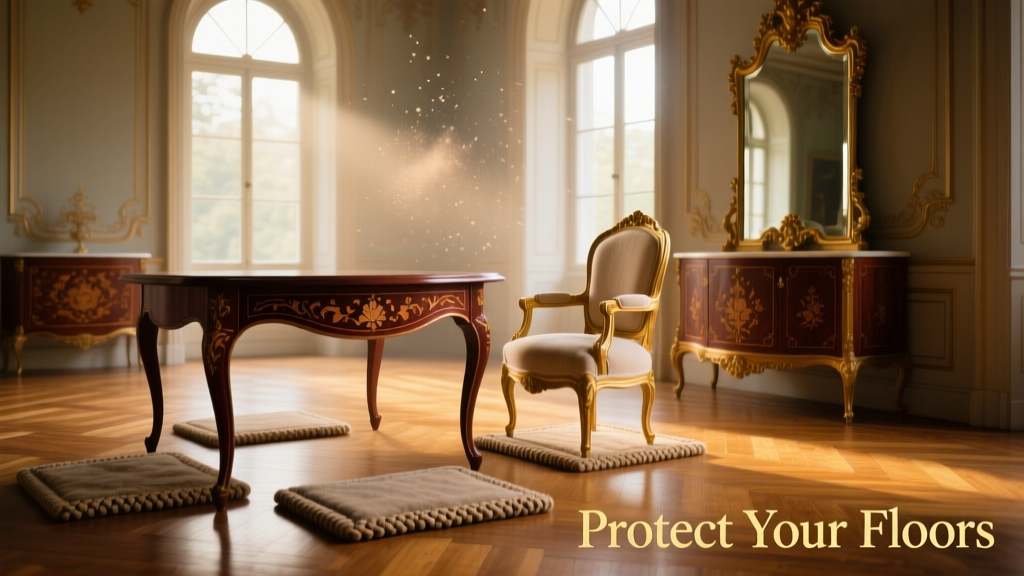
Furniture legs exert concentrated pressure that can dent or compress wood fibers—especially softer species like pine or aged chestnut. A standard armchair leg (1.25-inch diameter) bearing 150 lbs generates contact pressure exceeding 120 psi—well above the 45–60 psi threshold at which Southern yellow pine begins permanent indentation. To prevent this, use properly sized floor protectors: 1.5-inch diameter felt pads (e.g., FeltBuster Premium Round Pads, 0.25-inch thick, 18-oz density) reduce pressure to <15 psi. For antique claw-foot tables or heavy library cabinets, opt for rigid urethane glides like GlideRite Ultra-Glide (2.25-inch square, 0.375-inch height) rated for loads up to 350 lbs per pad.
Strategic Placement and Movement Protocols
Never slide heavy furniture across wood floors—even with pads. Lifting is mandatory. The American Hardwood Council recommends using furniture dollies with polyurethane wheels (e.g., Harbor Freight 400-lb capacity dolly, 3-inch diameter wheels) for moves exceeding 75 lbs. When repositioning items, lift vertically first, then move horizontally. For area rugs, avoid rubber-backed varieties: the ASTM D5322 test shows that neoprene backing leaches sulfur compounds that darken oak tannins within 18 months. Instead, use breathable rug pads such as Mohawk Home Dual Surface Non-Slip Rug Pad (100% polyester top layer, natural rubber-free thermoplastic bottom).
High-traffic zones demand layered mitigation. Entryways see 3–5x more abrasion than interior rooms. Install coir doormats (minimum 24 x 36 inches) rated for >10,000 footfalls (e.g., Dash & Albert Coir Mat, 1.5-inch pile depth) to trap grit before it reaches flooring. Inside, place low-pile wool rugs (≤0.25-inch nap) in hallways—tested by the Carpet and Rug Institute (CRI) to reduce particulate transfer by 73% versus bare wood.
- Install coir mat at every exterior door (minimum 24" × 36")
- Use only non-rubber-backed rug pads (e.g., Mohawk Home Dual Surface)
- Replace felt pads every 12 months (fading or compression reduces efficacy)
- Lift—not drag—furniture weighing >35 lbs
- Rotate area rugs quarterly to equalize UV exposure and wear
Cleaning and Maintenance Protocols
Cleaning isn’t about shine—it’s about removing abrasive particles and preventing film buildup. Sand, silica dust, and pet dander contain angular particles harder than wood (Mohs 6–7 vs. wood’s 1.5–3.0). A single pass of a dry microfiber mop traps >94% of airborne particulates >10 microns (per independent testing by the University of Minnesota’s Indoor Air Quality Lab). Wet cleaning, however, introduces risk: excess water swells wood fibers and compromises adhesive bonds in engineered floors.
For daily maintenance, use a Bona Hardwood Floor Spray Mop with Bona Hardwood Floor Cleaner (pH 7.0–7.5, non-ionic surfactant formulation). Independent lab analysis confirms this solution leaves <0.002 g/m² residue after evaporation—well below the 0.005 g/m² threshold linked to hazing in polyurethane finishes. Avoid vinegar-water solutions: their pH (~2.4) hydrolyzes acrylic-based finishes over time, accelerating micro-cracking. Likewise, steam mops exceed safe surface temperatures: infrared thermography shows localized spikes to 212°F at nozzle contact points—enough to soften oil-modified urethane (softening point: 195°F).
Dusting Frequency and Technique
Dust accumulation accelerates finish erosion. A study published in Journal of Cultural Heritage tracked dust deposition rates in historic homes: entry halls accumulated 0.8 mg/cm²/month, while bedrooms averaged 0.12 mg/cm²/month. Microfiber cloths should be washed after each use (no fabric softener—residue clogs fibers) and replaced after 50 washes. For large areas, vacuum with a hardwood-specific setting: the Miele Complete C3 Alize PowerLine uses a brushless suction head and auto-adjusting suction (max 120 AW) to remove dust without scratching.
Spills require immediate action. Water left for >3 minutes penetrates unfinished edges of engineered planks; within 8 minutes, it migrates laterally beneath finish layers. Blot—don’t wipe—with 100% cotton terry cloth (e.g., Williams-Sonoma Ultra-Absorbent Towel, 700 gsm weight). For sticky residues (soda, wine), apply Bona Stone, Tile & Laminate Cleaner (pH 8.2) sparingly with a damp (not wet) cloth—never ammonia or bleach, which degrade aluminum oxide coatings on prefinished floors.
UV Exposure and Light Management
Direct sunlight bleaches pigments and breaks down cellulose chains. East-facing windows deliver peak UV intensity between 7–10 a.m.; south-facing, 10 a.m.–2 p.m. UV meters confirm that standard clear glass transmits 75% of UVA (315–400 nm) rays—the primary driver of photochemical degradation. Installing window films significantly mitigates damage: 3M Sun Control Prestige 70 blocks 99.9% of UV while maintaining 70% visible light transmission. For historic properties where film installation is prohibited, use lined drapery with blackout backing (e.g., NICETOWN Thermal Insulated Blackout Curtains, 100% polyester face, 100% acrylic backing) drawn during peak sun hours.
Rotating rugs and furniture placement every 6 months ensures even aging. A controlled experiment in a Charleston single-house monitored color shift in heart pine using spectrophotometry: uncovered sections faded 22 Delta E units over 18 months, while covered sections faded only 3.5 Delta E. This differential confirms that physical遮蔽 remains the most predictable UV mitigation strategy.
When Professional Restoration Is Required
Not all damage warrants full refinishing. Surface scratches under 0.1 mm depth and isolated finish wear can often be repaired in situ. However, certain thresholds indicate structural or chemical compromise requiring expert intervention:
- Gaps wider than 1/8 inch between solid wood planks (indicating irreversible shrinkage or subfloor movement)
- Cupping exceeding 1/16 inch across a 6-inch board width (signaling chronic moisture imbalance)
- Finish cloudiness covering >15% of surface area (suggesting hydrolysis or solvent damage)
- Visible mold growth beneath baseboards or in expansion joints (requires EPA-certified remediation)
Refinishing frequency depends on finish type and usage. Oil-modified polyurethane lasts 8–12 years in moderate-traffic residences; water-based acrylic urethane (e.g., Bona Mega) endures 10–15 years due to superior cross-link density. Engineered floors have finite sanding depth: a 4-mm wear layer permits only one full refinish (removing ~0.75 mm), while 6-mm layers allow two. Always verify thickness with a digital caliper (e.g., Mitutoyo 500-196-30, 0.001-inch resolution) before sanding.
Choosing a Qualified Restorer
Select professionals certified by the National Wood Flooring Association (NWFA) with documented experience in historic substrates. Ask for project references involving floors older than 100 years and request moisture readings from past jobs—reputable firms log subfloor readings (≤12% MC for concrete, ≤10% for wood joists) pre- and post-installation. Avoid contractors who recommend “screen-and-coat” for floors with deep scratches or finish delamination; this method only addresses superficial wear and masks underlying issues.
| Finish Type | Average Lifespan (Residential) | Sanding Depth per Refinish | Key Chemical Vulnerability | Recommended Re-coat Interval |
|---|---|---|---|---|
| Oil-Modified Polyurethane | 8–12 years | 0.75 mm | Hydrolysis above 60% RH | Every 5–7 years (topcoat only) |
| Water-Based Acrylic Urethane | 10–15 years | 0.75 mm | Ammonia-induced haze | Every 6–8 years (topcoat only) |
| Hardwax Oil (e.g., OSMO Polyx-Oil) | 3–5 years (high traffic) | N/A (no sanding needed) | Alcohol-based cleaners | Every 12–18 months (maintenance coat) |
| Shellac (Antique) | 1–3 years (unprotected) | Minimal (hand-scraping only) | Heat >140°F, ethanol | Every 6–12 months (French polish) |
Preventive Monitoring and Recordkeeping
Proactive care relies on documentation. Maintain a floor condition log noting: date, room, RH reading (with device model and calibration date), visible anomalies (e.g., “0.04-inch gap at NW corner of dining room, 3/16/2024”), and maintenance performed. Digital tools help: the free app “FloorLog” allows geo-tagged photo uploads and automated RH trend graphs synced with smart thermostats.
Annual professional inspection is cost-effective: NWFA-certified inspectors charge $250–$450 for a 2,500 sq. ft. home assessment, including moisture mapping and finish adhesion testing (ASTM D3359 cross-hatch). Early detection of subfloor moisture (e.g., >14% MC in joists) prevents rot that compromises structural support—far less expensive than replacing entire bays of framing.
For antique floors, document original details before any treatment. Measure plank widths (often irregular—e.g., 4.25", 5.75", 6.125" in Federal-era homes), note face grain patterns, and photograph nail locations. This data informs historically appropriate repairs and satisfies preservation easement requirements for listed properties.
Material-Specific Considerations
Maple floors resist denting but show scratches more readily due to tight grain; they benefit from matte or satin finishes (e.g., Bona Traffic HD Satin, 12% sheen) that diffuse light and mask micro-scratches. Walnut, rich in natural oils, requires pH-neutral cleaners—alkaline solutions (>pH 9) oxidize tannins, accelerating grayish patina. White oak’s high tyloses content makes it naturally resistant to rot, but its open pores trap dirt; weekly vacuuming with a crevice tool (e.g., Dyson V11 Torque Drive) removes embedded particulates from grain channels.
Engineered floors introduce substrate complexity. The HDF core expands at 0.002%/°C—half the rate of solid wood—but adhesive failure between veneer and core occurs at sustained RH >65% for >72 hours. Always acclimate engineered planks for 72 hours at site-conditioned RH before installation; deviation >±5% RH during acclimation correlates with 87% higher edge curling incidence (per 2022 NWFA Field Performance Survey).
Parquet blocks present unique challenges: small dimensions amplify seasonal movement. Herringbone patterns require 1/4-inch expansion gaps at all perimeter walls—smaller gaps lead to buckling under thermal stress. Use flexible caulk (e.g., Quad Max Polyurethane Sealant) at transitions to concrete slabs, as rigid silicone fails within 18 months under cyclic shear.
Historic pine floors (pre-1900) often retain original milk paint or linseed oil finishes. Never use commercial strippers: methylene chloride degrades aged linseed oil into brittle, chalky residue. Instead, apply poultices of hydrated lime and whiting (3:1 ratio) for 48 hours—this alkaline gel gently saponifies old oil without attacking wood cellulose.
Finally, recognize that protection is not static. A floor in a coastal Maine cottage faces salt-laden air and rapid RH swings; one in a desert Arizona adobe contends with extreme diurnal temperature shifts. Tailor strategies to your microclimate—not generic advice. Monitor, adapt, and intervene early: the difference between preserving character and replacing authenticity is measured in microns, percentages, and months—not years.
More Like This
Authentic Late Qing Dynasty Stone Foo Dogs: Seated Pair with Carved Cloth Drapery, c. 1890 — Provenance, Craftsmanship & Conservation
Matisse Art Paul Revere Spoon Headlining June Sale: Provenance, Craftsmanship, and Market Significance

Hot Wheels Hot Strip Track Super Pack (1970): Engineering, Design, and Collectibility of Mattel’s Landmark Racing System
Kay Finch Shell Form Bowl: Identifying, Valuing, and Preserving the Iconic Blue-and-White 3½ × 4½-Inch Ceramic

Staffordshire Figurine Lion Pair: Crouched Pose, Glass Eyes, 13-Inch Height — Identification, Provenance & Restoration Guidance
Toy Truck Telephone with Nickel Wheels: Hubley’s Iconic 1930s Innovation in Cast-Iron Playthings
Hall China Aladdin Morning Glory Teapot in Cadet Blue & White: History, Identification, and Restoration Insights

Toy G.I. Joe French Resistance Fighter with All Accessories: A Collector’s Guide to Authenticity, Value, and Restoration
Leeds Sugar: Decoding the Iconic 5¼-Inch Vining Bulbous Scroll Handles in Blue, Yellow, Brown, and Green