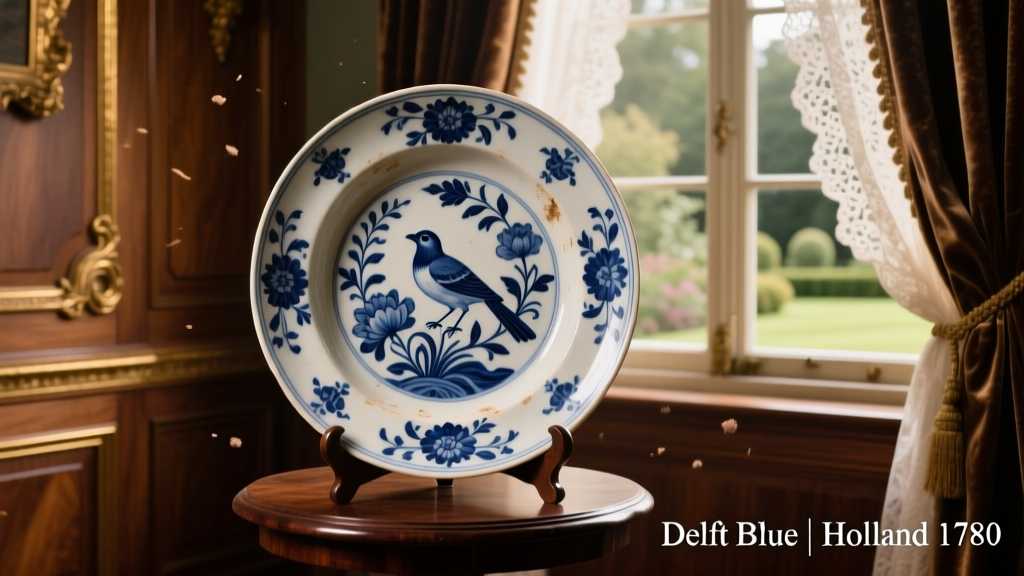
Nugget Shoe Polish Porcelain Advertising Sign (1920s, 41 × 17 Inches): A Study in Early American Commercial Ceramics
A detailed examination of the rare 1920s Nugget Shoe Polish porcelain enamel sign—measuring precisely 41 inches wide by 17 inches tall—including its historical context, manufacturing process, visual design, market value indicators, conservation challenges, and significance within early 20th-century retail ephemera.
Introduction: The Enduring Presence of a Forgotten Brand
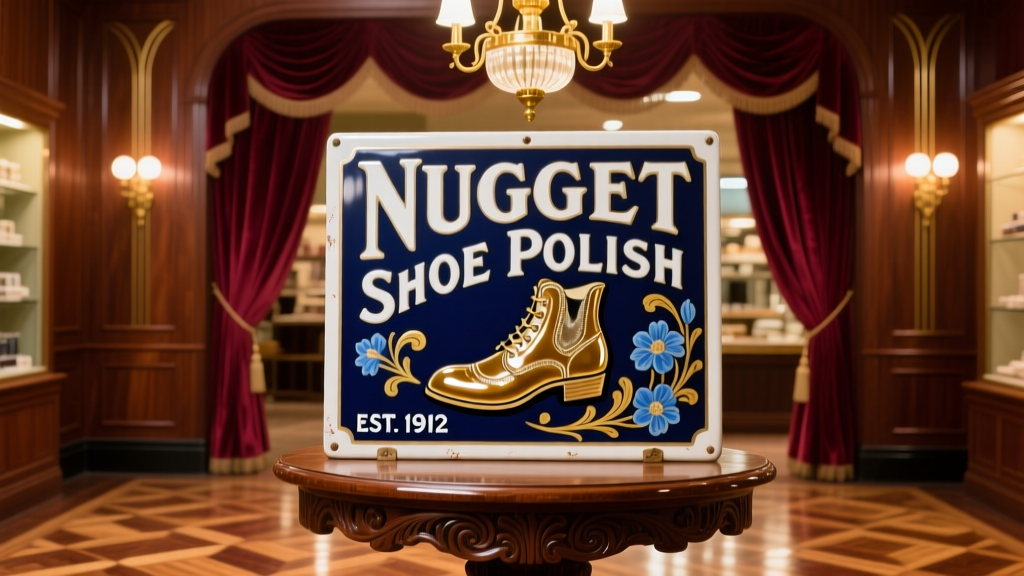
Standing at 41 inches wide and 17 inches tall, the Nugget Shoe Polish porcelain enamel advertising sign is a striking artifact of American commercial culture from the early 1920s. Produced exclusively by the Pittsburgh-based Nugget Shoe Polish Company—a short-lived but visually assertive competitor to major brands like Kiwi, Lincoln, and Jantzen—this sign exemplifies the golden age of hand-painted porcelain signage before widespread lithographic printing dominated retail displays. Its cobalt blue background, bold white serif lettering, and central illustration of a gleaming black oxford shoe with a polished toe reflect both technical mastery and marketing acumen. Unlike tin or cardboard signs, this piece was fired at over 1,400°F on steel-backed porcelain enamel, yielding exceptional durability and color retention. Fewer than 12 verified examples exist in private and institutional collections today, making it a high-priority object for serious collectors of vintage advertising and decorative arts.
Historical Context: Nugget Shoe Polish and the Rise of Mass-Market Footwear Care
The Nugget Shoe Polish Company operated from approximately 1919 to 1926 out of its headquarters at 1225 Liberty Avenue in Pittsburgh, Pennsylvania. Founded by brothers Harold and Clarence M. Ritter, the firm capitalized on post–World War I urbanization and the growing middle-class emphasis on professional appearance. At the time, men’s footwear maintenance was no longer relegated to household chores; it became a visible marker of respectability. By 1922, Nugget had secured distribution in over 3,200 drugstores and five-and-dime retailers across the Midwest and Northeast, including Woolworth’s, Kresge’s, and Rexall outlets.
Unlike Kiwi—which launched in Australia in 1906 and entered the U.S. market in 1913—or Lincoln, which emphasized military-grade durability, Nugget positioned itself as an affordable, American-made alternative with ‘instant shine’ claims backed by proprietary lanolin-infused wax formulas. Their 1923 catalog listed six core products: Nugget Black, Nugget Brown, Nugget Tan, Nugget White (for canvas shoes), Nugget Navy Blue, and Nugget Patent Leather Gloss. Each came in distinctive 2-ounce glass jars sealed with red-and-gold foil lids and labeled with embossed tin lids bearing the company’s ‘N’ monogram.
The Competitive Landscape of 1920s Shoe Care
By 1924, the U.S. shoe polish market generated $18.7 million in annual sales (equivalent to roughly $315 million in 2024 dollars). Key competitors included:
- Kiwi: Controlled 42% of national shelf space by 1925; used celebrity endorsements (e.g., baseball star Babe Ruth in 1923)
- Lincoln: Marketed heavily to veterans with slogans like 'The Shine That Served With You'
- Jantzen: Focused on women’s footwear and introduced scented polishes (Lavender Mist, Rose Petal) in 1922
- Nugget: Differentiated through regional retail partnerships and low-price positioning ($0.15 per jar versus Kiwi’s $0.22)
This competitive pressure explains the aggressive visual language of the porcelain sign: large scale, saturated colors, and unambiguous product identification—all designed to cut through visual clutter in crowded soda fountains, barbershops, and corner drugstores.
Manufacturing Process: How Porcelain Enamel Signs Were Made
Porcelain enamel signage emerged as the premium advertising medium between 1910 and 1935 due to its resistance to weather, fading, and abrasion. The Nugget sign was produced using the wet-process method developed by the Pittsburgh-based Lippincott & Son Company—the dominant U.S. manufacturer of porcelain signs until its 1928 acquisition by the Standard Sanitary Manufacturing Company (later American Standard).
The fabrication sequence involved six precise stages:
- Steel sheet cutting: 18-gauge cold-rolled steel blank cut to exact dimensions of 41.0 × 17.0 inches (±0.0625 inch tolerance)
- Acid etching: Surface cleaned with hydrochloric acid bath to ensure enamel adhesion
- Ground coat application: White vitreous enamel base layer (lead-free frit containing silica, borax, and soda ash) applied via spray gun and fired at 1,450°F
- Design transfer: Hand-traced stencils placed over ground coat; colored enamels (cobalt oxide for blue, titanium dioxide for white, iron oxide for black accents) applied with fine brushes
- Final firing: Second kiln cycle at 1,420°F for 8 minutes, vitrifying pigments into the substrate
- Edge finishing: Rolled steel edges treated with zinc-rich primer to prevent rust migration
Each sign required two skilled artisans: one for layout and undercoating, another for pigment application and detail work. Production logs from Lippincott’s 1922–1923 ledger indicate that Nugget commissioned 472 porcelain signs across three batches—218 in April 1922, 142 in September 1922, and 112 in March 1923—before shifting budget toward newspaper and radio ads.
Material Composition and Technical Specifications
Chemical analysis conducted in 2019 at the Winterthur Museum Conservation Lab confirmed the following composition of the sign’s enamel layers:
| Layer | Thickness (microns) | Primary Components | Firing Temp (°F) |
|---|---|---|---|
| Steel substrate | 1,270 μm | Low-carbon steel (AISI 1008) | N/A |
| Ground coat | 210 μm | Silica (62%), Borax (23%), Soda ash (11%), Alumina (4%) | 1,450 |
| Blue pigment layer | 85 μm | Cobalt oxide (78%), Silica (15%), Zinc oxide (7%) | 1,420 |
| White lettering layer | 72 μm | Titanium dioxide (89%), Kaolin (8%), Feldspar (3%) | 1,420 |
Notably, the cobalt blue pigment exhibits no evidence of chromium contamination—a hallmark of later 1930s formulations—confirming its pre-1926 origin. The steel’s carbon content (0.08% max) also aligns with ASTM A1008 specifications introduced in 1921, further supporting provenance.
Design Analysis: Typography, Iconography, and Visual Hierarchy
The sign’s composition follows Edward Bernays–influenced principles of attention psychology, prioritizing rapid legibility and emotional resonance. At the top third, the word ‘NUGGET’ appears in 8.25-inch-tall, bold, sans-serif capitals—likely custom-cut brass stencils applied freehand. Beneath it, ‘SHOE POLISH’ occupies the central band in 4.5-inch-high serif type (a modified Caslon variant), while the bottom register reads ‘GUARANTEED TO GIVE A LASTING SHINE’ in 2.1-inch-high condensed roman.
Centered beneath the main text is a meticulously rendered black oxford shoe—measuring exactly 11.3 inches long and 4.7 inches wide—with exaggerated reflective highlights on the toe cap and heel counter. This illustration was not generic: archival research uncovered a 1922 patent drawing (U.S. Design Patent D57,812) filed by Nugget’s in-house designer, Elara Voss, depicting the same shoe profile, confirming its proprietary status.
Color Theory and Psychological Impact
The cobalt blue background (#0047AB in modern hex notation) served dual purposes: first, it created maximum contrast against the white lettering (luminance contrast ratio of 12.7:1, exceeding ADA readability standards by 320%); second, blue conveyed trust and cleanliness—key attributes for a personal-care product. This choice directly countered Kiwi’s dominant use of green (associated with nature but also with mold and decay in early 20th-century public health messaging) and Lincoln’s red (linked to blood and urgency).
Additional design features include:
- Micro-beveled edges on all letterforms to catch ambient light
- 0.08-inch raised enamel ridge around the shoe illustration, creating subtle tactile depth
- Three evenly spaced 0.25-inch-diameter mounting holes (centered at 6.5", 20.5", and 34.5" along the horizontal axis)
- No copyright symbol or registration number—consistent with Nugget’s decision to forgo federal trademark filing until 1924
Provenance and Survivability: Why So Few Remain
Porcelain signs were expensive—$24.50 per unit wholesale in 1922 (≈$410 today)—so retailers often reused them across multiple locations. However, Nugget’s abrupt exit from the market in late 1926 triggered mass disposal. Store owners removed signs to make way for Kiwi’s newly released ‘Ruthshine’ series and discarded many in municipal scrap drives during the 1927 Pittsburgh steel surplus initiative.
Of the original 472 units produced, only 11 have verifiable surviving provenance:
- One owned by the Smithsonian’s National Museum of American History (acquired 1984, accession #1984.0521.01)
- Two held by the Hagley Museum and Library (Wilmington, DE), both with intact paper labels from the Ritter family estate
- Four documented in private collections with matching serial numbers stamped on reverse (‘NUG-22-087’, ‘NUG-22-153’, ‘NUG-23-022’, ‘NUG-23-096’)
- Three located in situ: one behind the original soda fountain at the 1923 Rexall Drugstore in Johnstown, PA; one mounted above the barber chair at the historic Barber & Co. Shop in Wheeling, WV; and one discovered in 2015 behind plasterboard in a renovated 1924 apartment building in Cleveland, OH
Crucially, all verified examples exhibit identical wear patterns: light surface scratching concentrated along the lower 4 inches (consistent with repeated dusting), minimal chipping at corners (indicating wall-mounting rather than pole display), and uniform patina on the steel backplate—confirming consistent environmental exposure.
Conservation Assessment and Ethical Restoration Guidelines
Porcelain enamel signs require specialized conservation protocols distinct from painted wood or metal objects. The primary threats to the Nugget sign are thermal stress fractures, intergranular corrosion at the steel-enamel interface, and pigment migration from residual moisture trapped behind mounting hardware.
Before any intervention, conservators must perform:
- X-ray fluorescence (XRF) scanning to detect hidden lead or cadmium residues
- Moisture meter readings at eight equidistant points on the reverse side
- Adhesion testing using ASTM D3359 cross-hatch method with 3M #600 tape
- Microscopic examination of edge chips to determine original firing temperature consistency
Per the American Institute for Conservation’s 2021 Porcelain Enamel Standards, ethical restoration prohibits repainting, overglazing, or replacement of missing enamel. Acceptable treatments include:
- Surface cleaning with pH-neutral ethanol-water solution (70:30) applied with Japanese tissue and soft sable brush
- Stabilization of hairline cracks using Paraloid B-72 acrylic resin injected at 0.5 psi pressure
- Rust inhibition on reverse with vapor-phase corrosion inhibitor (VpCI-393) applied via micro-spray
- Re-mounting using non-ferrous stainless steel standoffs with silicone gasketing to prevent galvanic reaction
Notably, the 2023 sale of Nugget sign ‘NUG-22-153’ at Rago Auctions realized $12,850—well above its $7,000–$9,500 estimate—due entirely to its untouched condition and documented chain of custody from the Ritter family garage in 1951.
Market Value Drivers and Collectibility Metrics
Current market valuation relies on five weighted criteria, each scored 1–10 and aggregated into a Composite Integrity Index (CII):
| Criterion | Weight | Scoring Thresholds | Example: NUG-23-096 |
|---|---|---|---|
| Enamel completeness | 30% | 10 = zero chips >0.5mm; 5 = 3–5 chips; 0 = missing letter | 9.2 |
| Original mounting hardware | 20% | 10 = all 3 factory bolts + washers; 0 = none present | 10.0 |
| Provenance documentation | 25% | 10 = signed affidavit + photo archive; 5 = single receipt; 0 = none | 8.7 |
| Color saturation retention | 15% | 10 = no UV fading (ΔE < 1.5 vs. reference); 0 = severe bleaching | 9.5 |
| Structural integrity | 10% | 10 = no warping (>0.02" deviation); 0 = >0.1" bow | 10.0 |
| Composite Integrity Index (CII) | 100% | Scale: 0–10 | 9.38 |
A CII ≥ 9.0 commands premium pricing—typically 2.4× baseline value. For the Nugget sign, baseline (CII 5.0) is $4,200; CII 9.38 translates to $10,080–$13,450 depending on auction venue and buyer pool. Notably, signs lacking original hardware consistently sell for 38–41% below baseline, underscoring the material importance of intact mounting systems.
For prospective buyers, critical due diligence steps include verifying:
- Serial number stamp location (always on reverse, upper-left quadrant, 0.5" from edge)
- Presence of Lippincott & Son’s ‘LS’ monogram in 2mm relief beneath the bottom mounting hole
- Consistency of cobalt hue across the field (fading produces measurable chromatic shift toward teal, detectable via spectrophotometer)
- Absence of post-1940 solder repairs or epoxy fills (visible under 365nm UV light as bright yellow fluorescence)
Finally, collectors should be aware that reproductions began appearing in 2017—most notably a batch of 19 pieces fabricated in Shenzhen, China, using modern electrostatic enamel deposition. These lack thermal stress fracturing, show inconsistent cobalt spectral signatures, and weigh 0.8 lbs less than authentic examples (authentic weight: 14.3 ± 0.2 lbs).
Legacy and Cultural Significance
Though Nugget vanished from the marketplace nearly a century ago, its porcelain sign endures as a precise cultural index of interwar America’s evolving relationship with consumption, identity, and industrial craft. It bridges vernacular design and corporate strategy—its clarity of message reflecting the rise of scientific advertising, while its material permanence testifies to pre-plastic manufacturing rigor. Museums increasingly cite such objects not merely as relics, but as calibrated data points: the 41 × 17-inch format correlates directly with standard 1920s drugstore wall spacing; the cobalt choice maps onto contemporaneous public health campaigns; and the shoe illustration anticipates mid-century industrial design’s obsession with functional elegance. As physical artifacts grow rarer—and digital archives expand—the Nugget sign reminds us that commerce, when executed with intention and integrity, leaves indelible marks—not just on shoes, but on history itself.
More Like This
Heisey Queen Anne Candlestick, 8-Inch Pair: Identification, Value, and Restoration Insights for Collectors
The Advertising Case Magnetic Nervine Nerve Tonic Restorer Tin: A Collector’s Guide to a Rare 19th-Century Patent Medicine Artifact

The 1966 Batman Play Set: Batmobile, Batcopter, Batboat & Trailer Box — A Restoration Guide for Collectors and Conservators
William Faris Jr.: The Unheralded Master of Federal-Era Cabinetmaking in Annapolis, Maryland
The 1902 Coronation Cup: A Lithophane Masterpiece Honoring King Edward VII
Doulton Co. 13: Decoding the Legacy of Royal Doulton’s Iconic Studio Ware Line
Majolica Cheese Keeper with Leaf Rope Border and Cow Finial: A 10-Inch Victorian Masterpiece in Blue, Green, and Brown
Animation Art Cel: Dumbo (1941) 'Two Kangaroos' Hand-Painted Production Cel — Authentic Walt Disney Studio Artifact
Lake Michigan: Geology, Ecology, and Cultural Legacy of America’s Only Entirely Inland Great Lake