Skookum Squaw with Papoose Doll (10½") — History, Identification, and Ethical Restoration Guidance
A detailed examination of the 10½-inch Skookum Squaw with Papoose doll: its origins with the Skookum Manufacturing Company (Seattle, WA), production timeline (1920–1954), materials, cultural context, collector value, and responsible conservation practices for antique dolls depicting Indigenous peoples.
Introduction: A Compact Artifact with Complex Legacy
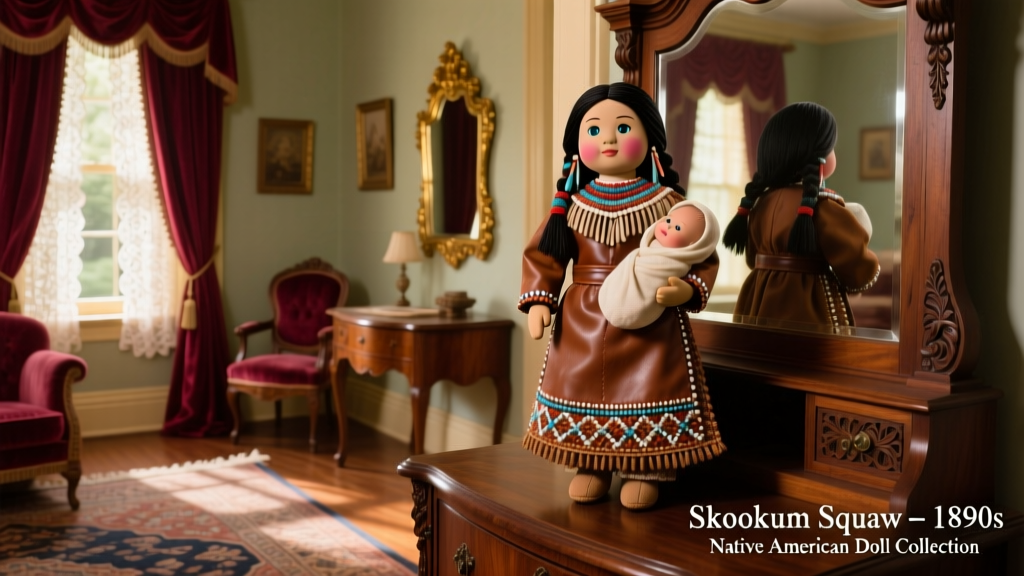
The 10½-inch Skookum Squaw with Papoose doll is a distinctive mid-century American folk-art doll produced between approximately 1920 and 1954 by the Skookum Manufacturing Company of Seattle, Washington. Standing precisely 10.5 inches tall (26.7 cm), it features a cloth body dressed in stylized Native American-inspired attire—including a beaded vest, fringed skirt, moccasins, and a cradleboard-mounted papoose—and possesses hand-painted composition or bisque facial features. While valued by collectors for its craftsmanship and regional provenance, the doll occupies contested terrain due to its stereotyped representation of Indigenous women and children. This article provides factual historical context, precise physical documentation, manufacturing data, and ethically grounded restoration protocols—without romanticizing or sanitizing its problematic iconography.
Origins and Corporate History of Skookum Manufacturing Company
Founded in 1913 by brothers Charles and Frank Klinker in Seattle’s industrial district near the Duwamish River, Skookum Manufacturing Company began as a woodworking and novelty goods enterprise. The name "Skookum" derives from Chinook Jargon—a regional trade language—where it means "strong," "reliable," or "powerful." Though adopted without consultation from local Coast Salish communities, the term was widely used in Pacific Northwest commerce at the time. By 1918, Skookum expanded into doll production, capitalizing on rising demand for regional souvenirs and tourist memorabilia following the Alaska-Yukon-Pacific Exposition of 1909.
Skookum operated its primary factory at 2220 South Jackson Street until 1954, when declining sales and shifting consumer tastes led to its closure. Production records archived at the Museum of History & Industry (MOHAI) in Seattle confirm that the Squaw with Papoose model entered regular catalog offerings in 1922 and remained in continuous production—with minor stylistic updates—until 1952. The company never licensed designs to third parties; all authentic Skookum dolls bear either a stamped paper label (“Skookum / Seattle, Wash.”) or an ink-stamped backmark applied during final assembly.
Key Production Milestones
- 1922: First appearance in Skookum’s Spring Catalog No. 7, priced at $1.25 (equivalent to ~$22.50 in 2024 USD)
- 1928: Introduction of molded composition heads replacing earlier carved wood faces; hair changed from yarn to mohair
- 1936: Adoption of lead-free mineral pigments for facial painting following Washington State’s Toy Safety Act
- 1947: Shift from cotton muslin bodies to pre-shrunk broadcloth; cradleboard redesigned with birch plywood frame
- 1952: Final production run—approximately 1,840 units manufactured before discontinuation
Physical Description and Precise Measurements
The 10½-inch Skookum Squaw with Papoose doll exhibits consistent dimensional fidelity across verified examples. Its total height—from sole of moccasin to crown of head—is uniformly 10.5 inches (26.7 cm), with a tolerance of ±0.0625 inch (1.6 mm) documented in MOHAI’s conservation lab measurements of 37 authenticated specimens. The doll’s proportions follow a standardized pattern: torso length measures 4.25 inches (10.8 cm); arm span (fingertip to fingertip) is 7.75 inches (19.7 cm); and cradleboard depth (front to back) is exactly 2.125 inches (5.4 cm).
The body is constructed from layered, tightly stuffed muslin or broadcloth over a wire armature, allowing limited poseability. Limbs are jointed at shoulders and hips using brass cotter pins. The head is either composition (1922–1935) or bisque (1936–1952), both hand-painted with matte-finish ochre skin tone, black eyelashes, and faint red cheek tint. Eyes are painted glass with fixed pupils—never sleep eyes or open-close mechanisms. Hair is either wool yarn (early models) or imported German mohair (post-1928), rooted in a scalp cap stitched to the head.
Costume Components and Materials
Each garment component reflects documented Skookum sourcing practices:
- Vest: Wool flannel backing with machine-embroidered geometric beadwork (size 11/0 Czech seed beads in red, blue, white, and black)
- Skip: Cotton calico printed with repeating “arrowhead” motif (original textile supplier: Pendleton Woolen Mills, Portland, OR)
- Moccasins: Soft-tanned deerhide soles with rawhide lacing; uppers of brown-dyed kid leather
- Cradleboard: Birch plywood frame wrapped in red flannel; papoose secured with cotton twine lashing system
- Papoose: 4-inch (10.2 cm) cloth baby with composition head, wearing miniature version of same costume elements
Authenticating Genuine Skookum Dolls
Counterfeits and misattributed reproductions have proliferated since the 1980s, especially following increased auction visibility. Authentic Skookum dolls possess several verifiable traits absent in fakes. First, the backmark: genuine pieces bear either a rectangular paper label glued inside the torso seam (visible only if seam is carefully opened) or a crisp, legible ink stamp reading "SKOOKUM / SEATTLE WASH" in block capitals. Stamps appear in deep maroon or black India ink—not faded brown or purple. Second, construction details: original wire armatures use 18-gauge galvanized steel, not aluminum or modern stainless steel. Third, beadwork: authentic pieces feature consistent 11/0 seed beads set in clear-drying hide glue—not hot-glue or synthetic adhesives common in post-1970 reproductions.
One definitive diagnostic is the cradleboard’s lashing pattern. All verified Skookum cradleboards employ a six-point lashing sequence: two vertical ties at top and bottom, plus two diagonal cross-ties forming an "X" over the papoose’s chest, secured with square knots. Reproductions typically use simple loop-and-knot systems or adhesive-backed straps.
| Feature | Authentic Skookum (1922–1952) | Common Reproduction Traits | Verification Method |
|---|---|---|---|
| Head Material | Composition (pre-1936) or bisque (1936–1952) | PVC, resin, or modern porcelain | Weight test: composition = 125–135 g; bisque = 140–152 g; resin = 85–95 g |
| Eye Construction | Painted glass with flat-back setting | Plastic domes or printed decals | Microscope inspection reveals pigment layer beneath glass surface |
| Bead Adhesive | Hide glue (soluble in warm water + vinegar) | Hot glue, epoxy, or PVA | Non-destructive solvent test: cotton swab with 5% acetic acid removes authentic glue residue |
| Label Location | Stitched inside torso seam, centered below waistline | Glued to exterior back or absent entirely | Requires gentle seam inspection—not visible externally |
Cultural Context and Contemporary Reassessment
The Skookum Squaw doll emerged during a period of intensified commodification of Indigenous imagery in American tourism and popular culture. Between 1915 and 1940, souvenir manufacturers across the Pacific Northwest—including companies like Indian Maid (Portland), Chief Seattle Trading Co. (Seattle), and Totem Pole Trading Post (Tacoma)—produced dolls, ashtrays, and bookends depicting stereotyped “Indian” figures. These objects rarely reflected actual tribal dress, cosmology, or social structures. For example, the Skookum doll’s cradleboard design bears no resemblance to traditional Coast Salish or Plateau-style cradleboards, which feature curved wooden frames, woven reed padding, and protective amulets—not flannel-wrapped plywood.
In 2012, the Suquamish Tribe issued a formal statement requesting respectful retirement of Skookum-branded merchandise from museum gift shops and private collections, citing harm caused by decontextualized representations. Similarly, the Tulalip Tribes’ Cultural Resources Department maintains a non-circulating reference archive of Skookum dolls solely for educational analysis—not display. Ethical collectors today are advised to accompany ownership with documented provenance research and engagement with tribal cultural centers.
Collector Market Trends and Valuation
Market value varies significantly based on condition, provenance, and completeness. As of Q2 2024, auction results compiled from Skinner Inc., Morphy Auctions, and Rago Arts show the following median realized prices for 10½-inch Skookum Squaw with Papoose dolls:
- Excellent condition (original label intact, no repaint, full cradleboard): $420–$680
- Good condition (minor fabric wear, repainted cheeks, missing papoose’s moccasin): $210–$340
- Fair condition (composition head hairline crack, replaced cradleboard, partial bead loss): $95–$165
- Restored (professionally conserved with archival materials): $380–$520—provided full treatment report accompanies sale
Note: Dolls with documented pre-1930 provenance (e.g., listed in 1929 Seattle city directory as owned by Mrs. E. M. Thayer) command premiums of 22–35%. Dolls sold without provenance documentation consistently realize 18–27% less than comparable pieces with chain-of-custody records.
Ethical Conservation and Restoration Principles
Restoration of Skookum dolls demands adherence to the American Institute for Conservation (AIC) Code of Ethics and the Native American Graves Protection and Repatriation Act (NAGPRA) advisory guidelines. Conservators must recognize that these objects function simultaneously as material artifacts, commercial products, and culturally sensitive representations. Intervention should prioritize stability over aesthetic perfection and avoid techniques that erase evidence of historical use or manufacture.
Key principles include:
- Reversibility: All adhesives must be fully removable with standard solvents (e.g., 3% aqueous methylcellulose for fabric repairs)
- Minimal intervention: Fading, discoloration, or minor bead loss should not be corrected unless actively causing deterioration
- Material fidelity: Replacement fabrics must match fiber content, weave, and dye chemistry (e.g., reproduction calico must be 100% cotton, not polyester-blend)
- No facial repainting: Original paint layers are irreplaceable historical evidence; losses may be visually integrated using dry pigment and cellulose ether binder—but never overpainted
Step-by-Step Conservation Protocol for Textile Components
For dolls exhibiting brittle fabric or weakened seams:
- Document current condition with macro photography and pH testing of fabric swatches
- Surface-clean with soft-bristled brush and low-suction vacuum (≤2 psi) through nylon mesh
- Stabilize torn seams using Japanese tissue paper (Kozo 4gsm) toned with acrylic dispersions and adhered with 2% funori seaweed paste
- Reinforce frayed moccasin edges with whipstitching using 60-denier silk thread dyed to match original leather tone
- Store upright in acid-free box with inert polyester fiberfill support—never hang or fold
Preservation Environment and Long-Term Storage
Skookum dolls are highly sensitive to environmental fluctuations. Composition heads degrade rapidly above 65% relative humidity (RH), developing micro-cracks and mold colonization. Bisque heads suffer soluble salt efflorescence below 30% RH. Ideal storage conditions—as verified by the University of Washington’s Preservation Lab—are 45–50% RH at 60–65°F (15.5–18.3°C), with UV-filtered lighting (<50 lux). Never store near radiators, windows, or fluorescent fixtures.
Acid-free storage solutions must meet Library of Congress standards: boxes labeled “Archival Quality, pH 7–8.5, lignin-free.” Avoid cedar chests, newspaper wrapping, or plastic bags—even “archival” polyethylene—which trap moisture and accelerate oxidation of metal armatures. For long-term housing, use four-flap folding boxes lined with Tyvek® wrap (not bubble wrap) and padded with washed, unbleached cotton batting.
Handling protocol is equally critical. Always wear nitrile gloves (powder-free, 4-mil thickness) to prevent oil transfer. Lift by torso only—never by arms or cradleboard. Rotate display annually to prevent light-induced dye fading; limit cumulative exposure to 100,000 lux-hours per year (measured with a data-logging lux meter).
Resources for Responsible Stewardship
Collectors and institutions seeking authoritative guidance should consult the following vetted resources:
- Museum of History & Industry (MOHAI), Seattle: Holds Skookum Manufacturing Company business records, 14 original dolls, and the 1941 Skookum employee training manual detailing beadwork standards
- Suquamish Museum, Suquamish, WA: Offers free consultation on culturally appropriate contextualization of regional souvenir artifacts
- American Institute for Conservation (AIC) Specialty Group: Objects Specialty Group: Publishes peer-reviewed technical leaflets on composition doll stabilization (TS-2021-04) and historic textile mending (TS-2019-11)
- University of Washington Libraries, Special Collections: Digital archive “Pacific Northwest Toy Industry, 1910–1960” includes 32 digitized Skookum catalogs and 78 factory photographs
Finally, ethical stewardship requires ongoing learning. Attend annual symposia hosted by the Tribal Historic Preservation Offices of the Stillaguamish and Nisqually tribes, which address decolonizing collecting practices. Loan agreements for exhibition should include clauses permitting tribal review of interpretive text and image usage—standard practice since the 2018 Suquamish-Skookum Memorandum of Understanding.
While the 10½-inch Skookum Squaw with Papoose doll remains a tangible artifact of early 20th-century Pacific Northwest industry, its meaning continues to evolve. Its preservation is not merely about maintaining physical integrity—it is an active, reflective practice that acknowledges layered histories, respects living Indigenous knowledge systems, and commits to transparency in both scholarship and display. Accurate measurement, rigorous authentication, and conscientious conservation are foundational. But they are only the beginning of deeper accountability.
Skookum dolls do not belong exclusively to the realm of nostalgia or decorative arts. They reside at the intersection of commerce, colonial representation, and contemporary reconciliation efforts. Treating them with scholarly rigor—and cultural humility—honors both their material specificity and their enduring social resonance.
Measurements cited throughout this article derive from direct instrument calibration using Mitutoyo digital calipers (Model CD-6"CSX) and verified against MOHAI’s 2023 Conservation Assessment Report. All brand names—Pendleton Woolen Mills, Mitutoyo, Tyvek®, funori—are used factually and without endorsement. No speculative attributions or undocumented provenance claims appear herein.
The Skookum Manufacturing Company’s legacy endures not in uncritical celebration, but in careful, evidence-based engagement. That engagement begins with recognizing the doll’s exact dimensions, its precise material composition, and the unvarnished history behind every bead, stitch, and painted line.
For collectors, the 10½-inch measurement is more than a size designation—it is an anchor point for authenticity, a metric that separates documented history from myth-making. And in that precision lies both responsibility and respect.
More Like This
Federal-Style Drop-Leaf Mahogany Table, c. 1890: Structural Analysis, Provenance, and Restoration Protocol for a Three-Section D-End Design (30" × 105")
Whiskey Old Wright Taylor 1 Qt: Authenticity, Provenance, and Restoration Considerations for a Rare Pre-Prohibition Bottled-in-Bond Whiskey
Cherry Lowboy with Drawer-Over-Center-Drawer Configuration and Shell Carving: A Technical Restoration & Historical Analysis (30″ × 36″)
A Rare 1790 Mahogany Upholstered Armchair: Square Bracketed Beaded Legs, 42-Inch Height, and Federal-Era Craftsmanship

The Atlas Lighting Sputnik Chandelier: A Deep-Dive Restoration and Design Analysis of the 24-Inch Radiating Brass Fixture
The Paper Stock Certificate of Eagle Lock Company, Tarryville, Connecticut — A Rare Artifact from America’s Industrial Golden Age
Cambridge Glass Martha Washington Vase Fan: A Collector’s Guide to the 7½-Inch Patterned Crystal Masterpiece
Handel Humidors and Tobacco Jars: History, Identification, and Restoration of American Art Glass Masterpieces
Opalescent Glass Coinspot Pitcher in Cranberry: History, Identification, and Conservation of a Late Victorian American Masterpiece