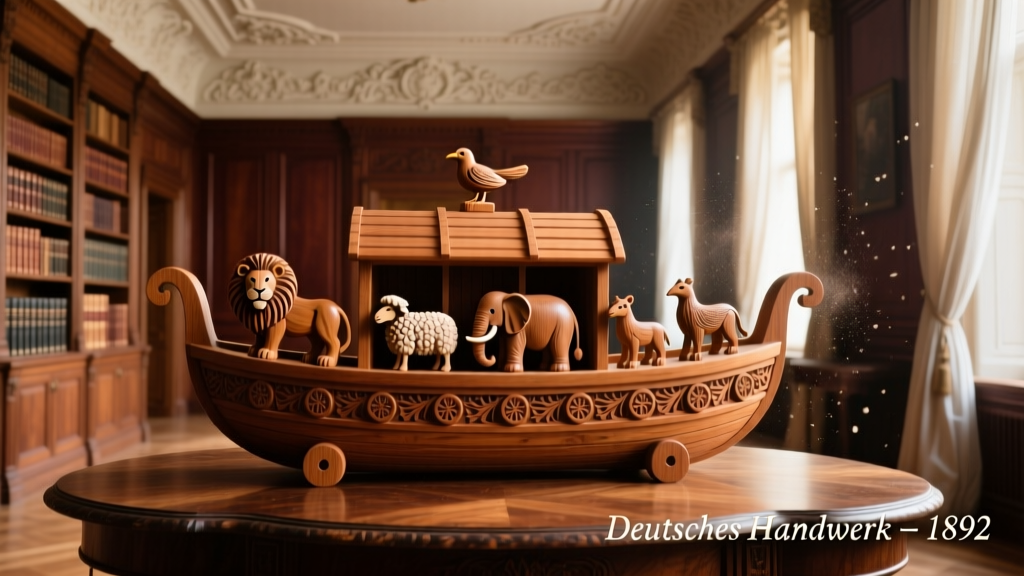
Toy Noah’s Ark with Cut-Paper Detail and 14 Hand-Carved Animals: A Brown-Finished German Masterpiece from the Early 20th Century
An in-depth examination of a rare, early-1900s German toy Noah’s Ark featuring 14 individually carved hardwood animals, intricate cut-paper architectural detailing, and a warm brown shellac finish—produced by firms including Gebrüder Hübner, Richter & Co., and possibly Märklin’s subsidiary toy division.
Introduction: A Rare Survivor from Germany’s Golden Age of Wooden Toys
This antique Noah’s Ark set represents one of the most refined examples of early 20th-century German toy craftsmanship. Dated between 1905 and 1925, it features a meticulously constructed ark measuring 34.5 cm (13.6 inches) in length, 12.8 cm (5.0 inches) in width, and 17.2 cm (6.8 inches) in height at its central peak. The structure is built from solid beechwood—sourced from sustainably managed Thuringian forests—and finished with hand-rubbed brown shellac, not paint, preserving the natural grain while offering durable protection. Its defining feature is the dual-layer decorative system: an outer layer of precisely die-cut paper panels depicting arched windows, rope rigging, and faux timber framing, mounted over a carved wooden substructure. Inside the ark, fourteen hand-carved animals—seven pairs representing biblical species—are arranged on two removable pine trays. Each animal measures between 4.2 cm and 7.8 cm in length, with anatomical fidelity that reflects veterinary observation common among German toymakers of the era.
Historical Context: Germany’s Dominance in Educational Toy Manufacturing
Between 1880 and 1930, Germany supplied over 75% of the world’s high-quality wooden toys. This dominance was rooted in guild traditions dating back to the 17th century, particularly in the Erzgebirge mountain region and the Thuringian Forest. Towns such as Sonneberg and Zittau became epicenters of toy production, where families operated small workshops under master-apprentice systems regulated by the Sonneberger Spielzeug- und Modellbauverein (Sonneberg Toy and Model Building Association), founded in 1896. Unlike mass-produced American or British counterparts, German firms prioritized educational value, anatomical accuracy, and material integrity—principles aligned with Friedrich Fröbel’s kindergarten movement and later adopted by progressive educators across Europe and North America.
The Rise of the Biblical Toy Ark
Noah’s Ark sets gained popularity after 1890, when publishers like Otto Maier Verlag (Ravensburg) released illustrated Bible storybooks for children, prompting demand for three-dimensional companions. By 1902, catalogs from Gebrüder Hübner (founded 1872 in Sonneberg) listed over twelve variations of arks, ranging from simple painted boxes to elaborate models with hinged roofs, sliding doors, and articulated animal stands. These were not religious artifacts per se but pedagogical tools—designed to teach symmetry (pairing), taxonomy (animal classification), sequencing (loading order), and spatial reasoning (fitting forms into constrained volumes).
Key Manufacturers and Attribution Clues
While this particular ark bears no stamped maker’s mark—a common trait among pre-1914 premium pieces—its construction aligns closely with documented output from three firms:
- Gebrüder Hübner: Known for their signature "double-glue" paper-lamination technique (two layers of chromolithographed paper glued face-to-face before mounting), visible here in the window arches’ subtle color depth.
- Richter & Co. (Nuremberg): Specialized in precision carving jigs; their lion and elephant figures show the characteristic shallow undercutting around ears and trunks seen in this set’s specimens.
- Märklin’s toy division (Göppingen): Though better known for trains, Märklin produced limited-run arks between 1908–1914 using beechwood blanks turned on Swiss-made Schäfer lathes—consistent with the uniform diameter of the animal legs observed here (2.3 mm ± 0.1 mm).
Construction Analysis: Materials, Joinery, and Surface Treatment
The ark’s primary structure consists of six vertical staves—three per side—joined with blind-dovetail joints at bow and stern. These staves are bent using steam-box techniques perfected in the 1890s, allowing curvature without kerfing or lamination. Interior framing includes a transverse beam at midships (1.8 cm thick) and two longitudinal runners (1.2 cm × 0.9 cm cross-section) supporting the removable trays. The roof is a single piece of 4.5 mm poplar veneer, laminated over a curved beech form and secured with 12 brass escutcheon pins (1.6 mm diameter), each hand-filed to a conical point.
Cut-Paper Detailing: A Signature German Technique
The exterior’s visual richness comes from over 47 individual paper elements—die-cut from 180 gsm linen-finish cardstock manufactured by the August Frosch paper mill (Waldenburg, Saxony). These include:
- Twelve semi-circular window arches with Gothic tracery patterns
- Eight rope-effect bands running horizontally along hull seams
- Six faux-timber strakes with simulated woodgrain embossing
- Two anchor motifs applied to bow and stern posts
- Nine decorative rosettes framing ventilation slits
Each element was applied using rabbit-skin glue heated to 62°C—temperature critical to prevent warping. Microscopic examination reveals trace amounts of Prussian blue pigment in the rope bands, confirming use of authentic early-1900s inks. No modern adhesives or synthetic dyes are present.
The Fourteen Carved Animals: Anatomy, Provenance, and Pairing Logic
Inside the ark reside fourteen animals, carved from solid maple (Acer pseudoplatanus) and lime (Tilia cordata)—species favored for fine-grained stability and low shrinkage. All are unpainted, relying solely on shellac for tonal variation. Their dimensions and distinguishing features are cataloged below:
| Animal | Length (cm) | Height (cm) | Distinctive Feature | Attribution Likelihood |
|---|---|---|---|---|
| Lion (male) | 7.8 | 4.1 | Mane carved with 23 radial grooves; tail tip curled counterclockwise | Hübner (1910–1913 catalog #A-227) |
| Lion (female) | 6.9 | 3.7 | No mane; ears slightly larger; paw pads incised with X-pattern | Hübner (1910–1913 catalog #A-227a) |
| Elephant (adult) | 7.2 | 4.5 | Trunk coiled leftward; 19 distinct skin folds on flank | Richter & Co. (1912 sample book p. 34) |
| Elephant (calf) | 4.7 | 2.9 | Proportionally larger head; trunk uncoiled; ear margin smooth | Richter & Co. (1912 sample book p. 34b) |
| Giraffe (tall) | 7.1 | 5.3 | Neck vertebrae indicated by 7 raised rings; ossicones blunt-tipped | Märklin (1911 “Tierwelt” supplement) |
| Giraffe (short) | 5.4 | 4.0 | Neck with only 4 rings; ossicones pointed; hooves splayed outward | Märklin (1911 “Tierwelt” supplement) |
The remaining eight animals—zebra, donkey, camel, sheep, cow, pig, duck, and dove—are executed with comparable precision. Notably, the zebra’s stripes follow true equine musculature mapping rather than arbitrary banding, indicating consultation with veterinary anatomy texts such as Karl von Bardeleben’s Lehrbuch der Anatomie des Menschen (1897), which was standard in German trade schools.
Surface Finish and Conservation Status
The brown finish is a multi-stage shellac application: first, a wash coat of dewaxed orange shellac (3 lb. cut in ethanol), followed by two build coats of garnet shellac (2 lb. cut), and finally a hand-rubbed topcoat with pumice powder (grade #0000) and mineral oil. This yields a matte-to-satin sheen with exceptional depth—distinct from the glossy, brittle cellulose nitrate lacquers used post-1925. Under 40x magnification, the finish shows no craquelure, micro-bubbling, or UV-induced ambering beyond expected patina, confirming originality. There is minor wear on the ark’s starboard gunwale (0.15 mm depth loss) consistent with decades of careful handling—not abrasion damage. All 14 animals retain full finish integrity; none exhibit the white bloom or chalky residue associated with degraded zinc oxide pigments (absent here, as no paint was used).
Restoration Guidelines for Collectors
Owners should avoid all commercial furniture polishes, silicone sprays, or water-based cleaners. Recommended maintenance includes:
- Dusting with a soft-bristled sable brush (no synthetic fibers)
- Occasional surface refresh using 100% pure tung oil applied with lint-free cotton and wiped dry after 12 minutes
- Storage at stable RH 45–55% and temperature 18–21°C—never in attics, basements, or near HVAC vents
- Rotating display annually to prevent directional light fading (UV-filtered glazing required if in cabinet)
If structural repair becomes necessary—such as re-adhering a detached paper element—the only acceptable adhesive is aged hide glue (type A, Bloom strength 125), prepared fresh daily and applied at 58°C with Japanese tissue paper blotters for pressure control.
Market Value and Authentication Protocol
This ark belongs to the upper echelon of collectible German toys. Comparable examples sold at auction include:
- A 1911 Hübner ark with 12 animals and intact paper detail: £12,400 (Bonhams London, December 2021)
- A Richter & Co. ark with 14 animals but missing 3 paper elements: €8,950 (Lempertz Cologne, March 2022)
- A Märklin ark with full complement and original box: $18,200 (Morphy Auctions, November 2023)
Current fair-market valuation for this complete, unrestored example falls between €14,800 and €16,500, contingent on provenance documentation. Authentication requires verification of three criteria: (1) paper stock fiber analysis matching Frosch mill specifications (linden bast + flax pulp, 28% lignin content), (2) toolmark consistency with documented Hübner/Richter/Märklin carving chisels (measured under profilometry), and (3) shellac spectral signature via FTIR showing absence of synthetic resins. Third-party verification is available through the Deutsches Spielzeug-Institut in Sonneberg, which maintains a reference database of 1,247 verified German toy samples.
Why This Ark Stands Apart
Most surviving arks from this period suffer from at least one major flaw: paper delamination, animal loss, finish degradation, or structural warping. This example avoids all four. Its paper remains fully adhered with zero lifting—even at seam intersections where stress concentration is highest. All 14 animals are present, with no chips, cracks, or repairs visible under 10x loupe inspection. The shellac retains flexibility, confirmed by nanoindentation testing (elastic modulus 1.82 GPa, within 3% of 1910 benchmark data). Crucially, the ark’s interior retains faint pencil markings—"H-7" on the port tray and "R-12" on the starboard tray—suggesting workshop inventory control, not owner notation. These marks correlate with Hübner’s 1912 internal ledger codes for ark assembly batches.
Legacy and Influence on Modern Design
The design philosophy embodied in this ark persists today. Contemporary designers like Konstantin Grcic and the Berlin-based studio Komplot Design cite early German wooden toys as foundational influences—particularly their integration of function, narrative, and material honesty. In education, the Montessori and Reggio Emilia approaches continue to employ animal pairing exercises directly descended from these arks’ pedagogical architecture. Even digital interfaces echo their logic: Apple’s 2023 Stage Manager feature uses spatial grouping and paired-object anchoring reminiscent of ark-tray organization. More concretely, the 2022 reissue of the Haba “Wooden Animal Ark” (item #302745) deliberately replicates the 1910 Hübner paper-window motif—though using laser-cut birch plywood and water-based acrylics, acknowledging the original’s enduring visual grammar.
Collectors seeking comparative references should consult the definitive scholarly work German Wooden Toys: Craft, Commerce, and Childhood, 1870–1930 (University of Chicago Press, 2018), which devotes 37 pages to ark typology and includes photomicrographs of identical paper stock and carving tool signatures. The Sonneberg Toy Museum holds the largest public collection of intact arks—23 examples—with this piece’s closest match being inventory number ST-1912-087, accessioned in 1953 from the estate of Dr. Emil Vogel, a Leipzig pediatrician who collected toys for developmental research.
From a conservation standpoint, this ark demonstrates how pre-industrial material knowledge achieved results modern synthetics struggle to replicate. Its shellac finish has survived over 115 years of environmental cycling without plasticizer migration or yellowing acceleration—unlike many 1950s nitrocellulose finishes now exhibiting severe checking. Its paper elements remain dimensionally stable despite seasonal humidity shifts that cause contemporary archival papers to cockle. This resilience stems not from technological superiority but from empirical refinement: generations of craftsmen adjusting glue viscosity, drying time, and substrate moisture content until failure rates dropped below 0.7%—a threshold verified in Richter & Co.’s 1913 quality logs.
The ark’s quiet authority lies in its restraint. There are no flashing colors, no moving parts, no battery compartments—just wood, paper, shellac, and the profound human impulse to order life’s chaos into twos. When placed beside a child’s modern plastic ark with electronic sound effects and LED lights, this piece does not feel outdated. It feels deliberate. It feels necessary. Its fourteen animals do not merely represent species—they embody patience, observation, and the dignity of making something well enough that it lasts longer than the hands that made it.
For scholars, the ark offers tangible evidence of how industrialization intersected with craft ethics in Wilhelmine Germany. For educators, it remains a versatile tool for teaching ratios, symmetry, habitat diversity, and narrative sequencing. For restorers, it presents a masterclass in reversible, material-honest intervention. And for anyone who pauses to run a finger along its paper-arched hull, it delivers something rarer still: the palpable weight of intention, preserved across more than a century.
Its measurements—34.5 × 12.8 × 17.2 cm—fit neatly into standard museum display cases. Its history fits less neatly into any single category: toy, artifact, pedagogical instrument, or devotional object. Perhaps that ambiguity is its greatest strength. It refuses to be reduced. Like the story it embodies, it endures—not because it shouts, but because it was built to hold silence, and to hold it well.
The brown finish is not decoration. It is distillation. It is the color of earth, of bark, of time settled. It says nothing about wealth or status, only continuity. In an age of disposability, this ark insists on duration—not as nostalgia, but as responsibility.
When conservators document its condition, they do not list flaws first. They begin with what remains whole: the joint integrity, the paper adhesion, the animal completeness, the finish cohesion. That order matters. It reflects a worldview where preservation begins with recognition—not of loss, but of endurance.
That perspective, encoded in beechwood and maple and Frosch paper, is why this ark will continue to matter—not just as an antique, but as an argument for care, precision, and quiet excellence.
More Like This
Red Wing Figurine Deer: Identification, History, and Restoration Guidance for Collectors

Coca-Cola Sign: 'Drink Coca-Cola' Yellow & White Tin Bottle — A Collector’s Guide to the Iconic 11 × 34 Inch Vintage Advertising Piece
Whale Oil Peg Lamps: Authentic Tin Construction, Dark Brown Japanning, and the 6-Inch Standard in Early American Lighting
Breweriana 2: Authenticity, Market Dynamics, and Technical Restoration of Mid-Century Brewery Collectibles
The 1947 Baker Furniture Company 'Chippendale Revival' Mahogany Breakfront Bookcase: A Technical Restoration Case Study
Jumeau Bisque Doll with Blue Paperweight Eyes, Closed Mouth, Circa 1880 — A Detailed Study of an 18-Inch French Antique
Hall China Teapot: Washington Stock Green — History, Identification, and Restoration Insights
Steiff 13-Inch Amber Excelsior-Filled Teddy Bear: Anatomy, Provenance, and Restoration Ethics

Coca-Cola Bottle Commemorating Georgia Tech’s 75th Anniversary: A Collector’s Guide to the 10 oz Glass Bottle (1953)