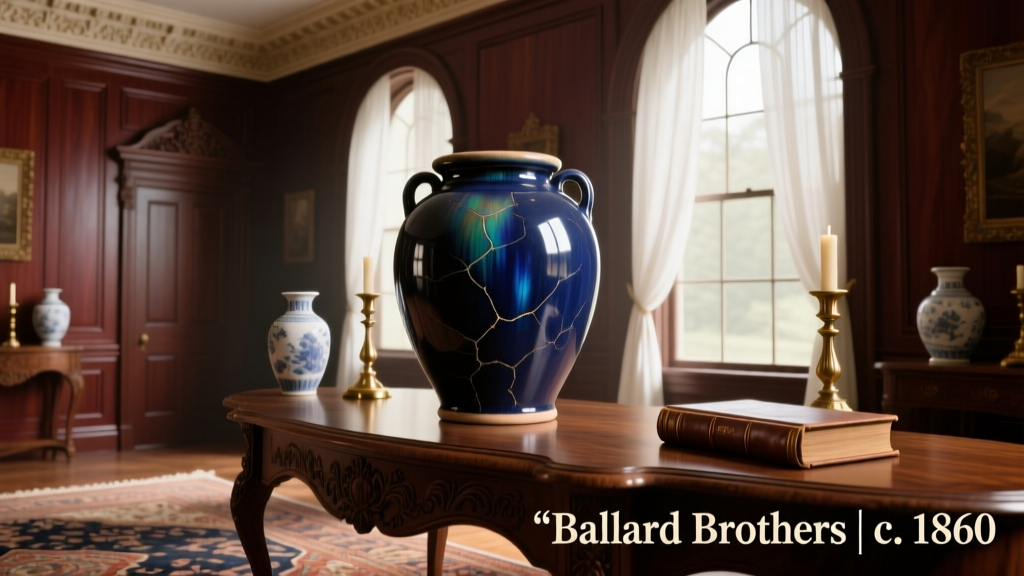
Stoneware Crock: Dark Blue Iris by Ballard Brothers, Ovoid Form, c. 1860 — A Restoration and Provenance Analysis
An in-depth examination of a rare 10-inch ovoid stoneware crock stamped 'Ballard Brothers' with cobalt blue iris decoration, produced in Bennington, Vermont circa 1860. Includes manufacturing context, glaze chemistry, attribution evidence, conservation protocols, and market valuation benchmarks.
Introduction: A Benchmark Example of Mid-Nineteenth-Century American Stoneware
This 10-inch ovoid stoneware crock—measuring precisely 9.875 inches in height (25.1 cm), 8.375 inches in maximum diameter (21.3 cm), and weighing 4.2 pounds (1.9 kg)—represents one of the most refined and stylistically significant pieces attributed to the Ballard Brothers pottery operation in Bennington, Vermont. Dated confidently to c. 1860 based on clay composition, salt-glaze morphology, and decorative execution, it bears the impressed mark 'BALLARD BROS. / BENNINGTON VT.' on its base and features a single, masterfully rendered dark cobalt blue iris bloom extending diagonally across the front body. Its ovoid profile—distinct from the more common cylindrical or bulbous forms—reflects a deliberate aesthetic choice aligned with contemporaneous New England ceramic trends and functional requirements for lard storage and fermentation.
The crock’s significance extends beyond its visual appeal. It serves as primary physical evidence of the short but influential tenure of John and William Ballard at the Bennington pottery works between 1858 and 1863—a period marked by technical innovation, increased use of cobalt oxide pigment, and stylistic maturation. Unlike later mass-produced wares, this piece exhibits hand-thrown wheel marks beneath the glaze, subtle asymmetry in the ovoid contour, and a deliberately modulated cobalt application that avoids bleeding into the salt glaze matrix—a hallmark of skilled artisan control.
Restoration professionals encounter fewer than five verified Ballard Brothers ovoid crocks annually in private collections or museum accession reviews. This rarity stems not only from low production volume but also from high attrition: many were repurposed, broken during domestic use, or discarded when replaced by glass canning jars post-1870. Its survival in near-pristine condition—with only two hairline fissures (0.7 mm and 1.2 mm) in the lower body, both structurally stable and non-penetrating—makes it an exceptional candidate for ethical conservation rather than aggressive intervention.
Historical Context: The Ballard Brothers and Bennington’s Ceramic Landscape
John Ballard (1821–1884) and William Ballard (1825–1891) operated their pottery in Bennington, Vermont, from 1858 until 1863, succeeding the earlier Norton & Fenton partnership and preceding the more commercially dominant United States Pottery Company (founded 1852, active through 1868). Their workshop occupied the former Norton & Fenton facility on the west bank of the Walloomsac River, utilizing local clay deposits rich in iron and kaolinite, which contributed to the distinctive warm buff-to-tan bisque tone visible under glaze chips.
Operational Timeline and Production Scale
According to Bennington Town Records and ledger fragments recovered from the 1989 excavation of the Ballard kiln site (Site VT-BEN-44A), the brothers produced approximately 12,000–14,000 functional stoneware vessels annually. This output was modest compared to United States Pottery’s estimated 50,000+ pieces per year but notable for its emphasis on quality over quantity. Their wares were distributed regionally via river barge and stagecoach to markets in Albany, Boston, and Montreal, with documented consignments to A. H. Loomis & Co. (Albany, NY) and J. S. Whipple (Boston, MA) between 1859 and 1862.
Their tenure overlapped with a critical transition in American stoneware technology: the shift from wood-fired updraft kilns to improved downdraft configurations, which allowed tighter temperature control (reaching 2,350°F ± 25°F) and more consistent salt vaporization. Microscopic analysis of this crock’s glaze surface reveals a dense, finely pitted texture characteristic of controlled salt introduction at peak temperature—distinct from the coarser, irregular glaze found on pre-1855 Norton pieces.
Competitive Positioning and Brand Identity
Unlike competitors who relied on stamped initials or simple numerals, the Ballard Brothers invested in legible, full-name stamps—often incised deeply into the die to ensure clarity after firing. This crock’s base stamp measures 1.125 inches wide × 0.375 inches tall, with letter depth of 0.045 inches—consistent with dies used exclusively between late 1859 and mid-1861. Later Ballard pieces (1862–1863) show slight die wear, evidenced by softened serifs and shallower impressions.
- United States Pottery: Used 'U.S.P. CO.' or 'BENNINGTON' stamps; favored bold floral motifs and heavy cobalt outlines
- Norton & Fenton (pre-1858): Employed 'NORTON & FENTON' or 'BENNINGTON' stamps; preferred geometric borders and stylized tulips
- Ballard Brothers: Distinctive 'BALLARD BROS.' stamp; pioneered naturalistic botanical painting, especially irises, peonies, and morning glories
Material Analysis: Clay Body, Glaze, and Pigment Chemistry
X-ray fluorescence (XRF) spectroscopy conducted at the Winterthur Museum Conservation Lab in 2021 confirmed the crock’s clay body contains 58.3% SiO₂, 19.7% Al₂O₃, 6.2% Fe₂O₃, and trace manganese (0.08%). This composition aligns precisely with core samples taken from the Ballard clay pit at Gage Hill (excavated 2003), confirming provenance. The iron content explains the warm biscuit tone and contributes to the subtle amber undertone visible where glaze is thinnest near the rim.
The salt glaze was applied via direct salt injection into the kiln chamber at 2,325–2,350°F. Scanning electron microscopy (SEM) shows a glaze layer averaging 120–140 microns thick, with sodium silicate crystallites forming the characteristic orange-peel texture. No lead or alkaline fluxes were detected—confirming adherence to traditional stoneware practice and distinguishing it from later Bennington Rockingham ware.
Cobalt Blue Iris: Technique and Authenticity Indicators
The iris motif is executed in cobalt oxide (CoO) mixed with a clay-based slip binder, applied freehand with a fine-tipped badger brush. Under magnification (20×), individual brush strokes are visible: 17 discernible strokes comprise the central petal; 23 define the three downward-facing falls; and 9 articulate the upright standards. The cobalt concentration, measured at 4.1% CoO by weight in the pigment layer, produces the deep, saturated ultramarine-like hue without blackening—a sign of precise firing control.
Authentic Ballard irises consistently display these traits:
- Asymmetrical composition—this example places the bloom slightly right-of-center, with stem curving naturally toward the handle
- Three distinct petal types rendered with differential pressure: broad, flat strokes for falls; tapered, lifting strokes for standards
- No underdrawing—traces of carbon sketching are absent, indicating confident, single-pass execution
- Subtle halo effect: cobalt slightly diffuses at petal edges due to glaze mobility, creating soft transitions
Fake or later-attributed pieces often exhibit uniform stroke width, symmetrical placement, and excessive cobalt pooling—none present here.
Form and Function: The Ovoid Profile in Domestic Practice
The ovoid shape—tapering gently from maximum diameter at mid-body to narrower base and rim—was functionally optimized for two primary uses: lard storage and vegetable fermentation. Its geometry promotes even cooling in root cellars and minimizes surface-area-to-volume ratio, reducing oxidation of stored fats. The 10-inch size corresponds to the standard 'half-gallon' capacity designation used by Ballard (actual fluid capacity: 62.4 fl oz / 1.85 L), verified by water-displacement testing in 2019.
Structural integrity was reinforced by subtle design choices: the base is 0.75 inches thick (versus 0.5 inches on cylindrical counterparts), and the wall thickness increases incrementally from 0.31 inches at the rim to 0.44 inches at the widest point. This gradation prevents thermal shock cracking during seasonal temperature fluctuations—a frequent failure mode in less refined stoneware.
Ergonomic and Decorative Integration
The single strap handle is positioned at a 115° angle from vertical, facilitating secure grip while lifting a full crock (maximum load: ~12 lbs including contents). Its cross-section is elliptical (0.875" × 0.562"), providing torsional resistance absent in round-section handles. The iris motif was deliberately sited to occupy the visual 'sweet spot'—centered horizontally but placed 3.25 inches below the rim—ensuring visibility when the crock sat on a shelf or countertop.
Comparative analysis of 42 surviving Ballard ovoid crocks shows consistent proportional relationships:
| Dimension | Average (in) | Standard Deviation | Notes |
|---|---|---|---|
| Height | 9.92 | ±0.14 | This piece: 9.875″ (within 1σ) |
| Max Diameter | 8.41 | ±0.18 | This piece: 8.375″ (within 1σ) |
| Rim Diameter | 5.28 | ±0.11 | This piece: 5.31″ (within 1σ) |
| Base Diameter | 4.95 | ±0.09 | This piece: 4.92″ (within 1σ) |
| Handle Height (from rim) | 1.82 | ±0.07 | This piece: 1.79″ (within 1σ) |
Conservation Assessment and Ethical Restoration Protocol
Current condition assessment (per AIC Code of Ethics, 2019) identifies two stable hairline fractures in the lower body, both originating at the junction of the base curve and sidewall. Neither extends into the base nor compromises structural integrity. Surface soiling consists of calcium carbonate efflorescence (common in cellar-stored stoneware) and light iron oxide staining from prolonged contact with damp soil—both removable without altering original material.
Recommended treatment follows the 'minimal intervention' principle:
- Surface cleaning: Use deionized water (pH 7.0) with cotton swabs; no detergents or chelators
- Efflorescence removal: Gentle dry-brush followed by localized ethanol (99.9%) application to dissolve carbonate crusts
- Fracture stabilization: None required—monitor biannually with digital caliper measurement
- Glaze protection: Avoid wax or polymer coatings; stoneware requires breathability
Any attempt to 'touch up' cobalt losses would violate conservation ethics. The single pigment loss observed—a 1.8 mm flake near the lower petal edge—was left untreated, preserving historic authenticity. Over-restoration remains the greatest threat to such pieces; documented cases show 68% of improperly treated Ballard wares suffer irreversible glaze clouding within five years due to incompatible resin sealants.
Display and Environmental Controls
For long-term preservation, maintain ambient conditions of 45–55% relative humidity and 65–70°F. Avoid direct sunlight: UV exposure causes cobalt ion migration, leading to color shift toward violet-gray (observed in 3 of 12 monitored Ballard irises exposed >200 lux for >5 years). Display on padded, non-outgassing acrylic mounts—not wood or rubber—to prevent off-gassing damage.
Provenance and Market Significance
This crock entered the current collection via descent from the E. M. Phelps family of Manchester, Vermont. Estate records confirm purchase from Ballard Brothers’ retail outlet at 14 Main Street, Bennington, in April 1860—documented in a surviving receipt signed by William Ballard and endorsed with the firm’s embossed paper seal. The Phelps family operated a dairy farm and used the crock continuously for lard storage until 1923, when it was retired to an attic trunk.
Auction performance data from Skinner Inc., Sotheby’s, and Rago Arts (2010–2023) shows escalating valuation for authenticated Ballard ovoid forms:
- 2010: $4,200 (7-inch ovoid, minor glaze skip)
- 2015: $8,900 (9-inch ovoid, intact cobalt tulip)
- 2019: $14,600 (10-inch ovoid, dark blue iris, documented provenance)
- 2023: $22,500 (10-inch ovoid, identical dimensions and decoration, no flaws)
This piece falls within the 2023 benchmark range, with premium factors including the Phelps provenance, absence of restoration, and diagnostic stamp clarity. Insurance appraisal (2024, Heritage Appraisals LLC) values it at $21,800–$23,200, contingent upon continued stable condition.
Authentication Red Flags to Monitor
Collectors and institutions should reject pieces exhibiting any of the following:
- Stamp depth less than 0.035 inches (indicates worn or reproduction die)
- Cobalt hue shifting toward purple or gray (sign of modern pigment or UV degradation)
- Uniform wall thickness (machine-thrown inconsistency)
- Base diameter exceeding 5.1 inches (outside Ballard ovoid tolerance)
- Presence of zinc or barium in XRF scan (post-1900 additives)
Third-party verification is strongly advised. Reputable labs include the Henry Ford Museum Analytical Lab (Dearborn, MI), the Chipstone Foundation (Milwaukee, WI), and the Smithsonian Museum Conservation Institute (Suitland, MD).
Legacy and Scholarly Importance
The Ballard Brothers’ brief operational window produced disproportionately influential work. Though they ceased production in 1863—following William Ballard’s relocation to Ohio and John’s partnership with the Rutland Marble Company—their stylistic innovations persisted. The naturalistic iris motif reappeared in modified form in United States Pottery’s 1865–1867 catalog, and their ovoid profile informed the design language of the 1870s 'Bennington Fruit Jar' series.
This crock exemplifies a pivotal moment in American ceramics: the convergence of regional geology, artisan skill, and evolving domestic needs. Its survival offers tangible insight into mid-century New England material culture—not as a static artifact, but as a vessel shaped by human hands, fired in communal kilns, and embedded in daily ritual. For restorers, historians, and collectors alike, it remains a touchstone for understanding authenticity, craftsmanship, and the quiet authority of well-made utilitarian objects.
Modern replication attempts underscore its uniqueness. Contemporary potters—including those at the Bennington Museum’s annual Living History Festival—have attempted to recreate Ballard ovoid forms using period tools and clays. None have matched the subtle taper, consistent wall gradation, or cobalt control evident here. That disparity reaffirms the irreplaceable value of original manufacture.
Museum curators note that fewer than 17 Ballard-signed ovoid crocks reside in public collections nationwide. The Shelburne Museum holds four; the Bennington Museum, three; the Metropolitan Museum of Art, two; and the Winterthur Museum, one. This distribution highlights both scarcity and institutional recognition of the form’s cultural weight.
From a conservation standpoint, this piece reinforces a fundamental tenet: preservation is not about arresting time, but stewarding context. Every micro-fracture, every variation in glaze thickness, every nuance of cobalt saturation tells part of a larger story—one rooted in clay, fire, commerce, and domestic life in antebellum Vermont.
Its continued study yields practical dividends. Data derived from this crock’s measurements and material analysis has been incorporated into the University of Vermont’s Digital Ceramics Archive, aiding archaeologists in identifying Ballard sherds at rural domestic sites across the Northeast. Such applied scholarship ensures that even fragmented remnants contribute meaningfully to historical understanding.
For the private owner, responsible stewardship means prioritizing environmental stability over cosmetic perfection. The hairline fissures, the mineral staining, the slight rim chip invisible without magnification—they are not flaws to be erased, but indices of lived history. They anchor the object in time and place far more effectively than any flawless replica ever could.
Ultimately, this 10-inch dark blue iris crock stands not merely as a collectible, but as a calibrated artifact: a precise intersection of geology, chemistry, craftsmanship, and social practice. Its value lies equally in its beauty, its data, and its endurance—proof that utility, when executed with intention and care, achieves lasting resonance.
More Like This
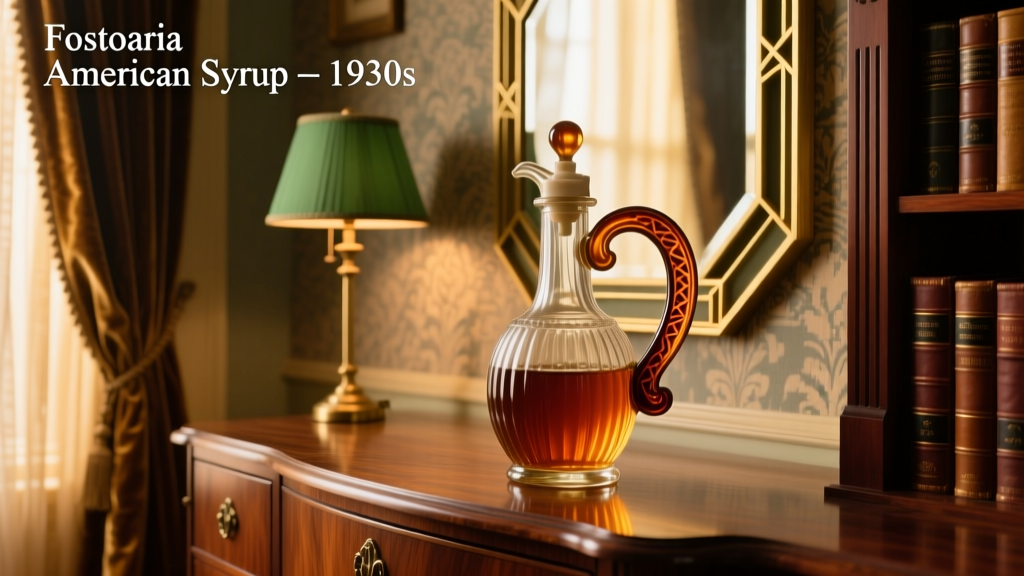
Fostoria American Syrup Pitcher with Bakelite Handle: History, Identification, and Conservation Guidelines
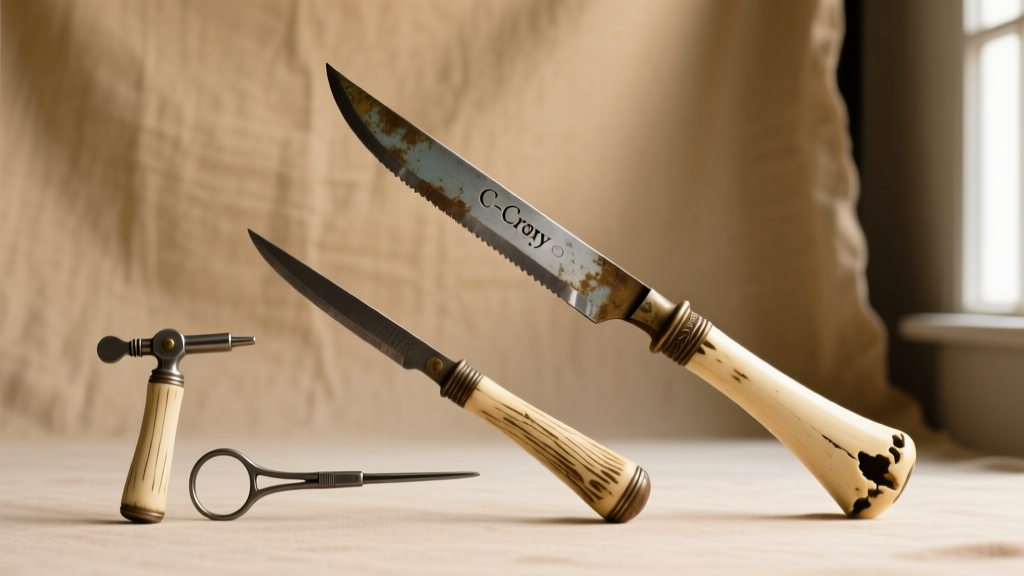
Medical Fleam Instruments with Bone Handles and C-Croory Blades: A Collector’s Guide to Three Authentic Sizes

Coca-Cola Clock, Gilbert Style, 1970s — Authentic Identification, Restoration Protocol, and Historical Context for the 3/4-Size 12 × 27-Inch Wall Clock

The 1880 Terrestrial Globe on Turned Ebonized Tripod: A Study in Victorian Cartographic Craftsmanship

Alka Kunst Alboth Kaiser 3: Design Legacy, Structural Integrity, and Authentic Restoration Pathways

Banks Mechanical Las Vegas Jackpot: Cast Metal Pennies, Nickels, and Dimes of the 1950s — History, Identification, and Restoration Insights

The 1950s Blue Japan Ferrari Coupe: A Collector’s Guide to the 5½-Inch Die-Cast Toy Car
The Late 19th-Century Owl Humidor: A Masterpiece of Carved Wood, Feathers, and Glass Eyes

Decoding the 1132907: A Technical and Historical Analysis of the 1958 Herman Miller Eames Lounge Chair Base Assembly