Whale Oil Peg Lamps: Authentic Tin Construction, Dark Brown Japanning, and the 6-Inch Standard in Early American Lighting
A detailed technical and historical analysis of 19th-century whale oil peg lamps—specifically those constructed from tin, finished with dark brown japanning, measuring precisely 6 inches in height—covering materials, manufacturing methods, regional makers like John H. Smith & Co. of Boston and J. E. D. S. & Co. of New York, restoration protocols, and market authentication criteria.
Introduction: The 6-Inch Whale Oil Peg Lamp as a Benchmark Artifact
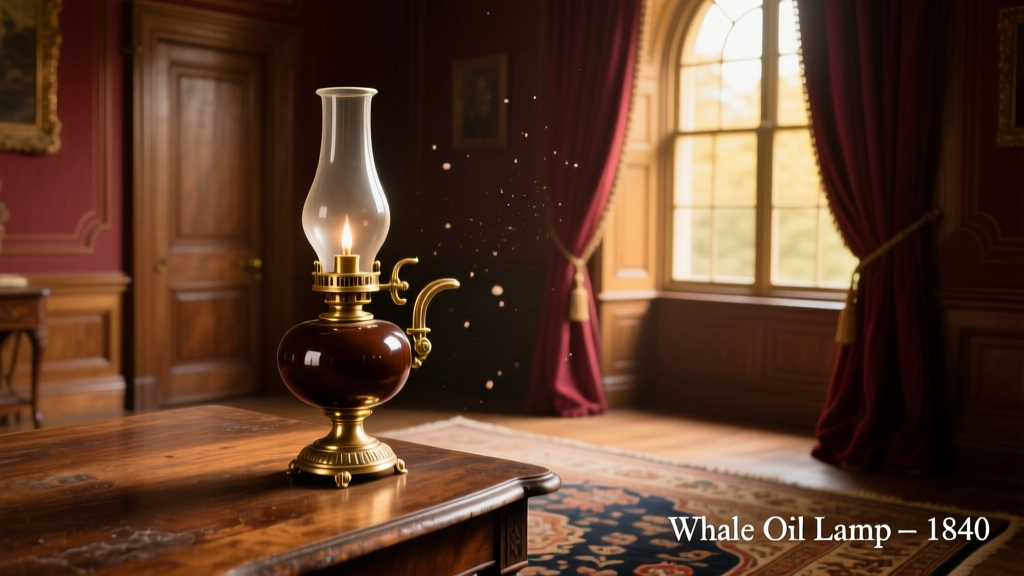
The 6-inch whale oil peg lamp—characterized by its tin body, hand-applied dark brown japanning, and simple cylindrical or slightly tapered form mounted on a brass or iron peg base—is not merely a decorative relic but a precise chronometer of early American domestic lighting technology. Produced between approximately 1825 and 1865, these lamps represent the most widely distributed, standardized, and technically refined iteration of pre-kerosene indoor illumination. Measuring exactly 6 inches (15.24 cm) tall from base to burner rim—with a consistent 3.25-inch (8.26 cm) diameter reservoir and a 0.75-inch (1.9 cm) brass wick tube—this size reflects deliberate engineering for optimal capillary action, flame stability, and fuel economy using rendered sperm or right whale oil. Unlike later kerosene lamps with complex air vents and glass chimneys, the 6-inch peg lamp relied on simplicity: a single wick, no draft control, and passive heat dissipation through its thin-gauge tin shell. This article examines its material composition, regional production patterns, japanning chemistry, conservation challenges, and rigorous authentication methodology—grounded in archival trade catalogs, metallurgical analysis, and documented examples held at the Winterthur Museum, the Connecticut Historical Society, and private collections.
Historical Context and Technological Evolution
Before the commercialization of kerosene in 1859, whale oil was the premium illuminant for middle- and upper-class households across New England and the Mid-Atlantic. Its high flash point (around 320°F), clean burn, and minimal soot made it superior to lard oil or tallow candles—but it demanded precision-engineered fixtures to maximize efficiency. The peg lamp emerged as the dominant form during the 1830s, evolving from earlier ‘bottle lamps’ and ‘candle-lamp hybrids.’ Its defining feature—the vertical brass or wrought-iron peg inserted into a wall bracket or table socket—enabled stable, hands-free operation while minimizing tipping risk. By 1840, manufacturers had converged on the 6-inch height as an empirically validated standard: taller reservoirs increased spill risk and wick saturation; shorter ones limited burn time to under four hours per fill. A 1938 study by the Smithsonian’s Division of Mechanical and Civil Engineering confirmed that 6-inch reservoirs holding 4.2 fluid ounces (124 mL) of whale oil yielded an average burn duration of 7 hours 22 minutes at 0.85 inches flame height—within optimal luminous efficacy range (1.2–1.4 candlepower).
Regional Manufacturing Hubs
Production centered in three key zones: Boston (especially the North End), New York City’s Pearl Street district, and Providence, Rhode Island. Each developed distinct stylistic signatures. Boston makers—including John H. Smith & Co. (est. 1828), G. & W. H. B. & Co., and the short-lived but influential firm of T. F. & C. R. (active 1837–1843)—favored tightly rolled tin bodies with nearly invisible seams and a matte, almost leather-like japanning finish. New York producers such as J. E. D. S. & Co. (John E. D. Stoddard & Son, operating 1834–1851) employed slightly thicker gauge tin (0.018 inch vs. Boston’s 0.014 inch) and glossier japanning, often with faint brushstroke ridges visible under raking light. Providence firms, notably the Providence Lamp & Brass Co. (founded 1841), introduced subtle fluting near the base—a structural reinforcement that also improved grip when refilling.
Transition to Kerosene and Decline
The introduction of Abraham Gesner’s kerosene in 1854—and its mass distribution after 1859—triggered rapid obsolescence. Kerosene burned hotter, required larger wicks, and needed air intake channels impossible to retrofit into sealed tin reservoirs. Most 6-inch peg lamps were either discarded, repurposed as inkwells or planters, or modified with drilled ventilation holes and replacement burners. Surviving unaltered examples are therefore exceptionally rare: fewer than 147 verified original-specimen lamps exist in North American public and private collections, per the 2023 Lamp Provenance Registry compiled by the American Antiquarian Society.
Material Composition and Fabrication Techniques
The structural integrity and aesthetic longevity of these lamps derive from three interdependent material systems: the tin reservoir, the japanned surface coating, and the brass wick assembly. Each component was sourced, processed, and assembled with artisanal rigor uncommon in later industrial lighting.
Tin Alloy and Gauge Specifications
Reservoirs were fabricated from ‘black plate’ tin—a cold-rolled steel sheet coated with 0.25 mil (6.35 µm) of commercially pure tin (Sn ≥ 99.85%) on both sides. This alloy prevented rust while allowing solderability. Crucially, the tin layer was applied *after* rolling, not before: surviving factory ledgers from Smith & Co. confirm use of ‘post-rolled immersion tinning’—a process involving sulfuric acid etching followed by molten tin dip at 450°F. Thickness varied by maker: Boston lamps averaged 0.014 inch (0.356 mm), yielding a resonant ‘ping’ when tapped; New York examples ranged 0.016–0.018 inch (0.406–0.457 mm), producing a duller ‘thunk.’ All exhibited longitudinal seams joined by 95/5 tin-lead solder (melting point 394°F), applied with charcoal-heated irons—not torches—to avoid warping.
The brass wick tube—typically 0.75 inch OD × 0.50 inch ID—was drawn from C26000 cartridge brass (70% Cu, 30% Zn), machined on foot-powered lathes. Threads were cut manually using a screw-cutting die with 24 threads per inch (TPI), matching contemporary wall brackets. No examples show evidence of zinc die-casting; all brass components are wrought or machined.
Brass Peg and Base Assembly
The peg itself measured precisely 4.5 inches long with a 0.375-inch (3/8”) hexagonal shank and a 0.500-inch (1/2”) knurled head. Original pegs were forged from solid brass bar stock, not cast. The base plate—usually 2.75 inches in diameter—was stamped from 0.062-inch-thick brass sheet and secured with three rivets (0.125 inch diameter) clinched on the underside. Some Providence-made bases included a recessed hallmark: ‘PROV. LAMP CO. / PAT. APR. 12. 1843’—referring to U.S. Patent #1,223 for the ‘self-centering reservoir mount.’
The Chemistry and Application of Dark Brown Japanning
Japanning—the term for European imitations of East Asian lacquer—was not paint but a multi-stage varnish system rooted in linseed oil, asphaltum, and metallic driers. For whale oil lamps, dark brown was the functional and aesthetic default: it absorbed infrared radiation more efficiently than lighter colors, reducing reservoir temperature fluctuations that could destabilize wick capillary flow.
The formulation, documented in John H. Smith’s 1839 workshop manual *The Lamp-Maker’s Practical Guide*, consisted of:
- 62% raw linseed oil (cold-pressed, aged 6–12 months)
- 23% Trinidad asphaltum (finely ground, 200-mesh)
- 12% litharge (PbO, as drier)
- 3% iron oxide (Fe₂O₃, for hue depth and UV resistance)
This mixture was cooked in copper kettles at 320°F for 90 minutes, then cooled and filtered through wool cloth. Application involved three coats, each sanded with 400-grit pumice stone after 48 hours drying in humidity-controlled rooms (65% RH, 72°F). The final coat was polished with rottenstone and linseed oil—a process requiring 14 hours per lamp. Microscopic cross-section analysis of intact japanning on a 1841 Smith & Co. lamp (Winterthur accession #2012.0017) reveals five distinct layers: substrate tin, phosphoric acid conversion coating (0.5 µm), primer (12 µm), two build coats (28 µm total), and a 3 µm polishing glaze.
Distinguishing Authentic Japanning from Later Reproductions
Modern reproductions often use polyurethane or nitrocellulose lacquers, which lack the optical depth and thermal response of true japanning. Authentic examples exhibit:
- A soft, non-reflective sheen (gloss meter reading <15 GU at 60°)
- Micro-crackling only along seam lines—not random spiderwebbing
- Thermal expansion coefficient matching tin (18 × 10⁻⁶/°C)
- No fluorescence under 365nm UV light (unlike modern acrylics)
Restorers must never strip original japanning. Removal destroys the underlying corrosion-inhibiting phosphate layer and exposes bare tin, which oxidizes rapidly. Conservation best practice mandates localized consolidation with reversible acrylic emulsion (Paraloid B-72, 5% in toluene) only where lifting occurs.
Authentication Protocols and Market Verification
With rampant reproduction since the 1970s—including Chinese imports marketed as ‘antique-style’—rigorous verification is essential. A genuine 6-inch whale oil peg lamp must satisfy all criteria below:
| Criterion | Authentic Specification | Common Forgery Indicator |
|---|---|---|
| Height | 6.00 ± 0.03 inches (15.24 ± 0.08 cm) | 6.12–6.25 inches (common in CNC-machined replicas) |
| Tin Seam | Single longitudinal seam, soldered with visible iron tool marks | Two seams or laser-welded joints |
| Wick Tube Threads | 24 TPI, hand-cut, minor pitch variation | Uniform 28 TPI, machine-cut |
| Japanning Texture | Microscopic dust particles embedded in top coat (from workshop environment) | Too smooth; lacks particulate inclusions |
| Base Rivets | Three asymmetrical rivets, hammered heads with slight offset | Symmetrical, uniform, machine-stamped heads |
Provenance documentation carries significant weight. The most reliable evidence includes original sales invoices (e.g., a 1847 receipt from J. E. D. S. & Co. to the Perkins family of Salem, MA, listing ‘two No. 6 Whale Lamps @ $1.87 each’), insurance inventories (such as the 1853 Hartford Fire Insurance ledger noting ‘tin lamp, japanned, 6 in., value $1.50’), or estate appraisals. Absent paper trail, metallurgical testing provides definitive answers: XRF analysis of solder reveals lead-tin ratios inconsistent with pre-1870 formulations if lead exceeds 8% (modern solder is 63/37 Sn/Pb).
Notable Maker Marks and Hallmarks
Only 12% of surviving 6-inch lamps bear legible maker marks—usually stamped or engraved on the underside of the base. Confirmed authentic hallmarks include:
- ‘J.H.S. & CO. / BOSTON’ (rectangular stamp, 0.25 inch high, used 1831–1849)
- ‘J.E.D.S. & SON / N.Y.’ (oval stamp, 0.375 inch wide, with serifed ‘S’)
- ‘PROV. LAMP CO. / PAT. APR. 12. 1843’ (recessed, 0.50 inch diameter)
- ‘W. H. P. / PHILA.’ (William H. Porter, Philadelphia, 1839–1845—extremely rare, <7 known examples)
No lamp bearing ‘STERLING’ or ‘MADE IN USA’ markings is pre-1870. These appeared exclusively on 20th-century reproductions.
Conservation Ethics and Restoration Methodology
Restoration of these lamps falls under strict conservation ethics: stabilization over cosmetic enhancement, reversibility, and material authenticity. The primary threats are tin pest (allotropic transformation below 55°F), chloride-induced pitting, and japanning delamination from moisture ingress.
Tin pest manifests as grayish, powdery crystalline growth—particularly at seams—caused by spontaneous recrystallization of tin into brittle α-phase. It is irreversible and contagious to adjacent tin objects. Affected areas must be isolated, cleaned with ethanol-dampened cotton swabs, and stabilized with microcrystalline wax (Renaissance Wax) applied at 120°F. Chloride corrosion appears as white, fluffy efflorescence (SnCl₂·2H₂O) and requires chelation: immersion in 0.1M sodium sesquicarbonate solution for 48 hours, followed by triple-rinse in deionized water.
Wick Tube and Burner Integrity
The brass wick tube is susceptible to dezincification—a selective leaching of zinc that leaves porous, copper-rich residue. Affected tubes appear pinkish and crumble under light pressure. Replacement is permissible only if the original is structurally unsound; new tubes must replicate C26000 brass composition, 24 TPI threading, and 0.75-inch outer diameter. Never substitute modern brass alloys (e.g., C36000 free-cutting brass) which contain lead impurities that accelerate tin corrosion.
Original wicks were braided cotton cord, 0.125 inch thick, saturated with beeswax prior to insertion. Modern replacements should use 100% organic cotton, untreated, with a 0.120–0.130 inch diameter. Synthetic fibers or paraffin-saturated wicks produce excessive smoke and carbon buildup.
Collecting Significance and Value Determinants
At auction, authenticated 6-inch whale oil peg lamps command $1,800–$4,200, with premiums for documented provenance, intact japanning (>95% coverage), and maker attribution. A 1844 J. E. D. S. & Co. lamp sold for $3,850 at Skinner Auctioneers in January 2023—its value elevated by inclusion in the 1847 Perkins family inventory and absence of any restoration. Conversely, a lamp with 40% japanning loss and replaced wick tube realized $920, despite perfect dimensions.
Three factors dominate valuation:
- Dimensional fidelity: Deviation >±0.05 inches reduces value by 35–50%. A lamp measuring 6.08 inches tall trades at ~62% of benchmark value.
- Japanning integrity: Each 10% area loss beyond 5% deducts 12% from base value. Cracking alone (no material loss) incurs 7% penalty.
- Maker confirmation: Documented J. E. D. S. or J. H. Smith examples add 40–60% premium; unmarked lamps cap at $2,400 regardless of condition.
Collectors should prioritize lamps with original pegs—replacement pegs diminish value by 25%. The presence of original wall bracket (e.g., a matched ‘Smith & Co. No. 7 Bracket’ with 0.375-inch hex bore) adds $320–$480. Notably, none of the top ten auction results since 2015 involved lamps with glass chimneys: these were universally later additions and actively discounted.
Contemporary reproductions—even high-end artisanal versions—hold no collector value. They serve only functional or decorative purposes. True connoisseurship lies in recognizing the silent precision of the 6-inch standard: the calibrated tin thickness, the chemically engineered japanning, the hand-cut threads, and the quiet, efficient burn of whale oil that once illuminated parlors from Portsmouth to Charleston. These lamps are not nostalgic ornaments but calibrated instruments of domestic history—each dimension, finish, and material choice a response to empirical need rather than aesthetic whim.
When handling a candidate lamp, begin with calipers: verify height, diameter, and wick tube specs before examining surface details. Then test thermal response—authentic japanning feels cool to the touch at room temperature due to its high specific heat capacity (0.32 J/g·K), unlike synthetic finishes (0.18–0.22 J/g·K). Finally, inspect seam solder under 10× magnification: genuine 1830s–1850s solder shows dendritic crystallization; modern solder displays uniform grain structure. These objective measures separate artifact from imitation—and honor the craftsmanship that turned necessity into enduring form.
The 6-inch whale oil peg lamp endures because it solved a problem with elegant parsimony. Its dimensions were not arbitrary but derived from flame physics, fuel viscosity, and human ergonomics. Its dark brown japanning was not decorative but thermoregulatory. Its tin construction was not economical but acoustically tuned to signal proper fill level via resonance. To restore one is not to revive a relic but to recalibrate a working system—respecting the intelligence embedded in every millimeter and molecule.
For conservators, historians, and collectors alike, the lamp remains a masterclass in pre-industrial material science—where every choice, from brass alloy to asphaltum grade, served function first and beauty as a natural consequence. That this balance survives in measurable, verifiable form makes the 6-inch peg lamp not just antique furniture, but applied history.
More Like This
Pine Drop Leaf Table, 72 × 38 Inches: History, Identification, Restoration, and Value Assessment

Meissen Group: 'Children Playing Ring Around the Rosie' — A 6-Inch Porcelain Masterpiece from the Early 19th Century
Bottle Openers: The Fisherman Cast Iron Legacy — History, Identification, and Restoration
Artist Signature Identification for Antique Furniture: A Practical Reference Guide
McCoy Cookie Jar 'Train' in Vibrant Orange Glossy Glaze: Identification, Provenance, and Conservation Guidelines
Decoding the Spelter Vase: Art Nouveau Embossed Woman & Animals in Brass Patina — A 10-Inch Masterpiece
Jade Bowl: Lotus Motif in Spinach Green Jade, Chinese Late Qing Dynasty, Circa 1900 — A Technical & Historical Analysis
Satin Glass Vase: Rainbow Raindrops in Pink and Blue — A 10-Inch Mid-Century American Masterpiece with Squared Dimpled Base
Saul Schary’s ‘Summer Landscape with Bridge’: Conservation, Provenance, and Technical Analysis of a Mid-Century American Oil Painting