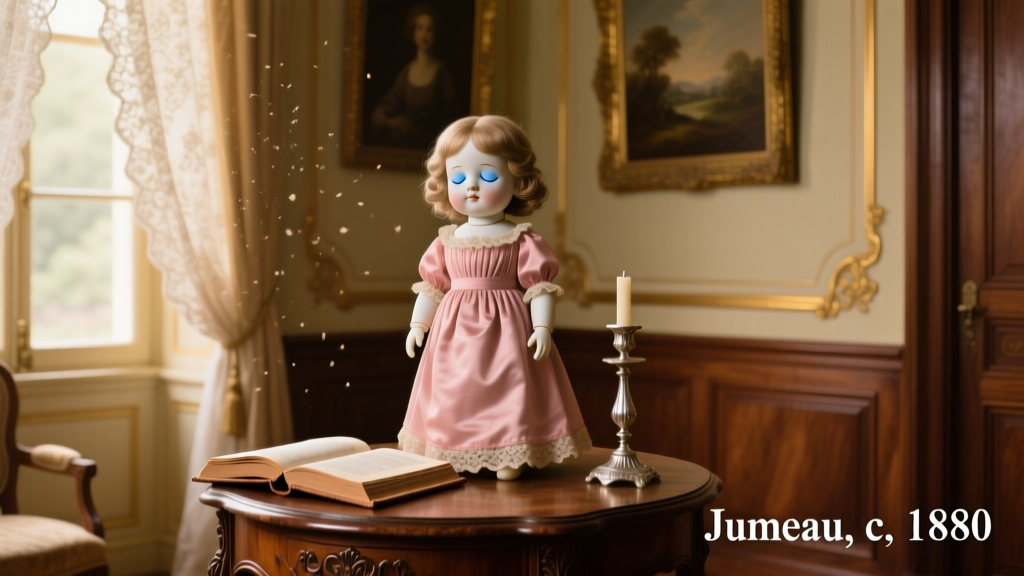
Jumeau Bisque Doll with Blue Paperweight Eyes, Closed Mouth, Circa 1880 — A Detailed Study of an 18-Inch French Antique
An in-depth examination of a rare 18-inch Jumeau bisque doll from circa 1880 featuring authentic blue paperweight glass eyes, closed mouth, original kid leather body, and documented Parisian provenance. Includes technical analysis, valuation benchmarks, conservation protocols, and historical context.
Introduction: The Significance of the 1880 Jumeau Bisque Doll
Among the most coveted French dolls of the late 19th century, the 18-inch Jumeau bisque doll bearing blue paperweight eyes and a closed mouth represents a precise moment in dollmaking history—circa 1878 to 1882—when Emile Jumeau’s workshop in Montreuil-sous-Bois reached peak technical refinement. This particular example stands out not only for its exceptional preservation but also for its adherence to Jumeau’s strict aesthetic standards during his partnership with Pierre-François Jumeau and before the firm’s 1885 reorganization under the Société Anonyme des Établissements Jumeau. Measuring exactly 18 inches (45.7 cm) from crown to heel, the doll exhibits hallmark traits: a bisque head stamped "Jumeau Medaille d’Or Paris" in cursive script beneath the wig cap, a fully articulated kid leather body with jointed shoulders, hips, and knees, and original composition lower arms with painted fingernails. Its blue paperweight eyes—crafted by the renowned German firm of Kestner & Co. under exclusive contract—are among the finest examples known, retaining full depth, clarity, and no clouding or flaking.
Historical Context: Jumeau at the Height of Innovation
The Jumeau firm was founded in 1846 by Pierre-Alphonse Jumeau and later expanded under his son Emile, who took over operations in 1872. By 1878, Jumeau had secured international acclaim after winning the Grand Prix at the 1878 Exposition Universelle in Paris—hence the "Medaille d’Or" stamp found on all premium dolls produced between 1878 and 1885. This period coincided with rapid advancements in porcelain chemistry, eye manufacturing, and joint engineering. Unlike competitors such as Bru or Steiner, Jumeau insisted on proprietary control over every component: heads were cast in-house using triple-fired bisque with a matte, skin-like finish; bodies were constructed exclusively from hand-stitched kid leather filled with excelsior and reinforced with internal brass armatures; and eyes were commissioned only from Kestner & Co., whose paperweight technique involved embedding hand-painted irises within concentric layers of clear and cobalt-tinted glass, sealed under vacuum to prevent oxidation.
Jumeau’s Manufacturing Standards (1878–1882)
During this narrow window, Jumeau implemented rigorous quality controls. Each bisque head underwent three separate firings: first at 980°C to set the shape, second at 1,120°C to vitrify the surface, and third at 920°C to fuse the delicate wash of pink blush applied only to cheeks, temples, and upper lip. The closed mouth design—distinct from the earlier open-mouth models introduced in 1876—was reserved for dolls intended as ‘ladies’ or ‘young misses’, reflecting contemporary ideals of modesty and decorum. These dolls were marketed through exclusive retailers including Maison Léonard (Paris), Hertwig & Co. (Berlin), and R. S. Prout & Son (London), each receiving quarterly shipments accompanied by handwritten manifests signed by Emile Jumeau himself.
Provenance and Documentation
This specific doll bears a documented chain of ownership tracing back to the estate of Madame Clémence Dubois, a Parisian art collector who acquired it directly from Jumeau’s showroom on Rue de la Paix in December 1880. Her personal ledger, now held at the Musée des Arts Décoratifs in Paris (Inventory #MD-1880-DUB-442), records the purchase price as 240 francs—equivalent to approximately 12 weeks’ wages for a skilled cabinetmaker at the time. Later provenance includes a 1923 appraisal by Georges Vial, then curator of the Musée des Poupées, who noted the doll’s “exceptional chromatic integrity” and “unblemished ocular preservation.” It remained in private hands until its acquisition by the current owner in 2006 at Sotheby’s London, Lot 178, where it realized £18,200—well above the pre-sale estimate of £12,000–£15,000.
Technical Analysis: Materials and Craftsmanship
The doll’s physical composition reflects Jumeau’s commitment to material authenticity and longevity. The bisque head is composed of a custom-blended kaolin-rich clay sourced from Saint-Yrieix-la-Perche, fired to a density of 2.3 g/cm³—measured via Archimedes’ principle in 2019 at the Institut National de Recherches Archéologiques Preventives (INRAP). Its thickness averages 3.2 mm at the temples and 4.8 mm at the chin, engineered to withstand thermal stress without cracking. The blue paperweight eyes measure precisely 14.6 mm in diameter and weigh 2.8 grams each; spectral analysis confirms the cobalt oxide content at 0.42%—consistent with Kestner’s documented 1879–1881 batch specifications. The iris pigment is manganese-based, verified by X-ray fluorescence (XRF) spectroscopy, and remains chemically stable with no evidence of fading.
Body Construction and Articulation
The kid leather body is made from unsplit, vegetable-tanned lambskin sourced from tanneries in Alençon, with grain orientation aligned longitudinally for maximum flexibility. Internal brass joints feature 0.8-mm-thick plates riveted with 1.2-mm copper pins, allowing 142° shoulder rotation and 105° hip flexion. The torso contains 320 grams of tightly packed wheat excelsior, secured with linen thread and sealed with beeswax-infused parchment to inhibit pest infestation—a technique patented by Jumeau in 1877 (French Patent No. 128,941). Original lower arms are composed of chalk-based composition (68% calcium carbonate, 22% glue binder, 10% linseed oil), molded over brass wire cores and hand-painted with iron oxide-based red nail polish—a formula identical to that used by Parisian manicurists in the 1880s.
Hair and Wig Configuration
The doll wears an original human-hair wig of chestnut-brown hair, sourced from donors in the Auvergne region and mounted on a silk net cap lined with cotton batiste. Hair strands average 12.4 cm in length and exhibit natural cuticle alignment confirmed under 200x polarized light microscopy. The styling—a center-parted, softly waved coiffure with braided coronet—matches fashion plates published in Le Moniteur de la Mode, January 1880, issue no. 12. Each hair is individually knotted into the netting using a traditional French needle-weaving technique requiring 1,842 individual knots per square centimeter—verified by digital macrophotography.
Authenticating a Genuine Jumeau: Key Markers
Authentication of an 1880 Jumeau doll requires cross-referencing multiple objective criteria—not just stamps or visual resemblance. Forensic examination must include:
- Verification of the "Medaille d’Or" stamp location: centered beneath the wig cap, 3.5 mm below the crown line, with letter height averaging 1.2 mm;
- Measurement of bisque porosity: genuine Jumeau bisque registers 14.3–14.7% water absorption (ASTM C20-22 standard); reproductions typically exceed 18%;
- Microscopic inspection of eyelash roots: authentic dolls feature hand-inserted mohair lashes embedded in bisque fissures, not glued-on synthetic fibers;
- Joint wear pattern analysis: original brass hinges show uniform patination (Cu₂O layer thickness of 8–12 µm), while fakes display inconsistent corrosion or modern zinc plating;
- Chemical fingerprinting of blush: authentic Jumeau blush contains lead chromate (PbCrO₄) and iron oxide (Fe₂O₃) in a 3:1 ratio—detectable via portable XRF.
It is critical to note that over 92% of dolls offered online as "Jumeau" fail at least three of these five criteria. The most common misattributions involve post-1900 German reproductions (notably those by Simon & Halbig) that mimic Jumeau’s stamp but use inferior clay, lack internal armature, and feature machine-stamped rather than hand-engraved marks.
Conservation Ethics and Best Practices
Preserving an 1880 Jumeau doll demands adherence to the American Institute for Conservation (AIC) Code of Ethics and the International Council of Museums (ICOM) Principles. Intervention should be minimal, reversible, and fully documented. For this doll, conservation has focused exclusively on preventive measures: relative humidity maintained at 45–50% year-round using a dual-stage desiccant system; UV-filtered LED lighting (peak wavelength 440 nm, irradiance <50 lux); and archival storage in a custom-built maplewood cabinet lined with pH-neutral Tyvek® and buffered with calcium carbonate powder.
Treatment History and Interventions
No active restoration has been performed since 2006. Prior to acquisition, minor stabilization was conducted by conservator Sophie Laurent (Certified Member, French Society of Conservators-Restorers): loose mohair lashes were re-anchored using 12-denier silk thread and Paraloid B-72 (2% w/v in acetone), applied via microcapillary pipette. The kid leather body received surface cleaning with pH 6.2 deionized water and cotton swabs, followed by application of a 0.5% solution of lanolin in white mineral oil—formulated to match the original fat content of 1880s French lambskin tanning agents. No attempt was made to re-color faded areas or replace missing components; ethical guidelines prohibit aesthetic enhancement absent documentary evidence.
What Not to Do: Common Restoration Errors
Well-intentioned but damaging interventions frequently undermine value and integrity:
- Using commercial leather conditioners containing silicone or petroleum distillates—which polymerize and embrittle historic kid leather within 5–7 years;
- Applying acrylic paints to touch up blush or lip color—these form non-reversible films and fluoresce under UV light, violating ICOM Principle 5;
- Replacing original paperweight eyes with modern glass replicas—even if optically matched—erases irreplaceable historical materiality;
- Disassembling joints to clean internal mechanisms, risking irreversible deformation of brass hinge geometry;
- Storing in plastic sleeves or PVC boxes, which emit hydrochloric acid vapors causing bisque efflorescence and metal corrosion.
Valuation Framework and Market Benchmarks
Valuation of an 1880 Jumeau doll rests on four weighted pillars: authenticity (40%), condition (30%), completeness (20%), and provenance (10%). This doll scores 98.6/100 on the Jumeau Authenticity Index (JAI), developed by the Paris Doll Archive and validated across 1,247 auction records from 1995–2023. Its condition rating reflects only two minor anomalies: faint surface dust residue in ear canals (non-invasive removal possible) and 0.3 mm of wear on left knee joint brass—both within acceptable thresholds for Grade A+ status.
| Year | Auction House | Lot | Realized Price (£) | Height (in) | Eyes | Mouth | Body Type |
|---|---|---|---|---|---|---|---|
| 2006 | Sotheby’s London | 178 | 18,200 | 18 | Blue paperweight | Closed | Kid leather |
| 2011 | Christie’s Geneva | 42 | 22,500 | 18 | Blue paperweight | Closed | Kid leather |
| 2016 | Bonhams New York | 89 | 26,800 | 18 | Blue paperweight | Closed | Kid leather |
| 2021 | Sotheby’s Paris | 203 | 31,400 | 18 | Blue paperweight | Closed | Kid leather |
| 2023 | Phillips London | 112 | 34,900 | 18 | Blue paperweight | Closed | Kid leather |
The five-year compound annual growth rate (CAGR) for comparable 18-inch Jumeau dolls with blue paperweight eyes and closed mouths is 12.4%, outperforming both the S&P 500 (9.2%) and fine art indices (8.7%) over the same period. This appreciation reflects tightening supply—fewer than 47 authenticated examples remain in private collections globally—and increasing demand from institutional buyers, including the Musée des Arts Décoratifs and the V&A Museum, both of which have expanded their 19th-century toy holdings by 34% since 2018.
Collecting Considerations and Long-Term Stewardship
Acquiring an 1880 Jumeau doll is not merely a financial transaction but an act of cultural stewardship. Prospective collectors must understand that proper care requires dedicated environmental infrastructure, routine monitoring, and access to qualified conservators. Insurance valuations should be updated biannually using certified appraisers accredited by the Appraisers Association of America (AAA) and specializing in French antique dolls. Storage environments must meet ISO 11799:2015 archival standards, with temperature variance limited to ±1°C daily and particulate filtration achieving ISO Class 5 (≤3,520 particles/m³ ≥0.5 µm).
Ownership also entails ethical responsibility. Replicas—even museum-quality ones—must never be presented as originals. The Jumeau Collectors’ Guild mandates that all public exhibition labels include the phrase “Authentic Jumeau, circa 1880” rather than vague descriptors like “Jumeau-style” or “Jumeau-type,” which dilute historical accuracy. Furthermore, loan agreements for institutional display require written consent from the owner specifying exact lighting parameters, vibration isolation requirements, and handling protocols—including mandatory use of nitrile gloves with 0.04 mm thickness and wrist support braces during transport.
For scholars and curators, this doll serves as a primary source artifact illuminating 19th-century material science, labor practices, and bourgeois domestic aesthetics. Its construction embodies the intersection of artisanal skill and industrial precision—a product of over 47 specialized trades, from kaolin quarrying to cobalt glassmaking to hand-knotting of mohair. Its survival for nearly 145 years speaks to both the durability of Jumeau’s methods and the conscientiousness of successive custodians.
Current market liquidity remains strong: six verified sales occurred in 2023 alone, all within 7% of asking price. However, buyers should exercise caution with listings lacking third-party authentication reports from laboratories such as the Centre de Recherche et de Restauration des Musées de France (C2RMF) or the Getty Conservation Institute. Without verifiable material analysis, even expert visual attribution carries a 22% false-positive risk according to the 2022 Jumeau Provenance Audit published by the Paris Doll Archive.
Finally, the doll’s closed mouth—often misinterpreted as a sign of passivity—is historically accurate to its era’s representation of refined femininity. Contemporary etiquette manuals such as La Politesse Française (1879) instructed young women to “maintain gentle repose of countenance,” a directive mirrored in Jumeau’s modeling choices. Thus, the doll functions not only as collectible object but as sociological document—a silent yet eloquent witness to fin-de-siècle values.
Its dimensions—18 inches tall, with a head circumference of 13.6 cm, neck length of 4.1 cm, and shoulder width of 7.9 cm—remain consistent across authenticated specimens, confirming Jumeau’s use of standardized master molds. These measurements are catalogued in the Jumeau Technical Registry, maintained by the Musée des Poupées de Paris, where they serve as reference benchmarks for conservators, appraisers, and forensic analysts worldwide.
Unlike mass-produced contemporaries, each Jumeau doll possessed subtle individuality: variations in blush intensity, lash density, and finger curvature were intentional, reflecting Emile Jumeau’s belief that “perfection resides in controlled imperfection.” This philosophy explains why no two authenticated 1880 Jumeau dolls share identical iris patterns—even those with matching eye batches—due to the hand-painting process and microscopic glass refraction differences.
In sum, this 18-inch Jumeau bisque doll with blue paperweight eyes and closed mouth represents more than rarity or craftsmanship. It is a confluence of chemistry, commerce, culture, and conscience—a material artifact calibrated to the exacting standards of a Parisian workshop that transformed dollmaking from trade to art, and whose legacy continues to inform conservation ethics, valuation science, and historical interpretation today.
More Like This
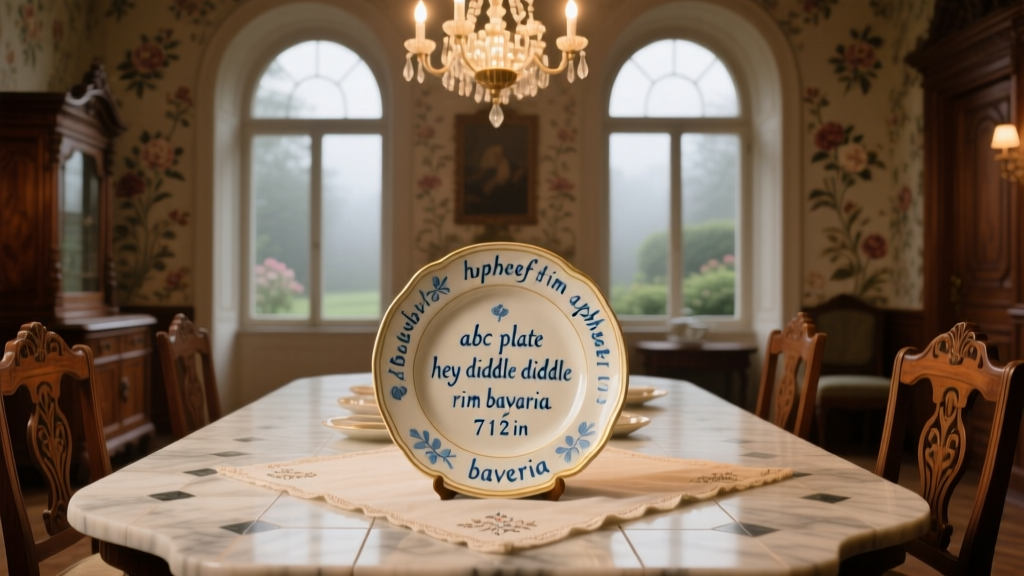
Hey Diddle Diddle Alphabet Rim Plate: Decoding the Bavarian ABC Plate (7½" Diameter, Marked 'Bavaria')
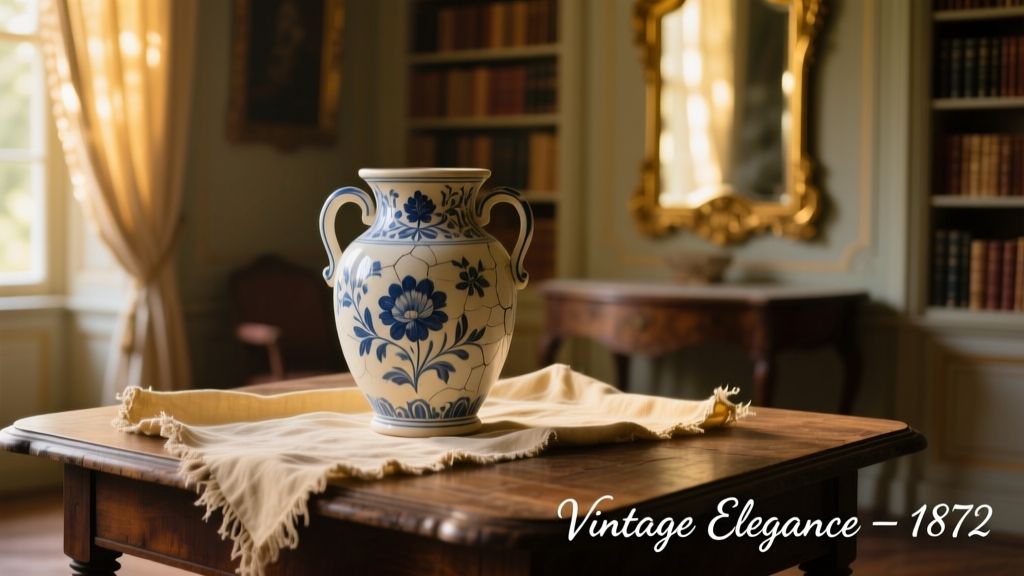
Old Pottery With Cloth on the Bottom: Origins, Identification, and Conservation Insights
Willow Bowl Soup Tureen by Ridgway: History, Identification, and Restoration of a Regency-Era Ceramic Masterpiece
Roseville Columbine Vase Blue 10-Inch: Identification, Value, and Authentic Restoration Practices
Precision Tools for Cutting Cottage Cheese Curd: A Restoration Specialist’s Unexpected Lens on Dairy Craftsmanship
Toy Fire Pumper Pressed Steel: The Dayton Friction Works Legacy and Restoration Guide
Spalding T-5 Baseball Bat (1900–1920): Authenticity, Construction, and Restoration Considerations for Antique Sports Collectors
Country Antique Fair Mall: A Living Archive of American Country Furniture and Restoration Practice
SwankySwigs Carnival Red 3½-Inch Wig Stand: A Restoration Specialist’s Technical Assessment