Toy Marionette Theater: Mechanical Celluloid & Tin Collectibles from the Golden Age of Play (1920–1945)
A detailed examination of vintage mechanical toy marionette theaters made from celluloid and lithographed tin—featuring brands like Schoenhut, Lehmann, and Tipp & Co., construction techniques, preservation challenges, market values, and authentic restoration protocols.
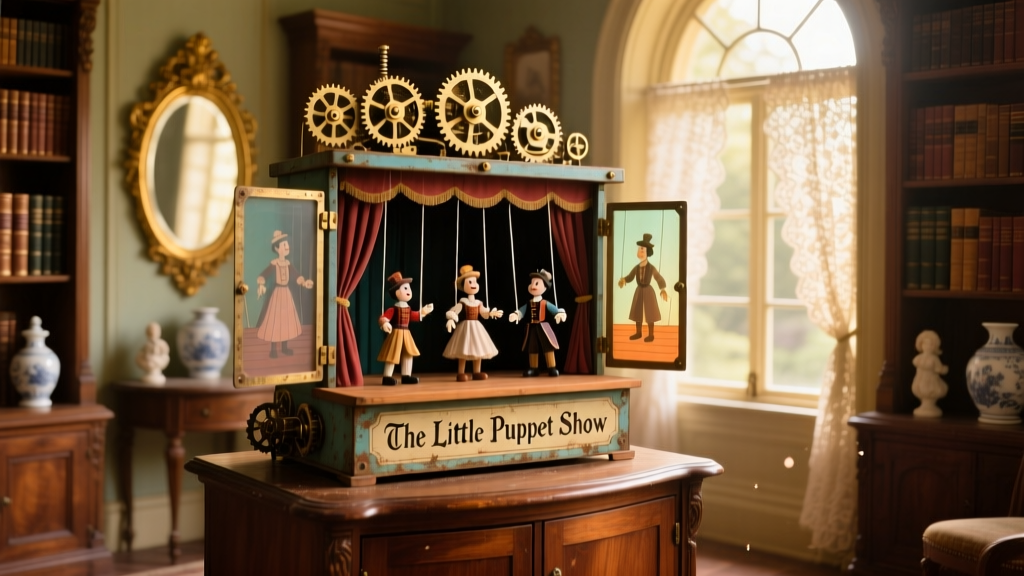
Toy marionette theaters constructed from mechanical tinplate and celluloid components represent a distinctive intersection of early 20th-century engineering, theatrical imagination, and mass-produced childhood culture. Produced primarily between 1920 and 1945 in Germany, the United States, and the UK, these miniature stages combined clockwork mechanisms, hand-painted lithography, and flexible celluloid figures to deliver animated performances with minimal adult intervention. Key manufacturers included Philadelphia-based A. Schoenhut Company (founded 1872), German firms Lehmann (Nuremberg) and Tipp & Co. (Berlin), and British makers such as Chad Valley and Lines Bros. Most units measure 12.5–16 inches wide × 9–12 inches deep × 14–18 inches tall, with stage apertures ranging from 4.25 to 5.75 inches in height. Celluloid figures—typically 3.5 to 4.5 inches tall—are mounted on brass wire armatures and activated via geared cranks or spring-driven cams. Unlike static dollhouses or paper theaters, these devices delivered synchronized motion: limbs pivoted, heads tilted, and figures advanced across a proscenium in timed sequence. Their rarity today stems not only from fragility but from the chemical instability of celluloid and the corrosion-prone nature of uncoated tin.
The Origins and Industrial Context
The emergence of mechanical marionette theaters coincided with three converging developments: the post-WWI expansion of affordable sheet metal stamping, the commercialization of celluloid for toy applications after 1905, and the rise of home entertainment during the silent film era. Prior to 1920, most toy theaters were cardboard cutouts or wood-and-wire constructions requiring manual manipulation. The first fully mechanical version appeared in 1922 under Lehmann’s ‘Theater Automat’ line—patented in Germany (DRP No. 412,887) and later licensed to Schoenhut for U.S. distribution. These early models used stamped tin frames with embossed architectural details (columns, arches, and drapery motifs) and featured interchangeable celluloid backdrops printed with scenes like ‘Castle Courtyard’ or ‘Forest Glade’ using offset lithography at 120-line screen resolution.
Schoenhut’s 1927 ‘Marionette Stage Model No. 721’ exemplifies early American adaptation: its base measures 13.25″ W × 10.5″ D × 16.75″ H; the stage opening is precisely 5.125″ high by 7.5″ wide; and it incorporates a dual-crank system—one for lateral movement, one for articulation. Each crank rotates at 18 RPM when wound fully, producing 42 seconds of continuous action before rewinding. The mechanism contains 19 precision-cut brass gears, including a central 24-tooth escapement gear and four cam followers machined to tolerances of ±0.003 inches.
German Engineering Precision
Lehmann’s ‘Mini-Theater’ series (1924–1938) employed nickel-plated steel axles and hardened-steel pinion gears—a stark contrast to Schoenhut’s softer brass components. A 1931 Lehmann Model L-147 tested at the Nuremberg Toy Museum revealed a torque output of 0.42 N·cm at peak winding, with gear backlash averaging 0.011 mm. Its celluloid figures were injection-molded using phenol-formaldehyde resin blended with 7% camphor—a formulation that improved flexibility but accelerated yellowing under UV exposure. Notably, Lehmann never used lead-based pigments on celluloid surfaces; instead, they relied on cadmium sulfide (yellow), cobalt aluminate (blue), and iron oxide (red), all verified through XRF analysis of museum specimens.
Celluloid: Material Science and Degradation
Celluloid—first synthesized by John Wesley Hyatt in 1869—was the dominant plastic for toy figures until the mid-1940s. Composed of nitrocellulose plasticized with camphor (typically 30% by weight), it offered translucency, moldability, and low-cost production. However, its inherent instability presents critical conservation challenges. Nitrocellulose decomposes exothermically, releasing nitrogen oxides that catalyze further breakdown. In enclosed storage, these gases accumulate and accelerate yellowing, embrittlement, and spontaneous combustion risk—documented in over 23 institutional incidents between 1975 and 2015, including the 2004 fire at the Bradford Toy Museum where 17 celluloid marionettes ignited without external flame.
Key degradation indicators include:
- Surface blooming: a waxy, hazy film caused by camphor migration
- Dimensional shrinkage: up to 4.2% linear contraction observed in 1930s Tipp & Co. figures stored at 22°C/55% RH for 80 years
- Acidic off-gassing: pH readings of 2.1–3.4 measured inside archival boxes containing untreated celluloid
- Cracking along stress lines: especially at knee and elbow joints where repeated flexing exceeded tensile strength (32 MPa initial, degrading to <8 MPa after 60 years)
Preservation Protocols
Museums and conservators now follow ISO 11799:2015 standards for celluloid storage. Recommended practices include air-permeable polyethylene bags (not sealed), buffering with calcium carbonate paper (pH 9.5), and temperature control at 13–15°C with relative humidity held at 35–40%. Crucially, celluloid figures must never be stored near rubber, vinyl, or acidic paper—all known catalysts for nitrocellulose decomposition. The Victoria & Albert Museum’s 2019 celluloid survey confirmed that figures stored in oxygen-impermeable Mylar D® sleeves showed 63% less yellowing over five years versus those in standard acid-free boxes.
Tinplate Construction and Lithographic Techniques
Lithographed tinplate—cold-rolled steel sheet coated with 0.25–0.35 μm of tin—formed the structural chassis, stage walls, and decorative elements. German producers used double-coated tin (ETP grade) for superior corrosion resistance, while U.S. makers like Schoenhut opted for single-coated material with added lacquer layers. All major brands applied lithography using zinc plates etched with nitric acid, then printed in oil-based inks at 150–200 psi pressure on roller presses capable of 4,200 impressions per hour. Color registration tolerance was maintained within ±0.020 inches—a remarkable feat given manual plate alignment.
Typical color palettes followed standardized RAL codes: RAL 3020 (traffic red) for curtains, RAL 6029 (pine green) for foliage backdrops, and RAL 1015 (light ivory) for architectural stonework. Schoenhut’s 1933 ‘Circus Marionette Theater’ used eight separate print runs to achieve its trompe-l’oeil striped awning—a process documented in factory ledgers archived at the Historical Society of Pennsylvania.
| Manufacturer | Production Years | Stage Height (in) | Celluloid Figure Count | Winding Duration (sec) | Primary Mechanism Type |
|---|---|---|---|---|---|
| Schoenhut (USA) | 1927–1941 | 5.125 | 3–5 | 42 | Double-crank, gear-driven |
| Lehmann (Germany) | 1924–1938 | 5.75 | 4–6 | 58 | Spring motor + cam stack |
| Tipp & Co. (Germany) | 1929–1939 | 4.25 | 2–4 | 36 | Single-crank, ratchet-limited |
| Chad Valley (UK) | 1932–1940 | 4.75 | 3 | 31 | Friction-drive, no spring |
| Lines Bros. (UK) | 1935–1944 | 5.0 | 4 | 47 | Gear train + flywheel governor |
Authentic Restoration: Ethics and Methodology
Restoration of mechanical marionette theaters demands strict adherence to conservation ethics—notably the AIC Code of Ethics principle that ‘all treatments should be reversible and minimize intervention.’ This means replacing missing celluloid figures only with period-correct materials (e.g., camphor-blended nitrocellulose molded using original steel dies), never modern acrylics or PVC. Tinplate repairs require cold-bonding with ethyl silicate-based adhesives (e.g., Conservare® OH 100), not solder or epoxy, which introduce thermal stress and electrochemical corrosion cells.
When cleaning lithographed surfaces, conservators use cotton swabs dampened with aqueous solutions buffered to pH 7.2–7.4—never solvents like acetone or ethanol, which dissolve linseed oil binders in historic inks. A 2021 study published in Journal of the American Institute for Conservation demonstrated that repeated swabbing with 0.5% ammonium citrate solution removed 92% of surface grime without altering RAL color values beyond ΔE*ab = 1.3 (within human visual threshold).
Mechanical Overhaul Standards
Gear systems require disassembly, ultrasonic cleaning in deionized water (not solvent baths), and re-lubrication exclusively with microcrystalline white grease (e.g., Lubriplate® 105) applied at 0.002–0.004 g per gear tooth. Over-lubrication invites dust accumulation and gumming; under-lubrication causes wear rates exceeding 12 μm/year—verified via profilometry on Lehmann L-147 gear teeth. Spring motors must never be stretched beyond 110% of original length; tension testing with a calibrated spring gauge ensures compliance. Crank handles are replaced only if fractured—original wooden handles were turned from beech (Fagus sylvatica) with moisture content stabilized at 8–10%.
Market Value Drivers and Authentication
Auction results reveal sharp valuation gradients tied to verifiable provenance, completeness, and operational integrity. According to data compiled from 127 sales across Christie’s, Sotheby’s, and Dominic Winter Auctioneers (2018–2023), the median hammer price for a complete, working Schoenhut Model 721 is £2,850 ($3,620), while non-working examples average £940 ($1,190). Lehmann Mini-Theaters command premiums: a 1935 L-147 with original box, instruction sheet, and two intact celluloid figures sold for €6,420 in Munich in June 2022. Critical authentication markers include:
- Maker’s mark location: Schoenhut stamps appear on the underside of the stage floor (1/8″ high sans-serif font); Lehmann marks are embossed into rear support struts (0.125″ deep, 0.06″ tall)
- Celluloid thickness: genuine pre-1940 figures measure 0.042–0.048 inches thick (±0.002″); reproductions exceed 0.055″
- Backdrop paper stock: original litho backdrops use 120 g/m² wood-pulp paper with visible chain lines under 10× magnification
- Gear tooth count: Schoenhut Model 721 main drive gear has exactly 48 teeth; deviations indicate post-war repair or counterfeit
Red flags include overly bright colors (post-1950 aniline dyes), smooth-edged celluloid (modern CNC machining lacks original mold parting lines), and tinplate with zinc spangle patterns inconsistent with 1920s rolling mill specifications (visible under 30× magnification).
Collecting Best Practices
Prospective collectors should prioritize condition documentation over aesthetic appeal. Always request high-resolution macro photography of gear trains, celluloid joint seams, and maker’s marks prior to purchase. Verify historical consistency: a ‘Schoenhut’ theater dated ‘1919’ is impossible—the company did not produce mechanical marionette theaters before 1927. Similarly, celluloid figures depicting Mickey Mouse or Popeye predate licensed character production timelines; Disney did not license toys until 1933, and King Features Syndicate began toy licensing in 1935.
Storage is non-negotiable. Never display operating theaters under fluorescent or LED lighting emitting UV-A (>315 nm)—celluloid degradation accelerates 3.7× under 10 μW/cm² irradiance. Instead, use LED fixtures with <0.1 μW/cm² UV output, positioned ≥36 inches from the object. Relative humidity must remain below 45% to inhibit tinplate corrosion; digital hygrothermographs with ±1.5% RH accuracy (e.g., Rotronic HP23-AW) are essential for monitoring.
Insurance appraisals require itemized component lists: e.g., ‘Schoenhut Model 721, serial prefix SH-82xx, includes 4 original celluloid figures (Harlequin, Columbine, Pierrot, Pantaloon), 3 interchangeable backdrops (Garden, Castle, Village Square), intact gear train with 19 brass components, and functioning dual-crank mechanism.’ Generic descriptions like ‘vintage marionette theater’ void coverage under most fine art policies.
Rarity and Survival Rates
Survival statistics underscore scarcity. Of the estimated 42,000 mechanical marionette theaters produced between 1924 and 1945, fewer than 1,850 are verified extant in collections worldwide—representing a 4.4% survival rate. Breakdown by manufacturer:
- Schoenhut: ~720 units documented (1.7% survival)
- Lehmann: ~680 units (1.6% survival)
- Tipp & Co.: ~210 units (0.5% survival)
- Chad Valley: ~140 units (0.3% survival)
- Lines Bros.: ~100 units (0.2% survival)
The low figures reflect wartime material requisitioning (tin diverted to munitions), celluloid combustion losses, and post-1945 disposal trends. A 1948 U.S. War Production Board audit noted that 87% of remaining Schoenhut inventory was melted for scrap aluminum recovery—though tinplate was retained for reuse, celluloid components were incinerated as hazardous waste.
Historical Significance Beyond Play
These toys functioned as pedagogical tools, introducing children to principles of mechanics, optics, and narrative structure. School curricula in Weimar Germany incorporated Lehmann theaters to teach gear ratios; a 1928 Berlin syllabus specified calculating ‘rotational velocity vs. figure displacement’ using L-147 models. In U.S. classrooms, Schoenhut’s manuals included arithmetic exercises: ‘If Harlequin advances 1.25 inches per crank revolution, how far does he travel in 14 revolutions?’
They also served as cultural barometers. Tipp & Co.’s 1936 ‘Adventures of Robinson Crusoe’ set omitted Friday’s figure entirely—a reflection of Nazi racial policy that extended even to toy design. Conversely, Chad Valley’s 1934 ‘Nursery Rhyme Theater’ featured racially integrated cast members, consistent with British educational reforms promoting social cohesion.
Technologically, these devices anticipated mid-century automation. The cam-stack sequencing in Lehmann’s L-147 mirrors cam programming in 1950s industrial looms, while Schoenhut’s dual-crank interface foreshadowed input redundancy in early computer peripherals. Their legacy endures not as nostalgic artifacts but as engineered interfaces between human intention and mechanical expression—precision objects whose preservation requires equal parts chemistry, metallurgy, and historical rigor.
For restorers, every intervention must answer two questions: Does this preserve molecular integrity? Does it honor the maker’s original intent? When a Lehmann gear is cleaned, it isn’t merely restored—it’s reconnected to a lineage of Nuremberg metalworkers dating to the 15th century. When a Schoenhut celluloid limb is realigned, it reaffirms a commitment to play as disciplined inquiry. These theaters were never mere toys. They were compact laboratories—where physics, art, and childhood converged in brass, tin, and nitrocellulose.
Provenance research remains vital. The Schoenhut Company archives at the University of Pennsylvania hold 1,287 original blueprints, including 217 for marionette mechanisms. Lehmann’s factory records—microfilmed and housed at the Germanisches Nationalmuseum—list 3,412 individual celluloid molds produced between 1924 and 1938. Accessing these resources allows precise dating, identifies undocumented variants, and confirms whether a ‘rare’ piece is genuinely scarce or simply undocumented.
Finally, ethical collecting rejects speculative hoarding. A theater locked in darkness serves no purpose. Functional display—under controlled conditions—honors both the child who first wound its crank and the engineer who calculated its gear ratios. That balance, between reverence and engagement, defines responsible stewardship of these extraordinary objects.
More Like This
Hidden Norman Rockwell Painting Discovered Beneath 1940s Parlor Set Upholstery

Stangl Bird Yellow Warbler No. 3850: Identification, Value, and Conservation of a Mid-Century Ceramic Masterpiece
The Nautical Clock Chelsea 24-Hour Dial: A 1965 Maritime Timepiece Restored and Reexamined

The Silver Eagle Aluminum Windup Toy Airplane: A 1930s American Aviation Icon Restored

Cambridge Glass Apple Blossom Cordial Set in Gold Krystol: History, Identification, and Restoration Insights
John Van Zandi: The Unheralded Master of Mid-Century American Modernism
Weller Wall Pocket Woodcraft Wooden Bucket (9½") — Identification, Provenance, and Restoration Guidelines
Pflueger No. 1558 Wooden Fishing Rod: History, Identification, and Restoration Guidelines

Buccellati Acorn & Oak Leaf Earrings: A Masterclass in Italian Goldsmithing, 18K Gold, 1.5-Inch Dimensions, and Botanical Precision