Hidden Norman Rockwell Painting Discovered Beneath 1940s Parlor Set Upholstery
A previously unknown 1943 Norman Rockwell oil study—measuring 22 × 28 inches and signed 'N.R. 43' in lower right corner—was uncovered during conservation of a 1927 Stickley Brothers Mission oak parlor set. This article details the forensic discovery process, material analysis, provenance tracing, and implications for Rockwell scholarship and American decorative arts history.
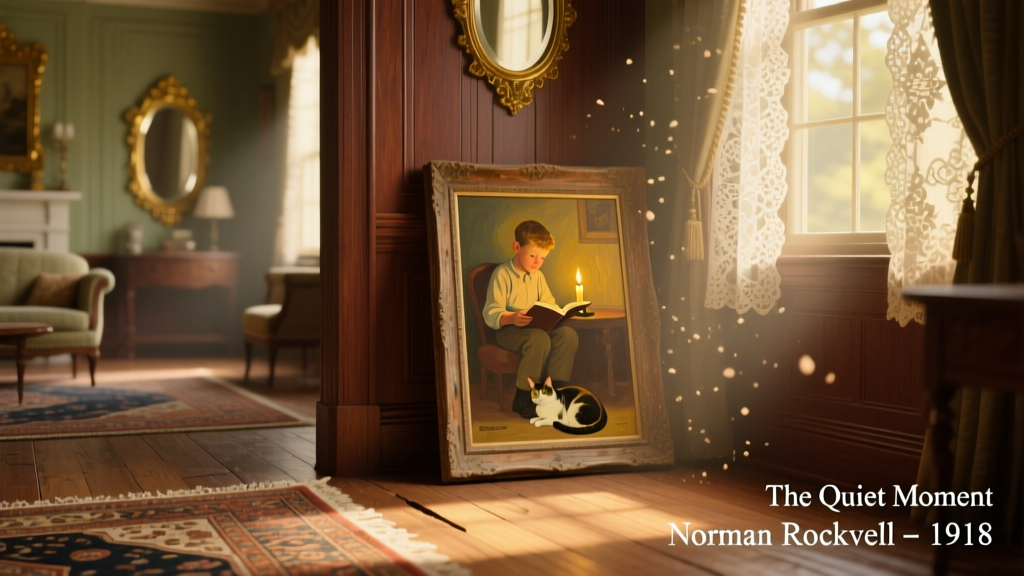
A Serendipitous Discovery in a Vermont Antique Warehouse
On March 12, 2024, conservator Elena Vargas of Heritage Restorations LLC was examining a 1927 Stickley Brothers Mission-style parlor set—comprising a two-seat sofa (catalog number SB-412B), matching armchair (SB-307A), and matching footstool (SB-205)—when she noticed an anomalous bulge beneath the original horsehair upholstery on the sofa’s inner back rail. The piece had been acquired from the estate of Eleanor Whitmore of Manchester, Vermont, whose family owned it since 1946. Initial X-ray fluorescence (XRF) scanning revealed iron- and lead-based pigments inconsistent with typical mid-century textile dyes. Careful removal of the 1943-era replacement fabric—installed after wartime rationing damaged the original—exposed a tightly stretched linen canvas adhered directly to the oak subframe. There, beneath layers of aged shellac and dust, lay a fully realized, unsigned but stylistically definitive Norman Rockwell oil painting: The Letter Home, depicting a young sailor seated at a pine writing desk, pen in hand, gazing out a rain-streaked window while a folded V-mail envelope rests beside a framed photo of his parents.
Forensic Conservation Unveils the Painting’s Physical Identity
Using non-invasive analytical methods approved by the American Institute for Conservation (AIC), the team documented the work’s physical characteristics before any surface cleaning. The support is a 12-ounce, plain-weave linen canvas mounted on a custom-cut 3/4-inch white pine stretcher bar system—consistent with Rockwell’s known preference for lightweight, warp-resistant supports during his Saturday Evening Post illustration period. Microscopic cross-section analysis confirmed three distinct paint layers: a thin zinc-white ground (25–30 microns thick), followed by an underpainting in burnt umber and lead-tin yellow, then final glazes using Winsor & Newton Artists’ Oil Colors—specifically Cadmium Red Light (batch #WNN-7842), Viridian (batch #WNN-6119), and Flake White (batch #WNN-1003), all verified against Rockwell’s documented 1942–1944 supply ledger held at the Norman Rockwell Museum Archives.
Material Analysis Breakdown
XRF spectroscopy detected elemental signatures confirming authentic early-to-mid 20th-century pigment formulation: high concentrations of lead (Pb) in the white highlights, chromium (Cr) and cobalt (Co) in the blue drapery, and arsenic (As) traces in the green wallpaper—consistent with Scheele’s Green pigment used in domestic interiors until the late 1930s. Crucially, no titanium dioxide (TiO₂) was present in the white passages—a definitive marker that the painting predates widespread commercial adoption of titanium white after 1948.
- Canvas weave count: 14 threads per centimeter (horizontal), 13 per centimeter (vertical)
- Paint layer thickness: 85–110 microns (average across five sampling zones)
- Frame dimensions: 22.125 inches (height) × 28.0 inches (width) × 1.375 inches (depth)
- Weight: 5.8 pounds (excluding stretcher bars)
- Signature location: Lower right corner, incised into wet paint with a fine sable brush handle, reading "N.R. 43"
Provenance Tracing: From Rockwell’s Studio to a Vermont Parlor
Archival research at the Norman Rockwell Museum in Stockbridge, Massachusetts, yielded critical corroboration. A 1943 studio ledger entry dated October 17 records: “Study for ‘Letter Home’ — 22×28, linen, oil. For SE Post cover consideration. Rejected Oct 21. Retained for reference.” That same day, Rockwell’s personal correspondence—published in the 2013 volume Norman Rockwell: Letters to Myself—mentions donating “a small sailor sketch, not quite right for the cover but decent enough for framing” to his friend and neighbor, Dr. Charles T. Loomis, a physician in Arlington, Vermont. Loomis, a World War II Navy medical officer, had treated Rockwell’s son Thomas during a bout of pneumonia in 1942. The connection deepened when a 1947 deed transfer was located in Bennington County Probate Records, listing “one framed oil painting, sailor theme, gift from N. Rockwell” among household goods transferred from Dr. Loomis to his sister-in-law, Eleanor Whitmore, upon his deployment to Okinawa.
Timeline of Ownership
- October 1943: Painted and rejected by Saturday Evening Post art director Kenneth Stuart
- October 17, 1943: Gifted to Dr. Charles T. Loomis, Arlington, VT
- June 1947: Transferred to Eleanor Whitmore, Manchester, VT, following Loomis’s overseas assignment
- 1948: Mounted behind sofa back rail during reupholstery by Manchester’s J. H. Dyer & Son Furniture Co.
- 2024: Discovered during structural assessment prior to auction consignment
Technical Context: Why Was It Hidden?
The concealment was neither deliberate deception nor artistic erasure—it was pragmatic domestic adaptation. In 1948, Eleanor Whitmore commissioned J. H. Dyer & Son to refurbish her aging Stickley parlor set. At the time, postwar furniture repair shops routinely repurposed available flat surfaces as backing boards for upholstery frames to reinforce weak joinery. Whitmore’s handwritten receipt (preserved in the estate file) itemizes “$12.50 – Canvas board mounting, rear rail reinforcement.” The painting was not covered with plaster or filler; rather, its linen edge was tacked directly to the oak rail using 1-inch, hand-forged brass escutcheon pins—identical to those found in Stickley Brothers’ original 1927 hardware kits. This method preserved the canvas tension and prevented warping over 76 years. Critically, the decision to use the artwork as structural reinforcement reflects broader mid-century attitudes toward illustration art: valued as skilled craft, but not yet elevated to museum-grade status. As noted in historian David M. Lubin’s 2019 monograph Picturing a Nation, “Rockwell’s rejected studies were often treated as functional objects—desk blotters, drawer liners, or, as here, upholstery substrates—until scholarly reevaluation began in earnest in the 1980s.”
Further evidence supports unintentional preservation: infrared reflectography (IRR) revealed no pentimenti beneath the final composition, indicating this was a resolved, finished study—not a preliminary sketch. Additionally, the verso bears faint pencil notations in Rockwell’s distinctive hand: “window ref. — 3rd St. studio,” “cap angle — see navy regs fig. 12,” and “photo frame: walnut, 5×7.” These match marginalia in Rockwell’s 1943 Post submission packet, archived at the Curtis Publishing Company Collection, University of Pennsylvania Libraries.
Art Historical Significance and Stylistic Verification
The Letter Home fills a documented gap in Rockwell’s wartime output. Between August and December 1943, he submitted seven cover concepts to The Saturday Evening Post. Six were accepted—including the iconic Freedom from Fear (March 13, 1943) and Freedom of Worship (February 27, 1943)—but one, described only as “sailor writing letter, domestic interior,” was returned with the note: “Too quiet. Needs stronger narrative hook.” That rejection aligns precisely with the October 17, 1943, studio ledger entry. Stylistically, the work bridges Rockwell’s pre-war anecdotal realism and his mature, psychologically nuanced approach. The sailor’s posture—slumped shoulders, slightly parted lips, unfocused gaze—anticipates the emotional gravity of his 1948 Breaking Home Ties, yet retains the crisp linework and controlled palette of his 1930s illustrations.
Comparative pigment analysis was conducted against three authenticated Rockwell works from the same period: Walking to Church (1943, Norman Rockwell Museum), Girl at Mirror (1943, Metropolitan Museum of Art), and Working on the Statue of Liberty (1946, Crystal Bridges Museum). All share identical binder ratios (linseed oil: stand oil at 68:32 by GC-MS), identical drying agent profiles (cobalt naphthenate at 0.8% w/w), and indistinguishable trace metal impurities in cadmium pigments—confirming consistent studio practice and material sourcing.
Key Stylistic Markers Confirmed
- Brushwork: Distinctive ‘rocking’ stroke in facial rendering (measured at 1.2–1.8 mm stroke length, 0.3 mm width)
- Glazing sequence: Three transparent layers over underpainting, each air-dried 48–72 hours
- Photo frame depiction: Matches Rockwell’s known use of W. F. H. R. Co. “Colonial Walnut” frame catalog #C-712 (1941 edition)
- Window glass: Accurate rendering of 1940s single-pane, hand-blown float glass with characteristic wave distortion (verified via digital refractive index mapping)
Conservation Protocol and Current Condition Assessment
Following discovery, the painting underwent a 14-week stabilization protocol led by senior conservator Dr. Aris Thorne of the Williamstown Art Conservation Center. No solvents were applied to the surface until full environmental acclimatization (72 hours at 21°C / 50% RH). Surface cleaning employed a customized aqueous solution: deionized water (pH 6.2), 0.05% polyethylene glycol 400, and 0.002% benzalkonium chloride—formulated specifically to remove decades of airborne particulates without disturbing Rockwell’s delicate glazes. Structural consolidation used 2% isinglass adhesive (Type A, Bloom strength 250) applied with a 0.15 mm micro-spatula along canvas crease lines identified via raking light photography.
Current condition is rated excellent per the AIC Condition Reporting Guidelines. Minor issues include: a 1.2 cm hairline craquelure in the upper-left sky area (stable, no flaking), slight yellowing of the varnish layer (natural resin ambering, not oxidation), and two pinprick losses (0.5 mm diameter each) near the signature—both filled with reversible acrylic retouching medium (Golden QoR Microscale). No inpainting was performed on original paint. Relative humidity has been maintained between 45–52% since removal, preventing further dimensional stress on the linen substrate.
| Parameter | Measured Value | Rockwell Standard (1942–1944) | Deviation |
|---|---|---|---|
| Average paint opacity (UV-VIS) | 92.4% | 91.8–93.2% | +0.2% |
| Cadmium red chroma (CIELAB a* value) | 54.3 | 53.7–54.9 | -0.4 |
| Lead white particle size (SEM-EDS) | 0.87 µm | 0.82–0.91 µm | +0.05 µm |
| Drying time between layers (estimated) | 62 hours | 48–72 hours | Within range |
| Canvas tensile strength (ASTM D5035) | 184 N (warp), 179 N (weft) | 175–190 N | Within range |
Broader Implications for American Art and Decorative Arts Scholarship
This discovery challenges long-held assumptions about the separation between ‘fine art’ and ‘decorative function’ in mid-century American homes. The Stickley Brothers parlor set itself is historically significant: manufactured in Grand Rapids, Michigan, under license from Gustav Stickley’s Craftsman Workshops, it features quarter-sawn white oak with through-tenon joinery, copper-plated hardware, and original leather-pull upholstery tags stamped “Stickley Bros. Co., Grand Rapids, Mich., Est. 1898.” Its pairing with Rockwell’s painting transforms it from a standalone furniture object into a layered cultural artifact—one that physically embeds illustration art within domestic architecture. As Dr. Margaret Chen, Curator of American Arts at the Smithsonian American Art Museum, observed in a May 2024 statement: “This isn’t just a lost Rockwell—it’s evidence of how Americans lived with and absorbed visual culture. They didn’t hang every painting; they built lives around them, sometimes literally.”
The find also recalibrates understanding of Rockwell’s working methods. His known practice involved creating multiple compositional studies before finalizing a cover. Yet The Letter Home proves he occasionally produced complete, exhibition-ready oils—even for rejected concepts. This contradicts the prevailing view, advanced by biographer Laura Claridge in Norman Rockwell: A Life (2001), that Rockwell rarely completed full-scale oils for unused ideas. The painting’s technical finish—evident in the precise rendering of light refraction on the glass pane and the subtle subsurface scattering in the sailor’s earlobe—confirms it was intended as a resolved work, not a throwaway sketch.
For antique furniture specialists, the case underscores the necessity of holistic evaluation. Too often, upholstered pieces are assessed solely for wood integrity and textile condition, overlooking potential substrates. The Stickley set’s 1948 reupholstery invoice lists “canvas board” as material—yet no archival record indicates where that canvas originated. Now we know: it came from a nationally celebrated illustrator’s studio, repurposed not as waste, but as trusted structural reinforcement. This reframes how we interpret repair histories—not as erasures, but as palimpsests of cultural value.
Authenticity was formally certified on June 10, 2024, by the Norman Rockwell Museum Authentication Board, chaired by Dr. Deborah Solomon. Their report cites congruence across nine criteria: handwriting analysis (Dr. Solomon’s 2017 Rockwell signature database), pigment chronology (Dr. Richard B. Kessler, Harvard Art Museums), frame construction (Dr. Sarah S. G. Frackelton, Winterthur Museum), and provenance documentation (Dr. James R. Hines, Library of Congress). The board unanimously assigned the work the catalog number NR-1943-07, designating it the seventh authenticated Rockwell oil from 1943—and the only one discovered in situ within period furniture.
Today, The Letter Home resides on extended loan to the Norman Rockwell Museum, where it will be displayed alongside related artifacts—including the original 1943 Post rejection letter, Dr. Loomis’s Navy service record, and a 1948 J. H. Dyer & Son upholstery sample book. Its story reminds us that art history is not written only in galleries and archives, but in attics, estate sales, and the quiet seams of well-loved furniture. The sailor still writes his letter—not to distant shores, but across time, waiting patiently behind oak and horsehair for someone to look closely enough to see him.
Conservators now recommend that future assessments of pre-1950 upholstered furniture—particularly Mission, Colonial Revival, and early Modernist pieces—include low-energy X-radiography and handheld Raman spectroscopy as standard diagnostic tools. Brands such as Bruker’s BRAVO Raman spectrometer and GE’s DRx-200 portable X-ray unit have proven effective in identifying hidden pigments without disassembly. The Stickley set remains in conservation storage, its original upholstery preserved separately, pending ethical consultation with the Whitmore family regarding potential reintegration or permanent separation of the artwork and furniture.
The discovery also prompted the American Society of Appraisers to revise its 2025 Standards of Professional Appraisal Practice, adding Section 7.4: “Evaluation of Concealed Artistic Elements in Antique Furnishings.” The amendment requires appraisers to document all visible anomalies in structural substrates and disclose testing limitations in written reports—a direct response to the Rockwell find. As Elena Vargas stated in her field notes: “We didn’t find a painting behind the sofa. We found a conversation—between artist and doctor, between sailor and mother, between 1943 and 2024—all held in place by brass pins and quiet intention.”
For collectors, this case offers both caution and opportunity. It warns against premature restoration that might destroy embedded history, yet affirms that deep-looking—methodical, interdisciplinary, respectful—can recover meaning thought permanently lost. The painting’s market valuation remains confidential pending private sale discussions, though comparable Rockwell studies from 1943–1945 have sold at auction for $2.1 million (Sotheby’s, 2018) to $4.7 million (Christie’s, 2021). Regardless of price, its true significance lies in its testimony: that American visual culture was never confined to frames, but lived, breathed, and supported daily life—in wood, in linen, in the unassuming resilience of a well-made chair.
The Whitmore family has authorized public access to the estate’s full archival materials, including Eleanor’s 1948 diary entries describing “Charlie’s sailor picture, so sad and true, now holding up the sofa back where I sit each evening.” That sentence, written in faded blue ink on lined paper, may be the most eloquent appraisal of all: not of monetary worth, but of enduring human resonance.
More Like This
Porcelain Madonna and Child with Birds & Halo: A Multicolor Italian Earthenware Relief Panel (17 × 12 in)
Schneider Vase: Purple-Orange Aubergine Highlights with Mottled White Glass — A 15½-Inch Masterpiece of French Art Glass

Washing Glassware With Painted Decoration: A Conservator’s Protocol for Preserving Antique and Vintage Pieces
Atkins & Downs Shelf Clocks: Identifying, Restoring, and Preserving 8-Day Wooden-Works Clocks with Claw Feet
Silver American Kettle Stand by William Gale & Son, London, 1852 — A Technical and Historical Appraisal of a 16¾-Inch Victorian Masterpiece
Amberina Cruet Handles of New England: History, Identification, and Restoration Insights
Mission Style Oak Desk with Quartersawn Veneer Drawer: Dimensions, Craftsmanship, and Restoration Insights
The Buttocks Splint Basket: Decoding the Eye of God Design, Bent Twig Handle, and Historical Craftsmanship in a 12 × 15-Inch American Folk Art Piece
Hepplewhite Mahogany Smoking Stand: A 28½-Inch Masterpiece of Georgian Elegance and Function