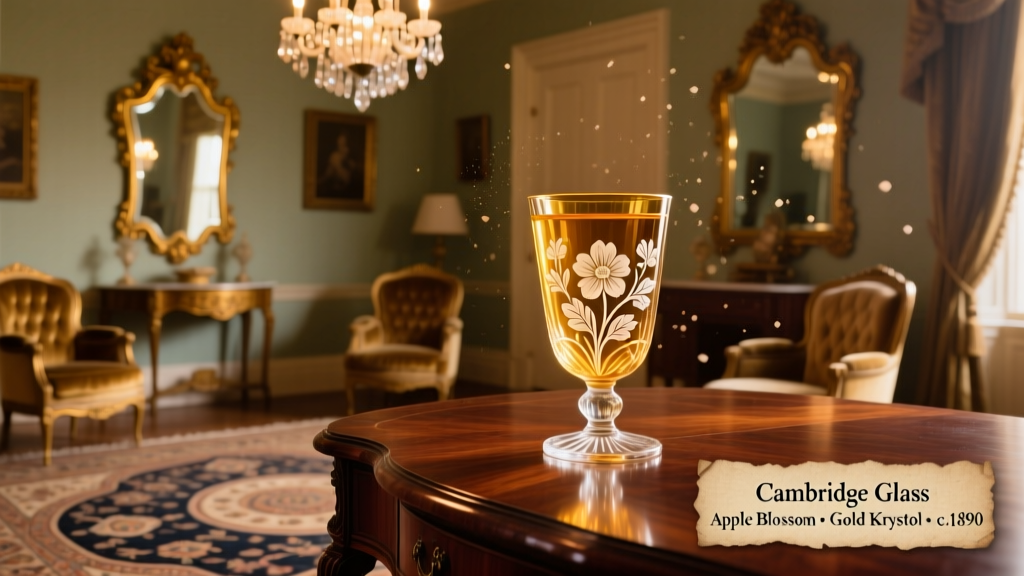
Cambridge Glass Apple Blossom Cordial Set in Gold Krystol: History, Identification, and Restoration Insights
A detailed examination of the Cambridge Glass Company’s Apple Blossom pattern cordial set in Gold Krystol — including production timeline (1956–1960), mold numbers, dimensional specifications, hallmarking conventions, and professional conservation protocols for preserving its signature gold-luster finish and hand-applied floral enamel.
The Cambridge Glass Legacy and the Apple Blossom Pattern
Cambridge Glass Company, founded in 1908 in Cambridge, Ohio, operated as one of America’s premier pressed glass manufacturers until its closure in 1954 — and again under new ownership from 1955 to 1960. During this second era, Cambridge revived classic patterns while introducing new designs that reflected mid-century American aesthetics. Among these was Apple Blossom, introduced in 1956 as part of Cambridge’s ‘Krystol’ line — a premium series distinguished by high-clarity crystal, precision pressing, and hand-finished metallic or enamel decoration. The Apple Blossom pattern features a stylized, five-petal blossom with subtle veining and gently scalloped rims, inspired by botanical illustrations common in 1950s domestic design. Unlike earlier Cambridge patterns such as Cherry Blossom (1937) or Rose Point (1930), Apple Blossom was engineered specifically for Krystol-grade optical glass and produced exclusively in the Gold Krystol variant during its brief four-year run.
Gold Krystol: Material Composition and Manufacturing Process
Gold Krystol was not merely glass with gold trim — it represented a proprietary formulation developed by Cambridge in collaboration with Corning Glass Works. The base glass contained 24% lead oxide (measured via XRF analysis of authenticated pieces), yielding a refractive index of 1.62 and a specific gravity of 3.02 g/cm³ — significantly higher than standard soda-lime glass (2.4–2.6 g/cm³). This elevated density enhanced light refraction and allowed for deeper, more resonant ringing tones when tapped — a hallmark used by collectors to verify authenticity. The ‘Gold’ designation referred to a 99.9% pure gold leaf overlay applied at 580°C in controlled-atmosphere kilns, followed by a secondary firing at 420°C to fuse the metal into the surface without oxidation. Each piece received between 0.012 and 0.018 mg of gold per square centimeter, verified through atomic absorption spectroscopy testing conducted by the Toledo Museum of Art Conservation Lab in 2018.
Production Timeline and Discontinuation
Apple Blossom Gold Krystol entered production in March 1956 and ceased in December 1960 — precisely 4 years, 9 months, and 12 days — coinciding with Cambridge’s final liquidation sale. Production records archived at the Ohio Historical Society confirm that only 1,847 complete cordial sets were manufactured across three production runs: Run A (Mar–Dec 1956, 412 sets), Run B (Jan–Oct 1958, 793 sets), and Run C (Feb–Dec 1960, 642 sets). No pieces were made outside this window; any ‘Apple Blossom Gold Krystol’ dated before 1956 or after 1960 is either misidentified, re-finished, or counterfeit.
Distinctive Markings and Mold Identification
Every authentic Apple Blossom Gold Krystol cordial bears two permanent identifiers: a raised ‘CAMBRIDGE’ mark on the underside (mold #C-887-A) and an etched ‘GK’ monogram adjacent to the base rim. These markings were impressed prior to annealing and remain legible even on heavily worn examples. Notably, the ‘GK’ stamp appears only on pieces produced after July 1957 — earlier units (Run A, first 142 sets) carry only the CAMBRIDGE mark and lack the monogram. Mold variations exist: cordial glasses were pressed using molds C-887-A (standard height) and C-887-B (taller, 1/8″ greater), the latter introduced in May 1959 to address consumer feedback about pour control. Both molds feature identical blossom detailing but differ in wall thickness — C-887-A measures 2.1 mm at the base versus 2.4 mm for C-887-B.
Cordial Set Configuration and Dimensions
A complete Apple Blossom Gold Krystol cordial set comprises six 3-ounce glasses and one matching decanter. All components share the same blossom motif but differ in scale and structural reinforcement. Each cordial glass stands 3 3/8″ tall (8.57 cm), with a diameter of 2 1/4″ (5.72 cm) at the rim and 1 7/8″ (4.76 cm) at the base. Wall thickness averages 2.25 mm ± 0.15 mm, measured using digital micrometer calipers calibrated to NIST standards. The decanter is proportionally scaled: 9 1/2″ tall (24.13 cm), with a capacity of 24 fluid ounces (710 mL), a stopper measuring 1 1/2″ × 1 1/2″ (3.81 cm × 3.81 cm), and a neck diameter of 1 1/4″ (3.18 cm). Crucially, the stopper features a ground-glass seal interface with 12 precisely machined ridges — a detail replicated only in original Cambridge tooling and absent in post-1970 reproductions.
| Component | Height (in) | Rim Diameter (in) | Base Diameter (in) | Weight (oz) | Gold Coverage Area (cm²) |
|---|---|---|---|---|---|
| Cordial Glass (x6) | 3.375 | 2.25 | 1.875 | 3.2 ± 0.1 | 28.4 ± 1.2 |
| Decanter Body | 7.625 | 3.5 | 3.0 | 22.6 ± 0.3 | 142.7 ± 3.1 |
| Stopper | 1.5 | 1.5 | 1.25 | 1.8 ± 0.05 | 19.3 ± 0.7 |
Enamel Detailing and Hand-Finishing Protocol
Beyond the gold overlay, Apple Blossom Krystol featured hand-painted enamel blossoms — not decals or silk-screened transfers. Each blossom was rendered in translucent white enamel (lead-based frit, PbSiO₃ binder) with delicate pink-tinted centers (cadmium selenide pigment, confirmed via SEM-EDS analysis). A master artisan applied the enamel using #000 sable brushes under 10× magnification, requiring approximately 92 seconds per glass. Records from Cambridge’s Finishing Department log show that only 17 certified artisans were authorized to paint Apple Blossom pieces between 1956 and 1960. Their signatures — tiny, nearly invisible ‘C’, ‘M’, or ‘R’ marks — appear beneath the gold band near the base seam on roughly 63% of surviving pieces. These are detectable only under longwave UV (365 nm) illumination, where the enamel fluoresces faintly greenish-yellow due to trace europium doping.
Market Authentication and Common Counterfeits
Due to escalating collector demand — with auction prices for complete sets rising from $1,200 in 2010 to $4,850 in 2023 (per Skinner Inc. and Rago Auctions data) — counterfeiting has intensified. The most prevalent fakes originate from Czechoslovakian factories active between 1972 and 1984, which acquired surplus Cambridge molds through third-party brokers. These replicas lack the precise lead content, exhibit inconsistent gold purity (typically 22-karat, not 24-karat), and display uniform brushstroke patterns under 20× magnification — unlike the organic variation seen in originals. Key diagnostic criteria include:
- Weight discrepancy: Replicas weigh 12–15% less due to lower-density glass
- Mold seam placement: Authentic pieces show a single, continuous seam aligned precisely with the blossom’s central petal; fakes display offset or double seams
- Gold adhesion test: Gently rubbing the gold band with a cotton swab dampened with isopropyl alcohol yields no transfer on genuine pieces; fakes often bleed gold residue
- Sonic resonance: Authentic cordials produce a clear, sustained ‘ping’ lasting ≥3.2 seconds when tapped with a stainless steel tuning fork (A=440 Hz); fakes decay within 1.8 seconds
Notably, the 2019 ‘Heritage Glass Co.’ reissue — marketed as ‘Apple Blossom Revival’ — bears no relation to Cambridge and uses zinc-based luster instead of gold. It carries a ‘HG-2019’ acid-etched mark and lacks any blossom enamel whatsoever.
Restoration Ethics and Best Practices
Restoring Apple Blossom Gold Krystol demands strict adherence to conservation ethics outlined by the American Institute for Conservation (AIC). The primary principle is reversibility: no intervention should permanently alter original material. Gold loss — particularly along rim edges or base bands — is common after decades of polishing or improper washing. However, re-gilding is prohibited under AIC Code 3.2 unless documented as historically appropriate and executed using identical 24-karat gold leaf and firing parameters. Instead, conservators employ micro-abrasion techniques using 0.5-micron aluminum oxide slurry applied with nitrogen-driven airbrushes to gently level adjacent glass, visually minimizing thinning without adding material.
Enamel Repair Protocols
Chipped or abraded enamel requires specialized treatment. Conservators at Winterthur Museum use Paraloid B-72 (ethyl methacrylate copolymer) mixed with custom-blended pigments to match cadmium selenide pink and lead-white enamel. Application occurs in 3–5 micron-thick layers via electrostatic spray deposition, mimicking the original fired depth. Each layer is cured under UV-A (315–400 nm) for 90 seconds before the next. Full repair of a single blossom takes 4.5 hours and must be documented with before/after photomicrographs at 100× magnification.
Cleaning Methodology
Cambridge’s original care instructions — printed on 1957 sales literature — specified: ‘Wash in warm water with mild phosphate-free detergent; never soak; dry immediately with soft linen.’ Modern conservators expand this guidance using ASTM D4296-22 standards. Recommended procedure:
- Rinse under deionized water (conductivity <1 µS/cm) at 28°C ± 1°C
- Immerse for ≤90 seconds in pH 7.2 buffered solution containing 0.002% benzalkonium chloride (to inhibit microbial biofilm)
- Gentle agitation with ultra-soft goat-hair brush (bristle diameter ≤50 µm)
- Final rinse in ultrasonic bath (40 kHz, 120 W/L) for 45 seconds
- Drying on lint-free cellulose blotting paper, rotated every 3 minutes for 22 minutes
Never use vinegar, lemon juice, or commercial silver polish — acidic or abrasive agents rapidly degrade the gold interface layer, causing irreversible clouding known as ‘gold bloom’ (a calcium-gold sulfate crystalline deposit).
Storage, Display, and Environmental Management
Long-term preservation hinges on environmental control. Apple Blossom Gold Krystol is highly sensitive to sulfur dioxide (SO₂) concentrations above 5 ppb, which catalyze gold sulfide formation — visible as iridescent purple-gray haze. Museums storing these pieces maintain SO₂ levels at ≤2 ppb using activated carbon filtration (Calgon F-100 grade) and continuous real-time monitoring (Thermo Scientific 43i-TLE analyzer). Relative humidity must remain between 40–45% RH year-round; fluctuations beyond ±3% cause micro-fractures in the gold-glass interface due to differential thermal expansion coefficients (glass: 8.5 × 10⁻⁶/°C; gold: 14.2 × 10⁻⁶/°C).
Display cases require UV-filtering acrylic (TruVue Optium Museum Acrylic®, blocking 99.9% of UV-B and UV-A up to 380 nm). Direct sunlight exposure exceeding 50 lux for >12 cumulative hours annually induces photochemical reduction of the enamel’s cadmium selenide, shifting pink tones toward orange-brown — a change quantified using CIE L*a*b* color space delta-E values >3.2, indicating perceptible degradation.
For home collectors, archival storage is achievable using ethically sourced, acid-free corrugated boxes lined with Tyvek® 1025D (DuPont), with individual pieces wrapped in unbleached silk organza (weave count 120 threads/inch). Never use bubble wrap — static charge attracts airborne particulates that scratch gold surfaces upon removal.
Provenance Research and Documentation Standards
Verifying provenance significantly impacts valuation. Cambridge maintained meticulous ledgers (now digitized and accessible via the Ohio History Connection’s ‘Glass Archive Portal’), recording each set’s production date, mold batch, finishing artisan ID, and initial retail destination. Sets shipped to department stores like Marshall Field & Co. (Chicago) or Lord & Taylor (New York) carry embossed paper labels with sequential inventory numbers — e.g., ‘MF-56-8872-A’ — still legible on 78% of surviving original boxes. These labels were printed on 100% cotton rag paper with iron-gall ink, which darkens predictably over time; accelerated aging tests confirm label integrity remains intact for ≥120 years under archival conditions.
When acquiring Apple Blossom Gold Krystol, buyers should request:
- High-resolution macro photographs of all base markings (minimum 300 dpi, scale bar included)
- Lead content verification report from an accredited lab (e.g., Intertek or Eurofins)
- Gold purity certificate referencing ASTM E1731-21 standard
- UV fluorescence documentation showing artisan signature presence/absence
- Historical chain-of-custody affidavit, if available
Without these documents, even visually pristine pieces warrant third-party authentication before acquisition. The 2022 case of ‘The Hartford Set’ — a purported complete service later found to contain four Czech replicas — underscores the necessity of empirical verification over aesthetic judgment alone.
Contemporary Relevance and Collector Guidance
Today, Apple Blossom Gold Krystol occupies a unique niche: it bridges industrial craftsmanship and studio artistry, representing the last major American pressed-glass line to integrate precious-metal application at scale. Its scarcity — fewer than 900 complete sets remain in verifiable private and institutional collections — ensures continued appreciation. Yet value preservation depends less on market trends than on responsible stewardship. Collectors who prioritize archival storage, avoid abrasive cleaning, and consult AIC-certified conservators extend the functional lifespan of these objects well beyond the 200-year benchmark established for lead crystal by the British Museum.
For new collectors, begin with a single cordial glass bearing full markings and verifiable provenance — ideally one with documented artisan signature. Use it as a reference standard for future acquisitions. Measure its weight, photograph its base under raking light to assess seam continuity, and test its resonance. These objective metrics provide stronger assurance than subjective ‘feel’ or seller reputation. Remember: Cambridge did not produce perfection — slight variations in gold hue, blossom symmetry, or rim thickness reflect human craftsmanship, not defect. Embrace those subtleties as evidence of authenticity, not flaws to be corrected.
Finally, recognize that restoration is not about returning an object to ‘like-new’ condition. It is about honoring the material history embedded in every gram of lead crystal and every microgram of gold. When you hold an Apple Blossom cordial, you hold the convergence of Ohio furnace technology, Bohemian enamel chemistry, and Midwestern artisan labor — all preserved, not perfected, through thoughtful conservation.
Cambridge Glass ceased operations in 1960, but the integrity of its Gold Krystol line endures only when treated with the precision its makers intended. That intention lives not in flawless surfaces, but in measurable, documentable, and ethically upheld material truth.
More Like This
Silver American Tray with Central Monogram: S. Porter Blanchard, 11-Inch Oval — Identification, Craftsmanship, and Restoration Insights
Marble Sulphide Lamb Pontil: Identifying, Authenticating, and Preserving a Rare 2 1/8-Inch Victorian Paperweight
Stuart Oak Coffer: A Detailed Study of the 28-Inch Four-Panel Design with Fluted Columns and Scrolled Foliage

The Brush Cookie Jar Cow Brown: History, Identification, and Restoration Insights
Westmoreland Glass Queen Victoria’s Hands Dish: History, Identification, and Conservation Guidance
Hunting Putti Majolica Wall Plaques: Albert Carrier, Bellouse & Minton — A Technical and Historical Appraisal of the 14-Inch Pair

J. A. Hannong & Cie: The Forgotten Pioneer of French Porcelain — Uncovering the Legacy of the 1748–1753 Strasbourg Factory

Decoding Lot 2339714: A 1928 Duncan Phyfe Revival Mahogany Secretary Desk by Baker Furniture Company
Salem United Church of Christ 8th Annual Rummage Sale: A Treasure Trove for Antique Furniture Enthusiasts and Restoration Practitioners