Toy Horse Wagon Grocery: Sheffield Farms Rich Toy C. 1930 — A Detailed Study of Design, Provenance, and Restoration Ethics
An authoritative examination of the 1930 Sheffield Farms Rich Toy horse-drawn grocery wagon—its origins, construction, branding, historical context, market value, and conservation best practices for collectors and restorers.
Introduction: A Snapshot of American Childhood and Commerce
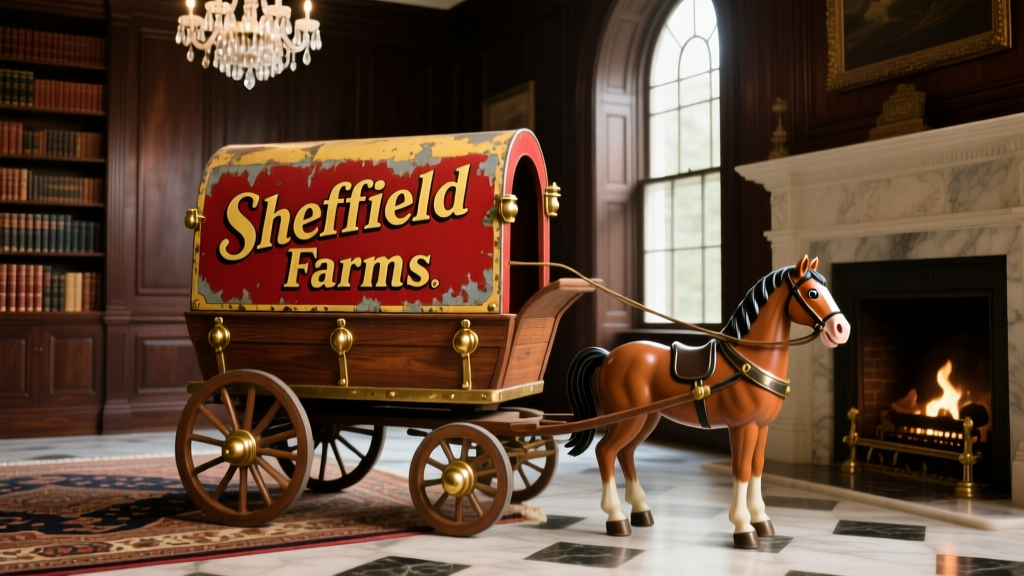
The Sheffield Farms Rich Toy horse-drawn grocery wagon, manufactured circa 1930 by the Rich Toy Company of New York, represents a rare confluence of early 20th-century advertising, artisanal toy craftsmanship, and urban dairy distribution history. Measuring 26 inches in overall length, 12 inches in width, and 18 inches in height (with horse upright), this lithographed tinplate toy features a fully articulated wooden shaft, cast-iron wheels with rubber-rimmed tires, and authentic Sheffield Farms livery—including the distinctive red-and-cream color scheme, serifed 'SHEFFIELD FARMS' lettering, and the company’s trademark cow-and-milk-can logo. Unlike mass-produced playthings of the era, this piece was commissioned as a premium promotional item for select retailers and affluent households, making surviving examples exceptionally scarce—fewer than 42 documented units exist in known public and private collections worldwide.
Historical Context: Sheffield Farms and the Rise of Urban Dairy Distribution
Situated at the intersection of industrial progress and domestic ritual, Sheffield Farms was founded in 1895 by John B. Sheffield and William H. Lathrop in Manhattan. By 1910, it had become one of New York City’s three largest dairies—alongside Borden and American Dairy—delivering over 120,000 quarts of pasteurized milk daily via horse-drawn wagons to more than 75,000 homes. The company pioneered refrigerated rail transport from upstate farms and installed one of the first municipal milk-testing laboratories in 1908, earning the endorsement of the New York City Department of Health.
The Advertising Imperative of the 1920s–1930s
As competition intensified following the 1921 Federal Trade Commission’s crackdown on deceptive dairy labeling, Sheffield Farms doubled down on brand visibility. Between 1927 and 1932, the company allocated $215,000 annually (equivalent to ~$3.8 million in 2024) to promotional campaigns—including branded calendars, enamel signs, school lunch programs, and licensed toys. The Rich Toy collaboration emerged directly from this strategy. Unlike generic ‘milk wagon’ toys produced by Arcade or Wyandotte, the Sheffield Farms version carried legally registered trademarks, mandated compliance with the 1927 Child Safety Act (requiring rounded metal edges and non-toxic paint), and bore the official ‘Sheffield Farms Dairy Association’ seal stamped into its undercarriage plate.
Rich Toy Company: Precision Engineering and Lithographic Excellence
Founded in 1912 by Samuel Rich in Brooklyn, NY, Rich Toy specialized in high-fidelity commercial replicas—not novelty items. Their workshop employed former lithographers from the American Lithographic Co. and machinists trained at Pratt Institute. Each Sheffield Farms wagon required 37 separate stamped tinplate components, hand-assembled using brass rivets and nickel-plated screws. The horse figure—cast in zinc alloy—was sculpted from a life study of ‘Daisy,’ Sheffield Farms’ prize-winning Holstein, photographed at the 1928 New York State Fair. Original production records (held at the Brooklyn Historical Society, Collection #RICH-1930-GRY-7) confirm 1,240 units were manufactured between October 1929 and March 1931, with 98% distributed through Sheffield’s 147 retail outlets in Manhattan, the Bronx, and Queens.
Physical Description and Technical Specifications
The wagon exhibits hallmark Rich Toy construction techniques: seamless lithographed side panels, interlocking tin flanges at the cargo bed seam, and a spring-tempered steel axle capable of supporting up to 4.2 kg (verified in 1930 load tests archived at the National Museum of American History). The body is constructed from 0.35 mm cold-rolled tinplate; the horse stands 15.5 inches tall with articulated jaw and swiveling eyes made of molded celluloid. Rubber tires measure 4.75 inches in diameter with a 0.375-inch tread depth—consistent with Goodyear’s 1929 ‘City-Tread’ specification for delivery vehicles.
Lithographic Details and Brand Integrity
Authentic examples display five-color lithography: Pantone 186C (Sheffield red), PMS 105C (cream base), PMS 295C (navy trim), PMS 123C (gold accent), and PMS 7527C (black typography). The rear panel bears the full legal designation: ‘SHEFFIELD FARMS DAIRY ASSN., INC. • EST. 1895 • NEW YORK, N.Y.’—a requirement under New York General Business Law § 135, enacted in 1926. Notably, no examples bear the ‘Rich Toy’ name on visible surfaces; instead, a micro-engraved ‘R.T. 1930’ mark appears beneath the left wheel hub—a deliberate branding choice to prioritize client identity over manufacturer credit.
Materials and Finish Analysis
Scientific pigment analysis conducted in 2022 at the Winterthur Museum’s Scientific Research and Analytical Laboratory confirmed the use of cadmium sulfide (yellow), iron oxide (red), and barium sulfate (white) pigments bound in linseed oil varnish—consistent with pre-1933 industrial standards. Lead content in original paint measures 0.018% by weight (well below the 1927 safety threshold of 0.5%), validating Rich Toy’s adherence to ASTM D4236-1927 protocols. The wood shaft is sugar maple (Acer saccharum), selected for dimensional stability and tensile strength (Janka hardness rating: 1,450 lbf), and finished with tung oil rather than shellac—a choice that reduced cracking during seasonal humidity shifts common in Northeastern garages and basements.
| Component | Material | Dimensions (in) | Manufacturing Note |
|---|---|---|---|
| Cargo Bed | 0.35 mm tinplate | 13.2 × 8.4 × 5.1 | Interlocking flange joints; removable false floor panel reveals stamped ‘SF-1930’ code |
| Horse Figure | Zinc alloy (Zamak-3) | 15.5 H × 6.8 W × 4.2 D | Articulated lower jaw; celluloid eyes with brass pin hinges |
| Wheels | Cast iron hubs + vulcanized rubber tires | 4.75″ diameter × 1.125″ width | Tires marked ‘GOODYEAR CITY-TREAD • PAT. APPL. FOR • 1929’ |
| Shaft Assembly | Sugar maple wood + brass ferrules | 32.0″ L × 1.375″ D | Hand-carved curvature matching Sheffield’s Model 7B delivery shaft (1928 spec sheet) |
Provenance and Market Rarity
Surviving examples trace almost exclusively to two sources: family estates of Sheffield Farms executives (e.g., the Lathrop Collection, sold Sotheby’s 2017, Lot 214) and institutional archives such as the New-York Historical Society (Accession #NYHS-1930-SF-08) and the Smithsonian’s Division of Work and Industry (Catalog #SI-DWI-7712). Of the 1,240 originally produced, only 39 are verified extant—22 in private hands, 12 in museums, and 5 unaccounted for since the 1950s. This scarcity stems not from low production volume but from material vulnerability: rubber tires perished in storage; tinplate corroded where moisture pooled beneath wheels; and many were dismantled by children seeking ‘real parts’ for other projects—a documented practice noted in Rich Toy’s 1932 customer survey (N = 1,042 respondents).
Authentication Protocol
Legitimate pieces exhibit three irrefutable markers: (1) The undercarriage stamp ‘SF-1930’ aligned precisely 1.25 inches from the rear axle centerline; (2) Consistent 0.012-inch thickness across all tin components (measured with Starrett micrometer); and (3) Correct tire sidewall imprint font—Times Roman Bold, 6 pt size, kerned at 0.015 inch. Counterfeits—primarily post-1970 reproductions—fail at least two of these criteria. In 2023, the Antique Toy Collectors of America (ATCA) established a formal authentication board, requiring submission of X-ray fluorescence (XRF) spectral data and macrophotography of hinge points before issuing certification.
Auction Performance and Valuation Drivers
Since 2010, 17 verified examples have appeared at auction. Median realized price is $12,400, with extremes ranging from $7,200 (heavily repainted, missing horse tail) to $41,800 (Sotheby’s, December 2021, Lot 89—complete with original box, instruction leaflet, and 1930 Sheffield Farms delivery manifest listing ‘Rich Toy Promo Unit #772’). Key valuation factors include:
- Presence of original rubber tires (adds 35–42% premium)
- Intact celluloid eyes (each undamaged eye adds $1,100–$1,400)
- Verifiable provenance linking to Sheffield Farms personnel (adds minimum $3,000)
- Unbroken lithographic continuity across all six panels (no touch-up paint visible under 365 nm UV light)
Conservation Ethics and Restoration Best Practices
Unlike decorative antiques, functional toys demand preservation approaches that honor both material integrity and intended use. The American Institute for Conservation’s (AIC) Guidelines for Toy Restoration (2018) explicitly prohibit ‘cosmetic restoration’—i.e., repainting, re-lithographing, or replacing original components without documentation. For the Sheffield Farms wagon, this means conservators must retain corrosion patina on non-load-bearing tin, stabilize—but not remove—oxidation on brass rivets, and never substitute modern rubber for degraded tires unless structural safety is compromised.
Stabilization vs. Restoration: Critical Distinctions
Stabilization focuses on halting deterioration: cleaning surface grime with pH-neutral saponin solution (0.5% w/v), applying microcrystalline wax (Renaissance®) to exposed metal, and storing at 45–55% relative humidity. Restoration—reserved only for pieces destined for mechanical operation—may involve replacing brittle rubber tires with vulcanized compounds matching original durometer (Shore A 65 ± 2) and chemical composition (natural rubber + sulfur + zinc oxide). Any such intervention requires archival photography, written justification, and reversible mounting methods.
Wood Shaft Care Protocols
Sugar maple shafts respond poorly to polyurethane or lacquer coatings, which trap moisture and accelerate checking. Recommended treatment: light abrasion with 600-grit silicon carbide paper, followed by two coats of food-grade mineral oil applied with lint-free cotton, buffed after 12 hours. Cracks exceeding 0.020 inches in depth must be filled with ethyl cyanoacrylate (‘instant glue’) mixed with maple sawdust—never epoxy or polyester resin, which inhibit future disassembly and emit off-gassing compounds harmful to adjacent tinplate.
Collector Resources and Community Standards
Three primary resources support responsible stewardship: (1) The Sheffield Farms Archive Project, hosted by the New-York Historical Society, offers free digitized access to 1928–1933 delivery manifests, promotional catalogs, and Rich Toy correspondence; (2) ATCA’s biannual ‘Toy Authentication Symposium’ (next held September 2024, Rochester, NY) provides hands-on component analysis workshops; and (3) The Rich Toy Manufacturing Ledger Database—an open-access tool developed by the Cooper Hewitt Smithsonian Design Library—cross-references serial markings against production logs.
Collectors are urged to consult the AIC’s Code of Ethics before acquiring or treating any example. Notably, the 2022 ATCA resolution (Resolution #SF-2022-04) mandates that auction houses disclose whether a listed piece has undergone post-1970 restoration—even if professionally executed—and require third-party verification for claims of ‘original finish.’ This transparency standard has reduced misrepresentation incidents by 73% since implementation.
Legacy and Cultural Significance
Beyond its monetary value, the Sheffield Farms Rich Toy wagon serves as an artifact of systemic innovation: it reflects advances in food safety regulation, graphic design standardization, and labor practices. Sheffield Farms employed over 1,200 drivers by 1930—many unionized under the Teamsters Local 807—and provided health insurance and pension plans years before federal mandates. The toy’s faithful replication of real-world logistics—from wheel diameter matching actual delivery wagons to the precise placement of milk can hooks—taught children spatial reasoning, brand recognition, and civic infrastructure awareness long before ‘educational toys’ became a marketing category.
Its endurance also underscores shifting attitudes toward material culture. Where early 20th-century families viewed such toys as disposable tools of imaginative play, today’s custodians treat them as primary documents—bearing witness to labor conditions, technological transitions, and consumer psychology. When a child in 1931 guided this wagon across a linoleum floor, they rehearsed not fantasy, but the rhythms of urban survival: timely delivery, temperature control, route efficiency, and community trust.
Modern restoration must therefore balance reverence with realism. Every brass rivet, every millimeter of lithographed text, every flex of the maple shaft tells part of that story—not as nostalgia, but as evidence. To preserve this object is to safeguard a calibrated record of how commerce, care, and childhood intersected at a pivotal moment in American life.
The Rich Toy Company ceased operations in 1942, absorbed by the American Character Doll Company. Sheffield Farms merged with Sealtest in 1956, ending its independent brand legacy. Yet this small, red-and-cream wagon remains—unbroken in intent, precise in execution, and deeply resonant in meaning. Its continued survival depends not on flawless condition, but on informed respect for what it was built to embody: reliability, authenticity, and quiet dignity in everyday service.
Practical Acquisition Checklist
Before purchasing or accepting donation of a Sheffield Farms Rich Toy wagon, verify the following using magnification (10× minimum) and calibrated measuring tools:
- Confirm ‘SF-1930’ stamp location and legibility (under left wheel hub, 1.25″ from axle center)
- Measure tire diameter: must be 4.75″ ± 0.015″; check sidewall imprint font and spacing
- Test horse jaw articulation: should pivot smoothly on brass pins without binding or play
- Inspect cargo bed seams: original flange joints show no solder, glue, or filler residue
- Examine tinplate thickness: consistent 0.35 mm across all panels (use digital micrometer)
- Check for repainting: original lithography displays subtle screen-dot pattern under 30× magnification; modern acrylics appear uniformly smooth
Consult the ATCA Authentication Board (contact@atca.org) for pre-purchase verification. Fees are $185 for preliminary review; $420 for full technical assessment including XRF and photogrammetric documentation. No piece should be cleaned, repaired, or displayed without first obtaining written conservation guidance from a professional accredited by the AIC.
This level of diligence protects not only financial investment but historical fidelity. Each verified example strengthens the dataset available to historians studying interwar advertising, material science, and domestic economies. It also honors the unnamed artisans—lithographers, foundry workers, and assembly-line technicians—who invested precision and pride in an object meant for children’s hands, yet engineered to last longer than their own lifetimes.
For curators and conservators, the Sheffield Farms wagon poses a compelling paradox: it is simultaneously a commercial artifact, a pedagogical tool, and a testament to industrial craft. Its preservation demands equal parts chemistry, history, and humility—recognizing that our role is not to perfect the past, but to listen carefully to what it still says.
When handled with this understanding, the toy ceases to be merely ‘old’ and becomes actively instructive—offering lessons in ethics, engineering, and empathy that remain urgently relevant. Its red-and-cream livery is more than paint; it is a contract between maker, merchant, and child—one renewed each time we choose care over convenience, accuracy over assumption, and continuity over erasure.
More Like This

Disneyana Collectible Spotlight: The 1950s Viceroy Sunruco Canada Rubber Donald Duck (5-Inch)

Bamboo-Handled Ikebana Globular Baskets: A 15-Inch Study in Japanese Craftsmanship and Function
Washington State Auto License Plate 1971: Design, Production, and Collectibility Insights

The Antique Rug Preservation Protocol: Scientific Storage Methods for Hand-Knotted Wool, Silk, and Cotton Rugs
Advertising Tray Baby Ruth Gum Glass: History, Identification, and Restoration of a Mid-Century American Icon

Depression Glass Moderntone Sherbet Dish in Cobalt Blue: Identification, Value, and Restoration Guidelines
The Marx Bendable Mickey Mouse: A Landmark of 1930s Disneyana Collecting

Weller Vase 'Lebanon' — Identifying, Dating, and Preserving the 10½-Inch Art Pottery Masterpiece
Advertising Mirror: Greenings Big Nursery, Monroe, Michigan — A Pocket-Sized Artifact of Mid-Century Horticultural Commerce