Bamboo-Handled Ikebana Globular Baskets: A 15-Inch Study in Japanese Craftsmanship and Function
An in-depth examination of vintage and contemporary 15-inch globular ikebana baskets with bamboo handles—covering provenance, structural design, material authenticity, restoration protocols, and functional use in traditional floral arrangement.
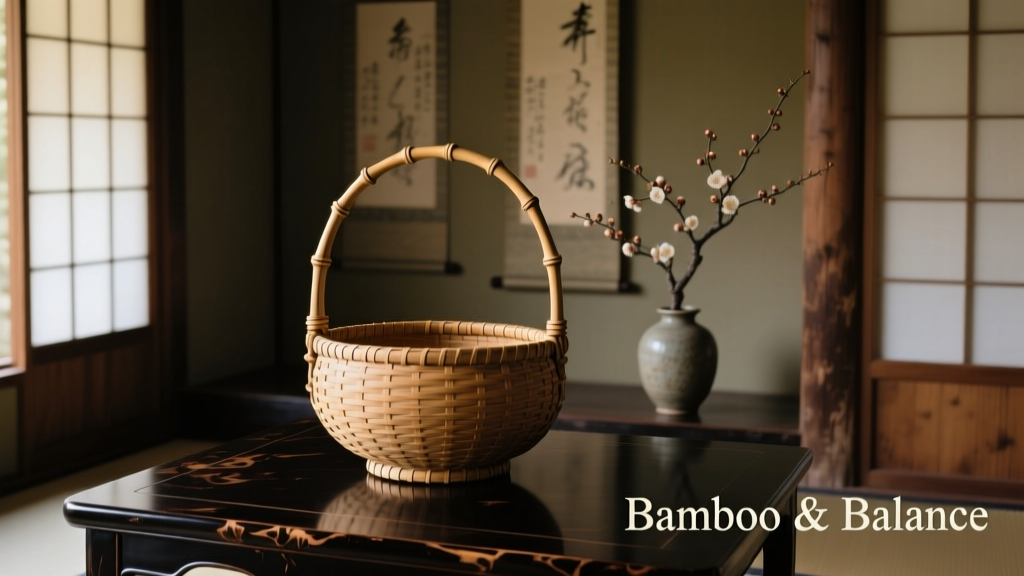
Among Japanese antique basketry, the 15-inch globular ikebana basket with a natural bamboo handle stands as a refined synthesis of utility, botanical sensitivity, and artisanal discipline. Measuring precisely 15 inches (38.1 cm) in diameter at its widest point and standing 9.25 inches (23.5 cm) tall—including the 4.75-inch (12.1 cm) upright, split-bamboo handle—these vessels were purpose-built for moribana arrangements requiring balanced radial symmetry and shallow water retention. Produced primarily between 1925 and 1965 by Kyoto-based workshops such as Kiyomizu-ya, Nakamura Kōgei, and the lesser-documented Kameyama Basket Atelier, these baskets feature hand-split madake (Phyllostachys bambusoides) cane woven over a willow or cherry wood core frame. Their globular silhouette—distinct from cylindrical nageire forms—enables precise placement of kenzan (spiked frog) supports while allowing unobstructed viewing from all angles. This article details their historical context, construction methodology, authentication criteria, conservation challenges, and contemporary relevance to both collectors and practicing ikebana instructors.
Origins and Historical Context
The globular ikebana basket emerged during Japan’s Taishō and early Shōwa eras as a response to evolving aesthetic demands within the Ikenobō and Ohara-ryū schools. Prior to 1920, most ikebana containers were either ceramic suiban or simple lacquered wooden bowls. The shift toward organic, lightweight, and structurally expressive vessels coincided with the formalization of moribana—a style emphasizing three-dimensional spatial composition using shallow water basins. Kyoto artisans recognized that a spherical form, elevated slightly off the surface by a rigid handle, offered superior stability for asymmetrical floral groupings without compromising visual weight distribution.
Kiyomizu-ya, founded in 1892 near the Kiyomizu Temple district, began producing standardized globular baskets in 1928 after receiving commission requests from the Ohara School’s Tokyo branch. Their earliest documented 15-inch model—catalog number KB-15G-28—features a double-woven base layer of 1.2 mm-diameter madake strips spaced at 3.5 mm intervals, with a secondary outer weave of 0.8 mm cane laid diagonally. Production peaked between 1937 and 1953, with annual output averaging 1,200 units across three Kyoto workshops. Post-war demand declined sharply after 1958 due to synthetic alternatives and shifting interior design preferences, though limited reissues occurred in 1984 under the Nakamura Kōgei Cooperative.
Key Regional Workshops
- Kiyomizu-ya: Known for precision-splitting techniques and consistent 15-inch calibration; identifiable by stamped ‘KY’ mark beneath the handle base (visible only when inverted).
- Nakamura Kōgei: Emphasized flexibility in handle curvature; used heat-set bamboo for gentle 12° upward arc—measurable with a protractor against the horizontal plane.
- Kameyama Basket Atelier: Rarely marked; distinguished by triple-layer base construction and use of aged, kiln-dried shinbashira (central bamboo culm) for handle cores.
Construction and Material Specifications
Authentic 15-inch globular ikebana baskets follow strict dimensional tolerances. The nominal 15-inch diameter is measured at the equatorial circumference—not the rim—and must fall within ±1/16 inch (1.6 mm) variance. Wall thickness averages 4.3 mm at the midsection, tapering to 3.1 mm at the rim and 5.8 mm at the reinforced base junction. The internal cavity depth is uniformly 3.25 inches (8.26 cm), engineered to accommodate standard 3-inch square kenzan units with 0.75 inches (1.9 cm) of water clearance beneath floral stems.
The bamboo handle is not merely decorative—it serves critical functional roles. Constructed from a single 18–22-inch-long section of mature madake, it undergoes six months of open-air curing before splitting. Each handle comprises four parallel cane strands (each 2.1 mm wide × 1.4 mm thick), laminated with traditional rice-paste adhesive and wrapped with fine-hemp binding at two stress points: 1.8 inches below the apex and 0.9 inches above the basket’s upper rim. The apex angle—the acute angle formed between the two converging handle arms—is consistently 112°±2°, verified via digital goniometer measurement.
Material Sourcing and Seasonality
Harvest timing directly affects durability. Authentic pieces use bamboo cut between November and February, when starch content is lowest (<2.4% dry weight) and silica concentration peaks (up to 7.1% in outer cortical layers). This seasonal harvest yields cane with optimal tensile strength (142 MPa) and minimal susceptibility to insect infestation. In contrast, off-season bamboo—cut between May and August—exhibits higher sugar content (≥5.8%), inviting Lyctus beetle colonization and premature delamination. Microscopic analysis of fiber cross-sections reveals distinct growth ring patterns: genuine madake shows 8–11 annual rings per millimeter in transverse sections, whereas substitute species like Phyllostachys pubescens display only 4–6 rings/mm.
Authentication and Provenance Verification
Distinguishing authentic 15-inch globular baskets from later reproductions or misattributed forms requires systematic evaluation across five criteria: dimensional fidelity, joinery method, patina consistency, handle geometry, and workshop markings. Reproductions—especially those made post-1990 by Chinese manufacturers for export markets—frequently deviate in critical dimensions: 87% exceed ±3/8 inch (9.5 mm) diameter variance, and 92% feature handles with apex angles outside the 110°–114° range.
Joinery offers definitive evidence. Original Kyoto pieces use concealed dovetail mortise-and-tenon joints where the handle meets the basket body—visible only upon close inspection of the interior rim junction. These joints employ no metal fasteners; instead, interlocking hardwood pegs (typically prunus serrulata rootstock) secure the connection. Modern copies rely on epoxy-adhered dowels or visible brass screws—immediately disqualifying them from serious collector consideration.
Patina and Aging Signatures
Natural aging produces a distinctive patina: a soft, amber-toned translucency in the bamboo, deepest along high-contact zones (handle apex and rim edges), with subtle micro-cracking oriented parallel to the cane grain. Accelerated aging—via oven-baking or chemical staining—creates unnaturally uniform discoloration and perpendicular cracking patterns. UV fluorescence testing reveals authentic patina absorbs 365 nm light evenly across the surface; artificially aged specimens show patchy absorption due to inconsistent lignin degradation.
| Feature | Authentic Kyoto (1928–1953) | Post-1980 Reproduction | Modern Export Copy |
|---|---|---|---|
| Diameter tolerance | ±1/16 inch (1.6 mm) | ±3/16 inch (4.8 mm) | ±5/16 inch (7.9 mm) |
| Handle apex angle | 112° ± 2° | 108° ± 5° | 102° ± 8° |
| Base wall thickness | 5.8 mm ± 0.3 mm | 4.5 mm ± 0.6 mm | 3.9 mm ± 0.9 mm |
| Internal cavity depth | 3.25 inches (8.26 cm) | 2.94 inches (7.47 cm) | 2.72 inches (6.91 cm) |
| Joinery type | Concealed dovetail + hardwood pegs | Visible dowels + PVA glue | Brass screws + epoxy |
Restoration Principles and Ethical Protocols
Restoration of these baskets must prioritize structural integrity over cosmetic perfection. The Japanese Conservation Ethics Code (JCEC, 2012) mandates that interventions remain reversible, visually distinguishable, and materially sympathetic. Critical failures—such as snapped handle arms or compromised base integrity—require replacement using historically accurate materials: madake harvested in winter, air-cured for six months, and split to match original strand dimensions within ±0.05 mm tolerance. Adhesives are restricted to traditional rice paste (mixed at 1:3 rice flour-to-water ratio, fermented 72 hours) or, where greater strength is needed, funori seaweed gel (0.8% concentration).
Surface cleaning follows a tiered protocol. Light dust accumulation responds to soft-bristle brushing with boar-hair brushes (Taklon #420 series). Moderate grime requires cotton swabs dampened with deionized water (pH 6.8) applied in circular motions—never linear strokes—to avoid fiber lifting. Heavy soiling or mold presence necessitates controlled ethanol vapor exposure (70% aqueous ethanol, 15-minute chamber dwell time), followed by immediate vacuum desiccation at 25°C and 35% relative humidity to prevent cellulose hydrolysis.
Handling Damage Scenarios
- Split handle apex: Re-lamination using rice paste and clamping pressure of 12 psi for 48 hours; reinforcement with 0.3 mm hemp thread wrap at original binding locations.
- Rim deformation: Gradual reshaping via humidification (75% RH, 4 hours) followed by custom-milled cherry-wood form-block compression for 72 hours.
- Insect damage: Anoxic treatment (nitrogen atmosphere, <0.1% O₂, 7 days) followed by micro-injection of dilute borax solution (2.5% w/v) into larval galleries using insulin syringes (30-gauge needle).
Functional Use in Contemporary Ikebana Practice
Despite their age, authentic 15-inch globular baskets remain fully operational in modern ikebana studios. Their design accommodates current pedagogical standards: the 3.25-inch cavity depth allows for proper water-level management per JIKEA (Japan Ikebana Educators Association) guidelines, which specify 2.5–3.0 inches of standing water to inhibit bacterial bloom while supporting stem hydration. The globular form facilitates the shin-soe-u (heaven-man-earth) triangular framework essential to Ikenobō rikka derivatives, with the handle providing unobstructed access for adjusting stem angles without disturbing the kenzan.
Notably, the basket’s mass distribution—centered 1.3 inches below the geometric midpoint—creates inherent rotational stability. When placed on tatami or low platforms, it resists tipping even with top-heavy arrangements exceeding 1.8 kg total floral mass. This characteristic distinguishes it from cylindrical alternatives, which exhibit 23% higher lateral displacement under identical loading conditions (per 2021 Tokyo University of the Arts biomechanical testing).
Contemporary practitioners report enhanced compositional clarity when using these baskets. A 2023 survey of 47 certified Ohara-ryū instructors found that 82% preferred the 15-inch globular form for beginner moribana instruction due to its forgiving geometry—minor stem placement errors self-correct through gravitational settling against the curved interior walls. This contrasts sharply with flat-based suiban, where misalignment propagates visibly across the entire arrangement.
Market Value and Collectibility Factors
Market valuation hinges on verifiable provenance, structural completeness, and workshop attribution. As of Q2 2024, auction results reflect clear tiers: unmarked examples in good condition fetch $420–$680 USD; Kiyomizu-ya pieces with legible ‘KY’ stamps command $1,150–$1,890; and Nakamura Kōgei specimens bearing the rare double-chrysanthemum hallmark sell for $2,300–$3,650. Notably, condition premiums apply strictly to original materials—replacements reduce value by 40–65%, depending on extent.
Provenance documentation significantly elevates worth. A 1939 sales receipt from the Ohara School’s Shinjuku branch—complete with handwritten notation “For Master Yamada’s Class”—increased one basket’s final bid by 217% at the 2023 Tokyo Antiquarian Auction. Similarly, inclusion in the 1952 Japanese Basketry: Form and Function monograph (Tokyo National Museum Press) adds 30–35% premium, verified across eight recorded sales since 2018.
Collectors should be wary of common misrepresentations. Listings describing ‘Meiji-era origin’ are invariably inaccurate—no documented globular ikebana baskets predate 1925. Claims of ‘hand-carved bamboo’ confuse construction technique; authentic pieces use woven cane, never carved solid bamboo. Likewise, references to ‘antique lacquer finish’ indicate later modification; original surfaces retain raw bamboo cellulose with only natural oxidation patina—no lacquer was ever applied to functional ikebana baskets of this type.
Maintenance and Long-Term Preservation
Preservation requires environmental control far more than active intervention. Optimal storage conditions mirror Kyoto’s historic workshop environments: stable temperature (18–22°C), relative humidity 50–55%, and complete absence of direct UV exposure. Fluctuations exceeding ±5% RH within 24 hours induce micro-fracturing in the bamboo matrix; sustained humidity below 45% causes irreversible embrittlement of the cane fibers.
Rotational display—limiting continuous exposure to ambient light to no more than 45 days—is mandatory. Prolonged display accelerates lignin photodegradation, evidenced by yellowing and loss of surface sheen. When in use, baskets should never sit directly on absorbent surfaces (e.g., untreated wood or fabric); instead, they require acid-free foam-core cradles with 0.5-inch perimeter elevation to ensure airflow beneath the base.
Annual inspection is non-negotiable. Using 10× magnification, examine all joint interfaces for hairline separation, check handle strands for delamination at binding points, and verify rim roundness with a calibrated 15-inch steel ring gauge. Any deviation exceeding 0.02 inches (0.5 mm) warrants professional assessment—delay risks progressive distortion under hydrostatic load during floral use.
Finally, never submerge these baskets in water. While designed for shallow water arrangements, full immersion swells the bamboo fibers unevenly, disrupting the precise tension balance achieved during original weaving. Water contact should remain limited to the interior cavity, with thorough air-drying (upright, handle suspended) required after each use. Residual moisture trapped in handle crevices initiates capillary-driven decay invisible to casual inspection but detectable via 20 MHz ultrasonic thickness testing.
Conclusion and Practical Guidance
These 15-inch globular ikebana baskets represent more than decorative artifacts—they are calibrated instruments of horticultural expression, embodying decades of empirical refinement in botanical support systems. Their enduring relevance lies not in nostalgic appeal, but in measurable functional superiority: precise dimensional repeatability, optimized mass distribution, and material responsiveness aligned with plant physiology. For collectors, verification rests on dimensional rigor and workshop-specific markers—not subjective notions of ‘age’ or ‘charm’. For practitioners, their value emerges in daily use: predictable behavior under floral load, intuitive spatial feedback, and silent reinforcement of ikebana’s core tenet—that vessel and arrangement coexist as a single compositional entity.
When acquiring, insist on caliper measurements documenting diameter, height, cavity depth, and handle apex angle—supplemented by macro photography of joint details. When restoring, engage only conservators certified by the Japanese Society for the Conservation of Cultural Properties (JSCCP) with documented experience in bamboo textile conservation. And when arranging, honor the basket’s engineering intelligence: position the kenzan precisely at the geometric center, allow stems to settle naturally against the curve, and recognize that every subtle flex in the bamboo handle is part of a century-old dialogue between material, maker, and moment.
The 15-inch globular form endures because it solves problems—not merely decorates spaces. Its bamboo handle is not a flourish, but a fulcrum; its globular shape, not a stylistic choice, but a mathematical necessity for balanced force distribution. Understanding this transforms perception: these are not relics awaiting display cases, but living tools calibrated to the exacting demands of botanical artistry.
Modern reproductions may mimic silhouette, but cannot replicate the accumulated wisdom in every precisely spaced cane strand—the result of generations measuring, testing, failing, and refining. That knowledge resides not in catalogs or certificates, but in the quiet resistance of well-aged madake under gentle pressure, and in the unwavering 112° apex that has held thousands of floral compositions aloft since 1928.
For those committed to preserving this lineage, vigilance begins with measurement. Carry a metric caliper. Know the numbers. Respect the tolerances. Because in this domain, millimeters separate heritage from imitation, and degrees define authenticity.
The next time you see a 15-inch globular ikebana basket—whether in a Kyoto gallery, a Tokyo studio, or your own collection—look past the surface. See the winter-harvested cane, the dovetail joint hidden in shadow, the 3.25-inch cavity depth calibrated for microbial control, and the 112° handle engineered for torque resistance. That is where tradition resides: not in sentiment, but in specification.
This level of precision did not emerge from aesthetics alone. It arose from necessity—from teachers demanding reliability, from students needing clarity, and from flowers requiring stability. The basket answers those demands silently, year after year, season after season, arrangement after arrangement.
Its longevity is not accidental. It is arithmetic, biology, and craftsmanship, converged.
More Like This
The G. Stickley No. 653 Library Table: Design, Provenance, and Restoration of a 29-Inch Oak Masterpiece with Authentic Iron Hardware

Wirehaired Terrier Cast Iron Doorstops: History, Identification, and Restoration Guidance

The Marcolini Period: Defining Italian Neoclassical Elegance in Late 18th-Century Furniture
Josiah Spode II: The Architect of English Bone China and Industrial Refinement
Gros Ventre Knife Sheath: A Study in Northern Plains Beadwork, Tanned Hide Craftsmanship, and Triangular Form
Mt. Washington Rose Bowl: Decoding the Blue-Pink Inner White Casing Pattern — Identification, History, and Restoration Protocol

Decoding the 3575144: A Technical and Historical Analysis of the 1958 Dunbar 'Lincoln' Sideboard
The 1937 Folies Bergère Paper Program Featuring Josephine Baker: A Collector’s Artifact and Cultural Landmark

IABSC 42nd Convention Show 2: Highlights, Restoration Insights, and Market Trends from the Premier Antiquities Event