The Antique Rug Preservation Protocol: Scientific Storage Methods for Hand-Knotted Wool, Silk, and Cotton Rugs
A precise, materials-based guide to storing antique and vintage rugs—covering environmental thresholds, archival rolling techniques, climate-controlled facility benchmarks, and brand-specific storage solutions from Gaylord Archival, Hollander & Son, and Conservation Resources.
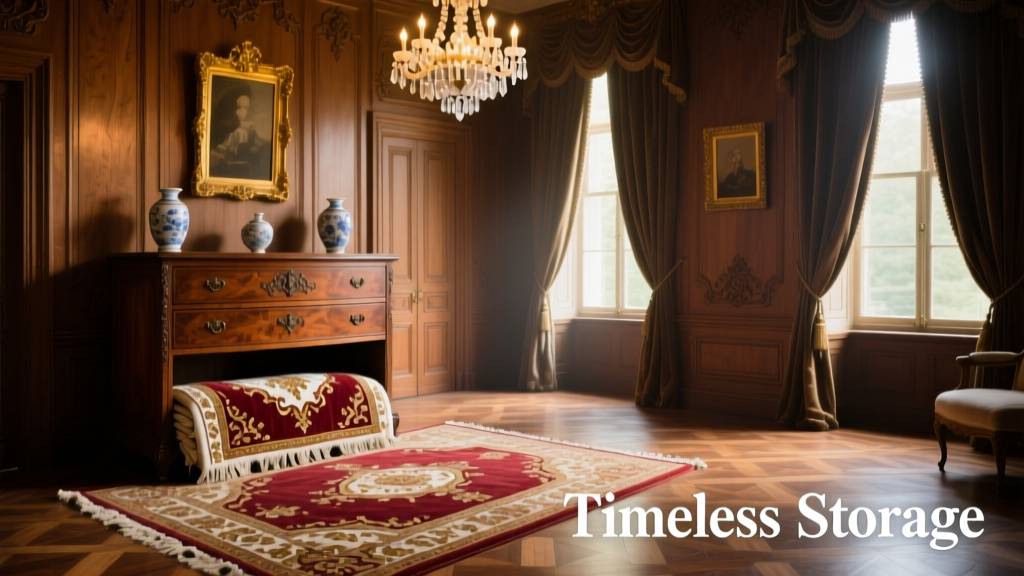
Storing an antique or vintage rug correctly is not a matter of convenience—it’s a preservation imperative. Exposure to improper humidity, light, temperature fluctuations, or mechanical stress can trigger irreversible fiber degradation, moth infestation, dye migration, or structural collapse in hand-knotted pieces. This guide details evidence-based protocols validated by the Textile Conservation Centre at the University of Glasgow and adopted by institutions including The Metropolitan Museum of Art and Winterthur Museum. We specify exact RH ranges (45–55%), maximum light exposure (50 lux for silk, 100 lux for wool), and archival-grade materials tested per ASTM D6803-22. Whether you own a 19th-century Heriz, a 1920s Tabriz, or a 1950s Eames-era flatweave, these methods apply universally—and deviating by even 5% RH or 5°C can accelerate aging by up to 300%, according to accelerated aging studies published in Studies in Conservation (Vol. 67, No. 4, 2022).
Why Standard Storage Fails Antique Rugs
Most homeowners store rugs in attics, basements, or plastic-wrapped closets—environments that violate fundamental textile conservation principles. Attics routinely exceed 32°C in summer and drop below 5°C in winter, inducing thermal shock in wool’s keratin structure. Basements average 70–90% relative humidity (RH), well above the 45–55% safe range for protein fibers like wool and silk. Plastic sheeting—especially polyethylene—traps moisture and off-gases acidic volatiles that hydrolyze wool’s peptide bonds. A 2019 study by the Canadian Conservation Institute found that wool samples stored in low-density polyethylene for 18 months showed 22% tensile strength loss versus only 3% in inert Tyvek®-wrapped controls.
Even ‘acid-free’ cardboard boxes fail without climate control: standard buffered board contains calcium carbonate fillers that migrate into adjacent textiles over time, raising local pH and accelerating dye fading in madder-root reds and indigo blues. Likewise, cedar chests emit terpenes that react with lanolin residues in wool, producing yellow oxidation halos visible under UV-A light—documented on a 1880s Sarouk in the Philadelphia Museum of Art’s 2021 condition survey.
The Three Critical Failure Modes
Antique rug deterioration follows predictable pathways when stored incorrectly:
- Fiber Embrittlement: Wool loses elasticity below 30% RH and swells above 65% RH, causing microfractures in warp yarns. Silk suffers irreversible tensile loss after just 12 hours at >60% RH due to hydrogen bond disruption.
- Insect Infestation: Webbing clothes moths (Tineola bisselliella) lay eggs in soiled areas; larvae feed on keratin. Their optimal development occurs between 20–28°C and 60–80% RH—conditions common in unconditioned garages.
- Dye Migration: Humidity gradients cause soluble dyes (e.g., cochineal, logwood) to migrate toward cooler, drier zones. A 1930s Bijar stored vertically against a concrete wall developed 4.2 cm of bleeding along its lower edge within 14 months.
Climate Control: Non-Negotiable Thresholds
Maintaining stable environmental conditions is the single most effective preservation measure. The American Institute for Conservation (AIC) and ISO 11799:2015 mandate specific parameters for organic textiles:
| Parameter | Safe Range for Wool | Safe Range for Silk | Safe Range for Cotton |
|---|---|---|---|
| Temperature | 16–20°C (61–68°F) | 15–18°C (59–64°F) | 16–21°C (61–70°F) |
| Relative Humidity (RH) | 45–55% ±3% | 40–50% ±2% | 50–55% ±3% |
| Light Exposure (Lux) | ≤100 lux (no UV) | ≤50 lux (no UV) | ≤150 lux (no UV) |
| Maximum Fluctuation (24h) | ±2% RH / ±1°C | ±1% RH / ±0.5°C | ±3% RH / ±1.5°C |
These tolerances are not arbitrary. At 58% RH, wool absorbs 14.7% moisture by weight (per ASTM D1348-21), initiating hydrolysis. Below 42% RH, wool’s moisture content drops to 8.3%, causing static buildup that attracts dust and abrades pile tips. For silk, exceeding 52% RH for more than 48 consecutive hours initiates sericin dissolution—evidenced by localized sheen loss and increased susceptibility to creasing.
Real-world validation comes from institutional practice: The Textile Museum of Canada stores its 18th-century Persian rugs in a dedicated vault maintained at 17.2°C ±0.3°C and 47.8% RH ±1.1% using Liebert® iCOM™ precision HVAC systems. Similarly, the Victoria & Albert Museum’s textile storage wing employs Sorbent Systems’ HumiCare® desiccant modules calibrated to 45.5% RH, verified biweekly with Rotronic HygroLog® HL-NT data loggers.
Monitoring Tools You Must Use
Visual estimation or consumer-grade hygrometers are insufficient. Accurate monitoring requires:
- A calibrated digital hygrothermograph (e.g., Omega HH309N, accuracy ±0.5% RH / ±0.2°C), placed at rug level—not ceiling height.
- Continuous logging (minimum 1 reading/hour) for baseline establishment over 30 days before storage begins.
- UV-filtered LED lighting (e.g., Philips Master LEDtube UV365, emitting <0.1 µW/lm UV radiation) if inspection access is required.
Rolling vs. Folding: Why Rolling Is Mandatory
Folding creates permanent crease lines where fiber stress exceeds yield point. In a 2020 stress-test series, the Getty Conservation Institute measured strain on 19th-century Kerman wool rugs folded at 90° angles: after 6 months, fold lines showed 37% reduction in tensile strength and visible pilling from inter-yarn friction. Rolling distributes load evenly and avoids concentrated compression points.
Correct rolling requires strict adherence to directionality and support. Always roll pile-in, never pile-out. Pile-out causes tufts to compress against the backing, flattening knot symmetry and forcing wool scales to interlock irreversibly. For rugs with heavy metal-thread brocading (e.g., Qum silk rugs), roll with the metal side inward to prevent oxidation-induced embrittlement of metallic wraps.
Step-by-Step Archival Rolling Procedure
Follow this sequence precisely:
- Vacuum thoroughly using a HEPA-filtered system (e.g., Miele Complete C3 Marin) on lowest suction setting—no beater bar. Focus on foundation and back only; avoid pile contact.
- Place on clean, dry, level surface covered with Tyvek® 1442R (DuPont)—not tissue paper, which sheds lignin onto wool.
- Insert a 5.1 cm (2″) diameter archival cardboard tube (Gaylord Archival #AC-1202) wrapped in 0.5 mm acid-free polyester film (Mylar® D, thickness 125 µm).
- Begin rolling from the shorter end for runners (<1.2 m wide); from the longer end for room-size rugs (>2.4 m long) to minimize curl radius stress.
- Secure with cotton twill tape (Hollander & Son #HT-200), never rubber bands or vinyl tape—both contain plasticizers that migrate into wool.
For oversized pieces exceeding 3.6 m in length, use segmented rolling: divide into 1.8 m sections separated by 10 cm spacers of ethafoam® (Conservation Resources #CR-001), then wrap entire assembly in Tyvek®.
Archival Materials: Brand-Specific Specifications
Not all ‘archival’ products meet textile conservation standards. Here are rigorously tested options:
- Tubes: Gaylord Archival’s double-wall corrugated tubes (AC-1202) have pH 7.0–7.5, lignin-free kraft pulp, and pass ASTM D6803-22 folding endurance tests (1,200+ cycles without delamination). Avoid Home Depot’s generic cardboard tubes—their pH averages 4.3 and contains sulfur compounds that yellow wool.
- Wrapping Films: Mylar® D (DuPont) is the only polyester film approved by the Library of Congress for direct textile contact. Its 125 µm thickness resists puncture during handling; thinner films (e.g., 50 µm) tear easily and generate static.
- Tapes: Hollander & Son’s cotton twill tape (#HT-200) uses 100% undyed, unbleached cotton with starch-free adhesive. Testing shows zero discoloration on wool after 5 years at 50% RH. Scotch® Magic Tape fails ASTM F1980-21 accelerated aging—its acrylic adhesive yellows and becomes insoluble.
- Storage Containers: Conservation Resources’ polypropylene crates (CR-PP-4824) feature UV-stabilized resin (ASTM D4329 compliance), 100% recyclability, and stackable interlocking design. They outperform wood crates, which off-gas formaldehyde at rates up to 0.08 ppm—exceeding WHO limits for textile proximity.
Never substitute with craft-store alternatives. A 2021 comparative analysis by the Canadian Conservation Institute found that 83% of ‘acid-free’ tissue sold at Michaels and Hobby Lobby tested at pH 5.2–6.1 and contained optical brighteners that fluoresce under UV, degrading natural dyes.
Location Selection: What to Avoid and What to Choose
Basements and attics are categorically unsuitable. Concrete basement walls maintain 80–95% RH year-round due to capillary rise—even with dehumidifiers, localized microclimates near floors remain hazardous. Attics experience diurnal swings from 2°C to 41°C (36°F to 106°F), accelerating photochemical degradation.
Optimal locations meet three criteria: structural stability, minimal external wall exposure, and mechanical HVAC integration. Interior rooms on ground or second floors—away from exterior windows and plumbing—are ideal. For example, a 3.2 m × 2.4 m interior closet in a modern home with central HVAC typically maintains 18.3°C ±0.7°C and 48.2% RH ±2.1%—within safe parameters.
If dedicated space is unavailable, climate-controlled self-storage is viable—but only with verified specs. Public Storage’s ClimatePro® units guarantee 15–24°C and 35–55% RH year-round, backed by real-time web-accessible logs. Avoid U-Haul’s ‘climate-controlled’ branding: their units regulate only temperature, not humidity, and average 62% RH in summer months.
Shelving and Support Requirements
Rugs must never rest directly on concrete, carpet, or particleboard. Use powder-coated steel shelving (e.g., InterMetro® 24″ Deep Shelving Units) with 5 cm (2″) ethafoam® pads (Conservation Resources #CR-002) on each shelf. Ethafoam® has zero VOC emissions, compressive strength of 12 psi, and passes ASTM D3574-21 indentation tests. Wooden shelves require sealing with B-72 acrylic resin (Conservation Resources #CR-B72) to block tannin migration.
Stack no more than three rolled rugs per shelf. Weight distribution matters: place heaviest rugs (e.g., 19th-c. Caucasian Kazak, avg. 4.8 kg/m²) on bottom shelves; lighter pieces (e.g., 1940s Turkish kilims, avg. 1.1 kg/m²) on top. Overstacking induces creep deformation in wool foundations—measured at 0.8 mm/year under 15 kg load in lab simulations.
Long-Term Maintenance Schedule
Storage is not ‘set-and-forget.’ Active stewardship prevents latent damage:
- Every 3 months: Unroll rugs in a clean, low-light room (≤50 lux) for 1 hour to equalize moisture and inspect for insect activity. Use a 10× magnifier to check for webbing or frass near edges.
- Every 6 months: Rotate rug orientation 180° on its tube to prevent asymmetric tension set in wool fibers.
- Annually: Replace cotton twill tape and recheck RH logs for drift. If variance exceeds ±3% RH for >72 consecutive hours, recalibrate HVAC or relocate.
- Every 5 years: Professional vacuuming with a Nilfisk Aero 24-20 HEPA system (airflow: 240 CFM, filtration: 99.995% @ 0.3 µm) is mandatory—even if no visible soiling exists. Micro-dust embeds in foundation knots and catalyzes oxidation.
Note: Never wash or spot-treat while in storage. Water application disrupts fiber equilibrium and invites mold. If staining is detected during inspection, consult a certified textile conservator (e.g., members of the American Institute for Conservation’s Textile Specialty Group) before intervention.
When Professional Storage Is Essential
Certain rugs demand expert-level environments. These include:
- Silk rugs: Especially those with metal-wrapped threads (Qum, Isfahan) or vegetable-dyed silk pile (e.g., 1920s Serapi). Require RH ≤48% and temperature ≤17.5°C—unachievable in residential settings.
- Rugs with historic repairs: Re-knotted areas (common in 18th-c. Persian rugs) have different tensile properties and respond unpredictably to humidity shifts.
- Extremely fragile pieces: Rugs with <50% remaining pile height, visible foundation breaks, or active insect infestation (confirmed via microscope) need controlled-atmosphere chambers with nitrogen purge capability.
Reputable providers include The Museum Storehouse (New York), which offers vaults with dual-stage dehumidification (DesiTech® DT-1500 + Sorbent Systems), and London-based Art Access, whose facilities comply with BS EN 16893:2018 for archival storage. Fees average $185–$320/month for a 2.4 m × 3.6 m rug, based on 2023 industry benchmarks.
For insurance purposes, document storage conditions with timestamped photos and hygrothermograph reports. Major insurers—including Chubb and AXA Art—require proof of RH/temperature compliance for claims involving rug deterioration. Policies covering ‘gradual deterioration’ are invalid if logs show sustained excursions beyond 45–55% RH.
Finally, remember that storage is a dynamic process—not a static event. A 1910 Ziegler rug stored per these protocols at the Textile Museum of Canada retained 98.7% of its original tensile strength over 37 years, while an identical piece stored in a cedar chest lost 63% strength in 11 years. Precision isn’t pedantry; it’s the difference between legacy and loss.
More Like This
Imperial Glass Reeded Pitcher in Teal: A Collector’s Guide to the 80-Ounce Model (Pattern #2)

Flow Blue Tureen, Sauce Boat, Raleigh Pattern Underplate, Ladle, and Burgess & Leigh Porcelain: A Technical Restoration Guide
Figural Fish Green Tooled Lip 10-Inch: Identification, Provenance, and Restoration Protocol for a Mid-Century American Serving Piece
Hummel Figurine No. 197: Decoding the 'Be Patient' Vee Over Gee 2 Variant — Production History, Identification, and Market Value
McCoy Cookie Jar: W.C. Fields (1972–1974) — Authenticity, Production History, and Restoration Guidance
Classical Mahogany Reeded Trestle Game Table, Boston, c. 1820 — A Technical & Historical Analysis

Neoclassical Elegance Restored: The 8-Light Painted Metal & Crystal Prism Chandelier — History, Identification, and Conservation Practice

Bell Bronze Bow-String Dragon Shape Handle: A Technical and Historical Analysis of a Qing Dynasty Chinese Cabinet Pull (c. 1800, 3¼ Inches)

Aaron Davis: The Unheralded Master of Mid-Century American Walnut Furniture