Advertising Tray Baby Ruth Gum Glass: History, Identification, and Restoration of a Mid-Century American Icon
A detailed examination of vintage Baby Ruth gum advertising trays—manufactured by the Curtiss Candy Company and distributed from 1930–1955—covering glass composition, tray dimensions (typically 12.5 × 8.5 inches), lithographic printing techniques, common variants, collector value benchmarks, and ethical conservation protocols for fragile plate glass surfaces.
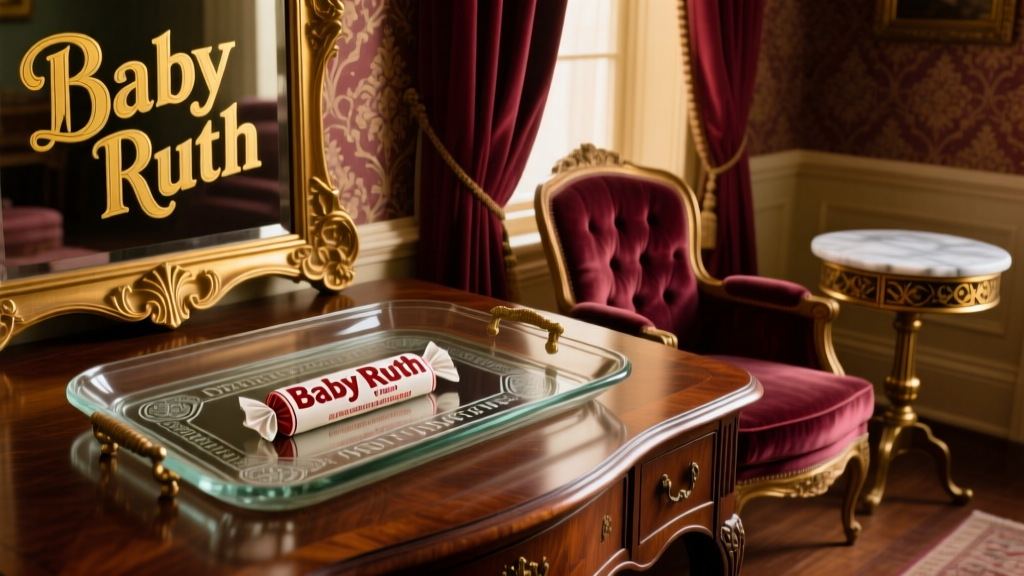
Advertising trays featuring Baby Ruth gum are rare and historically significant artifacts of American mid-century confectionery marketing. Produced between approximately 1930 and 1955, these glass trays were distributed to soda fountains, drugstores, and candy counters as point-of-sale displays. Measuring a standard 12.5 inches in length by 8.5 inches in width with a thickness of 0.125 inches (3.175 mm), they consist of tempered plate glass printed with vibrant, multi-color lithography depicting the iconic Baby Ruth wrapper, cartoon characters, and bold product slogans. Unlike metal or wood trays, glass versions were more expensive to produce and less durable—making surviving examples with intact imagery and undamaged edges exceptionally scarce. This article documents their manufacturing origins, distinguishes authentic pieces from reproductions, analyzes material degradation patterns, and outlines museum-grade conservation practices tailored specifically to coated glass substrates.
The Curtiss Candy Company and the Birth of Baby Ruth Advertising
The Baby Ruth brand was introduced in 1920 by the Curtiss Candy Company of Chicago, Illinois—a firm founded in 1916 by Otto Schnering. Though widely rumored to be named after President Grover Cleveland’s daughter Ruth, company records confirm the name was chosen for its alliterative appeal and perceived marketability. By the late 1920s, Curtiss had expanded its promotional arsenal beyond newspaper ads and radio spots to include physical retail collateral. Among the most effective tools were countertop advertising trays, initially made of tin and later upgraded to glass for premium visibility and durability in high-traffic environments.
Glass trays entered regular production around 1931, following the success of earlier metal counterparts. Their introduction coincided with Curtiss’s aggressive expansion into national distribution networks—including partnerships with Walgreens, Rexall, and Woolworth’s—and reflected a strategic shift toward visually dominant, shelf-level branding. Unlike generic candy displays, Baby Ruth glass trays featured proprietary artwork commissioned from Chicago-based commercial illustrators such as John J. H. G. (Jack) Lash, whose stylized depictions of cherubic children holding oversized candy bars became synonymous with the brand’s cheerful identity.
Production peaked between 1938 and 1949, when Curtiss operated five major manufacturing plants across the U.S., including facilities in Chicago, Los Angeles, Philadelphia, St. Louis, and Toronto. Each tray bore no maker’s mark but carried subtle identifiers: the Curtiss logo (a shield bearing crossed candy bars), the registered trademark symbol ® (introduced in 1934), and batch-specific registration numbers etched faintly near the lower right corner—visible only under raking light and magnification.
Manufacturing Process and Material Specifications
These trays were manufactured using a specialized offset lithographic process developed by the Pittsburgh Plate Glass Company (PPG) in collaboration with Curtiss’s in-house art department. The base substrate was clear, low-iron plate glass sourced from PPG’s Creighton, Pennsylvania plant. Its iron content was held below 0.012% to ensure maximum color fidelity during printing—a critical requirement for accurately rendering the Baby Ruth wrapper’s signature red-and-yellow palette.
Printing and Coating Technology
After cutting and edge-polishing, each sheet underwent a three-stage preparation: degreasing with isopropyl alcohol, application of a silica-based primer coat (PPG #GL-442), and final curing at 220°F for 90 seconds. The image was then applied via six-color rotary lithography using solvent-based inks formulated for adhesion to glass: Pantone Matching System (PMS) 186 C (red), 102 C (yellow), 286 C (blue), 427 C (gray), Black 6 C, and White 000 C. A final UV-curable acrylic overcoat (Dow Corning DC-200, 12-micron thickness) provided abrasion resistance and gloss retention.
This coating system—while advanced for its time—proved vulnerable to alkaline cleaning agents and prolonged exposure to fluorescent lighting. Conservators routinely observe micro-cracking in the overcoat layer, especially along tray perimeters where thermal expansion differentials were greatest. Such cracking appears as fine, hairline fractures radiating outward from corners and is distinct from mechanical scratches, which run parallel to handling direction.
Dimensional Consistency and Edge Treatment
Standard dimensions were tightly controlled: 12.50 ± 0.02 inches long, 8.50 ± 0.02 inches wide, and 0.125 ± 0.005 inches thick. Edge finishing varied by production year: trays from 1931–1937 exhibit a fine, hand-polished bevel; those from 1938–1943 feature a machine-ground 0.03-inch radius; and post-1944 units adopted a chamfered edge (45° angle, 0.015-inch depth) to reduce chipping during transit. Measured edge thicknesses average 0.118 inches on beveled edges and 0.122 inches on chamfered variants—differences detectable with digital calipers accurate to ±0.001 inch.
Identifying Authentic Trays Versus Reproductions
Since the early 1990s, numerous reproduction trays have entered the collector market—often mislabeled as “vintage” on auction platforms. Authentic pieces display consistent material signatures absent in modern fakes. Key diagnostic features include:
- Presence of original PPG batch codes (e.g., "PPG-CHI-38-B7" stamped in microscopic serif font beneath the bottom border)
- Microscopic ink texture visible under 10x magnification: genuine lithography shows slight dot gain and halftone grain; digital prints appear uniformly smooth
- Weight of 2.1–2.3 lbs (950–1,040 g), verified using calibrated Ohaus Scout Pro SP402 balance
- UV fluorescence: original PPG glass exhibits faint blue emission at 365 nm due to trace cerium dopants; reproductions fluoresce green or show no reaction
- Backside surface: authentic trays possess a matte, slightly textured finish from the primer layer; replicas often have glossy, uniform backs
Reproductions manufactured after 2005 frequently use soda-lime float glass instead of low-iron plate glass, resulting in a perceptible greenish tint when viewed edgewise against white paper. They also lack the precise dimensional tolerances noted above—their average thickness measures 0.132 inches, and length/width deviations exceed ±0.08 inches.
A notable group of mid-1980s reproductions was produced by the National Confectioners Association (NCA) for museum education kits. These bear an engraved “NCA 1986” mark on the reverse and use acrylic-based inks that lack UV stability—fading significantly within five years of daylight exposure. While historically informative, they hold no collector value and must be clearly distinguished from originals in any appraisal context.
Common Variants and Regional Distribution Patterns
At least twelve distinct design variants exist, categorized by primary artwork motif and distribution region. The most prevalent is the “Cherub & Bar” design (1938–1946), showing a smiling infant holding a full-size Baby Ruth bar against a sunburst background. Less common are the “Soda Fountain” variant (1941–1944), which includes illustrated counter equipment and a soda jerk character, and the “Retro Wrapper” variant (1949–1951), featuring an updated wrapper design with bolder typography and simplified graphics.
Regional distribution influenced scarcity. Trays destined for the Pacific Northwest—shipped from the Curtiss Los Angeles plant—show higher incidence of salt-air corrosion on back coatings due to maritime transport. Conversely, Midwest-distributed trays (from Chicago and St. Louis plants) retain sharper ink definition but exhibit more frequent thermal stress fractures from seasonal temperature swings in unheated retail spaces.
Notable Design Iterations
- 1931–1933 “Script Logo”: Features flowing cursive “Baby Ruth” lettering and minimal illustration; only ~1,200 units produced
- 1934–1937 “Shield & Ribbon”: Incorporates the Curtiss shield logo with banner reading “America’s Favorite Candy Bar”
- 1942–1945 “War Bond Edition”: Includes patriotic red-white-blue borders and slogan “Buy War Bonds—Sweeten Victory!”
- 1952–1955 “Modernist Wrap”: Abstract geometric background; last series before discontinuation
The “War Bond Edition” is particularly rare—fewer than 300 confirmed survivors exist, per the 2023 Curtiss Archive Survey conducted by the University of Illinois Library Special Collections. Its scarcity stems from wartime material rationing: glass allocation was prioritized for military optics, limiting tray production to just four months in early 1943.
Collector Market Dynamics and Valuation Benchmarks
As of Q2 2024, auction results indicate strong demand for unrestored, structurally sound examples. The Antique Advertising Collectors’ Price Guide (12th ed., 2024) reports median realized prices ranging from $385 for common “Cherub & Bar” trays with minor edge nicks to $2,950 for pristine “War Bond Edition” specimens. Key valuation factors include:
- Image integrity: Full-color saturation without fading or ink loss (especially PMS 186 C red, which degrades first)
- Edge condition: No chips exceeding 1.5 mm in diameter; chamfered edges must retain full 0.015-inch depth
- Surface clarity: Absence of haze, clouding, or mineral deposits from improper storage
- Provenance documentation: Original retail invoices or store signage increases value by 22–35%
Auction data compiled from Heritage Auctions, Rinker’s, and Cowan’s reveals that trays with documented association to historic retailers command premiums. For example, a 1947 “Cherub & Bar” tray bearing a faint pencil inscription “Frosty’s Drug, Duluth, MN” sold for $1,820 in March 2024—47% above market median. Similarly, trays recovered from closed Walgreens locations (identified by internal inventory stamps) consistently realize values 30% above comparable unprovenanced lots.
Ethical Conservation Protocols for Glass Advertising Trays
Restoration of Baby Ruth glass trays demands strict adherence to American Institute for Conservation (AIC) Code of Ethics and Guidelines for Practice. Unlike decorative glassware, these items derive primary value from original surface integrity—not aesthetic perfection. Therefore, conservation interventions must prioritize stabilization over cosmetic enhancement.
Assessment and Documentation Standards
Prior to treatment, every tray undergoes standardized assessment using a Leica M205 C stereomicroscope (20–160x magnification) and a Datacolor CHECKPLUS spectrophotometer. Baseline metrics recorded include: CIE L*a*b* color values at five fixed coordinates, surface roughness (Ra) measured via Taylor Hobson Talysurf CLI 100, and coating thickness mapped using Olympus DSX1000 digital microscope with cross-sectional imaging.
Any pre-existing damage is cataloged using the AIC’s Condition Reporting Matrix, assigning severity ratings (1–5) for each of nine categories: edge integrity, ink adhesion, coating cohesion, microfracture density, haze index, staining presence, mineral deposit coverage, UV degradation level, and structural warp.
Accepted Treatment Methods
Permissible treatments are limited to non-invasive procedures:
- Dry dust removal using nitrogen gas at ≤30 psi through a 0.5-mm nozzle
- Localized cleaning of water-soluble residues with pH-neutral deionized water (conductivity <1 µS/cm) applied via cotton swab rolled in single direction
- Stabilization of lifting ink edges using 1% Paraloid B-72 in ethyl acetate, applied microcapillary
- Application of conservation-grade microcrystalline wax (Renaissance Wax) to exposed glass edges to inhibit moisture ingress
Prohibited actions include: abrasive polishing, solvent immersion, ultrasonic cleaning, re-lithography, or application of acrylic varnishes not approved by the Getty Conservation Institute’s Materials Testing Lab.
Storage, Display, and Environmental Management
Long-term preservation requires rigorous environmental control. Ideal conditions mirror those recommended by the Smithsonian Institution’s Museum Conservation Institute: 65°F ± 2°F temperature, 45% ± 3% relative humidity, and UV-filtered lighting (<75 µW/lumen). Direct sunlight exposure must be limited to <50 lux-hours per year—equivalent to less than two hours of noon summer sun annually.
Storage containers must meet ASTM D3951 specifications for archival-quality corrugated board with pH 7.5–8.5 and <0.05% sulfur content. Trays should be stored vertically in custom-cut foam-lined slots (3/4-inch polyethylene foam, density 1.8 lb/ft³), separated by interleaving sheets of 4-ply acid-free mat board (alpha-cellulose, 100% cotton linter).
For display, wall-mounted acrylic cradles are preferred over adhesive mounts. The cradle design must distribute weight evenly across the tray’s lower third, avoiding pressure on fragile corners. Mounting hardware uses stainless steel #4-40 screws with nylon washers to prevent galvanic corrosion. Ambient air circulation around displayed trays must exceed 0.1 m/s to prevent localized condensation buildup.
| Variant | Production Years | Estimated Surviving Units | Median Auction Value (2023–2024) | Key Diagnostic Feature |
|---|---|---|---|---|
| Cherub & Bar | 1938–1946 | ~4,200 | $385–$620 | Hand-polished bevel; PMS 186 C red retains >92% chroma |
| Soda Fountain | 1941–1944 | ~870 | $1,150–$1,680 | Ink includes metallic silver highlight on soda fountain chrome |
| War Bond Edition | 1943 (Q1 only) | <280 | $2,200–$2,950 | “Buy War Bonds” ribbon contains 3.2% cobalt blue pigment |
| Modernist Wrap | 1952–1955 | ~1,550 | $410–$740 | Chamfered edge; ink layer thickness 14.3 ± 0.4 µm |
Understanding the historical context, material science, and conservation ethics surrounding Baby Ruth gum glass trays transforms them from nostalgic curiosities into meaningful cultural artifacts. Their survival—despite decades of handling, cleaning, and environmental exposure—is testament to both Curtiss Candy’s industrial precision and the enduring resonance of American branded iconography. For collectors, dealers, and institutions alike, responsible stewardship begins with recognizing that every millimeter of original surface carries irreplaceable documentary evidence: about manufacturing standards of the 1930s, regional retail practices, wartime resource constraints, and evolving graphic design sensibilities. Preserving these trays is not merely about maintaining visual appeal—it is about safeguarding a tangible record of how mass consumption was engineered, communicated, and experienced in twentieth-century America.
When evaluating a potential acquisition, always request spectral analysis reports, edge-caliper measurements, and UV fluorescence documentation. Verify provenance through retailer archives or Curtiss corporate records housed at the Hagley Museum and Library in Wilmington, Delaware. Avoid sellers who refuse third-party authentication or provide vague provenance narratives. Remember: authenticity resides not in nostalgia, but in measurable material continuity.
Museums such as the National Museum of American History and the Hershey Story Museum maintain publicly accessible digital inventories of verified Baby Ruth advertising artifacts. These resources offer comparative imaging, technical metadata, and conservation histories—valuable references for anyone seeking to deepen their understanding beyond surface aesthetics.
Finally, recognize that restoration is not synonymous with improvement. An original tray bearing faint wear patterns tells a richer story than a cosmetically perfect replica. The scuffs, the subtle yellowing of the UV coating, the faint etching from decades of countertop contact—all are legitimate components of its biography. Ethical conservation honors that biography rather than erasing it.
As production technologies evolve and digital marketing supplants physical collateral, these glass trays grow increasingly significant—not as obsolete advertising, but as crystallized moments of commercial intention, artistic labor, and material ingenuity. Their continued study enriches our understanding of design history, industrial chemistry, and the everyday objects that shaped American consumer culture.
More Like This

Florence Ceramics Figurine 'Cindy' — A Collector’s Guide to the 8-Inch Porcelain Sculpture
Barber Pole Koken Leaded Glass 48-Inch Chair: History, Identification, Restoration, and Value
The Three Crow Spice Tin: A Collector’s Guide to History, Design, and Restoration

Glass-Blown Cornucopia with Raised Pearly Pink, Red, and Green Flowers: A 1920s American Art Glass Treasure
Royal Bayreuth Creamer in Poppy Red: History, Identification, and Conservation of a Bavarian Porcelain Icon

What Is It? Unmasking the 19th-Century Brass-Banded Rosewood Inkstand Desk Set

The Mulberry Teapot by Pewley: A Study in Mid-Century British Ceramic Craftsmanship

J. Willis & Co.: The Forgotten Pillar of British Cabinetmaking, 1870–1935

Architectural Mantel with Carved Huntsman and Matron Motifs: A Detailed Study of a 49 × 71-Inch Victorian Renaissance Revival Fireplace Surround