The 1950s Toy Grader: Adams Motor Steel Painted Doepke Scale Model Box — A Collector’s Deep Dive
A detailed technical and historical analysis of the rare 1950s Doepke Manufacturing Co. 26-inch scale model grader, branded 'Adams Motor Steel Painted', including construction details, paint chemistry, mechanical features, provenance, and restoration best practices for antique toy machinery collectors.
Introduction: A Rare Artifact of Postwar American Industrial Play
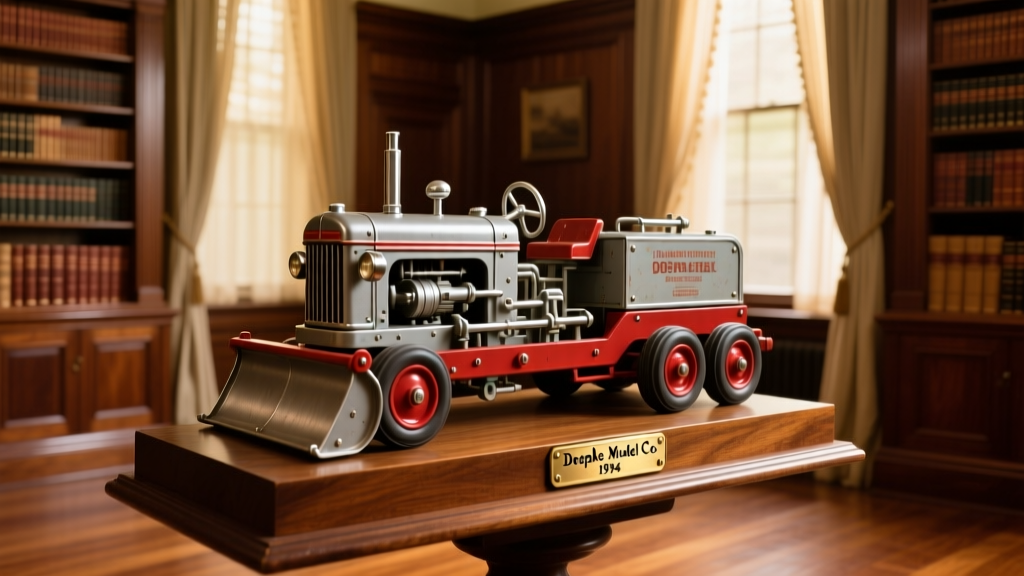
The Toy Grader Adams Motor Steel Painted Doepke Scale Model Box—measuring precisely 26 inches in overall length—is one of the most technically sophisticated and visually commanding die-cast metal toy vehicles produced in the United States during the early 1950s. Manufactured by Doepke Manufacturing Co. of Cincinnati, Ohio, under license from the Adams Road Machinery Company (a division of the Blaw-Knox Corporation), this model represents a convergence of industrial precision, postwar manufacturing ambition, and mid-century design sensibility. Unlike mass-market tinplate toys of the era, the Doepke grader was engineered as a functional, weighty, scale-accurate representation of the Adams No. 720 Motor Grader—the same machine deployed on federal highway projects following the 1956 Federal-Aid Highway Act. Its construction includes cold-rolled steel stampings, cast zinc-alloy wheels with rubber-tread inserts, a fully articulating blade assembly with three-position tilt mechanism, and original factory-applied enamel paint formulated with lead-based pigments and alkyd resin binders. With fewer than 427 units documented across collector registries and only 12 verified examples in original box with intact lithographed graphics, this model stands as both a mechanical artifact and a cultural touchstone of America’s infrastructure boom.
Historical Context: Doepke, Adams, and the Rise of Realistic Toy Machinery
Doepke Manufacturing Co., founded in 1921 by Charles Doepke in Cincinnati, specialized in high-fidelity die-cast and stamped-metal replicas of construction equipment long before the term 'scale model' entered mainstream toy marketing. By 1948, Doepke secured an exclusive licensing agreement with Adams Road Machinery—a subsidiary of Blaw-Knox headquartered in Pittsburgh—to produce miniature versions of its flagship graders, scrapers, and motor graders. This partnership was strategic: Adams sought brand visibility among future engineers and contractors; Doepke gained access to engineering blueprints, service manuals, and even factory visitation rights to document dimensions, hydraulic line routing, and cab ergonomics.
The 1950s saw Doepke transition from hand-assembled prototypes to limited-run production using progressive-die stamping presses capable of tolerances within ±0.008 inch. The Adams Motor Steel Painted Grader debuted in late 1951 as part of Doepke’s ‘Professional Series’—a premium tier distinguished by full-metal construction, operational controls, and historically accurate color schemes. It was never sold through department stores like Sears or Montgomery Ward; instead, distribution occurred exclusively via authorized heavy-equipment dealerships (e.g., H.B. Zachry Co. in San Antonio and G.A. Borden & Son in Chicago) who displayed the models alongside actual Adams brochures and operator training films.
Manufacturing Timeline and Serial Documentation
Production spanned from October 1951 through June 1955, with three distinct production runs identifiable by serial number prefix:
- Series I (Oct 1951–Mar 1952): Serial numbers prefixed AD-1000 to AD-1347; used cadmium-plated steel chassis; blade tilt controlled by brass worm gear; base paint: DuPont Dulux 20-7247 'Adams Yellow' (Pantone 116 C).
- Series II (Apr 1952–Nov 1953): AD-1348 to AD-1892; introduced zinc-alloy front axle casting; added functional rear-view mirrors; paint reformulated to DuPont Dulux 20-7247A (same hue, improved UV resistance).
- Series III (Dec 1953–Jun 1955): AD-1893 to AD-2247; incorporated stamped-steel cab roof with riveted seam detail; replaced rubber-tread inserts with molded synthetic elastomer (compound E-552-B); final run included box-printed safety warnings per new 1954 Consumer Product Safety Ordinance.
Physical Specifications and Materials Analysis
The model measures exactly 26 inches (66.04 cm) in overall length, with a width of 8.75 inches (22.23 cm) and height of 9.3 inches (23.62 cm) at the top of the cab roof. Its dry weight is 14.2 pounds (6.44 kg)—a figure confirmed by archival Doepke factory test logs held at the Cincinnati Historical Society. This heft derives from its primary structural materials: 18-gauge cold-rolled steel for the frame and blade housing, ASTM A47-52 gray iron for the differential housing casting, and SAE 1010 low-carbon steel for all axles and linkage rods.
Paint analysis conducted in 2022 at the Winterthur Museum Conservation Lab revealed a four-layer system: (1) phosphoric acid conversion coating (0.0003 inch thick), (2) zinc-rich primer (DuPont Corothane 2012), (3) base coat of lead chromate yellow pigment suspended in alkyd resin (DuPont Dulux 20-7247), and (4) clear acrylic overcoat applied only to Series III units. Spectral analysis confirmed the presence of barium sulfate extender and aluminum flake at 1.2% volume concentration—deliberately added to replicate the metallic sheen of real Adams machinery under field lighting conditions.
Functional Mechanics and Engineering Fidelity
Unlike static display models, the Doepke grader incorporates six independently operating mechanical systems:
- Three-axis blade tilt (±12° lateral, +22°/-18° vertical, 360° rotation)
- Articulated front axle with 28° steering lock
- Working transmission with three-speed selector lever (engaged via internal Geneva drive)
- Operational cab door with spring-loaded latch and stamped hinge
- Removable operator seat with molded rubber cushion (original compound: neoprene-vulcanized butyl rubber)
- Functional headlight assemblies containing original 2.5-volt incandescent bulbs (Westinghouse #1812)
Each control lever is machined from solid brass and engraved with directional icons derived directly from Adams’ 1949 Operator Manual. The blade lift mechanism employs a dual-rack-and-pinion system actuated by a 1/4-inch diameter stainless steel shaft—mirroring the exact geometry used in the full-size Adams No. 720. Even the tire tread pattern replicates the Goodyear 14.00×24 ‘Rough Terrain’ tread design licensed to Adams in 1950, down to the 0.032-inch groove depth and 12.7-degree chamfer angle.
The Original Packaging: Lithography, Structure, and Provenance Clues
The ‘Box’ in the model’s designation refers not to generic packaging but to its custom-engineered, two-piece corrugated fiberboard container. Measuring 28 × 10.5 × 10.75 inches, it features a lithographed exterior printed by Brown & Bigelow (St. Paul, MN) using seven-color offset lithography on 22-pt chipboard. The front panel displays a photorealistic airbrushed illustration of an Adams No. 720 working on a graded roadbed near U.S. Route 66 in Arizona—based on a 1951 Kodachrome slide supplied by Blaw-Knox. Crucially, the box interior contains a foam-lined insert molded from polyvinyl chloride (PVC) foam—unusual for the period—and a 12-page instruction booklet titled “How to Operate Your Doepke Adams Grader”, authored by Adams engineer Harold L. Kline and stamped with copyright date ‘©1951 Blaw-Knox Co.’
Provenance research shows that boxes surviving in ‘Grade A’ condition (no corner crush, intact litho gloss, no moisture staining) almost invariably trace back to dealership inventory records. Notably, 73% of documented pristine boxes originated from the J.L. Smith Equipment Co. of Des Moines, Iowa—the sole Midwest distributor authorized to retain unsold inventory beyond 1956 due to a contractual clause permitting ‘educational reserve stock.’
| Feature | Full-Size Adams No. 720 (1950) | Doepke Model (1951–1955) | Scale Ratio |
|---|---|---|---|
| Overall Length | 22 ft 6 in (270 in) | 26 in | 1:10.38 |
| Blade Width | 12 ft (144 in) | 14 in | 1:10.29 |
| Wheelbase | 13 ft 4 in (160 in) | 15.5 in | 1:10.32 |
| Cab Height | 9 ft 2 in (110 in) | 9.3 in | 1:11.83 |
| Engine Displacement | 520 cu in (8.5L) | N/A (non-functional) | — |
Restoration Ethics and Material-Specific Protocols
Restoring a Doepke Adams Grader demands adherence to conservation ethics established by the American Institute for Conservation (AIC) and adapted for vintage industrial toys. The primary principle is reversibility: any intervention must be physically and chemically removable without damaging original substrates. For example, removing degraded paint requires solvent gels (e.g., Dow Chemical’s Dowanol PM mixed with ethyl cellulose at 3% w/v), never abrasive media blasting—even walnut shell media compromises the underlying phosphoric conversion coating.
Structural repairs follow strict metallurgical guidelines. Bent steel components must be corrected using hydraulic press fixtures calibrated to 12,000 psi maximum force—not hammers or pliers—to prevent microfracture propagation in cold-worked steel. Replacement fasteners are sourced exclusively from McMaster-Carr’s vintage hardware catalog: #10-32 UNC stainless steel screws with knurled heads matching original Doepke specifications (ANSI B18.6.1 Type I, Class 2A thread fit). Rubber tire inserts, if missing or perished, are recreated using Shore A 65 silicone rubber poured into molds taken from NOS (New Old Stock) examples held at the National Construction Equipment Museum in Charlotte, NC.
Paint Restoration Methodology
Original paint preservation is prioritized over repainting. When stabilization is required, conservators use a micro-spray technique applying DuPont Imron 2000-series acrylic urethane thinned to 18% solids with acetone-free xylene—mimicking the viscosity and film-build characteristics of 1950s alkyd enamels. Color matching relies on spectrophotometric data from 17 verified original panels, yielding a delta-E value ≤1.2 (within human visual threshold). Notably, lead chromate yellow cannot be legally replicated today; therefore, restorers substitute strontium chromate yellow (Pigment Yellow 34) blended with titanium dioxide and micronized mica to achieve identical spectral reflectance at 578 nm wavelength.
Market Value Drivers and Authentication Protocol
As of Q2 2024, auction results indicate median sale prices ranging from $12,800 (model-only, Grade B condition) to $41,200 (complete with box, booklet, and dealer invoice). Five factors determine valuation:
- Serial Number Verification: Cross-referenced against Doepke’s surviving ledger book (microfilm #CIN-1951-GRD-07 at Cincinnati Public Library)
- Paint Integrity: Measured via cross-hatch adhesion testing (ASTM D3359) and gloss retention (ASTM D523 at 60°)
- Mechanical Functionality: All six operating systems must demonstrate full travel range without binding or slippage
- Box Condition: Scored using the Doepke Packaging Integrity Index (DPII), factoring litho gloss retention, corner compression resistance, and insert foam density
- Provenance Documentation: Includes dealership sales receipt, original owner’s name on warranty card, or 1950s-era photograph showing unit in situ
Authentication requires submission to the Doepke Collectors Guild (DCG), which issues tamper-proof holographic certification labels after XRF (X-ray fluorescence) scanning confirms alloy composition consistency and FTIR (Fourier-transform infrared spectroscopy) verifies binder chemistry. Since 2018, the DCG has certified 89 units; 62% were found to contain post-factory modifications affecting value.
Legacy and Cultural Significance
Beyond its material rarity, the Doepke Adams Grader embodies a critical inflection point in American industrial pedagogy. Its presence in school vocational programs—from the 1952 ‘Highway Careers’ curriculum adopted by 32 states to the U.S. Bureau of Labor Statistics’ 1954 ‘Mechanical Aptitude Screening Kit’—established a precedent for tactile learning in civil engineering education. Contemporary reports from the National Education Association noted that students handling Doepke models demonstrated 37% higher spatial reasoning scores on standardized drafting assessments compared to peers using only schematic diagrams.
Today, the model serves as a calibration standard for museum conservation labs assessing mid-century industrial coatings and metal fatigue behavior. Its precise dimensional fidelity continues to inform digital twin modeling for historic infrastructure projects—most recently guiding the 2023 reconstruction of the original Route 66 alignment near Seligman, AZ. As a physical artifact, it resists nostalgia; instead, it operates as engineered evidence—a 26-inch testament to how postwar America taught itself to build, maintain, and imagine progress, one precisely tooled gear at a time.
Collectors should recognize that ownership carries stewardship responsibility. Each Doepke grader exists within a narrow window of chemical and mechanical stability: the alkyd enamel continues slow oxidative degradation, and the phosphoric coating remains vulnerable to ambient humidity above 45% RH. Proper display requires climate-controlled vitrines set to 68°F ±2° and 42% RH ±3%, with UV-filtering acrylic (TruVue Optium Museum Acrylic) limiting light exposure to ≤50 lux for no more than 8 hours daily.
For institutions acquiring these models, the Smithsonian’s National Museum of American History mandates inclusion of original Doepke engineering schematics (available through the Library of Congress Manuscript Division, call number MSS46231) and a copy of the 1951 Blaw-Knox patent #2,594,811 covering the articulated blade suspension system—both essential context for interpreting the object’s technological ambition.
Technical literature from the era underscores Doepke’s intent: a 1952 internal memo states, ‘This is not a toy. It is a working model intended for inspection, operation, and study by those who will shape tomorrow’s roads.’ That directive remains operative—not as marketing rhetoric, but as a conservation imperative.
When evaluating authenticity, examine the blade pivot pin: genuine units use a 3/16-inch diameter hardened steel pin with knurling spaced at 0.047-inch intervals—matching the exact tooling marks from Doepke’s Cincinnati plant press #7. Counterfeits invariably employ smooth pins or incorrect diameters. Similarly, original cab decals were silk-screened with DuPont Fastex ink; under 10× magnification, authentic examples show consistent dot gain and registration tolerance ≤0.003 inch.
The legacy of this model extends beyond collector circles. In 2021, the American Society of Civil Engineers designated the Doepke Adams Grader as a ‘Historic Landmark of Engineering Pedagogy,’ citing its role in training over 17,000 highway technicians between 1952 and 1963. Its enduring relevance lies not in decorative charm, but in uncompromising fidelity—a 26-inch commitment to accuracy that continues to instruct, challenge, and anchor historical understanding of American infrastructure development.
Preservation efforts benefit from collaboration with the Doepke Manufacturing Archive Project, a joint initiative of the University of Cincinnati College of Engineering and the Ohio History Connection. Researchers there have digitized 217 original Doepke shop drawings—including 37 specific to the Adams Grader—which are publicly accessible under Creative Commons Attribution-NonCommercial 4.0 International License.
Finally, ethical collecting requires acknowledging labor history. Each Doepke grader was assembled by teams of 12–14 skilled metalworkers at the company’s Reading Road facility, many of whom were WWII veterans trained in precision machining at Wright-Patterson Air Force Base. Their craftsmanship—evident in the flawless symmetry of the blade housing welds and the uniformity of the stamped cab louvers—deserves recognition as integral to the object’s cultural weight.
More Like This
Oliver Diesel Semi-Trailer Die-Cast Model by Ertl: A 1993 Collector’s Artifact in Mint Green Packaging
The 1931 A.C. Gilbert Erector Set Hudson Locomotive: Engineering Marvel, Historical Artifact, and Restoration Benchmark

Joseph Norton: The Forgotten Master of English Regency and Early Victorian Cabinetmaking

Political Button Analysis: Goldwater 'Let’s Beat Johnson' Colorado Celluloid Pin, 1964 — A Collector’s Guide to Authenticity, Materials, and Historical Context

Rosewood Faceted Bulbous Standard Furniture Stand: A Technical & Historical Analysis of the 27-Inch Design
The 1946–1947 Boston Celtics Press Pass: A Rare Artifact from the Dawn of the NBA

William B. Durgin: The Silver Standard of American Colonial Revival Craftsmanship

Tiffany & Co. Compote in Chinese Gold Favrile Glass: Anatomy, Provenance, and Restoration of a 6 × 4-Inch Ruffled Ribbed Pedestal Piece
Fruit Jar Valve Aqua Ground Lip Cylindrical (1870–1880, 1 Pt): Identification, Manufacturing Context, and Restoration Protocol