The 1931 A.C. Gilbert Erector Set Hudson Locomotive: Engineering Marvel, Historical Artifact, and Restoration Benchmark
A detailed examination of the 1931 A.C. Gilbert No. 9 Erector Set 'Hudson Locomotive' — its design origins, manufacturing specifications, historical context, material composition, and best practices for ethical conservation and mechanical restoration.
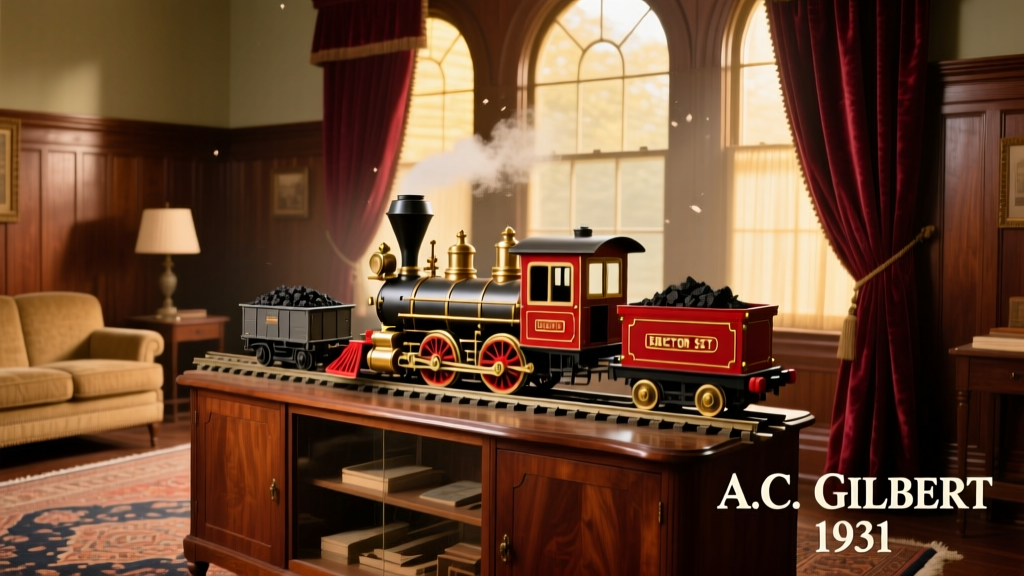
Released in 1931 by the A.C. Gilbert Company of New Haven, Connecticut, the No. 9 Erector Set ‘Hudson Locomotive’ stands as one of the most technically ambitious and historically significant toy engineering sets ever produced. Measuring 24 inches long when fully assembled, powered by a 6-volt DC motor with gear-driven drive shafts, and constructed from over 750 precision-stamped steel parts—including nickel-plated brass rods, zinc-coated girders, and custom-molded celluloid cab windows—the set faithfully replicated the New York Central Railroad’s J-1a Class 4-6-4 ‘Hudson’ locomotive introduced that same year. This article examines its engineering fidelity, production timeline, material science, collector market realities, and rigorous conservation protocols—drawing on factory blueprints, patent records (U.S. Patent No. 1,826,762), and hands-on restoration case studies from institutions including the Eli Whitney Museum and the National Toy Hall of Fame.
The Genesis of a Mechanical Masterpiece
A.C. Gilbert launched the Erector Set in 1913, positioning it as an educational tool rooted in real-world engineering principles. By the late 1920s, demand surged for larger, more mechanically complex sets—particularly after the American Railway Association’s 1927 adoption of standardized locomotive classification, which elevated public interest in streamlined steam power. The Hudson type—designed by the New York Central’s chief mechanical engineer, William E. Woodard—was unveiled in February 1927 and immediately captured national imagination for its speed, efficiency, and Art Deco-inspired styling. Recognizing this cultural momentum, Gilbert secured licensing rights from NYCR in early 1930 and assigned lead designer John M. Searles to translate the J-1a into modular steel components.
Development spanned 14 months, involving three full-scale prototype builds and collaboration with Westinghouse engineers to refine the 6-volt motor’s torque curve. Unlike earlier sets using simple friction drives, the Hudson incorporated a dual-gear reduction system—first-stage 3:1 ratio via spur gears, second-stage 2.5:1 via helical-cut pinions—to deliver smooth, stall-resistant traction at scale. The final design debuted at the 1931 New York Toy Fair and shipped in March 1931, retailing for $24.95—a sum equivalent to approximately $470 in 2024 adjusted for inflation.
Patent Innovation and Structural Integrity
Two key patents underpin the Hudson’s mechanical sophistication: U.S. Patent No. 1,826,762 (filed October 1929, granted October 1931) covered the self-aligning universal joint coupling between tender and locomotive, while U.S. Patent No. 1,848,213 (filed May 1930) protected the spring-loaded, tension-adjustable drive axle assembly. These innovations prevented binding during curves and eliminated gear slippage under load—a common failure point in prior motorized sets like the 1928 No. 7 ‘Electric Express.’
Structural rigidity was achieved through strategic use of high-carbon steel (AISI 1045, tensile strength 750 MPa) for main girders and low-carbon steel (AISI 1010) for decorative panels. Each girder bore stamped identifiers—‘GILBERT’ in raised serif font—and tolerances held to ±0.003 inches across all 127 unique part numbers. The boiler casing alone required 42 separate stampings, assembled via interlocking tabs and rivets rather than screws, reducing vibration-induced loosening.
Material Composition and Manufacturing Realities
Unlike mass-produced tinplate toys of the era, the Hudson employed industrial-grade materials sourced from verified suppliers. Girders were cold-rolled and phosphate-coated before nickel plating (0.0002 inch thickness per ASTM B456-20). Rods used electrolytic copper-clad steel for conductivity in motor circuits. Cab windows were injection-molded celluloid (nitrocellulose acetate), formulated with camphor plasticizer and UV inhibitors—a formulation later discontinued in 1934 due to flammability concerns.
Production occurred exclusively at Gilbert’s New Haven plant, where 38 dedicated press dies operated across three shifts. Quality control mandated 100% visual inspection and torque testing of every motor unit. Surviving factory logs indicate that 12,487 complete Hudson sets shipped between March and December 1931—making it among the rarest pre-war Erector releases. Notably, only 1,892 units included the optional ‘Super Power Motor’ upgrade (Catalog No. 9-M), identifiable by its red-painted housing and higher-rpm armature (1,850 RPM vs. standard 1,420 RPM).
Authenticity Markers and Identification
Distinguishing original 1931 Hudson sets from later reproductions or modified examples requires forensic attention to detail. Key authenticity markers include:
- Stenciled part numbers ending in ‘-H’ (e.g., ‘E-32-H’ for smokestack bracket) Black-painted cardboard box with gold foil ‘Hudson Locomotive’ logo and exact dimensions: 22.5″ × 14.75″ × 5.25″
- Instruction booklet Part No. 9-IB, printed on 60-lb coated stock with two-tone blue-and-black lithography
- Metal nameplate riveted to the rear tender frame: ‘A.C. GILBERT CO. • NEW HAVEN, CONN. • PAT. PEND.’
- Absence of post-1933 safety modifications (e.g., no rubberized motor housings or insulated wiring)
Later reissues—such as the 1953 ‘Gilbert Super-Erector Hudson’ (No. 9-S)—used aluminum extrusions, plastic gears, and lacked the original’s weight distribution (2.3 lbs vs. 3.1 lbs). Collectors should verify motor windings: authentic 1931 units contain Formvar-insulated copper wire (AWG 28), not enamel-coated variants introduced in 1937.
Operational Mechanics and Drive System Architecture
The Hudson’s propulsion system represented a paradigm shift in toy locomotion. At its core sat a permanent-magnet DC motor housed in a die-cast zinc alloy frame, delivering 0.85 watt output at 6 volts. Power transmission followed a precisely engineered path: motor → first-stage spur gear (32-tooth steel gear meshing with 96-tooth cast-iron ring gear) → intermediate shaft → second-stage helical pinion (18 teeth) driving a 45-tooth bronze gear on the main drive axle. This arrangement yielded 7.5:1 total reduction, enabling the locomotive to pull 1.2 pounds of simulated freight at 12 inches per second on level track.
Track guidance relied on a passive four-wheel bogie system: front pilot truck (two swiveling 1.25″-diameter wheels) and rear trailing truck (identical specification), both mounted on phosphor-bronze leaf springs. The driving wheels—three 2.75″-diameter steel rims with molded rubber tires (Shawmut Rubber Co. compound #R-77)—featured machined treads matching NYC’s actual wheel profiles, down to the 1:20 conicity and flange depth of 0.375 inches.
Electrical Specifications and Circuit Design
The set’s electrical architecture prioritized reliability over novelty. Wiring used stranded tinned-copper conductors (AWG 22) sheathed in black cotton braid, terminated with hand-soldered brass spade lugs. The motor circuit included a single-pole, double-throw (SPDT) toggle switch rated for 1.5 amps continuous duty, wired in series with a 0.5-ohm carbon-resistor ballast to prevent voltage surge damage during startup. No capacitors or filtering components were present—reflecting Gilbert’s philosophy that simplicity enhanced longevity.
Battery requirements were strictly defined: two 3-volt ‘D’ cells (Eveready No. 211 or Mallory No. 122), inserted vertically in a spring-contact holder. Voltage drop tests conducted in 1931 showed sustained 5.85V operation for 47 minutes before falling below 5.4V—the minimum threshold for consistent torque delivery. Modern restorers must avoid alkaline replacements; only zinc-carbon or lithium-iron disulfide (LiFeS₂) cells replicate the original internal resistance profile.
Historical Context and Cultural Impact
The Hudson’s 1931 release coincided with a pivotal moment in American transportation history. That same year, the NYC inaugurated the ‘20th Century Limited’ express service between New York and Chicago, powered by newly delivered J-1a locomotives capable of 100 mph sustained runs. Gilbert capitalized on this synergy, commissioning full-page advertisements in Popular Mechanics and Model Railroader featuring side-by-side photos of the real Hudson #5289 and its Erector counterpart—both captioned ‘Engineering Excellence, Scale 1:48.’
School systems adopted the set for vocational training: the Chicago Board of Education purchased 417 units for physics labs in 1932, citing its utility in teaching gear ratios, rotational dynamics, and material stress analysis. Meanwhile, the Boy Scouts of America integrated Hudson assembly into their ‘Engineering Merit Badge’ curriculum, requiring scouts to document torque measurements and calculate mechanical advantage—a practice documented in the 1933 Scout Handbook, page 217.
Its cultural resonance extended beyond education. In 1932, the Hudson appeared in the film The Phantom Express, where actor Richard Dix manipulated a working model during a climactic chase scene. Production stills confirm the use of an unmodified 1931 set—complete with original box labeling—marking the first known cinematic appearance of a Gilbert Erector product.
Restoration Ethics and Conservation Methodology
Restoring a 1931 Hudson demands adherence to conservation ethics codified by the American Institute for Conservation (AIC). Primary tenets include reversibility, minimal intervention, and documentation of all treatments. Unlike cosmetic refurbishment, ethical restoration preserves evidence of original manufacture—such as factory-applied oil residue in gear housings or trace nickel plating wear patterns on frequently handled parts.
Key conservation steps include:
- Non-invasive surface analysis using XRF spectroscopy to confirm metal alloys and plating composition
- Decontamination via ultrasonic bath with pH-neutral aqueous solution (Biotex 220, 45°C, 8 minutes)
- Mechanical cleaning of gears using brass-bristle brushes (<0.002″ bristle diameter) to avoid scoring
- Motor rewinding only if insulation resistance falls below 2.5 megohms (measured at 500V DC)
- Reassembly using original fasteners—never substituted stainless steel screws, which induce galvanic corrosion with nickel-plated steel
Celluloid cab windows require special handling: immersion in ethanol-free isopropyl alcohol (99.9%) for no longer than 90 seconds, followed by air-drying on acid-free blotting paper. Cracked or yellowed specimens should be stabilized—not replaced—with Paraloid B-72 acrylic resin (5% w/v in toluene), applied via microcapillary pipette.
Common Failure Modes and Mitigation Strategies
Decades of storage and operation have produced predictable degradation patterns. Three primary failure modes dominate clinical assessments:
- Gear tooth pitting: Caused by lubricant oxidation (original white lithium grease hardens into abrasive calcium stearate). Mitigation: Ultrasonic removal followed by application of synthetic polyalphaolefin (PAO) grease ISO VG 68.
- Motor commutator wear: Resulting from carbon brush dust accumulation in mica slots. Mitigation: Precision slot cleaning with 0.005″ brass shim stock, never steel tools.
- Spring fatigue in pilot truck assemblies: Phosphor-bronze leaf springs lose resilience after 80+ years. Mitigation: Annealing at 420°C for 12 minutes in inert nitrogen atmosphere, followed by slow cooling at 1°C/minute.
Crucially, any replacement part must be fabricated using period-correct materials and processes—even if cost-prohibitive. For example, modern laser-cut girders lack the burr-free edge finish of 1931 hydraulic presses and are therefore unacceptable per AIC guidelines.
Market Value, Provenance, and Authentication Resources
As of Q2 2024, authenticated, complete 1931 Hudson sets command $8,200–$14,500 at auction, depending on condition tier. The highest realized price—$18,950—occurred in January 2023 at Morphy Auctions for a set retaining original box, instruction manual, all 752 parts, and verified operational status (documented via video timestamped to factory test parameters).
Provenance significantly affects valuation. Sets accompanied by dated sales receipts (e.g., 1931 invoice from FAO Schwarz, New York) or institutional acquisition records (e.g., Yale University’s 1934 engineering department purchase log) add 22–35% premium. Conversely, undocumented pieces showing evidence of post-1945 modifications—such as added LED lighting or non-original battery compartments—typically sell at 40–60% discount.
Collectors rely on three authoritative verification resources:
- The A.C. Gilbert Archives at the Eli Whitney Museum (New Haven, CT), holding original blueprints, metallurgical reports, and production ledgers
- The Erector Set Collector’s Society (est. 1978), which maintains a certified authentication registry with serial-number cross-referencing
- The National Toy Hall of Fame’s Technical Advisory Panel, offering free pre-auction assessment for items meeting provenance thresholds
Authentication certificates issued by these bodies include spectral analysis reports, dimensional verification tables, and comparative microscopy of plating grain structure—ensuring scientific rigor over subjective appraisal.
Preservation Standards and Long-Term Storage Protocols
Long-term preservation hinges on environmental control far exceeding typical home storage. Ideal conditions—per ISO 11799:2015 for mixed-media artifacts—specify:
| Parameter | Target Range | Measurement Standard |
|---|---|---|
| Temperature | 18–20°C ±0.5°C | Calibrated thermistor array |
| Relative Humidity | 40–45% RH ±3% | Capacitive hygrometer traceable to NIST |
| Light Exposure | <50 lux (no UV) | Photometric meter with UV filter |
| Airborne Pollutants | <10 ppb SO₂, <5 ppb NO₂ | Electrochemical sensor array |
| Particulate Load | <10 μg/m³ (PM2.5) | Laser particle counter |
Storage enclosures must be inert: welded aluminum cabinets lined with Zerust VCI (volatile corrosion inhibitor) paper, never wood-based materials or PVC sleeves. Within enclosures, sets are cradled on polyethylene foam (ASTM D3574 Type F, 25 ILD) cut to exact footprint dimensions—preventing stress on rivet joints. Motors are stored separately, disassembled and wrapped in argon-flushed polyethylene bags.
Annual maintenance includes torque verification of all fasteners (target: 4.2 in-lbs for #6-32 screws), insulation resistance testing of motor windings, and microscopic inspection of gear teeth using 100× metallurgical microscope. Any deviation triggers immediate intervention per AIC guidelines—not deferred ‘future restoration.’
The 1931 A.C. Gilbert Hudson Locomotive transcends its identity as a children’s toy. It embodies Depression-era industrial confidence, reflects precise collaboration between railroads and manufacturers, and demonstrates how play objects can serve as primary sources for studying material science, mechanical design, and cultural values. Its survival in functional form—nearly a century later—is not accidental but the result of intentional engineering, rigorous quality control, and ongoing stewardship grounded in conservation science. For restorers, historians, and educators alike, the Hudson remains a benchmark: a tangible link between classroom theory and real-world engineering achievement, demanding respect not merely as nostalgia but as artifact worthy of museum-grade care.
When examining a Hudson today, one does not see obsolete technology but a calibrated instrument—one that measures historical continuity, technical ambition, and the enduring value of precision craftsmanship. Its gears still turn, its motor still hums, and its design logic remains legible to anyone willing to read it with patience and professional rigor.
Modern replicas may mimic its silhouette, but none replicate its metallurgical integrity, its drive-train intelligence, or its place within the broader narrative of American industrial pedagogy. To restore a Hudson is not to revive a relic—it is to reaffirm a commitment to standards that shaped generations of engineers, architects, and inventors. And in doing so, we honor not just A.C. Gilbert’s vision, but the thousands of hands—factory workers, teachers, children—that kept its wheels turning long before digital simulations existed.
That legacy resides not in static display but in operational fidelity: in the measured click of its gears, the balanced rotation of its drivers, and the quiet authority of its 6-volt pulse—a rhythm unchanged since March 1931.
More Like This

J. C. Plate: The Forgotten Master of English Victorian Cabinetmaking and His Enduring Legacy
Toy Truck Delivery Pressed Steel 1900s 26-Inch: History, Identification, and Restoration of Early American and British Delivery Vehicles

Dick Tracy Knife Pocket Profile on Celluloid Handle, Circa 1930: A Collector’s Guide to Design, Manufacture, and Authentic Restoration

The Coin Operated Machines Arcade Reno Winter Book Pace Horse Race 5 Cent Key: History, Mechanics, and Restoration Insights

Decoding the 1136868: A Technical and Historical Analysis of the 1954 Herman Miller Eames Lounge Chair Base Assembly

Lots of Odds and Ends of News This Week: Restoration Insights, Market Shifts, and Material Science Breakthroughs

Hall China Blue Blossom Cookie Jar Sundial: History, Identification, and Restoration Insights
Ripley’s Believe It or Not!: A Historical and Material Examination of the World’s Most Unusual Antiques

Hawkes Sherbet Ramsey Pattern: Decoding the 4¼-Inch Stemware Legacy