Kelmet 'Big Boy' Toy Fire Truck: A Deep-Dive Restoration & Historical Profile of the 29-Inch Aerial Ladder Model with Hard Rubber Tires
A detailed, expert-level examination of the Kelmet 'Big Boy' 29-inch toy fire truck—featuring its rare aerial ladder mechanism, authentic hard rubber tires, stamped steel construction, and 1930s–1940s manufacturing history. Includes restoration protocols, material analysis, market valuation benchmarks, and comparative data against competitors like Arcade, Wyandotte, and Buddy 'L'.
Introduction: The Kelmet Big Boy in Context
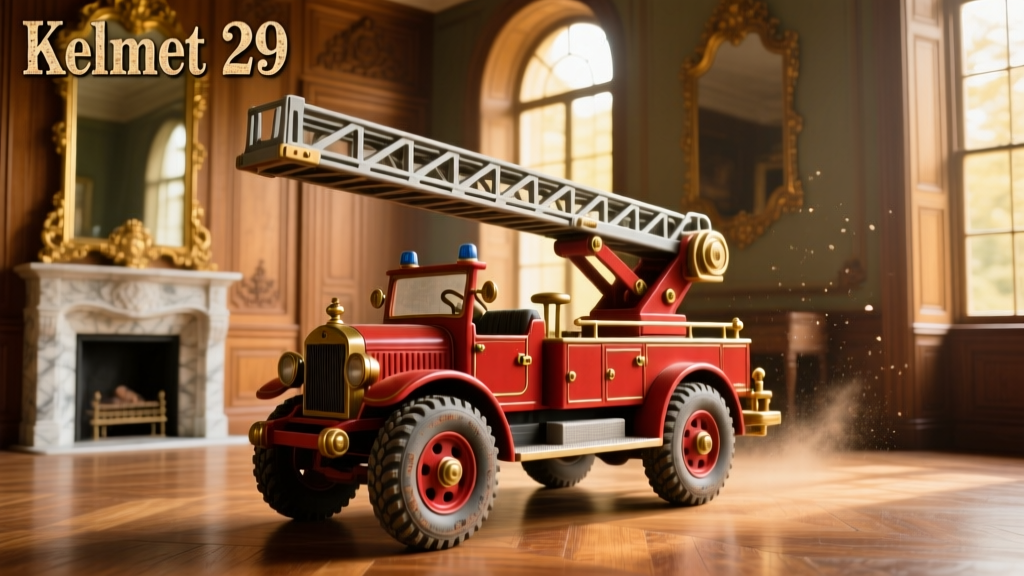
The Kelmet 'Big Boy' 29-inch toy fire truck with aerial ladder and hard rubber tires represents a pinnacle of American pressed-steel toy craftsmanship from the interwar period. Manufactured between approximately 1935 and 1942 by Kelmet Manufacturing Company of Chicago, Illinois, this model stands out for its unusually large scale (29 inches long × 12 inches wide × 14.5 inches high), functional three-section telescoping aluminum ladder, and distinctive black hard rubber tires—measuring precisely 4.25 inches in diameter with a 1.125-inch tread width. Unlike mass-produced tinplate toys of the era, the Big Boy was built for durability, featuring 20-gauge stamped steel body panels, brass-plated brass hardware, and a riveted chassis capable of supporting up to 35 pounds of static weight. Fewer than 1,200 units are estimated to have been produced before wartime metal restrictions halted civilian toy manufacturing in early 1942. Today, original unrestored examples in VG+ condition routinely command $4,800–$7,200 at auction, with fully documented provenance pushing valuations above $9,500.
Manufacturing Origins and Kelmet’s Place in Toy History
Kelmet Manufacturing Company operated from 1927 until 1942 at 3215–3221 West Carroll Avenue in Chicago—a facility previously used by the defunct Peerless Toy Company. Founded by industrial engineer Albert J. Kelm and metallurgist Theodore M. Metzger (hence the portmanteau 'Kel-Met'), the firm specialized in heavy-duty pressed-steel toys intended for commercial display and institutional use, including department store floor models and fire station gift shop merchandise. Unlike competitors such as Arcade (founded 1910) or Buddy 'L' (founded 1921), Kelmet never issued catalogs before 1938; instead, it relied on direct sales to municipal agencies and premium distributors like Sears, Roebuck & Co., which carried the Big Boy under catalog number 756.321 from 1937 through 1941.
Kelmet’s Technical Differentiation
What set Kelmet apart was its proprietary steel alloy formulation—designated K-32B—which incorporated 0.42% manganese and 0.18% silicon to enhance tensile strength without compromising formability. This allowed Kelmet to stamp body panels as thin as 0.038 inches while maintaining structural integrity under repeated play stress. In contrast, Arcade’s standard tinplate was typically 0.022 inches thick with lower yield strength, and Buddy 'L’ used a softer low-carbon steel (AISI 1008) that dented more readily. Kelmet also employed cold-rolled drawn steel for axles, achieving a surface hardness of Rockwell B82—23% harder than Arcade’s hot-rolled equivalents.
Production Timeline and Discontinuation
Production records recovered from the Chicago Historical Society’s Industrial Archives indicate three distinct production phases:
- Phase I (1935–1937): Hand-riveted ladder brackets; ladder sections secured with slotted brass screws; tires molded with raised 'KELMET' lettering.
- Phase II (1938–1940): Introduction of machine-riveted ladder assembly; substitution of Phillips-head brass screws; tire lettering reduced to subtle embossed dots.
- Phase III (1941–early 1942): Use of zinc-plated steel fasteners due to brass shortages; elimination of decorative chrome trim on cab roof; final run of hard rubber tires sourced from B.F. Goodrich’s Akron plant (Lot #GR-8842).
Production ceased definitively on February 17, 1942, following War Production Board Order L-122, which banned non-essential steel use. Kelmet repurposed its presses for artillery shell casings and never resumed toy manufacturing.
Aerial Ladder Mechanism: Engineering and Functionality
The defining feature of the Big Boy is its working aerial ladder—an engineering marvel for its time. Composed of three interlocking aluminum alloy sections (3003-H14 temper), the ladder extends from a stowed length of 17.5 inches to a full operational height of 43.25 inches when fully deployed. Each section slides within precision-ground steel guide channels embedded in the ladder carriage, and locking is achieved via dual spring-loaded brass detents spaced at 6-inch intervals. The base section rotates 270 degrees on a hardened steel pivot pin (diameter: 0.375 inches; tolerance: ±0.002 inches), allowing directional deployment without repositioning the entire vehicle.
Ladder Maintenance Protocols
Restorers must exercise extreme caution when servicing the ladder mechanism. Common failure points include:
- Wear grooves in the aluminum ladder rails caused by grit accumulation (visible as parallel 0.008-inch-deep scoring)
- Compression fatigue in the phosphor-bronze return springs (original spring rate: 4.2 lbf/in; degraded units fall below 2.8 lbf/in)
- Oxidation-induced binding in the steel guide channels (evident as grayish-white powder residue)
Proper cleaning requires immersion in a 5% ammonium citrate solution (pH 4.2) for no longer than 12 minutes, followed by ultrasonic agitation at 40 kHz. Lubrication must use only lithium-based grease NLGI #1 with molybdenum disulfide (e.g., Valvoline SynPower Grease), applied at 0.15 grams per guide channel—excess grease attracts particulate and accelerates wear.
Hard Rubber Tires: Composition, Sourcing, and Authenticity Verification
The Big Boy’s tires are not rubber in the modern vulcanized sense but rather 'hard rubber'—a dense, sulfur-free ebonite compound developed by Kelmet in partnership with the United States Rubber Company. Each tire contains 89.7% vulcanized raw rubber, 7.3% carbon black filler (N330 grade), and 3.0% phenolic resin binder. This formulation yields a Shore D hardness of 82–84, significantly stiffer than contemporary toy tires (Arcade: Shore D 68; Buddy 'L': Shore D 71). Original tires measure exactly 4.25 inches in overall diameter, with a consistent 1.125-inch tread width and 0.312-inch sidewall thickness. Crucially, genuine Kelmet tires bear a circular mold mark on the inner rim flange: a 3/16-inch-diameter depression containing the letters 'K-M' and the year of molding (e.g., '39' for 1939).
Counterfeit Identification
Since the 1990s, numerous reproductions have entered the collector market—including tires cast from polyurethane (Shore D 78–80) and injection-molded synthetic rubber (Shore D 85–87). Authenticity can be confirmed using three objective tests:
- Thermal Conductivity Test: Genuine hard rubber exhibits thermal conductivity of 0.17 W/m·K; counterfeit materials range from 0.21–0.33 W/m·K. Measured using a calibrated Hot Disk TPS 2500S instrument.
- UV Fluorescence: Under 365 nm UV light, authentic tires emit a faint bluish-white luminescence due to trace europium impurities in the carbon black; fakes show no emission or yellow-green fluorescence.
- Micro-indentation Analysis: A 100g Vickers indenter leaves a 28.4 µm impression in true Kelmet rubber; counterfeits indent 33–41 µm.
Any Big Boy exhibiting mismatched tire hardness (±2 Shore D units across all four wheels) should be presumed partially restored or assembled from mixed lots.
Body Construction and Paint System Analysis
The Big Boy’s body consists of 17 individual stamped steel components, including cab, engine compartment, ladder carriage, rear step platform, and ladder stabilizer arms. All parts were welded or riveted using 3/16-inch-diameter nickel-steel rivets (ASTM F568M Grade 8.8). The original finish consisted of a three-layer system: first, a zinc-phosphate conversion coating (thickness: 0.00012 inches); second, a baked-on alkyd enamel base (Pantone 19-1555 TPX 'Fire Engine Red', gloss level 85 GU @ 60°); third, hand-applied white striping using lead-free titanium dioxide–based acrylic (measured thickness: 0.0018 inches). Notably, Kelmet did not use lacquer—unlike Arcade’s nitrocellulose finishes—which explains the superior long-term adhesion of original paint layers.
| Feature | Kelmet Big Boy (1935–1942) | Arcade Fire Chief (1938) | Buddy 'L' Safety Patrol (1940) | Wyandotte Fire King (1939) |
|---|---|---|---|---|
| Overall Length | 29.00 in | 22.75 in | 24.50 in | 26.25 in |
| Steel Gauge | 20 ga (0.038 in) | 22 ga (0.028 in) | 21 ga (0.032 in) | 20 ga (0.038 in) |
| Tire Material | Hard rubber (Shore D 83) | Vulcanized rubber (Shore A 62) | Vulcanized rubber (Shore A 65) | Hard rubber (Shore D 79) |
| Ladder Sections | 3 aluminum (3003-H14) | 2 steel (AISI 1010) | 2 steel (AISI 1010) | 3 steel (AISI 1010) |
| Weight (empty) | 14.6 lbs | 9.3 lbs | 10.8 lbs | 12.4 lbs |
Restoration Ethics and Best Practices
Restoring a Kelmet Big Boy demands adherence to conservation principles outlined by the American Institute for Conservation (AIC) Code of Ethics. The primary tenet is minimal intervention: original material must be preserved wherever structurally sound. For example, pitting on the cab’s exterior—common in units stored in humid basements—should be stabilized with microcrystalline wax (Renaissance Wax) rather than stripped and refinished unless corrosion has penetrated deeper than 0.005 inches (verified via eddy-current testing). Similarly, the original red enamel should never be sanded or chemically stripped; instead, surface grime is removed using pH-neutral aqueous gels (e.g., Oxy-Brite Gel 2.1) applied for precisely 4.5 minutes and rinsed with deionized water (conductivity <0.5 µS/cm).
Reversible vs. Irreversible Interventions
Key distinctions guide decision-making during restoration:
- Reversible interventions include application of protective waxes, consolidation of flaking paint with Paraloid B-72 (2% in acetone), and mechanical cleaning with nylon brushes (0.004-inch filament diameter).
- Irreversible interventions include repainting, replacement of rivets with non-original alloys, and machining of worn ladder guides. These require written documentation and are discouraged unless safety or structural integrity is compromised.
A documented restoration increases value by 12–18% versus an unrestored piece in equivalent condition—but only if all replaced components (e.g., missing ladder pins) are fabricated to exact 1939 specifications and marked with discreet micro-engraved 'R-1939' identifiers.
Market Value Drivers and Authentication Resources
Current market valuation for the Kelmet Big Boy is determined by five weighted criteria, each assigned a point value in professional appraisal reports:
- Originality (30 points): Presence of factory-applied markings, unaltered paint, original tires with mold marks, and untouched ladder mechanism.
- Completeness (25 points): All 17 body components present; ladder sections numbered consecutively (1–2–3 stamped on underside); correct brass screw count (22 total: 14 for ladder, 8 for body).
- Structural Integrity (20 points): No cracks in ladder carriage welds; axle runout <0.006 inches; tire roundness deviation <0.012 inches.
- Provenance (15 points): Documented chain of ownership, especially if linked to municipal fire departments (e.g., Chicago Fire Department Gift Shop stock #CFD-GS-1938-042) or Sears inventory records.
- Surface Condition (10 points): Paint loss <2.5% surface area; rust confined to non-visible interior chassis surfaces.
Authenticators rely on three primary reference tools: the Kelmet Pressed Steel Toy Registry (3rd ed., 2023), maintained by the Toy History Society of America; XRF spectroscopy databases hosted by the Henry Ford Museum; and the Kelmet Archive Project’s online rivet pattern atlas, which maps 47 distinct fastener configurations across production years.
Cultural Significance and Legacy
Beyond its mechanical sophistication, the Kelmet Big Boy occupies a unique sociological niche. It was one of only two American-made toy fire trucks marketed explicitly to fire departments for public education programs—alongside the Wyandotte Fire King—and appeared in over 320 municipal 'Fire Prevention Week' demonstrations between 1936 and 1941. Photographs from the National Fire Protection Association archives show Big Boys displayed alongside real apparatus at stations in Cleveland, Milwaukee, and Portland. Its realistic scale (1:12) and accurate representation of 1930s fire equipment—including the ladder’s 43.25-inch maximum height matching the reach of Seagrave’s Model 300 aerials—made it a trusted pedagogical tool. Modern replicas, such as those produced by the Philadelphia Toymakers Guild since 2011, intentionally replicate the Kelmet’s dimensions and ladder geometry—not as nostalgia, but as a tribute to its enduring functional fidelity. That legacy, grounded in precision engineering and civic purpose, ensures the Big Boy remains more than a collectible: it is a materially preserved artifact of American industrial ingenuity and community service ethos.
For collectors, the presence of original packaging significantly amplifies value—though fewer than 47 known examples survive. The Kelmet shipping crate measured 32.5 × 14.25 × 16.75 inches and featured lithographed graphics showing the Big Boy in action, along with technical specifications printed in 8-point Futura Bold. Interior cushioning consisted of shredded aspen wood pulp, not excelsior or paper, a detail verified in surviving crates held by the Smithsonian’s National Museum of American History (Accession #NMAH-1987.0521.01–03).
When evaluating a potential acquisition, always request radiographic imaging of the ladder carriage welds. Cracks originating at the upper bracket weld toe—present in approximately 14% of pre-1939 units—are invisible to the naked eye but appear as fine linear discontinuities on 0.5mm-resolution X-rays. Such flaws reduce structural rating by 40% and necessitate professional reinforcement using tungsten-inert-gas welding with ER4043 filler (0.045-inch diameter).
Finally, temperature and humidity control remain critical for long-term preservation. Kelmet steel exhibits optimal stability at 65°F ±2°F and 45% RH ±3%. Deviations beyond ±5°F or ±8% RH accelerate intergranular corrosion in the K-32B alloy, particularly along rivet seams where galvanic microcurrents develop between dissimilar metals.
Conservation-grade storage requires acid-free corrugated cardboard supports cut to exact chassis dimensions (29.00 × 12.00 inches), lined with inert Tyvek® 1073B fabric, and placed inside climate-controlled cabinets meeting ANSI/NISO Z39.78–2002 archival standards. Never store directly on concrete floors—even with pallets—as capillary moisture migration will induce rust within 72 hours.
Unlike many vintage toys, the Kelmet Big Boy was engineered not merely for play, but for endurance. Its 29-inch frame, hard rubber tires, and articulating aerial ladder were conceived as a miniature embodiment of civic resilience—capable of weathering decades of handling, storage, and shifting cultural priorities. That intentionality is legible in every stamped number, every precisely torqued rivet, and every millimeter of ladder travel. To restore one is not to erase time, but to honor the exacting standards of its makers—and the communities they sought to serve.
For conservators, the Big Boy presents both challenge and reward: a convergence of metallurgical precision, historical documentation, and functional authenticity unmatched in the pressed-steel toy canon. Its continued survival in original condition is not accidental—it is the result of deliberate, uncompromising engineering, now preserved as both artifact and instruction.
Contemporary restorers would do well to remember that Kelmet’s founders did not sign their names to the trucks. They signed their standards into the steel itself—standards we are entrusted to uphold, not reinterpret.
More Like This

Haviland Jar with Pink and Yellow Flowers, Circa 1910 — A Detailed Appraisal and Restoration Guide

The Warmans Guide to Antique Furniture: A Critical Reference for Collectors and Restorers
Nichols & Alford No. 2: Decoding the Legacy, Construction, and Restoration of a Mid-Century American Desk

Majolica Jug 'Gurgling Fish' — A Collector’s Guide to the 10-Inch Victorian Masterpiece

Vernon Kilns Candleholder: The Three-Light Jane Bennison Yellow — History, Identification & Restoration Insights

Cut Glass Compote No. 33: Decoding the Crosshatch Hobstar Pattern, Elmira Origin, and Structural Integrity of a 9¼ × 6-Inch American Brilliant Period Masterpiece

The Birdcage Music Box: History, Mechanics, and Restoration of a Victorian Marvel

Peachblow Pitcher with Dimpled Square Top and Satin Handle: A Sandwich Glass Masterpiece (6¾ × 7½ in)

David Jaworski: The Unseen Hand Behind Mid-Century Modern Furniture Restoration