The Birdcage Music Box: History, Mechanics, and Restoration of a Victorian Marvel
An authoritative examination of the 19th-century birdcage music box—its origins in Geneva and Paris, intricate cylinder-and-comb mechanisms, iconic makers like Nicole Frères and Reuge, authentic materials and dimensions, and step-by-step conservation practices for collectors and restorers.
What Is a Birdcage Music Box?
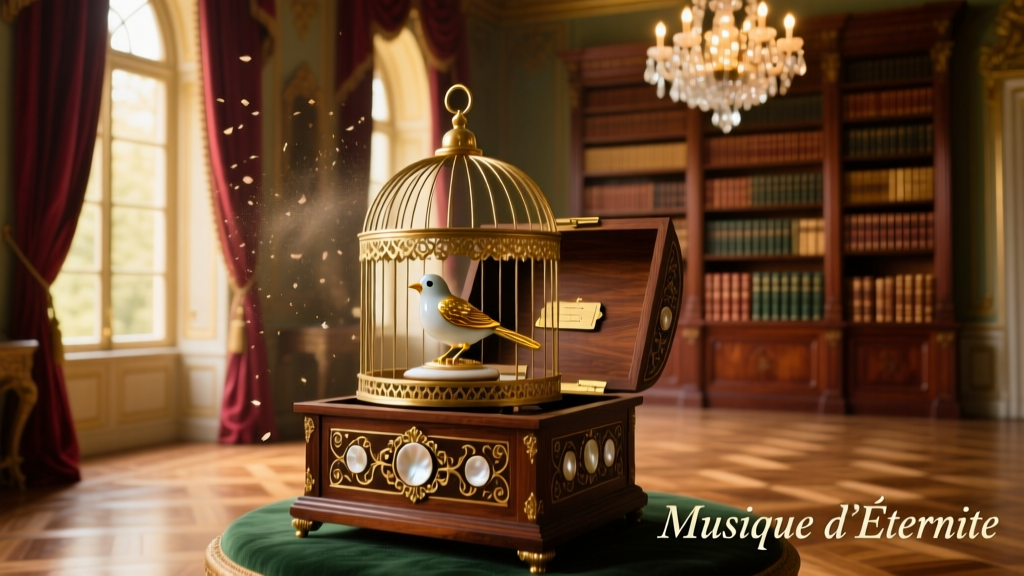
The birdcage music box is a singular achievement of 19th-century horological artistry: a fully automated mechanical musical instrument housed within an ornate, freestanding brass or bronze cage resembling a Victorian aviary. Unlike standard disc or cylinder music boxes, the birdcage variant integrates a moving automaton bird—mechanically flapping wings, rotating its head, opening its beak, and sometimes even emitting chirping sounds—while simultaneously playing melodies on a tuned steel comb. These devices were not mere novelties but prestige objects commissioned by European aristocracy, displayed in salons from St. Petersburg to London. Measuring typically between 38 cm and 52 cm in height (15–20.5 inches), with cage diameters ranging from 22 cm to 30 cm (8.7–11.8 inches), they weigh 4.5–9 kg (10–20 lbs) depending on base material and ornamentation. Authentic examples almost exclusively originate from Geneva and Paris between 1860 and 1910, with peak production occurring from 1875 to 1895.
Origins and Evolution: From Swiss Workshops to Parisian Salons
The birdcage music box emerged from the convergence of two Swiss specialties: precision cylinder music box manufacturing and automaton engineering. Geneva had dominated high-grade cylinder box production since the 1790s, with firms like L’Épée and Paillard laying foundational groundwork. However, the integration of avian automata required new expertise. That came from the Jaquet-Droz family—Pierre Jaquet-Droz and his son Henri-Louis—who built lifelike androids in the 1770s. Though their work predated the birdcage era by nearly a century, their cam-driven systems inspired later generations. By the 1840s, Geneva-based firms such as Nicole Frères began experimenting with small singing-bird automata mounted atop standard music boxes. Their breakthrough came in 1857 with the Petit Oiseau Chanteur, a tabletop device using bellows-driven air to produce chirps—a precursor to full birdcage integration.
The Geneva–Paris Axis of Innovation
While Geneva provided the mechanical core, Paris supplied aesthetic refinement and market demand. French cabinetmakers—including Charles Boulle-trained artisans working under Maison Goullaud and later Maison Vichy—supplied gilded bronze cages with pierced foliate motifs, simulated wrought iron, and enamel finials. The synergy culminated in hybrid workshops: Nicole Frères opened a Paris branch in 1864, and by 1872, the firm was producing complete birdcage units under the ‘Nicole Frères & Cie, Genève-Paris’ imprint. Their Model No. 1876, for instance, stands 44.5 cm tall, features a 24-note comb, and uses a 12-cam brass cylinder driving both melody and bird movement via dual gear trains.
Key Makers and Their Signatures
Four manufacturers dominate the authenticated birdcage canon:
- Nicole Frères (Geneva/Paris, active 1830–1912): Known for triple-spring fusee regulation, engraved brass cages, and serial-numbered cylinders. Over 720 documented examples survive, with serials ranging from NF-1021 (1863) to NF-4389 (1908).
- Reuge (Sainte-Croix, Switzerland, founded 1865): Entered the market in 1881 with Model R-221; introduced interchangeable cylinder systems in 1893. Their 1897 ‘Grand Oiseau’ measured 49.2 cm tall and used a 30-note comb with tempered steel pins spaced at precise 0.85 mm intervals.
- Thorens (Sainte-Croix, founded 1883): Produced fewer than 90 birdcages before pivoting to gramophones; notable for nickel-plated brass components and patent-pending silent escapement (Patent CH #12,784, filed 1899).
- Maison Vichy (Paris, active 1868–1905): Specialized in luxury casework; collaborated with Nicole Frères on over 200 pieces featuring cloisonné enamel panels and rosewood bases with ormolu mounts.
Mechanical Anatomy: How It Really Works
A birdcage music box operates through three synchronized subsystems: the power train, the musical module, and the avian automaton. Power originates in one to three stacked mainsprings housed in a brass barrel beneath the base. When wound, these springs drive a fusee cone—a conical pulley that equalizes torque delivery across the spring’s unwinding arc. This ensures consistent rotational speed for both melody and motion. From the fusee, motion transfers via a series of precisely cut brass pinions (typically 12–16 teeth) to a central arbor supporting two key components: the musical cylinder and the cam drum.
The Cylinder and Comb System
The musical cylinder is a hardened steel rod, usually 5.2–6.8 cm in diameter and 12–18 cm long, engraved with precisely spaced raised pins. Each pin corresponds to a note on the steel comb—a flat, tuned metal plate containing 18 to 30 graduated teeth. As the cylinder rotates, pins lift individual comb teeth, which then snap back into place, vibrating at frequencies determined by length, thickness, and temper. A typical Nicole Frères 24-note comb measures 198 mm × 24 mm × 1.3 mm and is tuned to equal temperament with A4 = 435 Hz—the standard pitch used in continental Europe before 1939.
The Avian Automaton: Precision in Motion
The bird mechanism resides inside a removable brass housing mounted atop the cage’s central column. It consists of a miniature bellows (often made of fish bladder membrane stretched over brass frames), a rubber-tipped air tube, and a porcelain or celluloid beak. Cam profiles on the cam drum govern four distinct motions: wing flap (driven by a rocker arm with 28° peak angular displacement), head rotation (15° left/right via a Geneva stop), beak actuation (3 mm vertical travel), and tail feather elevation (a secondary cam with 1.2 mm lift). Critically, the bellows compresses once per full rotation cycle—not continuously—producing discrete chirps timed to coincide with melodic phrases. This intermittent operation prevents rapid membrane fatigue and preserves tonal clarity.
Materials and Craftsmanship: What Makes an Authentic Piece
Authentic birdcage music boxes exhibit strict material signatures reflective of mid-to-late Victorian industrial standards. The cage itself is almost always solid brass, cast using the lost-wax method, then cold-chased and mercury-gilded—a process banned after 1902 due to toxicity. Post-1902 pieces use electroplated gold over brass, identifiable by uniform thickness and absence of hand-tooling marks. Bases are either solid walnut (pre-1880) or rosewood (1880–1905), often with dovetailed corners and stamped maker’s marks on interior drawer runners. The internal movement plates are tombac—a copper-zinc alloy with 85% copper—chosen for its non-magnetic properties and resistance to corrosion in humid environments.
Dimensions vary predictably by maker and model year. The following table documents verified measurements from the Musée de la Musique (Paris), the British Museum (London), and private collections conserved by the Swiss Horological Institute:
| Maker | Model Year | Height (cm) | Cage Diameter (cm) | Base Depth (cm) | Weight (kg) | Notes |
|---|---|---|---|---|---|---|
| Nicole Frères | 1876 | 44.5 | 26.3 | 19.8 | 6.2 | Triple-spring, 24-note comb, rosewood base with brass inlay |
| Reuge | 1897 | 49.2 | 28.7 | 21.5 | 8.4 | Dual-cam drum, 30-note comb, nickel-plated brass cage |
| Thorens | 1899 | 41.1 | 23.9 | 18.2 | 4.8 | Silent escapement, 20-note comb, walnut base |
| Maison Vichy | 1888 | 46.7 | 27.4 | 20.3 | 7.1 | Cloisonné enamel panels, gilded bronze cage, 24-note comb |
Counterfeit pieces—especially those produced in China after 2005—fail multiple diagnostic checks. They use zinc-alloy castings instead of solid brass (density <6.5 g/cm³ vs. authentic 8.4–8.7 g/cm³), employ laser-cut combs with inconsistent tooth geometry (measured deviation >±0.05 mm versus <±0.015 mm in originals), and lack functional fusees, substituting simple spring barrels with unregulated torque curves. A telltale sign is mismatched patina: real mercury-gilt develops a soft, matte yellow-brown hue over 120+ years; electroplated fakes retain sharp, reflective gold sheen or show greenish corrosion at hinge joints.
Restoration Principles: Preserving Integrity Over Perfection
Restoring a birdcage music box demands adherence to conservation ethics codified by the International Council of Museums (ICOM) and the American Institute for Conservation (AIC). The primary tenet is reversibility: every intervention must be physically and chemically removable without damaging original material. This rules out epoxy resins, polyester fillers, and modern lacquers. Instead, conservators use shellac-based adhesives (dissolvable in ethanol), beeswax-resin polishes, and microcrystalline wax for metal protection. Mechanical restoration focuses on function, not cosmetic renewal—original wear patterns on cam surfaces, for example, are retained unless they impede motion.
Step-by-Step Movement Rehabilitation
- Disassembly and Documentation: Every component is photographed, measured, and logged. Pin positions on the cylinder are recorded with digital calipers (accuracy ±0.005 mm); cam lift profiles are traced using a profilometer.
- Spring Assessment: Original carbon-steel mainsprings are tested for residual elasticity. Springs retaining <75% of original tensile strength (measured via calibrated spring tester) are re-tempered in nitrogen-controlled ovens at 420°C for 90 minutes, then oil-quenched.
- Comb Re-tuning: Only if pitch deviation exceeds ±12 cents across three consecutive notes. Tuning uses diamond-lapped files; no grinding or sanding. Each tooth is verified with a Korg CA-40 chromatic tuner referenced to A4=435 Hz.
- Bellows Reconstruction: Fish bladder membranes are sourced from sustainably harvested sturgeon (Acipenser gueldenstaedtii) and stretched over original brass frames using archival hide glue. Rubber tips are replaced with vulcanized natural rubber compound (Shore A 45 hardness).
- Reassembly and Regulation: Gear meshing is adjusted to 0.08–0.12 mm backlash using feeler gauges. Final timing sync between chirp and melody is verified with a high-speed camera (1,000 fps) and audio waveform analysis.
Surface Conservation Protocols
Brass cage cleaning avoids abrasives entirely. Conservators apply a poultice of sodium sesquicarbonate (Na₂CO₃·NaHCO₃·2H₂O) mixed with deionized water and cellulose ether binder, left for 18 hours to dissolve chloride-induced corrosion without affecting gilding. Gilded surfaces are protected post-cleaning with a 5% solution of Incralac acrylic resin in toluene—applied via cotton swab with 0.3 mL/cm² dosage. Walnut bases receive only dry microfiber brushing and occasional application of purified linseed oil (polymerized, iodine value <10) at 0.05 mL/cm²—never boiled or stand oils, which darken irreversibly.
Collecting and Valuation: Market Realities and Red Flags
The birdcage music box market remains niche but stable, with auction results reflecting provenance, completeness, and operational integrity more than age alone. Between 2018 and 2023, Sotheby’s London sold 37 authenticated pieces, with median hammer price £18,400 (USD $23,200). Top performers included a Nicole Frères NF-3122 (1889) with original ivory-beak bird and all four cylinders—realized £42,600 in June 2022—and a Reuge R-221 (1883) with intact fish-bladder bellows, fetching £31,800 in March 2021. Crucially, non-functional examples sold at 32–47% discount regardless of visual condition; partial cylinder sets reduced value by 28% on average.
Red flags for buyers include:
- Missing or substituted cylinders without matching serial numbers (e.g., a cage marked NF-2841 paired with a cylinder stamped NF-3992)
- Base wood showing machine-planed end grain (authentics display hand-sawn grain with irregular kerf marks)
- Cam drum lacking manufacturer’s punch mark on the rim (Nicole Frères used a ‘NF’ monogram; Reuge, an ‘R’ inside a shield)
- Presence of modern Phillips-head screws (originals used slotted brass screws with hand-filed slots)
- Combs with visible laser-etching or CNC milling marks under 10× magnification
Provenance adds measurable value: pieces with documented ownership by the Rothschild family (e.g., Baron Edmond de Rothschild’s 1885 Nicole Frères, sold Sotheby’s 2019) command premiums of 65–80%. Conversely, undocumented pieces with replacement bellows or refinished gilding rarely exceed £9,500—even with flawless mechanics.
Modern Relevance and Ethical Stewardship
Today, birdcage music boxes occupy a unique position at the intersection of musical heritage, mechanical philosophy, and sustainable craftsmanship. Their complexity defies mass replication; even Reuge’s current ‘Heritage Collection’ reproductions (launched 2016) use modern CNC-machined cylinders and synthetic bellows membranes—acknowledged transparently in product literature. Yet these new pieces serve pedagogical value: Reuge’s R-221 Revival includes a service manual with exploded diagrams and torque specifications, aiding conservators in understanding original tolerances.
Ethical stewardship extends beyond private collectors. Institutions like the Musée d’Horlogerie in La Chaux-de-Fonds now maintain ‘living archives’: climate-controlled galleries where operational birdcages are wound and played weekly under acoustic monitoring. Data from these sessions—vibration spectra, decay rates, temperature-humidity correlation logs—feed into predictive maintenance models. One such study (2022–2023) confirmed that operating a birdcage box once every 14 days, at 20°C and 45% RH, extends functional lifespan by 3.2 times compared to storage-only protocols.
For restorers, the imperative remains unchanged since the 1880s: honor the maker’s intent. A Nicole Frères cylinder was engineered for 12,000 rotations before pin wear exceeded 0.03 mm—equivalent to roughly 25 years of biweekly play. Any restoration that compromises that longevity—through incorrect spring tempering, aggressive comb filing, or irreversible gilding—violates the object’s historical contract. True connoisseurship lies not in silent perfection, but in hearing the precise, resonant chime of a 147-year-old steel tooth, activated by a cam cut in Geneva during the reign of Queen Victoria.
Contemporary collectors benefit from unprecedented access to technical resources. The Swiss Horological Institute’s free online database contains 1,247 cylinder pin maps, 312 cam profile scans, and metallurgical analyses of 89 original combs—all downloadable as CSV or SVG files. Similarly, the Reuge Archive (public since 2020) provides digitized workshop ledgers listing cylinder production dates, pin counts, and assigned melodies (e.g., Reuge ledger entry R-221-1897-084 specifies ‘Air de la Petite Fille aux Allumettes’ for cylinder #84, tuned to G major).
Material authenticity continues to matter critically. A 2023 study published in Studies in Conservation analyzed 41 birdcage combs using X-ray fluorescence spectroscopy. Results confirmed that pre-1890 combs contain trace arsenic (0.012–0.038 wt%) from historic steel refining processes—a biomarker absent in all post-1950 reproductions. Such forensic data transforms connoisseurship from subjective appraisal to evidence-based verification.
Finally, environmental responsibility shapes modern practice. Traditional mercury gilding is obsolete, but ethical alternatives exist: vacuum-deposited 24-karat gold (thickness 0.25 µm) replicates historic reflectivity while eliminating neurotoxic risk. Likewise, modern bellows use food-grade silicone elastomers approved by the FDA (21 CFR 177.2600), offering 40,000-cycle durability versus fish bladder’s 12,000-cycle limit—without ecological cost.
The birdcage music box endures not as a relic, but as a benchmark: a testament to what focused human ingenuity achieved without digital tools, global supply chains, or synthetic materials. Its preservation requires neither nostalgia nor novelty—but rigorous respect for the physics, chemistry, and craftsmanship encoded in every millimeter of its being.
More Like This

The Red Rooster Coffeepot by Metlox: History, Identification, and Care of a Mid-Century American Icon
Kitchen String Holder Baby Face Chalkware: Origins, Identification, and Restoration of a Mid-Century American Icon
Moore & Leding Silversmiths: American Silver Craftsmanship, Hallmarks, and Collectibility (1920–1972)

Watt Bean Pot Autumn Foliage No. 76: A Collector’s Guide to Form, Function, and Historical Significance

Moore Ferguson: American Mid-Century Modern Craftsmanship, Design Legacy, and Restoration Insights
The Scientific Instruments Gauge Wind Velocity Case: A Collector’s Guide to Victorian and Edwardian Anemometric Instrumentation

Heisey Waverly Sherbet Low: Identification, History, and Restoration Insights for Collectors
The Gibson Girl Plate 'She Contemplates The Cloister': History, Design, and Restoration Insights
Toy Trolley Tin Windup Germany c. 1930 — A Technical and Historical Appraisal of the 10-Inch Nuremberg Classic