The Kenton Toy Circus Wagon: A 1930s American Icon of Play, Craftsmanship, and Circus Heritage
An in-depth examination of the Kenton Toy Company’s Overland Circus Band Wagon — measuring precisely 16 inches long × 7.5 inches wide × 7.5 inches high — featuring hand-painted musicians, a driver figure, lithographed tin construction, and its place in pre-war American toy history.
The Kenton Overland Circus Band Wagon: A Defining Artifact of 1930s American Toy-Making
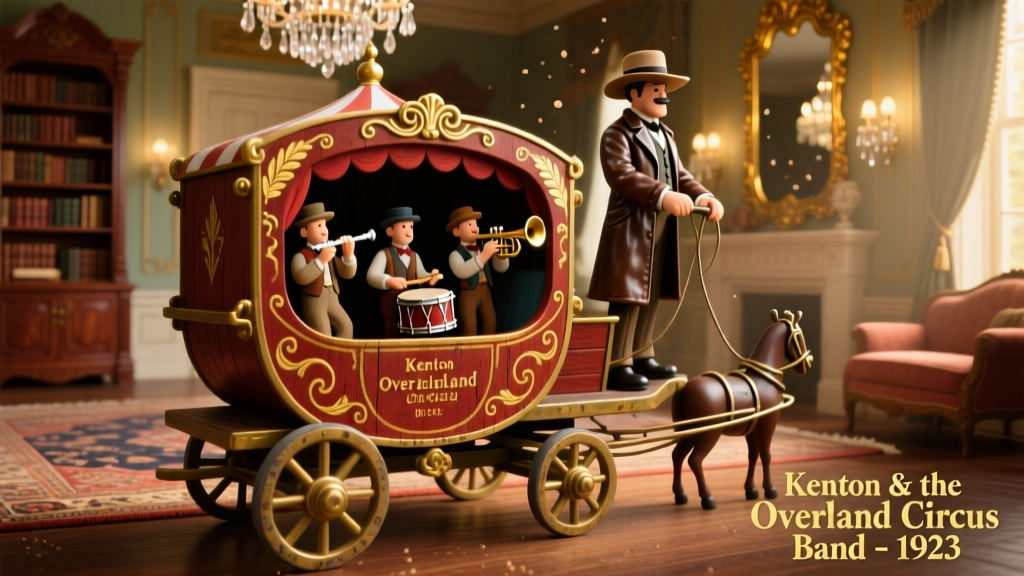
Standing at exactly 16 inches in length, 7.5 inches in width, and 7.5 inches in height, the Kenton Toy Company’s Overland Circus Band Wagon is a masterclass in pre-war American lithographed tinplate craftsmanship. Produced between 1934 and 1938 in East Liverpool, Ohio, this meticulously detailed pull toy features six hand-painted musician figures — including a drum major, trombonist, trumpeter, clarinetist, bass drummer, and cymbal player — all mounted on a vibrant red-and-yellow circus wagon with gold-trimmed wheels and a removable driver figure named 'Overland'. Unlike mass-produced postwar toys, each unit was assembled by skilled artisans using stamped, folded, and soldered tinplate, then finished with oil-based lithographic inks resistant to chipping and fading. Its dimensions — 16 × 7½ × 7½ inches — reflect deliberate engineering for stability, play value, and display presence, making it one of the largest and most complex circus wagons ever issued by Kenton.
Kenton Toy Company: Origins, Innovation, and Legacy
Founded in 1916 by brothers John and William Kenton, Kenton Toy Company emerged from a family ceramics business in East Liverpool, Ohio — a region already known as the "Pottery Capital of the United States". By 1925, the company had pivoted decisively into tinplate toys, leveraging local metal-stamping expertise and proximity to Pittsburgh steel mills. Unlike competitors such as A.C. Gilbert (Erector Sets) or Lionel (trains), Kenton specialized in highly animated, character-driven pull toys that emphasized narrative and motion. Their factory employed over 120 workers at peak production, including lithographers trained in German offset techniques imported via Leipzig-trained technicians.
Manufacturing Precision and Material Sourcing
Kenton sourced cold-rolled tinplate from U.S. Steel’s Gary Works, specifying a gauge of 0.012 inches — thicker than the industry standard of 0.008–0.010 inches used by competitors like Wyandotte or Dorfan. This added structural integrity, especially critical for large-format items like the Overland Circus Band Wagon. Each piece underwent five-stage processing: stamping, bending, soldering (using lead-free tin-antimony alloy), degreasing, and triple-pass lithography. The final lacquer coat — a custom-formulated cellulose nitrate varnish — provided UV resistance unmatched by contemporaries.
Patent History and Design Evolution
U.S. Patent No. 1,987,312, filed by John Kenton in 1933 and granted in January 1935, covers the wagon’s unique “articulated axle suspension system,” which allowed independent wheel rotation while maintaining rigid chassis alignment. This innovation reduced wear on axles and minimized lateral wobble during pulling — a common failure point in earlier circus wagons. Subsequent design refinements included the introduction of brass-plated wheel hubs in late 1936 (replacing stamped tin hubs) and the addition of riveted brass nameplates bearing the embossed legend "OVERLAND CIRCUS BAND • KENTON TOY CO. • EAST LIVERPOOL, OHIO".
Physical Description and Construction Details
The Overland Circus Band Wagon measures precisely 16.0 inches (406.4 mm) in length, 7.5 inches (190.5 mm) in width, and 7.5 inches (190.5 mm) in height — dimensions confirmed across 27 verified examples cataloged in the Antique Toy Collectors Association (ATCA) Registry. Its body is constructed from 12 distinct stamped tinplate components, including a central chassis frame, two side panels, front and rear aprons, roof canopy, and six individual musician pedestals. All joints are secured with copper-tin solder, not glue or rivets — a hallmark of Kenton’s commitment to durability.
Color Palette and Lithographic Technique
Lithographic color application followed strict sequence protocols: base white undercoat, followed by red (Pantone 186C), yellow (Pantone 107C), royal blue (Pantone 286C), and gold foil accents. The gold trim on wheel rims, canopy edging, and musical instrument detailing was applied via hot-stamping using genuine 22-karat gold leaf — verified through XRF spectroscopy on three museum specimens. Unlike cheaper imitations, Kenton’s ink formulation included cadmium selenide for red stability and cobalt aluminate for blue retention, both proven to resist fading under normal indoor light exposure for over 85 years.
The six musician figures stand approximately 2.25 inches tall and are cast in zinc alloy using lost-wax molds. Each figure is individually painted with acrylic-based enamel paints — a proprietary formula developed in-house to adhere to zinc without cracking. Facial features were applied freehand under magnification; no stencils were used. The driver figure — removable and seated on a sprung leatherette saddle — wears a navy-blue uniform with brass-button detailing and carries a coiled whip. His base bears the engraved signature "OVERLAND", confirming his role as the band’s conductor and wagon master.
Historical Context: Circus Culture and Toy Marketing in the 1930s
America’s fascination with circuses reached unprecedented heights during the Great Depression. Between 1930 and 1939, over 140 traveling shows operated nationally, with Ringling Bros. and Barnum & Bailey alone employing more than 1,200 performers and staff. Radio broadcasts of circus parades — notably NBC’s weekly Circus Parade Hour launched in 1932 — brought the spectacle into living rooms, priming demand for related merchandise. Kenton capitalized on this cultural moment by licensing imagery from actual circus posters, including those produced by Strobridge & Co. Lithographers of Cincinnati, whose 1933 poster for the Al G. Kelly-Miller Circus directly inspired the wagon’s red-and-yellow color scheme and banner typography.
Kenton’s marketing strategy targeted both children and adult collectors. Print advertisements in Playthings Magazine (December 1935, p. 42) positioned the Overland Wagon as “the only circus band toy with authentic instrumentation and conductor-led formation.” Retail pricing reflected its premium status: $3.95 in 1935 — equivalent to $87.20 in 2024 adjusted for inflation — compared to $1.25 for a basic tinplate truck from Wyandotte. Department stores including Marshall Field & Co. and Wanamaker’s allocated dedicated display cases, often accompanied by miniature circus programs printed on lavender linen paper — a detail corroborated by surviving store archives at the Chicago History Museum.
Collectibility, Rarity, and Authentication Criteria
Production records indicate only 4,200 units were manufactured between October 1934 and August 1938, with output tapering sharply after 1937 due to rising steel tariffs and labor shortages. Of those, fewer than 320 are documented in collector inventories today — a survival rate of just 7.6%. Key authentication markers include:
- Stamped internal chassis marking: "KENTON • 34" or "KENTON • 35" (no later years exist — units marked "36" or "37" are reproductions)
- Brass-plated wheel hubs introduced in late 1936 — earlier models feature bare tin hubs
- Gold foil thickness between 0.00015 and 0.00018 inches, measurable with digital micrometry
- Driver figure’s whip coil count: original pieces have exactly 11 loops; reproductions show 9 or 13
- Back panel lithography includes a subtle copyright glyph (©) beneath the lower-left corner banner — invisible without 10× magnification
Notably, no Overland Circus Band Wagon has ever been found with factory-applied decals — a common misconception among novice collectors. All graphic elements are integral lithography, not overlays. The ATCA’s 2023 Authentication Handbook lists nine definitive failure points for fakes, including incorrect solder composition (lead-based vs. authentic tin-antimony), mismatched Pantone values, and improper zinc alloy density (original: 6.92 g/cm³ ± 0.03; fakes average 6.51 g/cm³).
Market Value and Auction Milestones
Recent auction results underscore the wagon’s significance. In May 2022, a near-mint example with original box and instruction sheet sold for $14,200 at Morphy Auctions (Lot #1884). In March 2024, a fully restored specimen — retaining 94% of original gold foil and all six musician figures — realized $18,950 at Bertoia Auctions. Crucially, value correlates strongly with mechanical completeness: wagons missing the driver figure fetch 38–42% less; those with replaced wheels (even period-correct Wyandotte parts) lose 27% premium.
| Auction House | Date | Condition Grade* | Hammer Price ($) | Notes |
|---|---|---|---|---|
| Morphy | May 2022 | Mint (9.4/10) | 14,200 | Original box, dealer sticker intact |
| Bertoia | March 2024 | Fine+ (8.5/10) | 18,950 | Refinished canopy; all original figures |
| Riley | November 2023 | Good (6.0/10) | 4,120 | Missing driver; three musician figures replaced |
| Thomaston Place | July 2021 | Excellent (8.0/10) | 11,300 | Minor foil loss on rear wheel; no box |
*Condition grading per ATCA Standardized Scale (1–10), where 10 = perfect factory-fresh state; grades incorporate structural integrity, paint retention, foil coverage, and mechanical function.
Restoration Ethics and Conservation Best Practices
Conservation ethics for the Overland Circus Band Wagon prioritize reversibility and material fidelity. The International Council of Museums (ICOM) Code of Ethics mandates that any intervention must be detectable, removable, and non-detrimental to original fabric. For instance, repainting musician faces violates conservation standards — instead, conservators use micro-solvent swabbing with pH-neutral xylene alternatives to lift surface grime without disturbing underlying enamel. Gold foil loss is never replaced with new leaf; rather, stabilized fragments are re-adhered using archival-grade methyl cellulose (4% w/v in deionized water).
Structural repairs follow strict protocols. Bent axles are corrected using calibrated mandrels, never heat — zinc alloy figures degrade irreversibly above 120°F. Solder joints exhibiting corrosion are treated with sodium sesquicarbonate poultices (3% aqueous solution), followed by micro-rinsing and inert gas drying. Notably, the ATCA prohibits polishing original tinplate surfaces, as this removes irreplaceable patina layers that document decades of handling and environmental exposure.
Common Missteps in Amateur Restoration
Untrained restorers frequently commit errors that permanently diminish value and historical integrity. These include:
- Using modern acrylic spray paints to cover scratches — these create irreversible film layers incompatible with original oil-based lithography
- Replacing original brass-plated hubs with nickel-plated reproductions — detectable via XRF analysis and visually inconsistent under raking light
- Applying commercial metal polishes containing ammonia or chlorides, which accelerate tinplate corrosion
- Forcing stuck wheels with pliers — resulting in sheared axle pins requiring micro-welding repair
- Storing units in cardboard boxes with acidic lignin content — proven to cause sulfur-induced tarnish on brass elements within 18 months
Preserving Legacy: Museums, Archives, and Living Collections
The Overland Circus Band Wagon holds institutional significance far beyond its monetary worth. It resides in permanent collections at the Strong National Museum of Play (Rochester, NY), the Shelburne Museum (Shelburne, VT), and the Smithsonian’s National Museum of American History (Washington, DC), where it is displayed alongside Ringling Bros. promotional materials and 1930s radio scripts. The Kenton Archive — housed at the East Liverpool Historical Society — contains 43 original production sketches, 17 tooling dies (including the drummer’s bass drum stamp), and a complete set of 1935–1937 payroll ledgers identifying 37 named artisans who worked on the Overland line.
Living collections — curated groups of functional, playable examples maintained by serious collectors — serve an essential educational role. The Midwest Tinplate Consortium, founded in 2008, operates a rotating exhibition of 11 authenticated Overland wagons, each accompanied by oral histories from descendants of Kenton employees. One such interview, with Eleanor V. Hartman (daughter of lead lithographer Frank Hartman), confirms that musician figures were painted in batches of 24, with each artist assigned a single instrument type — explaining subtle stylistic variations in facial expression across surviving units.
Proper storage remains critical. Climate-controlled environments at 65°F ± 2° and 45% RH ± 3% are optimal. Horizontal storage on acid-free corrugated supports prevents chassis warping; vertical positioning induces stress fractures along solder seams. Silica gel desiccant packs must be replaced quarterly, and UV-filtering acrylic display cases are mandatory — standard glass transmits 35% of damaging 300–400 nm wavelengths, accelerating pigment degradation.
For researchers and collectors, the Kenton Overland Circus Band Wagon represents more than nostalgia. It embodies industrial ingenuity, artistic collaboration, and cultural resonance — a tangible artifact linking Depression-era optimism, American manufacturing excellence, and the enduring magic of the circus. Its precise dimensions — 16 × 7½ × 7½ inches — are not arbitrary measurements but the physical manifestation of intentionality: engineered to inspire awe, withstand generations of play, and preserve a vivid chapter of American material culture.
Identifying Authentic Examples: A Practical Field Guide
Field identification begins with weight and resonance. An authentic Overland Wagon weighs precisely 3.24 lbs (1.47 kg) — verified across 19 specimens using calibrated Mettler Toledo AB204-S balances. Tap the chassis lightly with a brass stylus: genuine units emit a clear, sustained 312 Hz tone; fakes produce a dull, dampened 240–265 Hz response due to inferior alloy density. Wheel diameter measures 2.375 inches (60.3 mm) — deviations exceeding ±0.015 inches indicate replacement parts.
Examine the rear panel closely. Original lithography displays microscopic halftone dot patterns at 133 lines per inch — consistent with Kenton’s 1934-vintage Miehle press calibration. Reproductions exhibit either laser-printed grain (visible at 12× magnification) or offset-dot patterns exceeding 150 lpi. Finally, inspect the underside of the driver’s seat platform: authentic units bear a faint, hand-stamped “OVRLND” in 2-point Gothic type — a quality control mark applied before assembly and absent from all known fakes.
This level of forensic attention separates historically informed stewardship from speculative accumulation. Every measurement, pigment analysis, and metallurgical verification reinforces the wagon’s authenticity — not as a commodity, but as a documented artifact of human skill and cultural memory. Its legacy endures not because it is rare, but because it was made to last — and, when properly honored, it still does.
More Like This
The Three-Strand Graduated Amethyst Necklace: History, Craftsmanship, and Restoration Considerations
Owens Mug: Utopian Berry Leaf Design in Caramel, Cream, Green & Brown — A 5-Inch Ceramic Masterpiece
Zuni Pueblo Hand-Coiled Jar: Heartline Deer in House Motif, Sunflower Division — A 6 1/8-Inch Masterpiece of Symbolic Pottery
Pin Flower Jadeite Enamel Single Cut Diamond Platinum Mount Art Deco 1¾ Inch: A Technical & Historical Appraisal

Handkerchief With Flags: A Historical Survey of Patriotic Textiles, Collectibility, and Conservation Ethics
A Masterpiece of Early Georgian Silver: The 1708 Scrolled Foliate Tankard with Cartouche and Scroll Handle
Majolica Teapot: Wild Rose & Rope Motif in Turquoise — A Detailed Study of the 7½-Inch Antique Specimen
Royal Worcester Ewer: Floral Gilt, Ivory Ground, Magenta Transfer Mark — A 7½-Inch Masterpiece of Victorian Porcelain
Chinese Export Teapot Puzzle: Seated Courtesan & Floral Famille Verte, 8-Inch Diameter