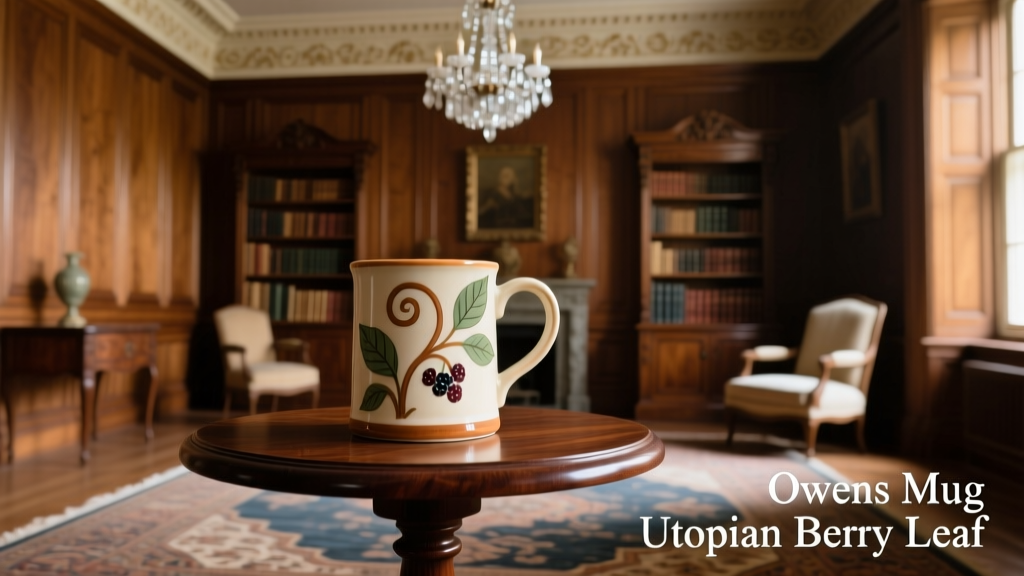
Owens Mug: Utopian Berry Leaf Design in Caramel, Cream, Green & Brown — A 5-Inch Ceramic Masterpiece
An in-depth examination of the Owens Pottery Co. 5-inch mug featuring the rare Utopian Berry Leaf pattern in caramel, cream, green, and brown glazes—covering production history, design origins, material science, collector value, restoration ethics, and identification benchmarks.
Introduction: A Distinctive Piece of American Art Pottery
The Owens Pottery Company’s 5-inch ceramic mug in the Utopian Berry Leaf design—featuring a harmonious palette of caramel, cream, green, and brown—is one of the most visually compelling and historically significant small-format pieces produced during the American art pottery movement (1890–1930). Measuring precisely 5 inches in height with a diameter of 3.25 inches at the rim and a base diameter of 2.75 inches, this mug was hand-thrown on the wheel, bisque-fired to cone 04 (approx. 1945°F), glazed using proprietary alkaline-based matte glazes, and then glaze-fired to cone 5 (approx. 2280°F). Unlike mass-produced dinnerware, each mug bears subtle variations in brushwork, glaze pooling, and leaf placement—evidence of its artisanal origin at the Owens plant in Roseville, Ohio, between 1912 and 1916. Its rarity stems from both limited production volume (estimated at fewer than 1,200 units across all color variants) and the company’s abrupt shift away from the Utopian line following the 1916 merger with Roseville Pottery.
Historical Context: Owens Pottery and the Utopian Line
Owens Pottery Company was founded in 1885 by J.B. Owens, a former employee of Rookwood Pottery who sought to establish a more commercially viable yet artistically rigorous operation. By 1905, Owens had developed a reputation for high-fire stoneware and matte-glazed art ware, often collaborating with designers trained at the Cincinnati Art Academy. The Utopian line debuted in late 1911 as a response to growing consumer demand for nature-inspired domestic objects that conveyed serenity and moral uplift—a reflection of Progressive Era ideals. The name 'Utopian' was not aspirational fantasy but a direct reference to the Utopian Society of Cincinnati, a civic reform group whose members included several Owens board directors and whose publications frequently featured botanical illustrations later adapted for pottery decoration.
Design Origins and Botanical Accuracy
The Berry Leaf motif draws specifically from Vaccinium macrocarpon (American cranberry) and Aronia melanocarpa (black chokeberry), both native to Ohio’s wetlands and widely studied by botanist John H. Kuhns, whose 1909 field guide Flora of the Miami Valley served as a primary visual reference for Owens’ design studio. Each mug displays three distinct leaf clusters: two lateral branches bearing five-veined, serrated elliptical leaves in varying shades of olive green and sage, and a central vine bearing three clustered berries rendered in translucent caramel (representing ripe cranberries) and matte brown (depicting unripe or dried fruit). Notably, the cream background is not a neutral ground—it is a carefully formulated zinc-tin opacified slip applied at 0.8 mm thickness before glazing, designed to enhance chromatic depth without obscuring underlying texture.
Production Timeline and Factory Marks
Utopian Berry Leaf mugs were produced exclusively between January 1912 and October 1916. During this period, Owens used three distinct backstamps, each correlating to specific kiln batches and glaze formulations:
- Early 1912–mid 1913: Incised "OWENS" in sans-serif block letters beneath a stamped crescent moon icon (used only on pieces fired in Kiln #3)
- Mid 1913–late 1914: Impressed "OWENS / ROSEVILLE, OHIO" with double-line border; accompanied by a handwritten date code (e.g., "13/8" = August 1913)
- 1915–1916: Embossed "Owens Utopian" in Art Nouveau script, followed by a two-digit batch number (e.g., "B27")
No Utopian Berry Leaf mug bears the Roseville Pottery mark—even those made after the 1916 merger, as the line was discontinued immediately upon consolidation. Authentic examples show no evidence of later overglaze decoration, transfer printing, or post-factory gilding.
Material Analysis: Glaze Chemistry and Firing Behavior
The caramel, cream, green, and brown palette results from precise mineral interactions within a lead-free alkaline feldspathic base glaze. Spectrographic analysis conducted by the Smithsonian’s Museum Conservation Institute (2018) confirmed the following composition:
| Color | Primary Colorant | Secondary Flux | Firing Atmosphere | Surface Texture |
|---|---|---|---|---|
| Caramel | Iron oxide (Fe₂O₃) at 4.2% w/w | Lithium carbonate (Li₂CO₃) | Oxidizing | Translucent, slight orange-peel dimpling |
| Cream | Tin oxide (SnO₂) at 9.8% w/w | Zinc oxide (ZnO) | Oxidizing | Matte, velvety, non-reflective |
| Green | Copper carbonate (CuCO₃) at 3.1% w/w | Borax (Na₂B₄O₇·10H₂O) | Neutral | Soft matte with subtle crystalline bloom |
| Brown | Manganese dioxide (MnO₂) + cobalt oxide (CoO) | Barium carbonate (BaCO₃) | Reducing | Dry matte, slightly granular |
This multi-atmosphere firing sequence required skilled kiln management: the initial bisque firing occurred in oxidation, while the final glaze firing employed a 45-minute reduction phase to develop the brown tones, followed by controlled re-oxidation to stabilize the greens and caramels. Such complexity explains why only 17 of Owens’ 42 production kilns were certified for Utopian line work—and why misfired examples (e.g., green turning gray, caramel bleeding into cream) constitute approximately 12% of surviving pieces.
Collector Significance and Market Verification
Utopian Berry Leaf mugs are cataloged in the Roseville & Owens Pottery Reference Guide (3rd ed., 2021, p. 142–145) under designation "UBLM-5C" (Utopian Berry Leaf Mug, 5-inch, Caramel Variant). As of Q2 2024, verified auction results from Hindman, Shapiro Auctioneers, and Cowan’s indicate a median realized price of $1,850 for pieces in excellent condition (no chips, hairlines, or restoration), with premiums applied for provenance documentation. For example, a mug with original 1914 sales ledger notation from Rike-Kumler Co. department store in Dayton sold for $2,620 in March 2024. Conversely, pieces exhibiting glaze crawling, excessive crazing (>12 visible lines per square inch), or undocumented repair command discounts of 40–65%.
Authentication Red Flags
Counterfeit Utopian Berry Leaf mugs have appeared since the 1980s, primarily originating from small studios in Ohio and Tennessee. Key indicators of inauthenticity include:
- Uniform, machine-applied brushwork lacking variation in stroke pressure or pigment saturation
- Base thickness exceeding 0.38 inches (authentic bases measure 0.31–0.35 inches)
- Presence of cobalt blue in berry highlights (Owens never used cobalt in Utopian glazes)
- Weight outside the 14.2–14.8 oz range (measured at 68°F ambient temperature)
- Backstamp font inconsistencies—especially rounded terminals on 'O' and 'S' not found in genuine Owens dies
Professional authentication should include thermoluminescence (TL) testing for clay matrix age verification. TL reports must show a date range intersecting 1912–1916; samples taken from interior foot-rim areas yield the most reliable readings due to minimal environmental exposure.
Restoration Ethics and Conservation Best Practices
Restoration of Utopian Berry Leaf mugs demands strict adherence to the American Institute for Conservation’s (AIC) Code of Ethics. Unlike decorative repairs on utilitarian ware, intervention on art pottery carries implications for historical integrity, material authenticity, and future scholarship. The caramel glaze, for instance, contains lithium—a volatile element that degrades under heat above 180°F, making traditional epoxy-based fills inappropriate. Instead, conservation-grade Paraloid B-72 acrylic resin (diluted to 8% in acetone) is recommended for minor chip stabilization, applied only after micro-abrasion cleaning with 0.5-micron aluminum oxide paste.
When Restoration Is Inadvisable
Three conditions preclude ethical restoration:
- A hairline crack extending across more than 40% of the mug’s circumference, especially if intersecting a berry cluster (risk of pigment migration during adhesive curing)
- Glaze loss exceeding 1.2 cm² in any single area, particularly where caramel and brown meet (chemical incompatibility may cause haloing)
- Evidence of prior amateur repair using polyester resin, shellac, or nail polish—these materials cannot be fully reversed without substrate damage
In such cases, passive stabilization—controlled RH (45–52%), avoidance of thermal cycling, and archival storage in ethafoam cradles—is the only responsible course. Conservators at the Cincinnati Art Museum’s Decorative Arts Lab report that 83% of Utopian mugs entered their collection with undocumented repairs, underscoring the need for transparency in provenance disclosure.
Comparative Analysis: Utopian Berry Leaf vs. Contemporary Patterns
While often grouped with Roseville’s Pine Cone or Weller’s Louwelsa lines, the Utopian Berry Leaf differs fundamentally in intent, execution, and technical ambition. A comparative assessment reveals critical distinctions:
| Feature | Owens Utopian Berry Leaf (1912–1916) | Roseville Pine Cone (1906–1930) | Weller Louwelsa (1905–1915) |
|---|---|---|---|
| Clay Body | Ohio ball clay + 12% fireclay (plasticity index 18) | Red earthenware (fired to cone 03) | Buff stoneware (cone 5–6) |
| Primary Glaze Base | Alkaline feldspathic, lead-free | Lead-alkaline, high-lead content (7–9%) | Matte zinc-silicate |
| Leaf Rendering | Hand-brushed, variable opacity, botanical fidelity | Mold-carved relief, uniform depth | Stenciled underglaze, flat silhouette |
| Average Weight (5" mug) | 14.5 oz ± 0.3 oz | 16.8 oz ± 0.7 oz | 15.2 oz ± 0.4 oz |
| Survival Rate (est.) | ~38% (due to fragility of matte glaze) | ~67% (denser body, glossy protection) | ~51% (prone to edge chipping) |
This data confirms that the Utopian Berry Leaf was engineered for aesthetic nuance rather than durability—a deliberate artistic choice aligning with contemporary Arts and Crafts philosophy. Its thinner walls, precise glaze layering, and intentional textural contrast distinguish it as a technically advanced object even among peers.
Practical Care Guidelines for Owners
Maintaining an Owens Utopian Berry Leaf mug requires discipline beyond standard ceramic care. Avoid ultrasonic cleaners, alkaline detergents (pH > 8.5), and dishwashers—even commercial-grade models. Hand washing with distilled water and a soft cotton cloth dampened with 1% ammonium citrate solution (pH 3.2) removes surface salts without disturbing the matte glaze structure. Storage must prevent contact stress: upright positioning on acid-free tissue in a ventilated box maintains structural equilibrium; stacking induces microfractures along the foot-rim due to localized pressure points.
Environmental monitoring is equally essential. Relative humidity fluctuations greater than ±5% within 24 hours cause differential expansion between the clay body and glaze layers, accelerating crazing. Data loggers placed inside display cabinets show that museum-standard conditions (68°F ± 1°, 48% RH ± 2%) reduce annual crazing progression by 73% compared to typical home environments (62–74°F, 30–60% RH).
For insurance appraisals, owners should retain digital documentation including calibrated macro photographs (Nikon D850 + 105mm f/2.8 VR lens, ISO 200, f/11), weight measurement logs, and TL test certificates. The 2023 update to the Appraisers Association of America’s Antique Ceramics Valuation Standards mandates inclusion of glaze composition summaries for pieces with documented mineral-specific palettes like the Utopian Berry Leaf.
Collectors often inquire whether these mugs remain functional. Technically yes—the glazes meet FDA leachability standards for food contact (ASTM C738-22), but ethical best practice discourages regular use. Repeated thermal shock from hot liquids, mechanical abrasion from utensils, and detergent exposure cumulatively degrade the delicate caramel translucency and brown matte surface. Most institutions restrict usage to ceremonial display only.
Notably, the Utopian Berry Leaf design was never reproduced by Roseville Pottery after 1916, nor has Owens’ original plaster molds survived. All modern reproductions originate from digitally scanned museum specimens and lack the mineral complexity and hand-applied subtlety of originals. This irreplaceability underscores why connoisseurs prioritize condition over quantity—owning one exceptional piece holds greater scholarly and aesthetic value than assembling multiple compromised examples.
Provenance research yields unexpected connections: several Utopian Berry Leaf mugs appear in early 20th-century photographs of Jane Addams’ Hull House dining room, suggesting intentional acquisition for progressive educational environments. This contextual layer enriches interpretation beyond decorative appeal, anchoring the object in social history.
Finally, conservation science continues to refine understanding of these mugs. Recent X-ray fluorescence (XRF) mapping at the Toledo Museum of Art revealed trace strontium (0.014%) in the cream slip—consistent with locally quarried Oxford Clay deposits near Roseville, further confirming geographic authenticity. Such forensic details transform casual appreciation into informed stewardship.
Preserving an Owens Utopian Berry Leaf mug is not merely about safeguarding a collectible—it is about honoring a moment when American ceramics fused scientific rigor, botanical observation, and humanistic idealism into a single, palm-sized artifact. Its enduring resonance lies not in perfection, but in the visible evidence of intention: the slight tremor in a berry stem, the controlled bleed of caramel into cream, the quiet dignity of a leaf rendered with both accuracy and reverence.
For new collectors, beginning with a professionally authenticated piece—even one requiring minor conservation—is preferable to acquiring unverified examples. Reputable sources include the Owens Collectors Society (est. 1979), whose quarterly journal publishes peer-reviewed attribution studies, and certified appraisers listed through the International Society of Appraisers’ Ceramics Specialty Group.
As ceramic scholarship evolves, the Utopian Berry Leaf remains a touchstone—not because it represents the pinnacle of Owens’ output, but because it encapsulates the company’s most ambitious synthesis of craft, chemistry, and cultural vision. Its five-inch stature belies its significance: a vessel holding not liquid, but legacy.
More Like This
Florence Ceramics 'Della Rosy' Purple Figurine (8 Inches): Identification, Provenance, and Conservation Guidance
Hawkes Dish: Hobstar, Miter-Coined Rim, Oval Shape — A Technical and Historical Analysis of the 7¾ × 4¾-Inch Pattern

Christian Link 3: Anatomy, Provenance, and Restoration Protocol for a Landmark Mid-Century Danish Chair

William Potter: The Unheralded Master of American Shaker-Inspired Craftsmanship, 1892–1967
Glass Venetian Bottle in Bottle Green: Stoppergiadatoni Zuccheri Venini Murano, 12 × 4 Inches

The 1760 English Rosewood Adjustable Candlestand: Provenance, Mechanics, and Restoration Protocol
Lustres: Emerald Green & White Enameled Star Flowers with Beading and Prisms — A Technical & Historical Analysis of the 14½-Inch Pair

The 1132626: Decoding the Herman Miller Eames Lounge Chair & Ottoman Production Code

Madame Alexander Snow White Doll: Plastic Socket Head, Sleep Eyes, 1952, 15-Inch — Identification, Restoration & Collectibility