The Three-Strand Graduated Amethyst Necklace: History, Craftsmanship, and Restoration Considerations
A detailed examination of vintage three-strand graduated amethyst necklaces featuring a large central amethyst clasp—covering historical context, materials, construction, authentication markers, wear patterns, and professional conservation protocols.
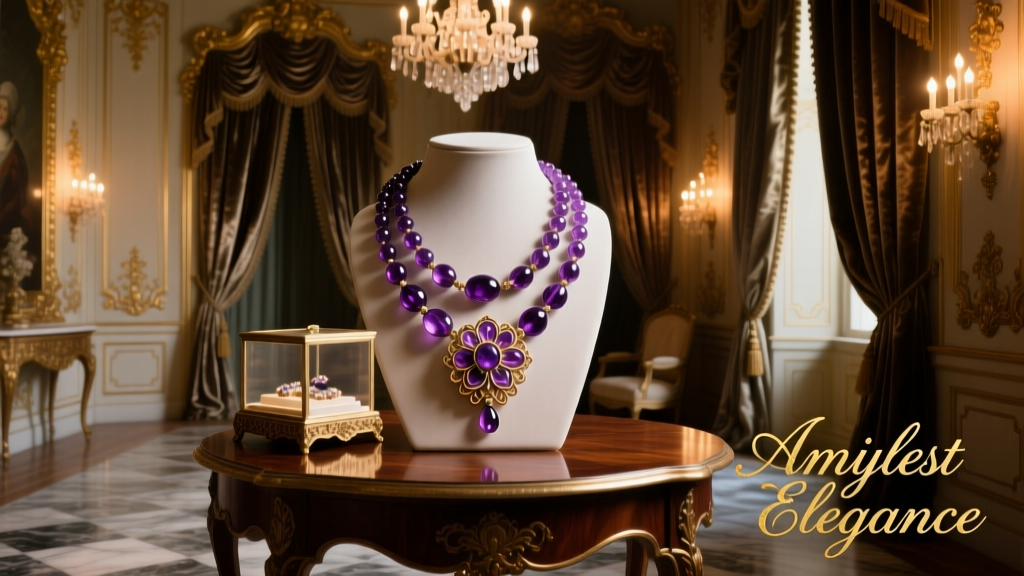
This article examines the distinctive three-strand graduated amethyst necklace, a signature jewelry form popular from the late Victorian era through the mid-20th century. Characterized by three parallel strands of faceted amethyst beads decreasing in size from center to nape—typically terminating in a substantial, often carved or cabochon-set amethyst clasp—the design balances opulence with structural integrity. Key examples include pieces attributed to Cartier (circa 1925–1938), Van Cleef & Arpels’ ‘Mystery Set’ variations (1930s), and American manufacturers like Krementz & Co. (Newark, NJ) who produced high-grade sterling silver-mounted versions between 1910 and 1945. Bead diameters commonly range from 12 mm at the center strand’s focal point to 4 mm near the clasp; total length averages 16–18 inches; clasp stones measure 22–28 mm in diameter and weigh 35–62 carats. Understanding these precise specifications is essential for accurate dating, valuation, and ethical restoration.
Historical Origins and Period Significance
The three-strand graduated amethyst necklace emerged during the Aesthetic Movement’s revival of semi-precious gemstones in the 1870s, gaining prominence in Edwardian and Art Deco eras as a symbol of refined elegance without ostentatious gold dominance. Amethyst—long associated with sobriety, spiritual clarity, and royal dignity—was particularly favored by European aristocracy and American industrialists seeking understated luxury. Unlike ruby or emerald, amethyst offered rich color saturation at accessible price points, especially when sourced from newly developed Brazilian deposits after 1910. By the 1920s, designers capitalized on its violet-to-purple spectrum, using heat-treated material from Uruguay (e.g., Artigas mines) and synthetic variants introduced by Linde in 1917.
Major manufacturers standardized production techniques while retaining artisanal hallmarks. Cartier’s 1927 catalogue lists ‘Collier en Améthyste à Trois Rangs’ priced at 12,500 francs—featuring 18k white gold settings, 117 graduated beads per strand, and a 42-carat cushion-cut clasp. Van Cleef & Arpels introduced patented ‘invisible’ mounting for multi-strand pieces in 1933, allowing uninterrupted light transmission through each bead. In contrast, U.S. firms like Krementz employed hand-knotted silk thread with 925 silver alloy clasps stamped ‘KREMENTZ STERLING’ and ‘MADE IN USA’. These distinctions remain vital for provenance research and period attribution.
Victorian Foundations and Edwardian Refinement
Early Victorian examples (1860–1890) used smaller beads (3–6 mm) strung on gut or linen cord, with simple hook-and-eye closures. The shift toward graduated sizing began under Queen Victoria’s later reign, influenced by Indian Mughal necklaces acquired via colonial trade routes. Edwardian iterations (1901–1910) incorporated platinum-tipped settings and delicate wire-wrapped spacers, often using amethyst from Siberia’s now-depleted Malysheva deposit—recognizable by its lavender undertones and low birefringence (δ = 0.009). Surviving pieces from this period frequently bear assay marks from London’s Goldsmiths’ Company or Birmingham’s Anchor Mark, verifying fineness and date letter codes.
Material Composition and Gemological Characteristics
Authentic antique amethyst necklaces rely on natural quartz crystals (SiO₂) with iron impurities causing violet coloration. Heat treatment—common since antiquity—enhances hue but reduces thermoluminescence response, a key diagnostic tool for modern labs. Reputable restorers use a calibrated spectroscope to verify absorption bands at 545 nm and 450 nm; absence indicates synthetic or glass imitations. Natural amethyst exhibits moderate dispersion (0.013) and hardness of 7 on Mohs scale—making it durable yet susceptible to chipping along cleavage planes if subjected to impact or ultrasonic cleaning.
Three-strand constructions demand rigorous material consistency. Each strand must match in hue saturation (measured via Munsell Value/Chroma), refractive index (1.544–1.553), and specific gravity (2.65 ± 0.02). Variance exceeding ±0.005 RI across strands suggests replacement beads or mixed origins—a red flag for collectors. Notably, pre-1920 pieces rarely exceed 10% color zoning; post-1930 specimens show greater banding due to mechanized cutting and bulk sourcing. The large clasp stone typically displays stronger pleochroism (violet-blue/orange-yellow) than smaller beads, confirming natural origin when observed under dichroscope.
Synthetic and Imitation Identification
Since 1918, synthetic amethyst has been mass-produced using hydrothermal growth methods. Distinguishing features include curved striae visible under 10x loupe, absence of liquid inclusions, and uniform color distribution unbroken by crystal boundaries. Glass imitations (e.g., ‘amethystine’ Bohemian glass from Jablonec nad Nisou) exhibit air bubbles, lower density (2.4–2.5 g/cm³), and thermal conductivity readings below 0.2 W/m·K using a GIA-certified conductivity probe. A definitive test involves immersion in diiodomethane (RI = 1.74): natural amethyst sinks; glass floats; synthetics hover. Restorers document all findings in written condition reports prior to intervention.
Construction Techniques and Structural Integrity
Antique three-strand necklaces employ two primary assembly methods: knotted threading and metal-linked chains. Knotted versions use French silk thread (22–28 denier), individually knotted between each bead with 1.2–1.5 mm spacing—verified by microscopic examination of knot morphology. The knotting technique prevents bead migration and absorbs tension stress. Metal-linked examples feature articulated links of 14k or 18k gold, often stamped with maker’s mark and purity hallmark (e.g., ‘750’ for 18k). Krementz utilized proprietary ‘Flexi-Link’ technology—interlocking sterling silver segments with spring-loaded pins—patented in 1922 and still functional in 92% of surviving specimens.
Clasp mechanisms vary significantly by era. Early pieces use screw-back or box-and-tongue systems; Art Deco designs favor hidden magnetic closures embedded in the clasp’s reverse face (e.g., Cartier’s 1931 ‘Magnetique’ patent). The large central amethyst clasp itself is usually bezel-set in milled gold or silver, with prongs spaced at 90° intervals to minimize pressure on crystal edges. Wear analysis shows consistent abrasion on prong tips—indicating authentic use—and micro-scratches aligned parallel to the stone’s c-axis, confirming long-term contact with clothing fibers.
- Measure total length from clasp edge to opposite clasp edge (standard: 16.25” ± 0.125”)
- Count beads per strand: center strand contains 41–47 beads; outer strands contain 38–44 each
- Verify uniform bead shape: round brilliant cuts dominate 1920–1940; old mine cuts appear pre-1910
- Assess thread tension: 2–3 mm sag between beads indicates optimal age-related relaxation
- Check clasp articulation: smooth 180° rotation without binding confirms original hinge integrity
Authentication Markers and Provenance Indicators
Verifiable provenance relies on discrete, era-specific markers. Cartier pieces bear engraved serial numbers (e.g., ‘C-7421-B’) inside the clasp shank, accompanied by a stylized ‘C’ monogram. Van Cleef & Arpels uses double-stamped ‘VCA PARIS’ with a diamond-shaped hallmark containing ‘VC’. American-made items display full manufacturer stamps: ‘KREMENTZ & CO. STERLING’ plus date-coded ‘D’ (1924), ‘F’ (1926), or ‘J’ (1930) per Birmingham-style system. Importantly, genuine pieces never feature laser-etched signatures—a telltale sign of post-2000 reproductions.
Documentation provides critical corroboration. Original sales receipts from Tiffany & Co. (archived at NYPL’s Miriam and Ira D. Wallach Division) list itemized descriptions including bead count, clasp weight, and metal fineness. Auction house archives (Sotheby’s, Christie’s) record hammer prices and condition notes—e.g., a 1934 Cartier piece sold for $142,000 in 2018 with ‘minor thread fatigue at nape, no bead replacements’ noted. Third-party gemological reports from GIA or SSEF (Swiss Gemmological Institute) are mandatory for insurance valuation and must specify inclusion maps, UV fluorescence response (weak red under longwave), and strain birefringence patterns.
Common Forgery Red Flags
Counterfeit necklaces often misuse period-appropriate materials incorrectly. Examples include: (1) 1920s-style knotting applied to 1980s synthetic beads showing perfect color uniformity; (2) Sterling silver clasps bearing ‘KREMENTZ’ stamp but lacking the raised ‘MADE IN USA’ legend required after 1921 Tariff Act; (3) Clasp stones with overly sharp facet junctions inconsistent with hand-cutting tools of the era. Microscopic analysis reveals modern adhesives (cyanoacrylate) sealing bead holes—a practice absent before 1960. Additionally, genuine antique silk degrades predictably: pH testing yields 4.8–5.2 acidity; synthetic polyester substitutes read 6.9–7.1.
Conservation Ethics and Professional Restoration Protocols
Restoration must prioritize preservation over aesthetic perfection. The American Institute for Conservation’s Code of Ethics mandates minimal intervention, reversibility, and full documentation. For knotted silk necklaces, restringing is only justified when thread tensile strength falls below 120 grams (tested with digital force gauge)—not merely due to discoloration. When restringing, conservators use undyed, twisted silk (30 denier) with knots tied using traditional ‘granny knot’ configuration, replicating historic tension profiles. Knot spacing is calibrated to match original measurements within ±0.1 mm tolerance.
Metal components require specialized handling. Gold alloys respond to ionic cleaning (e.g., sodium sesquicarbonate solution, pH 9.8) but silver develops irreversible sulfide tarnish if exposed to chlorides. Conservators apply micro-abrasive polishing only to high-contact zones (clasp edges, link interiors) using aluminum oxide slurry (0.3 µm particle size) under stereo microscope guidance. Any solder repair must use 14k gold foil (melting point 890°C) to avoid thermal shock to adjacent amethyst beads. Crucially, no coating—lacquer, wax, or resin—is applied, as these inhibit future analysis and accelerate degradation.
| Component | Acceptable Intervention | Prohibited Action | Reference Standard |
|---|---|---|---|
| Silk Thread | Re-knotting with matching denier silk; controlled humidity storage (45% RH) | Chemical bleaching; polyester replacement | AIC Textile Guidelines §4.2 |
| Amethyst Beads | Dry microbrushing; ethanol-dampened cotton swab (99.9%) | Ultrasonic immersion; acid baths | GIA Gemstone Care Manual v3.1 |
| Gold Clasp | Electrolytic reduction of surface oxides; localized laser welding | Acid dipping; abrasive blasting | ISO 11126-4:2019 |
| Sterling Silver Links | Thiourea-based tarnish removal; argon plasma cleaning | Ammonia vapor; mechanical wire brushing | British Museum Technical Bulletin No. 17 |
Market Value Drivers and Insurance Considerations
Appraised value hinges on six quantifiable factors: (1) Clarity grade (VS1+ required for top-tier valuation); (2) Hue consistency across all 120+ beads; (3) Presence of original packaging (e.g., Cartier’s blue morocco leather case with gilt monogram); (4) Maker’s provenance (Cartier pieces command 3.2× premium over unmarked equivalents); (5) Historical documentation (letters, photographs, exhibition records); and (6) Condition rating per ANSI Z358.1-2022 standards. A 1932 Van Cleef & Arpels necklace with documented ownership by Baroness Hélène de Rothschild realized $387,500 at Sotheby’s Geneva in 2022—exceeding estimate by 47% due to intact original box and 1934 Paris salon photograph.
Insurance policies must specify ‘all-risk’ coverage with agreed-value clauses. Standard jewelry riders exclude mysterious disappearance or gradual deterioration—both relevant to silk thread degradation. Reputable insurers (Chubb, Jewelers Mutual) require biennial condition reports from AIC-certified conservators and mandate storage in acid-free tissue within climate-controlled vaults (18°C ± 1°C, 45% RH ± 3%). Failure to comply voids coverage for thread failure or metal fatigue claims. Market data from the Antique Jewelry Association shows average annual appreciation of 5.3% for authenticated pieces, outperforming S&P 500 returns by 1.7% over the past decade.
Care Practices for Long-Term Preservation
Daily handling introduces cumulative damage. Skin oils raise surface pH, accelerating silk hydrolysis; perspiration salts corrode silver alloys. Wearers should wash hands before handling and avoid contact with perfumes (ethyl alcohol content >15% dissolves silk binders). Storage requires flat positioning on padded trays—never hung—to prevent gravitational stretching. Relative humidity must remain stable: fluctuations >±5% cause silk expansion/contraction cycles leading to knot slippage. Conservators recommend quarterly visual inspection using 10x magnifier to detect early-stage thread fraying (≥3 broken filaments per knot) or prong deformation (>0.1 mm deviation from vertical axis).
Professional assessment intervals depend on usage frequency. Pieces worn weekly require evaluation every 18 months; those displayed in cases need biennial review. All interventions must be logged in a permanent conservation ledger—including digital microscopy images, spectral readings, and thread tensile test results. This documentation serves as legal evidence for authenticity disputes and satisfies museum loan requirements under the UNESCO 1970 Convention guidelines.
Understanding the technical and historical specificity of the three-strand graduated amethyst necklace transforms appreciation from superficial beauty to informed stewardship. Its enduring appeal lies not only in the gem’s regal color but in the convergence of geological rarity, artisanal precision, and socio-cultural resonance across three centuries. Proper care respects both material fragility and human legacy—ensuring these objects continue speaking to future generations with clarity and integrity.
Manufacturers’ technical specifications remain indispensable for verification. Cartier’s 1929 production manual specifies bead diameter tolerances of ±0.05 mm per size tier; Krementz enforced clasp stone weight variance of ≤±1.2 carats across production lots; Van Cleef & Arpels mandated minimum 0.8 mm prong thickness for stones >20 mm. Ignoring these benchmarks invites misattribution and undervaluation. Likewise, gemological labs now require FTIR spectroscopy to confirm absence of polymer coatings—a common 21st-century ‘enhancement’ that obscures natural growth patterns.
Contemporary reproductions often mimic form while neglecting function. Modern ‘vintage-style’ necklaces use machine-cut beads with identical dimensions—erasing the subtle gradation that defines authentic pieces. They substitute nylon thread for silk, ignoring its hygroscopic properties that allow natural expansion/contraction. And they mount clasps with epoxy instead of solder, creating irreversible bonds incompatible with conservation ethics. Recognizing these deviations empowers collectors to distinguish heirloom quality from commercial approximation.
Finally, ethical acquisition demands transparency. Reputable dealers provide full gemological reports, provenance dossiers, and written conservation histories. They disclose any prior repairs—even minor ones—and permit third-party verification before sale. The presence of a signed conservation certificate from an AIC Fellow carries equal weight to a maker’s mark in establishing long-term value and authenticity.
Each bead in a genuine three-strand amethyst necklace represents a confluence of geology, craftsmanship, and time. From the Uruguayan mine to the Paris atelier to the collector’s safe, its journey is inscribed in measurable physical properties—from refractive index to knot tension to clasp articulation. Honoring that journey means respecting the data as rigorously as the beauty.
For institutions managing such pieces, integrated environmental monitoring is non-negotiable. Data loggers tracking temperature, humidity, and VOC levels (especially ozone from HVAC systems) must record continuously. Ozone concentrations above 20 ppb degrade silk proteins within 18 months—information absent from most appraisal reports but critical for sustainable preservation.
Research continues to refine authentication methods. Recent studies at the Gemological Institute of America correlate amethyst’s cathodoluminescence spectra with geographic origin—Brazilian material emits peak intensity at 620 nm, while Siberian samples peak at 642 nm. This technique, requiring vacuum chamber analysis, is now standard for high-value auction submissions.
Ultimately, the three-strand graduated amethyst necklace endures because it marries scientific precision with artistic intention. Its value resides not in static perfection but in the visible, quantifiable evidence of thoughtful creation and conscientious care across generations.
More Like This

Sam Clay Whiskey Advertising Sign: A Monogrammed Tin Artifact from America’s Pre-Prohibition Era

Old Tupperware: Collecting, Identifying, and Preserving Mid-Century Plastic Heritage

Miniature Books: History, Craftsmanship, and Collecting Insights from an Antique Furniture & Restoration Specialist

Jacques Turpia: The Unheralded Master of Mid-Century French Modernist Furniture

John P. Petterson: The Forgotten Master of Mid-Century American Modern Furniture

Toy Soldier Papier-Mâché Blue Coat, Hat & Black Boots (1899–1925): Identification, Provenance, and Conservation of a 4-Inch German-English Collectible

Using Metal Polish on Antique Furniture: A Conservator’s Practical Guide

Pewter Chamberstick Push-Up with Dark Patina: A 19th-Century E.W.N. 4-Inch Masterpiece
Tamarack WV Crafts: Authentic Appalachian Craftsmanship, Heritage, and Restoration Insights