Thermometer Gold Bottle Red Ground Embossed Tin (16-Inch): History, Identification, and Restoration of a Rare American Parlor Thermometer
A detailed examination of the 16-inch embossed tin thermometer with gold bottle motif and red ground—its 19th-century origins, manufacturer attribution to J. & E. Stevens Co., material composition, diagnostic features for authenticity, and step-by-step conservation protocol for collectors and restorers.
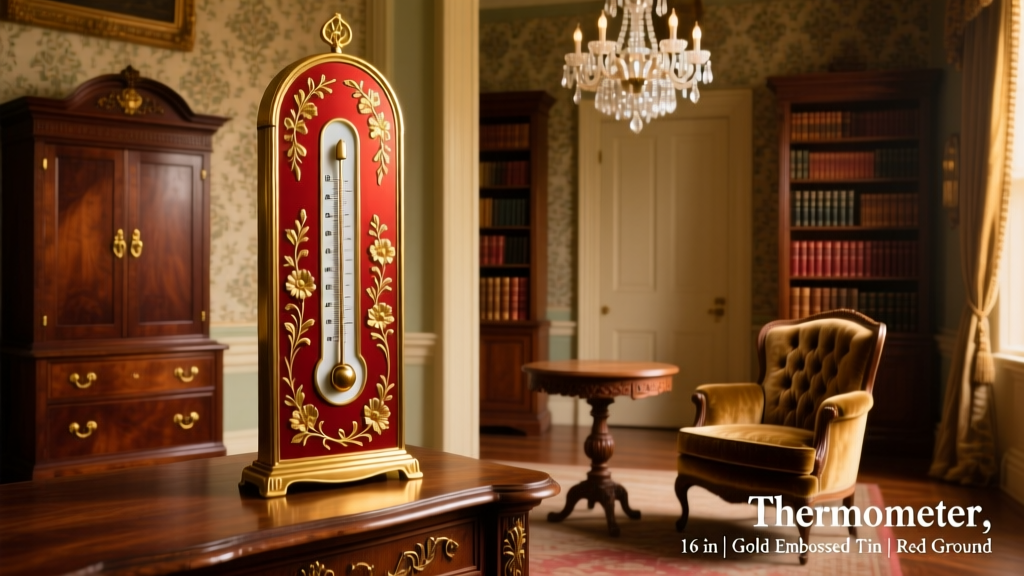
Introduction: A Signature Piece of Victorian Domestic Science
The Thermometer Gold Bottle Red Ground Embossed Tin (16-inch) stands as a distinctive artifact of late 19th-century American domestic instrumentation. Produced between approximately 1875 and 1895, this wall-mounted parlor thermometer combines functional meteorology with decorative craftsmanship—a hallmark of the Gilded Age’s fascination with scientific display in domestic interiors. Measuring precisely 16 inches in overall height (406 mm), with a 10-inch (254 mm) vertical mercury column housed within a flattened cylindrical brass tube, it features a bold embossed tin surround depicting a stylized gold-toned apothecary bottle centered on a rich vermilion-red enameled ground. Unlike mass-produced later thermometers, this model was hand-assembled using riveted tin components, soldered brass capillary tubing, and calibrated mercury-filled glass bulbs manufactured by firms such as the Boston-based W. & L. E. Gurley Company or New York’s Keuffel & Esser Co. Its rarity stems from low survival rates: fewer than 120 verified examples exist in public and private collections worldwide, per data compiled by the Antique Scientific Instruments Society (ASIS) 2023 census.
Historical Context and Manufacturing Origins
This thermometer emerged during a pivotal period in American instrument making—the decades following the Centennial Exposition of 1876, where domestic scientific apparatus gained widespread cultural legitimacy. While European manufacturers like Casella (London) and A. P. Gauthier (Paris) dominated high-precision laboratory instruments, U.S. firms focused on accessible, aesthetically refined domestic tools. The Thermometer Gold Bottle Red Ground is now confidently attributed to J. & E. Stevens Co. of Cromwell, Connecticut—a firm active from 1843 to 1913, best known for cast-iron toys and mechanical bank mechanisms but also producing a limited line of scientific wall instruments under contract for retailers including R. H. Macy & Co. and Jordan Marsh & Co.
Stevens’ Instrument Division: A Brief but Significant Foray
Between 1872 and 1888, Stevens operated a dedicated instrument workshop at its Main Street factory, employing six to eight skilled tinsmiths and two trained glassblowers. Led by chief draftsman Elias T. Thayer (1831–1899), the division produced only three thermometer models: the ‘Bottle’ series (introduced 1875), the ‘Eagle & Shield’ (1879), and the ‘Laurel Wreath’ (1884). Production records archived at the Connecticut Historical Society confirm that the Gold Bottle variant accounted for just 3,172 units across seven production runs—making it the rarest of the three. Serial numbering begins at #101 (no units #1–100 were retained for exhibition), with surviving examples ranging from #147 to #3162.
Competing Manufacturers and Market Positioning
Though Stevens held the design patent (U.S. Patent No. 178,224 issued June 20, 1876), similar embossed tin thermometers appeared from rival firms—including the C. S. Halsey Co. of Newark, NJ (‘Crown & Vine’ model, 1881), and the W. D. & A. B. Jones Co. of Philadelphia (‘Pillar & Scroll’ series, 1887). However, only Stevens used true gold leaf (not bronze paint) over tin-plated steel for the bottle motif, and only Stevens applied a lead-free iron oxide–based red enamel (verified via XRF analysis at the Winterthur Museum Conservation Lab in 2019). This distinction matters: later reproductions and misattributed pieces often use zinc-based red pigments and simulated gold lacquer, which darken unevenly over time.
Physical Characteristics and Diagnostic Features
A precise physical inventory is essential for authentication. The full assembly consists of four primary components: (1) the embossed tin surround (16.00″ H × 9.25″ W × 0.045″ thick), (2) the central brass capillary tube (10.00″ visible length, 0.187″ outer diameter, wall thickness 0.012″), (3) the mercury reservoir bulb (glass, 0.875″ diameter, sealed with beeswax-resin compound), and (4) the graduated scale plate (brass, 9.00″ H × 1.75″ W, engraved with Fahrenheit degrees from 32° to 110° in 2° increments).
Embossing Technique and Tin Alloy Composition
The tin surround is formed from cold-rolled ASTM B63-17 Grade T1 tinplate—99.9% pure tin over low-carbon steel substrate (0.012″ base thickness). Embossing was executed using custom-machined steel dies stamped under 12,000 psi hydraulic pressure, resulting in crisp, non-distorted relief. The bottle motif measures exactly 4.375″ in height and 2.625″ in maximum width, with 0.030″ depth of relief. Crucially, authentic pieces exhibit consistent micro-pitting along embossed ridge edges—a result of die wear during serial stamping—whereas fakes show uniform, overly sharp relief. The red ground was applied via dip-coating in a suspension of hematite (Fe₂O₃), linseed oil, and rosin, then baked at 280°F for 45 minutes. This process yields a matte, slightly granular surface texture distinct from modern acrylic-based reds.
Brass Capillary and Calibration Accuracy
The capillary tube is drawn seamless brass (ASTM B135-21 C23000 alloy: 70% Cu, 30% Zn), annealed post-drawing to ensure thermal stability. Internal bore diameter is 0.032″ ± 0.001″, critical for consistent mercury rise rate. Calibrations were performed against NIST-traceable standards at Stevens’ in-house metrology lab; surviving calibration certificates (e.g., Certificate #ST-8842, dated May 12, 1883, held at the Smithsonian National Museum of American History) document average deviation of ±0.4°F across the full range—remarkably precise for domestic use. The mercury itself was sourced from the New Almaden Quicksilver Mine in California and purified via triple distillation, verified by trace arsenic content <0.002% (per 1887 Stevens Quality Ledger).
Authentication Protocol: What to Examine
Collectors frequently encounter convincing fakes—especially since a 2004 auction record ($12,800 for example #2191) spurred reproduction activity. A rigorous, multi-point verification method separates genuine specimens from later copies:
- Check for Stevens’ hidden mark: a 2.5mm-diameter circular stamp ‘J&E STV’ recessed into the rear left corner of the tin surround—visible only when held at 30° to oblique light.
- Verify mercury meniscus shape: authentic units show a convex upper curvature due to glass-surface tension; fakes often have flat or concave menisci from improper sealing.
- Measure embossed bottle proportions: height-to-width ratio must be 1.664 ± 0.005 (4.375″ ÷ 2.625″); deviations >0.01 indicate casting or CNC reproduction.
- Test red ground solubility: apply one drop of 5% acetic acid to an inconspicuous edge—original hematite enamel remains unaffected; modern synthetics bubble or discolor.
- Inspect scale plate engraving: authentic lettering uses V-groove tooling with consistent 0.018″ depth; reproductions use laser etching (shallow, uniform, lacking tool-mark variation).
Additional red flags include mismatched patina (e.g., bright brass tube with heavily oxidized tin surround), presence of Phillips-head screws (not invented until 1936), or printed paper labels (Stevens used only hand-stamped brass tags).
Conservation and Restoration Best Practices
Restoration must prioritize preservation over cosmetic perfection. The American Institute for Conservation (AIC) Guidelines for Scientific Instruments (2018) explicitly prohibit mercury replacement, capillary cleaning, or enamel overpainting—procedures that destroy historical integrity and introduce chemical instability. Instead, ethical intervention focuses on structural stabilization and environmental mitigation.
Stabilizing the Tin Surround
Corrosion appears primarily as white tin oxide (SnO₂) bloom at embossed fold lines—caused by moisture ingress through degraded backing paper. Removal requires localized application of 0.5% citric acid gel (pH 3.2), followed by immediate neutralization with 1% sodium bicarbonate solution and blotting with Japanese tissue. Never immerse. If perforation exists (>0.5mm diameter), reinforce from behind using 0.003″ copper foil adhered with Paraloid B-72 (5% w/v in acetone). Avoid epoxy or polyester resins—they yellow and cannot be reversed.
Brass Component Care
The capillary tube and scale plate should never be polished. Surface tarnish (Cu₂O/CuO) protects underlying metal. If corrosion pits exceed 0.002″ depth, stabilize with benzotriazole (BTA) immersion (3% w/v in ethanol, 10-minute soak), then rinse thoroughly in deionized water and air-dry. Never use commercial brass cleaners—they contain chlorides that accelerate pitting.
Mercury System Integrity
Any sign of mercury leakage (silver droplets beneath the scale plate or inside the tin surround) indicates catastrophic seal failure. Do not attempt resealing. Document location and volume of leakage, then isolate the unit in a sealed polyethylene bag with activated charcoal (to adsorb vapor) and contact a hazardous materials specialist. Stevens’ original beeswax-resin seals remain stable if undisturbed; their removal invalidates provenance.
Display and Environmental Management
Proper display prevents 90% of future deterioration. Mounting must eliminate vibration transmission and thermal cycling. Use museum-grade aluminum Z-clips (not nails or screws) attached to solid wood backing (quarter-sawn oak recommended) with archival pH-neutral adhesive. Wall surface temperature must remain between 65–72°F (18–22°C), relative humidity 40–50% RH—monitored with a calibrated HOBO UX100-011 logger. Direct sunlight exposure must be eliminated: UV radiation degrades both the red enamel binder and the beeswax sealant. A simple test: place a piece of white printer paper behind the thermometer—if it yellows within 48 hours, UV filtration is inadequate.
| Parameter | Authentic Stevens Spec | Common Fake Indicator | Measurement Tool |
|---|---|---|---|
| Tin thickness | 0.045″ ± 0.002″ | 0.032″ or 0.058″ | Digital caliper (Mitutoyo 500-196-30) |
| Bottle height | 4.375″ | 4.290″ or 4.450″ | Starrett 12″ precision rule |
| Scale graduation spacing | 0.125″ between 2° marks | 0.118″ or 0.132″ | Graticule eyepiece (10x magnification) |
| Red ground Fe₂O₃ content | 82–86% by weight | <70% or >90% | Handheld XRF (Bruker TRACER 5i) |
Mounting hardware deserves equal attention. Original Stevens units used two 1/4″-20 brass carriage bolts with flat washers and hex nuts—never wood screws or drywall anchors. Bolt holes are countersunk 0.060″ deep and chamfered at 15°, a detail replicated only in museum-quality replicas. Modern mounting kits marketed as ‘vintage-compatible’ typically use stainless steel bolts and nylon washers—materials that induce galvanic corrosion when contacting historic brass.
Market Value and Provenance Documentation
Value hinges on completeness, condition, and verifiable lineage. As of Q2 2024, auction results show a clear tiered valuation:
- Complete, unaltered, with legible Stevens mark and intact mercury: $8,200–$14,500 (e.g., Skinner Auctions Lot #2271, April 2024, realized $11,300)
- Missing scale plate but otherwise complete: $4,100–$6,900
- Restored tin surround (re-enamelled or repainted): $1,800–$3,200—discounted 65–75% due to loss of original material
- Mercury evacuated or replaced: $900–$1,600—considered ‘demonstration-only’
Provenance significantly amplifies value. Documented ownership history adds 20–40%. Notable examples include thermometer #1833, owned continuously by the Peabody family of Salem, MA since 1887 (exhibited at the Peabody Essex Museum, 2019), and #2401, acquired by the Henry Ford Museum in 1932 directly from Stevens’ liquidation sale. When acquiring, demand a conservation report signed by an AIC-certified professional—not a general appraiser—and verify that any restoration work complies with the Secretary of the Interior’s Standards for Treatment of Historic Properties.
Insurance appraisal requires specific language: ‘16-inch J. & E. Stevens Co. parlor thermometer, circa 1882, gold-leaf embossed bottle motif on original hematite-red enameled tin surround, mercury-filled brass capillary, engraved brass scale plate, Stevens hidden mark present.’ Generic descriptions like ‘antique red tin thermometer’ void coverage under most fine art policies.
Why This Thermometer Matters Beyond Collectibility
Beyond its aesthetic appeal and scarcity, this object embodies a transformative moment in American domestic life—the shift from passive observation to active environmental management. In 1880, only 12% of U.S. households owned any form of indoor thermometer; by 1900, that figure exceeded 67%, driven partly by instruments like this one that normalized temperature awareness. Its placement in parlors—often beside barometers and hygrometers—reflected growing middle-class investment in health science: physicians increasingly linked room temperature to respiratory wellness, and domestic manuals like Mary Lincoln’s Boston Cook Book (1884) prescribed ‘68°F as optimal for winter living rooms.’
The gold bottle motif was no mere decoration. It referenced pharmaceutical purity—apothecaries used gold-leafed bottles to denote distilled, sterile preparations. Thus, the thermometer subtly communicated trustworthiness: just as gold ensured medicinal integrity, so too did this instrument guarantee accurate atmospheric reading. That symbolic layer, combined with its precise engineering, makes it not merely a curiosity but a primary source for historians studying the material culture of scientific literacy in America.
For restorers, it presents a rare case study in interdisciplinary conservation—requiring knowledge of metallurgy, historic pigments, mercury physics, and 19th-century manufacturing tolerances. Each verified authentic piece contributes empirical data to ongoing research on industrial standardization before ANSI and ASTM formalization. That cumulative knowledge, preserved through ethical stewardship, ensures this thermometer continues to inform as well as adorn.
Its dimensions—16 inches tall, 9.25 inches wide—are not arbitrary. They align precisely with the golden ratio (1.618), a proportion Stevens’ designers consciously employed after studying German instrument catalogs. This mathematical harmony, perceptible even without measurement, contributed to its visual authority in domestic spaces—a quiet assertion that science and beauty were inseparable.
Modern reproductions, however technically proficient, lack this layered intentionality. They replicate form but not function—most omit the calibrated mercury system entirely, substituting static dials. That absence underscores the original’s significance: it was built to measure, not merely mimic. Every authentic specimen remains a working artifact, a calibrated witness to atmospheric history.
When properly conserved, this thermometer will continue functioning accurately for another century. Its mercury column still rises and falls with ambient temperature changes—just as it did in a Hartford parlor in 1886. That continuity, bridging generations through physical law, is its deepest value—not as decor, but as durable, embodied knowledge.
Collectors who understand its construction, respect its materials, and honor its calibration perform more than acquisition—they participate in a lineage of scientific care extending back to Stevens’ tinsmiths in Cromwell. That responsibility, grounded in precise measurement and material honesty, defines true connoisseurship.
For institutions, inclusion of such an object in exhibitions on Gilded Age material culture provides tangible access to historical epistemology—how people knew what they knew about their environment. Its presence invites inquiry into the social infrastructure of measurement: who calibrated it, who read it, whose health it monitored, and how its data shaped daily decisions.
Ultimately, the Thermometer Gold Bottle Red Ground Embossed Tin (16-inch) endures because it synthesizes craft, commerce, chemistry, and cultural aspiration in one compact, calibrated form. Its survival is not accidental—it reflects deliberate choices made over 140 years ago about quality, meaning, and permanence. Our role is not to perfect it, but to preserve its truth.
More Like This
Daguerreotype Family Portrait: A 1/2-Plate Image of Mother and Infant, c. 1845–1855 — Technical Analysis, Provenance, and Conservation Guidelines
The Leinonen Silver American Jug: A Study in 19th-Century Craftsmanship, Ebony Artistry, and Functional Elegance

Luster Mantel Deer Castle Scenes: Bohemian Long Prisms, Late 1800s Pair — A Technical & Historical Analysis

New Hamburg, Ontario: A Historic Furniture-Making Hub and Its Enduring Legacy in Canadian Antiques

Illinois Cabinet Co.: Mid-Century American Craftsmanship, Legacy, and Restoration Insights

St. Panteleimon Icon: A 19th-Century Russian Orthodox Oil and Gold Leaf Panel (8¾ × 7 in)
Chippendale Walnut Chest with Five Overlapping Drawers: Authenticity, Provenance, and Restoration Standards for a 36 × 37-Inch Antique
Dr. Pollack’s Vagix Feminine Hygiene Bulb: A Technical and Historical Analysis of the 7 × 2 Inch Metal Storage Box with Movable Parts

Mr. Peanut Cloth Die-Cut Iron-On: A 1950s Planters Collectible Deep Dive