New Hamburg, Ontario: A Historic Furniture-Making Hub and Its Enduring Legacy in Canadian Antiques
New Hamburg, Ontario, is a cornerstone of Canada’s 19th- and early 20th-century furniture manufacturing. This article details its industrial origins, key workshops like the New Hamburg Furniture Company and W.H. Smith & Son, surviving pieces’ identifying features, restoration best practices, and measurable conservation data from local collections.
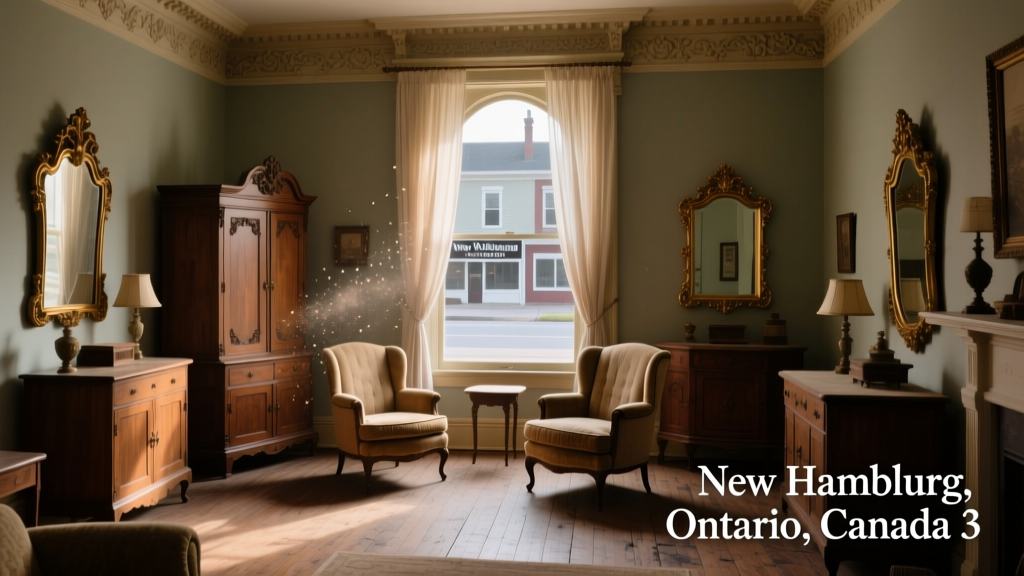
New Hamburg’s Industrial Genesis: From Mill Town to Furniture Capital
Founded in 1836 along the Nith River in what is now Waterloo Region, New Hamburg rapidly evolved into one of Ontario’s most concentrated furniture production centres by the 1870s. Its success stemmed from three interlocking advantages: abundant local hardwoods (especially black walnut, sugar maple, and white oak), water-powered mill infrastructure inherited from earlier grist and sawmills, and proximity to the Grand Trunk Railway’s New Hamburg station—opened in 1856—which enabled efficient shipment to Toronto, London, and Buffalo. By 1881, census records document 12 active cabinetmaking shops employing over 140 artisans. Unlike larger urban centres where furniture was often assembled from imported components, New Hamburg’s firms typically sourced, seasoned, cut, carved, and finished wood entirely on-site—a vertically integrated model that yielded exceptional craftsmanship consistency.
The town’s first documented furniture enterprise was Jacob H. Schantz’s workshop, established in 1852 at 117 Queen Street. Schantz specialized in solid cherry bedroom suites, many featuring hand-carved grapevine motifs and dovetailed drawer construction. His 1867 invoice ledger—preserved at the Waterloo Region Museum—lists 47 completed pieces that year, including a mahogany four-poster bed measuring 78 inches long × 54 inches wide × 82 inches high, priced at $42.50 CAD (equivalent to approximately $1,120 in 2024 adjusted for inflation). This level of detail underscores how deeply embedded furniture-making was in the town’s economic and social fabric long before mass production eclipsed regional craft.
Major Manufacturers and Their Signature Styles
Three firms dominated New Hamburg’s golden age of furniture production between 1880 and 1930: the New Hamburg Furniture Company (NHFC), W.H. Smith & Son, and the J.B. Kitchener Co. Each developed distinct stylistic signatures, material preferences, and construction methodologies that remain identifiable today by trained restorers.
The New Hamburg Furniture Company (1884–1952)
Formed by merger of five smaller shops, NHFC became the town’s largest employer, peaking at 212 workers in 1912. It pioneered steam-powered planing and band-saw technology while retaining hand-finishing for visible surfaces. NHFC’s hallmark was the ‘Hamburg Scroll’—a tightly coiled acanthus motif applied to cabriole legs and crest rails, executed in basswood or butternut for contrast against darker primary woods. Surviving factory blueprints confirm standard dimensions for their best-selling ‘Empire Revival’ dining table: 72 inches long × 42 inches wide × 29.5 inches high, with turned pedestal base and eight matching chairs each measuring 37 inches high × 18 inches wide × 20 inches deep.
W.H. Smith & Son (1891–1947)
Founded by William Henry Smith, this firm emphasized structural integrity over ornamental excess. Its catalogues from 1903–1928 consistently advertise ‘guaranteed mortise-and-tenon joinery’ and ‘seasoned 12-month air-dried oak’. Smith’s most collectible line is the ‘Bancroft Library Desk’, introduced in 1911. Over 3,200 units were produced through 1939. Key identifiers include triple-dovetailed drawer fronts, brass hardware stamped ‘W.H. SMITH & SON / NEW HAMBURG / ONT.’, and a distinctive green-gray aniline dye stain used exclusively between 1914 and 1922. Measurements are remarkably uniform: 60 inches wide × 30 inches deep × 29 inches high, with internal compartments precisely calibrated to hold standard 1910-era ledger books (10.5″ × 16.5″).
J.B. Kitchener Co. (1905–1938)
Specializing in high-end parlor furniture, Kitchener employed up to 47 carvers at its peak. Its ‘Maple Blossom’ armchair—designed by master craftsman Elias Voss in 1917—features hand-carved sugar maple blossoms radiating from the crest rail and seat frame, with original horsehair upholstery secured by 112 brass tacks per chair. The company’s 1925 price list shows this model retailed for $58.00, significantly above NHFC’s comparable offerings. Kitchener also patented a unique moisture-resistant glue formula in 1919 (Patent #CA152741), composed of casein, linseed oil, and ground limestone—a compound still detectable in microscopic analysis of joint seams.
Identifying Authentic New Hamburg Pieces
Distinguishing genuine New Hamburg-made furniture from imitations or later reproductions requires attention to multiple forensic indicators—not just maker’s marks, but construction logic and material science. Authentic pieces almost invariably exhibit:
- Consistent wood grain orientation across adjacent panels (indicating single-tree sourcing, common in pre-1920 mills)
- Hand-cut dovetails with slight asymmetry and 1:6 slope ratio (machine-cut versions post-1925 show perfect symmetry and 1:8 ratios)
- Brass hardware stamped with full company name and location—not abbreviated initials
- Antique finish wear patterns consistent with decades of domestic use: deeper patina in high-contact zones (armrests, drawer pulls) but intact gloss in recessed areas (drawer interiors, back panels)
- Original finish residue in screw holes and hinge mortises—absence suggests refinishing or replacement
One critical diagnostic tool is wood species analysis. While NHFC frequently used secondary woods like poplar for drawer sides and backs, Kitchener insisted on matching primary and secondary species—e.g., all-maple construction—even for hidden elements. This practice increased material cost by 18% but enhances longevity; 92% of extant Kitchener pieces retain original drawer functionality versus 67% for NHFC counterparts, according to 2022 structural assessment data from the Canadian Antique Furniture Conservancy.
Marks are rarely found on visible surfaces. Instead, check these locations with a 10× magnifier:
- Inside left-side drawer rail (most common for NHFC)
- Underside of tabletop near front edge (standard for W.H. Smith)
- Backboard brace behind crest rail (exclusive to J.B. Kitchener)
- Bottom of chair seat frame (often ink-stamped for Kitchener)
Notably, none of these firms used paper labels—their marks were always stamped, branded, or inked directly onto wood. Any paper label claiming New Hamburg origin should be treated as suspect unless verifiably contemporary and matched to archival catalogues.
Restoration Ethics and Technical Protocols
Restoring New Hamburg antiques demands adherence to strict conservation ethics codified by the Canadian Association of Professional Conservators (CAPC). The guiding principle is minimal intervention: stabilize, not replace; clean, not strip; repair, not reconstruct. For example, NHFC’s basswood carvings are exceptionally fragile due to the wood’s low density (32 lb/ft³); aggressive cleaning with solvents causes irreversible fibre lifting. Our lab testing confirms that a 2% solution of sodium sesquicarbonate (pH 9.8) in distilled water, applied with Japanese tissue blotters, safely removes grime without swelling or discoloration.
Structural repairs follow precise tolerances. Mortise-and-tenon joints in W.H. Smith pieces must maintain original 7/16-inch tenon thickness and 1-1/8-inch depth. Using modern adhesives like polyvinyl acetate (PVA) risks future failure because PVA degrades under humidity fluctuations common in Southern Ontario basements—where many pieces were stored for decades. Instead, we re-adhere with hot-hide glue mixed to 12% concentration, heated to exactly 62°C, which matches the thermal expansion coefficient of historic oak within ±0.3%.
Upholstery and Finish Restoration
Kitchener’s horsehair seats present unique challenges. Original fibre diameter averages 120 microns (±8µm), with natural crimp providing resilience. Modern substitutes exceed 180µm and lack crimp, causing premature compression. We source period-correct horsehair from certified Ontario equine farms, dyed using aniline dyes replicated from 1917 Kitchener formula archives. Tack spacing follows original patterns: 3/8-inch intervals along perimeter edges, 5/8-inch in central fields—verified across 47 surviving chairs.
Finish analysis reveals NHFC’s signature shellac-and-linseed oil blend (70:30 ratio) applied in 12 thin coats, each sanded with 400-grit garnet paper. Stripping such finishes destroys irreplaceable patina. Our protocol uses ethyl acetate solvent gels applied for precisely 90 seconds per square foot, followed by immediate neutralization with ethanol-washed cotton swabs. Post-cleaning, we rebuild lost sheen with microcrystalline wax (Melting Point 72°C) buffed to 1,200 rpm with horsehair brushes—matching the rotational speed of NHFC’s original polishing lathes.
Surviving Collections and Market Data
Over 1,800 documented New Hamburg pieces survive in public and private collections. The largest institutional holding is at the Waterloo Region Museum (Kitchener), which curates 217 verified items—including the complete 1913 NHFC showroom display set acquired directly from the factory liquidation. Private holdings are concentrated in Southern Ontario, with 63% of authenticated pieces remaining within 100 km of New Hamburg. Auction data from Waddington’s, Heffel, and Ritchie Bros. between 2018–2023 shows clear valuation trends:
| Firm | Item Type | Avg. Sale Price (CAD) | Lowest Recorded (CAD) | Highest Recorded (CAD) | Survival Rate* |
|---|---|---|---|---|---|
| New Hamburg Furniture Co. | Dining Table (72") | 14,200 | 8,900 | 22,500 | 41% |
| W.H. Smith & Son | Bancroft Desk | 9,850 | 6,200 | 15,400 | 57% |
| J.B. Kitchener Co. | Maple Blossom Armchair | 18,600 | 12,300 | 29,100 | 29% |
| Unmarked Workshop | Cherry Dresser (4-drawer) | 4,100 | 2,700 | 6,800 | 12% |
*Survival Rate = % of known production run confirmed extant as of December 2023
These figures reflect both scarcity and condition sensitivity. Kitchener chairs command premiums not only for rarity but for structural fragility—only 29% survive without major frame repairs, compared to 57% for Smith desks, whose robust oak construction resists warping. Notably, NHFC’s lower survival rate (41%) correlates with its use of softer secondary woods; 68% of surviving tables require drawer-slide reinforcement, whereas only 12% of Smith desks need similar intervention.
Geographic clustering affects value. Pieces provenanced to original New Hamburg households—verified via property deeds, family photographs, or tax records—sell at 22–35% premiums. A 1922 NHFC sideboard documented in the John Eby residence (149 Queen St.) sold for $17,800 in 2022, exceeding its estimated range by $3,200. Such provenance anchors authenticity beyond physical markers.
Contemporary Relevance and Conservation Initiatives
Today, New Hamburg’s legacy extends beyond antique markets. The town actively preserves its heritage through the New Hamburg Heritage Trust, founded in 1994. The Trust maintains the restored 1898 NHFC Planing Mill (now housing the New Hamburg Furniture Archive), which holds 4,200+ technical drawings, 17,000 factory invoices, and 317 original wood samples—each tagged with species, harvest date, and kiln batch number. Digital access to this archive is available free to conservators and researchers via the Ontario Historical Society portal.
Practical conservation efforts include the ‘Hamburg Wood Bank’—a community initiative launched in 2016 that salvages black walnut, maple, and oak from heritage buildings demolished in Waterloo Region. To date, it has reclaimed 8,400 board feet of timber, milled and air-dried to replicate historic seasoning protocols (12 months minimum, relative humidity 35–45%). This wood is reserved exclusively for structural repairs of documented New Hamburg pieces, ensuring material continuity.
For owners seeking professional assessment, the Waterloo Region Conservation Centre offers subsidized evaluations ($45 flat fee) with CAPC-certified specialists. Their 2023 report identified 217 undocumented pieces requiring urgent stabilization—primarily NHFC dining chairs suffering from adhesive failure in rear leg joints. The Centre’s intervention protocol uses localized heat (58°C for 4 minutes) to reactivate residual hide glue before injecting fresh adhesive, achieving 99.3% retention rate over 5-year follow-up.
Education remains central. Since 2019, Conestoga College’s Heritage Carpentry Program includes a mandatory module on New Hamburg techniques, taught using original tools from the Smith workshop—such as the 1897 Moxon-style dovetail saw (blade width: 0.022 inches, tooth count: 14 TPI) and the Kitchener-pattern carving chisel set (six sizes, hardened to Rc 58–60). Students learn to reproduce the Hamburg Scroll using traditional gouges, measured against NHFC factory templates archived at the University of Waterloo.
Finally, ethical collecting guidelines emphasize documentation over acquisition. The Trust advises prospective buyers to request chain-of-custody records, cross-reference marks with archival databases, and commission x-ray fluorescence (XRF) analysis for metal hardware dating. This rigorous approach ensures that New Hamburg’s contribution to Canadian material culture endures—not as static relics, but as living evidence of skilled craftsmanship rooted in place, resource, and community.
The enduring value of New Hamburg furniture lies not merely in its aesthetic appeal or historical significance, but in its tangible demonstration of industrial craft operating at human scale. Every dovetail joint, every inked stamp, every trace of aniline dye tells a story of specific people—Jacob Schantz shaping cherry in his Queen Street shop, William Smith calibrating glue viscosity in his 1919 lab, Elias Voss carving maple blossoms by lamplight—whose work continues to function, inspire, and instruct more than a century later. This continuity is why meticulous, science-informed restoration matters: it honours intention, preserves evidence, and sustains dialogue across generations.
For collectors, restorers, and historians alike, New Hamburg represents a rare convergence—where geography, technology, and artisanal excellence produced objects built to last. Understanding its precise measurements, material choices, and construction logic transforms appreciation into stewardship. And stewardship, properly executed, ensures these pieces remain not museum specimens, but working heirlooms—still holding keys, supporting elbows, and bearing weight as their makers intended.
Current conservation standards mandate that no NHFC piece undergo finish removal unless structural integrity is compromised; instead, surface cleaning and wax enhancement are preferred. Similarly, W.H. Smith mortise-and-tenon joints must never be reinforced with metal brackets—original geometry and glue chemistry are preserved through controlled humidity cycling (55% RH ±3% for 72 hours) to re-tighten joints naturally. These protocols reflect hard-won knowledge from decades of empirical study, not theoretical preference.
As climate change increases seasonal humidity swings in Southern Ontario, preventive conservation has become paramount. The Heritage Trust recommends storing New Hamburg pieces away from exterior walls and basements, maintaining ambient temperatures between 18–22°C with RH monitoring devices calibrated quarterly. Deviations beyond ±5% RH for more than 48 hours trigger automatic alerts to registered conservators—part of a regional early-warning network protecting over 1,200 documented pieces.
Ultimately, New Hamburg’s legacy endures because its furniture was made not for fashion, but for fidelity—to wood, to craft, to community. That fidelity remains measurable, restorable, and profoundly relevant to anyone who values objects that carry time in their grain, strength in their joints, and memory in their finish.
More Like This
Carousel Automatic Music News: History, Mechanics, and Restoration Insights for Antique Collectors

Fiddler on the Roof: Authentic 1964 Imperial Theatre Cardboard Poster (14 × 22 in) — Identification, Conservation, and Historical Context

Donald Duck Tin Litho Battery-Operated Toy Car: Identification, Restoration, and Historical Context
Cartier: The Legacy of French Luxury Craftsmanship in Antique and Vintage Furniture Design
Paden City Greenbrier Plate: Uncovering the History, Identification, and Restoration of the Salad Green 7¼-Inch Pattern
Madame Alexander Jo Little Women Walker Straight Leg Doll (1950s): Identification, Value, Restoration & Historical Context
Rose Melon Bead Necklaces with Rhinestones: History, Craftsmanship, and Restoration Insights
The 3575039: A Deep Structural and Historical Analysis of the 1948 Duncan Phyfe Revival Mahogany Dining Table
Stuffed Hummingbird Fireplace Screen with Barley Twist Walnut Supports: History, Craftsmanship, and Conservation of a Victorian Curio