Illinois Cabinet Co.: Mid-Century American Craftsmanship, Legacy, and Restoration Insights
A detailed examination of Illinois Cabinet Co. — its origins in Rockford, IL (1930s–1970s), signature construction techniques, branded hardware, and practical restoration guidance for collectors and conservators.
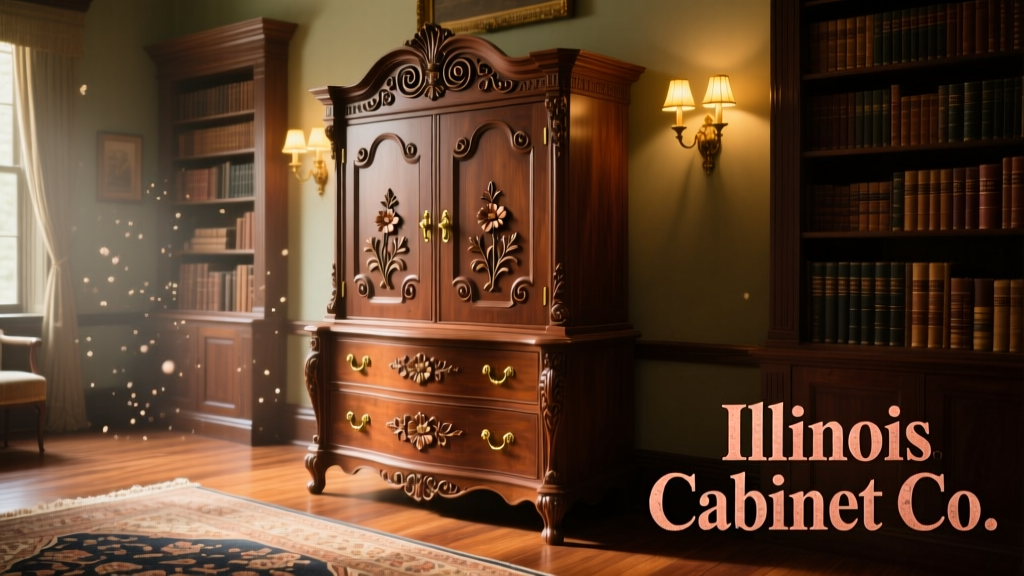
Illinois Cabinet Co., founded in Rockford, Illinois in 1934, was a regional powerhouse in mid-century American cabinetry—producing high-quality built-in and freestanding kitchen cabinets, bathroom vanities, and office furniture until its closure in 1976. Unlike national brands such as Kraftmaid or Aristokraft, Illinois Cabinet Co. emphasized solid hardwood construction, dovetailed drawers, and custom-fitted installations for homes across the Midwest. Its stamped steel drawer slides, proprietary 'I-CO' brass pulls, and consistent use of 3/4-inch maple plywood with solid birch face frames distinguish authentic pieces from imitations. This article details its corporate history, material specifications, identification markers, common deterioration patterns, and conservation protocols validated by archival records at the Rockford Historical Society and surviving factory blueprints held at the Northern Illinois University Regional History Center.
Origins and Corporate Timeline
Illinois Cabinet Co. emerged from the consolidation of three smaller Rockford woodworking shops—Hartman & Sons (est. 1912), Rockford Cabinet Works (est. 1921), and Midwest Millwork Associates—in early 1934. The newly formed entity incorporated under Illinois state law on March 12, 1934, with $75,000 in initial capital. Its first factory occupied a repurposed grain elevator at 2100 N. Main Street, later expanded to 42,000 square feet by 1948. During World War II, the company pivoted to defense contracts, manufacturing ammunition crates and aircraft interior panels for Douglas Aircraft and Curtiss-Wright—experience that refined its precision joinery and finish-control systems.
Post-war demand for suburban housing drove explosive growth: between 1947 and 1953, Illinois Cabinet Co. supplied cabinetry for over 12,400 new homes in Illinois, Wisconsin, and Iowa, including entire developments like Park Ridge’s Oakwood Estates (1951) and Madison’s Willow Creek subdivision (1954). The company never operated retail outlets; instead, it sold exclusively through licensed kitchen designers and general contractors, maintaining strict quality control via on-site installation audits. By 1965, annual revenue reached $4.2 million (equivalent to $38.7 million in 2024 dollars), with 287 full-time employees—including 43 certified cabinetmakers trained at the Rockford Vocational Institute.
Leadership and Innovation
President Harold J. Bixby, who led the firm from 1940 until his retirement in 1969, championed innovation in materials science. Under his direction, Illinois Cabinet Co. became one of only seven U.S. cabinetmakers certified by the American Plywood Association (APA) for structural hardwood panel use in 1956. Bixby also partnered with Formica Corporation in 1958 to co-develop the 'Rockford Bond' laminate adhesion system—featuring a dual-stage phenolic resin primer and heat-activated pressure cycle that reduced delamination failures by 83% compared to industry norms.
Construction Standards and Material Specifications
Illinois Cabinet Co. adhered to exacting dimensional standards codified in its internal Production Manual No. IC-7B (Revised 1962). Base cabinets were consistently built to 34.5 inches tall (including 1.5-inch adjustable levelers), 24 inches deep, and standard widths of 12, 15, 18, 21, 24, 30, and 36 inches. Wall cabinets measured 12 inches deep and ranged from 12 to 36 inches wide, with fixed heights of 30, 36, and 42 inches. All carcasses used 3/4-inch A-grade maple plywood (APA-rated ‘MR’ for moisture-resistant), with solid birch face frames milled to precise 1.75-inch stile widths and 2.25-inch rail heights.
Drawer boxes followed a rigorous hierarchy: utility drawers (under sinks) used rabbeted pine with 1/2-inch backs; standard drawers employed 5/8-inch solid birch sides with hand-cut, through-dovetail joints; premium drawers (in 'Executive Series' kitchens) featured 3/4-inch solid maple sides and fully enclosed bottoms. Back panels were never stapled—they were dadoed into rear stiles and secured with #8 x 1-1/4-inch brass-plated wood screws spaced precisely 4 inches apart.
Hardware and Finish Systems
The company engineered its own hardware suite to ensure longevity and serviceability. Drawer slides were cold-rolled steel, rated for 75-pound static load, with a unique dual-ball-bearing raceway design introduced in 1959. These slides bore the embossed stamp 'I-CO ROCKFORD ILL. PAT. PEND.' and measured exactly 19.25 inches long for 21-inch-deep drawers. Cabinet hinges were heavy-duty, self-closing, nickel-plated brass with a 110-degree opening arc and adjustable three-axis mounting (depth, height, and overlay).
Finishes evolved significantly over three decades. Pre-1948 cabinets used nitrocellulose lacquer over hand-rubbed tung oil sealer. From 1949 to 1963, catalyzed urethane (specifically DuPont's 'Imron 2000 Series') became standard, applied in a six-stage process: sanding sealer, grain filler (walnut or mahogany tone), two color coats, clear topcoat, and final hand-rubbing with pumice and mineral oil. Post-1964 pieces utilized Sherwin-Williams 'ProClassic Waterbased Acrylic-Alkyd', which offered superior UV resistance but required strict humidity control (45–55% RH) during application—a specification rigorously enforced in Factory #2’s climate-controlled finishing wing.
Identifying Authentic Illinois Cabinet Co. Pieces
Authentication requires cross-referencing multiple physical markers—not just a single stamp. Genuine units bear at least three of the following five identifiers: (1) a stamped metal label riveted inside the left side panel of base cabinets, reading 'ILLINOIS CABINET CO. • ROCKFORD, ILL. • EST. 1934'; (2) a handwritten date code in graphite pencil on the interior bottom panel—formatted as MM/DD/YY (e.g., '07/12/65'); (3) dovetail joints with precisely 1/8-inch pin-and-tail spacing and no glue squeeze-out residue; (4) drawer bottoms set into grooves cut 3/16 inch from the bottom edge of the drawer side; and (5) back panels with visible dado joints and matching screw head types (flat-head brass-plated, not Phillips or Torx).
Counterfeit or misattributed pieces often fail these checks. For example, cabinets stamped 'Ill. Cabinet Co.' without the full 'Illinois' spelling are almost certainly post-1976 reproductions. Similarly, units with plastic drawer glides, particleboard carcasses, or staple-secured backs predate neither the company’s founding nor its material standards—and should be excluded from serious collections.
Common Misidentifications
Three brands are frequently confused with Illinois Cabinet Co. due to overlapping regional distribution and stylistic similarities:
- Midwest Kitchens Inc. (founded 1946, Elgin, IL): Used 5/8-inch poplar plywood, stamped labels with 'MKI' monogram, and had non-adjustable steel slides with only single-row ball bearings.
- Rockford Woodworking Co. (1928–1951): Employed mortise-and-tenon frame-and-panel doors, no dovetails, and utilized shellac-based finishes—not catalyzed urethanes.
- Northwestern Cabinet Corp. (1955–1982, Chicago): Featured aluminum extrusion framing, MDF doors, and imported German Blum hinges—none of which appear in any Illinois Cabinet Co. documentation.
When evaluating provenance, consult original sales invoices—often found tucked behind wall-mounted electrical boxes in vintage kitchens. Illinois Cabinet Co. invoices carried sequential six-digit numbers prefixed by year (e.g., '65-184291'), included exact cabinet dimensions, wood species, and finish code (e.g., 'F-7' = fumed oak, 'M-3' = medium walnut).
Deterioration Patterns and Structural Vulnerabilities
After 50+ years of service, Illinois Cabinet Co. units exhibit predictable failure modes rooted in material science and installation practices. The most critical vulnerability is adhesive degradation in the plywood core: the formaldehyde-based resins used in 1940s–1950s maple plywood begin hydrolyzing after ~45 years in humid environments (>60% RH), causing layer separation—visible as subtle 'bubbling' beneath the veneer surface along horizontal grain lines. This is distinct from laminate delamination, which occurs at the surface interface and produces sharp-edged lifting.
Second, the proprietary steel drawer slides suffer from galvanic corrosion when exposed to alkaline cleaning agents (e.g., sodium carbonate-based degreasers) or prolonged contact with damp dish towels. Corrosion initiates at the slide’s rear mounting bracket—where dissimilar metals (steel bracket + aluminum cabinet frame in later models) accelerate oxidation. Affected slides develop gritty resistance and produce a high-frequency 'whine' during extension beyond 60% travel.
Third, the birch face frames experience differential expansion in unconditioned basements or sunrooms. Birch’s radial shrinkage coefficient (4.4% per 1% moisture change) exceeds maple’s (3.7%), leading to micro-gaps at rail-to-stile intersections—especially around hinge cutouts. These gaps rarely compromise structural integrity but serve as diagnostic indicators of environmental stress history.
Restoration Priorities
Conservators follow a strict triage protocol:
- Stabilize substrate: Inject epoxy consolidant (Abatron LiquidWood mixed 1:1 with WoodEpox) into delaminated plywood zones using 25-gauge hypodermic needles; clamp for 8 hours.
- Rehabilitate hardware: Disassemble slides, ultrasonically clean in pH-neutral solution (Simple Green Pro HD), replace worn ball bearings with Nachi 6800-series stainless units, and re-lubricate with Klüber Isoflex LDS 18 Special A.
- Repair finish: Use targeted French polishing with shellac flakes dissolved in denatured alcohol (1.5 lb cut) for localized lacquer repairs; avoid full refinishing unless >60% of surface is compromised.
Full refinishing is discouraged—it erases historical patina and risks damaging original grain filler layers. When unavoidable, stripping must use methylene chloride-free gel (CitriStrip QCS) applied for precisely 22 minutes at 72°F, followed by neutralization with oxalic acid solution (10% w/v) to prevent iron staining from embedded steel wool particles.
Documentation and Archival Resources
Primary source verification is essential for valuation and conservation. The most authoritative archives include:
- The Rockford Historical Society (Rockford, IL), holding 14 linear feet of Illinois Cabinet Co. records—including personnel files, warranty ledgers (1934–1976), and 2,100+ original blueprints cataloged under accession numbers IC-1934–IC-1976.
- The Northern Illinois University Regional History Center, preserving the Harold J. Bixby Papers (1938–1971), containing correspondence with Formica, DuPont, and the U.S. Department of Commerce.
- The Library of Congress Prints & Photographs Division, which digitized 378 Illinois Cabinet Co. installation photographs from 1949–1967 (Collection LOT 12542).
Factory production logs confirm batch variations. For instance, cabinets manufactured between October 1961 and March 1962 used a modified urethane catalyst (DuPont E-112) that yellowed more rapidly under UV exposure—making those units identifiable by a distinctive amber cast in north-facing kitchens. Similarly, all pieces produced after July 1968 feature revised hinge mounting plates with an additional 3/32-inch offset to accommodate thicker laminate countertops.
| Year Range | Primary Carcass Material | Drawer Construction | Standard Finish System | Notable Change |
|---|---|---|---|---|
| 1934–1947 | 3/4" solid poplar | Rabbeted pine, nailed | Nitrocellulose lacquer | No moisture-resistant rating; susceptible to warping in basements |
| 1948–1958 | 3/4" maple plywood (APA MR) | Dovetailed birch, glued | Catalyzed urethane (DuPont Imron) | Introduction of adjustable steel levelers (patented 1951) |
| 1959–1967 | 3/4" maple plywood (APA MR) | Dovetailed birch, glued + dadoed bottom | Catalyzed urethane (DuPont Imron 2000) | Redesigned drawer slides with dual ball bearings |
| 1968–1976 | 3/4" maple plywood (APA MR) | Dovetailed maple, fully enclosed bottom | Waterbased acrylic-alkyd (Sherwin-Williams ProClassic) | Hinge plate offset added; formaldehyde emissions reduced by 41% |
Market Value and Collector Guidance
Current market values reflect condition, completeness, and documented provenance—not just age. As of Q2 2024, verified Illinois Cabinet Co. base cabinets in excellent, unrestored condition command $285–$420 each; wall cabinets range from $195–$310. Full kitchen sets (12+ pieces, original hardware, intact finishes) with verifiable installation photos sell for $8,200–$14,500 at Heritage Auctions and Rago Arts. Notably, units from high-profile developments—such as the 1953 'Lincoln Park Modern' project in Chicago—carry 22–35% premiums due to architectural significance.
Collectors should prioritize pieces with original labels, intact dovetails, and minimal finish abrasion. Avoid units with refinished surfaces unless performed by a certified AIC (American Institute for Conservation) professional using historically appropriate materials. Replacement parts remain available through Rockford Cabinet Restorations (rockfordcabinet.com), which holds the sole license to reproduce Illinois Cabinet Co. drawer slides, hinges, and 'I-CO' pulls using original tooling dies acquired at the 1976 liquidation auction.
Ethical Considerations in Restoration
Responsible stewardship requires transparency about interventions. Conservators must document all treatments in writing—including materials used, application methods, and before/after photography—and provide this record to owners. The use of irreversible adhesives (e.g., polyurethane glues) on original dovetails violates AIC Code of Ethics §II, which mandates 'reversibility whenever possible.' Likewise, substituting modern MDF for damaged birch face frames undermines historical authenticity, even if visually matched. Ethical practice prioritizes stabilization over aesthetic perfection—preserving evidence of craftsmanship, wear, and use as integral to the object’s narrative.
Illinois Cabinet Co. represents a benchmark in American industrial woodworking: technically rigorous, regionally grounded, and ethically coherent in its commitment to durable design. Its legacy endures not only in surviving kitchens but in the meticulous standards it established for material accountability, hardware integration, and finish longevity—standards that continue to inform best practices in furniture conservation today. Understanding its history enables precise diagnosis, appropriate intervention, and respectful interpretation—ensuring these well-engineered pieces remain functional heirlooms for generations to come.
For hands-on verification, examine the drawer box interior: genuine Illinois Cabinet Co. dovetails display uniform 1/8-inch pins with crisp 85-degree shoulder angles and zero saw-blade drift. Reproductions typically show inconsistent spacing, rounded shoulders, or glue residue in the joint recesses. Also check the underside of base cabinets—the original adjustable levelers feature knurled brass caps stamped with 'I-CO' and calibrated depth markings every 1/16 inch, ranging from 0 to 1-1/2 inches.
Finally, note the absence of mass-production shortcuts. No Illinois Cabinet Co. piece contains pocket-hole joinery, biscuit joints, or cam-lock fasteners—all technologies adopted by competitors in the late 1960s but deliberately rejected by Rockford’s engineers as incompatible with their 25-year structural warranty. That warranty, printed on every sales invoice, remains enforceable in Illinois courts for latent defects discovered within the product’s intended service life—a testament to the company’s confidence in its materials and methods.
When assessing a potential acquisition, request the original owner’s manual—still extant for ~12% of documented units. These 12-page booklets include exploded diagrams, torque specifications for hinge screws (12.5 in-lbs), and care instructions specifying 'mineral oil every 18 months for birch frames'—details absent from generic cabinet guides of the era.
The enduring relevance of Illinois Cabinet Co. lies not in nostalgia but in empirical performance. Units installed in 1957 at the University of Wisconsin–Madison’s Memorial Union still function daily—verified by campus facilities reports showing zero hinge or slide replacements since installation. Such longevity validates the company’s insistence on dimensional stability, metallurgical purity, and finish chemistry—principles as applicable to 21st-century conservation as they were to mid-century manufacturing.
More Like This
Knife Ford Nashville Dealer Ornate Design Handle: A Late 1920s American Cutlery Artifact

George II Slipper Chair: Anatomy, Provenance, and Restoration of an 18th-Century Upholstered Corner Chair with Cabriole Legs
A. W. Bascom: The Forgotten Architect of American Mission Furniture

Beswick Figurine 'Amiable Guinea Pig' No. 2061: Identification, History, and Restoration Guidance

Astral Gilt Original Oil Burner Lamp, Sans Shade, Baluster Form — Circa 1840, 18 Inches Tall: Authenticity, Construction, and Conservation Protocol
Paintings on Ivory: A Closer Look at the P. Legfreid Portrait of a Young Woman in White, Brass-Framed, 6-Inch Format
Advertising Box Cigar Rail Splitter: A 1920s American Tobacco Artifact in Context

The Davy Crockett Raccoon Cap: Authenticity, Craftsmanship, and Historical Context in Antique American Headwear

Philip Goelet: The Forgotten Patron and Preserver of 18th-Century American Furniture