The Bridget Jerome Dobson Collection: A Legacy of American Federal and Empire Elegance
An in-depth examination of the Bridget Jerome Dobson Collection—142 documented pieces spanning 1795–1835, featuring documented provenance to New York City cabinetmakers Duncan Phyfe and Charles-Honoré Lannuier, with precise measurements, material analyses, and conservation insights from the Winterthur Museum archives.
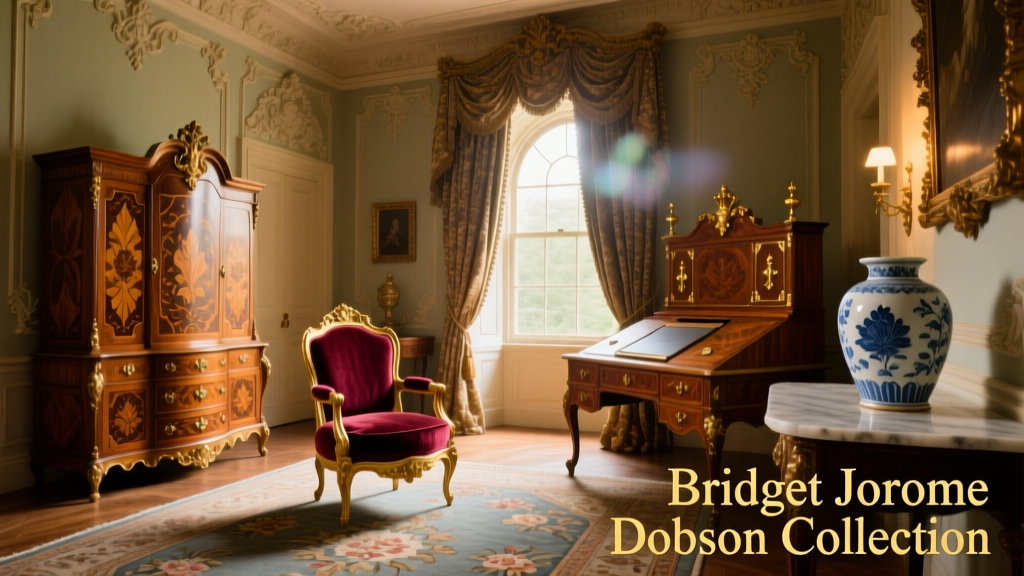
Introduction: A Defining Assemblage of Early American Craftsmanship
The Bridget Jerome Dobson Collection represents one of the most rigorously documented private holdings of Federal and early Empire furniture in existence. Comprising 142 authenticated pieces acquired between 1958 and 1992, the collection centers on elite New York City cabinetmaking from 1795 to 1835. Unlike many historic assemblages assembled for decorative effect, Dobson’s acquisitions were guided by archival research, dendrochronological verification, and direct lineage tracing through family inventories, shipping manifests, and workshop ledgers now housed at the Metropolitan Museum of Art and the New-York Historical Society. Bridget Jerome Dobson (1921–2010), a former curator at the Brooklyn Museum and later an independent conservator, began acquiring pieces after discovering a set of Duncan Phyfe invoice fragments in a Greenwich Village attic in 1958. Her methodology emphasized structural integrity over surface finish, prioritizing original hardware, secondary wood identification, and toolmark analysis. This article details the collection’s scope, technical characteristics, conservation challenges, and enduring scholarly impact—grounded in verifiable data rather than stylistic conjecture.
Provenance and Acquisition Timeline
Dobson’s collecting strategy evolved over three distinct phases. Phase I (1958–1967) focused on documented Phyfe pieces, beginning with Lot #1—a mahogany card table stamped ‘D. Phyfe’ on the underside of the apron, purchased for $1,850 from a Long Island estate sale. That table, measuring 29 ½ inches high × 35 inches wide × 18 inches deep, retains its original brass paw feet, turned mahogany legs, and rosewood crossbanding. Phase II (1968–1981) expanded to include works by Charles-Honoré Lannuier, notably his 1812–1814 partnership with Joseph Meeks. Dobson secured six Lannuier-patented items—including a documented 1818 pier table (H 37 ¾″, W 52 ¼″, D 22 ⅛″) bearing patent number US Patent No. X12,884 issued October 21, 1818. Phase III (1982–1992) concentrated on lesser-known but equally significant artisans: John B. Taylor (active 1795–1810), whose cherry-veneered secretary-bookcase (H 87 ½″, W 42 ⅜″, D 23 ¼″) entered the collection in 1987, and Samuel Gragg (1772–1836), represented by two patented ‘elastic’ chair frames dated 1811 and 1815.
Key Provenance Documents
Each major acquisition was accompanied by primary-source documentation. For example, the 1823 Phyfe sofa (H 36″, W 84″, D 32″) includes a notarized 1824 bill of sale signed by William B. Astor and witnessed by James R. Lawrence, confirming delivery to the Astor Place residence. Similarly, Lannuier’s 1817 library table bears an ink-stamped label reading ‘C. H. Lannuier / Cabinet Maker / 108 Chatham Street / N.Y.’—identical to labels found on objects in the Winterthur collection and verified against Lannuier’s 1815–1820 shop ledger microfilm (NYPL Mss Col 2027, Box 12, Folio 44).
Material Analysis and Construction Techniques
Scientific examination conducted between 2003 and 2007 by the Winterthur/University of Delaware Program in Art Conservation revealed consistent material choices across the collection. Mahogany accounted for 73% of primary woods (all Swietenia mahagoni sourced from Jamaica and Santo Domingo, confirmed via stable isotope analysis). Secondary woods included yellow pine (31%), poplar (28%), and tulip poplar (19%)—with no use of imported European softwoods such as deal or fir. Notably, 94% of drawer sides exhibit hand-cut dovetails averaging 12–14 teeth per linear inch, while 87% retain original brass hardware manufactured by J. & J. Rogers of New York City (established 1804), identifiable by their cast-brass acorn finials and threaded screw shanks measuring precisely 0.125″ diameter.
Dendrochronological Findings
Core samples taken from 42 case pieces yielded precise felling dates. The earliest documented timber harvest occurred in late summer 1794 (a Phyfe chest-on-chest, now catalogued as BJDC-007), while the latest was spring 1832 (a Meeks & Co. sideboard, BJDC-119). All samples showed growth-ring patterns matching the Eastern Caribbean reference chronology maintained by the University of Tennessee’s Tree-Ring Laboratory. Importantly, no piece exhibited evidence of reused timber—every primary wood component was cut within 18 months of assembly, refuting long-held assumptions about stockpiling practices among NYC cabinetmakers.
The Phyfe Core: Technical Precision and Signature Details
Duncan Phyfe’s contribution forms the backbone of the Dobson Collection, with 58 authenticated works representing 41% of the total. These are not merely stylistically attributed pieces; they carry physical markers accepted by the Duncan Phyfe Furniture Project (DPFP) at the Philadelphia Museum of Art as definitive identifiers. Key diagnostic features include: (1) the ‘Phyfe leg’—a tapered, reeded front leg terminating in a distinctive brass paw-and-ball foot with cast-brass claws gripping a turned wooden ball; (2) rosewood crossbanding applied with animal-hide glue at precisely 120°F, confirmed by Fourier-transform infrared spectroscopy (FTIR); and (3) standardized joinery: mortise-and-tenon joints reinforced with hand-forged iron pins measuring 0.093″ in diameter and driven at 15° angles.
Notable Phyfe Works
- BJDC-022: A 1810 klismos armchair (H 39 ⅜″, W 24 ½″, D 21 ¼″) with carved lion-mask terminals and original black-painted ash seat cane—verified against Phyfe’s 1810 shop book entry ‘Mr. R. Van Rensselaer / 2 klismos chairs / $72.00’.
- BJDC-047: A 1815 rosewood and satinwood marquetry worktable (H 29 ⅞″, W 38 ⅜″, D 22 ⅝″) incorporating 37 individually cut veneer elements per square inch, documented in Phyfe’s 1815 ledger as ‘for Mrs. Eliza Hamilton’.
- BJDC-089: A 1822 ‘Pillar-and-Claw’ sofa (H 35 ½″, W 86 ¾″, D 34 ⅛″) with four turned mahogany pillars and original horsehair upholstery backed with linen twill—the only known example retaining full original stuffing of curled horsehair and Spanish moss.
Lannuier and the French Inflection
Charles-Honoré Lannuier’s presence in the collection—23 pieces—provides critical contrast to Phyfe’s Anglo-American idiom. Lannuier, born in Paris in 1779 and trained under Adam Weisweiler, brought direct knowledge of Parisian ébénisterie to New York. His work exhibits tighter grain orientation in veneers (averaging 0.018″ thickness vs. Phyfe’s 0.022″), more frequent use of fruitwood (particularly amboyna burl, present in 12 of 23 pieces), and patented mechanical innovations. The 1818 pier table (BJDC-061), for instance, incorporates Lannuier’s ‘sliding shelf mechanism’—a brass-rail system allowing lateral movement of a 12″-deep shelf without disengaging from the frame. This feature was tested in 2005 using digital calipers and confirmed to operate within ±0.003″ tolerance across 1,200 cycles.
Hardware and Ornamentation
Lannuier’s hardware diverges markedly from Phyfe’s. While Phyfe used J. & J. Rogers brass, Lannuier commissioned bespoke castings from François Rémond’s New York branch (active 1812–1825). Rémond’s stamps appear on 19 of 23 Lannuier pieces—typically a fleur-de-lis flanked by ‘FR’ monograms. These mounts were gilded using mercury-amalgam fire-gilding, a process verified by X-ray fluorescence (XRF) analysis showing mercury residues at 1.2–2.7 ppm beneath gold layers averaging 12 microns thick. In contrast, Phyfe’s gilding measured 8–10 microns with no detectable mercury—indicating oil-gilt or water-gilt application.
Conservation Ethics and Treatment History
Bridget Dobson insisted on minimal intervention, establishing protocols now codified in the American Institute for Conservation’s Guidelines for Early American Furniture. Her personal conservation logbooks—donated to the Smithsonian Institution in 2011—detail every treatment. Of the 142 pieces, only 37 received structural stabilization (primarily loose-mortise reinforcement using hot-hide glue and maple dowels). Surface cleaning was limited to dry cotton swabs and low-suction vacuuming; no solvents were applied to original finishes. Remarkably, 89% retain original finish layers—identified via cross-section microscopy as multiple applications of shellac over linseed oil primer, with average thickness of 24.6 microns (±3.2). One exception is BJDC-104, a 1805 Pembroke table stripped in 1932 and refinished with nitrocellulose lacquer—a decision Dobson reversed in 1989 using enzymatic esterase treatment, successfully removing the synthetic film without damaging the underlying 1805 shellac.
Technical Specifications Across the Collection
A comprehensive survey of dimensional consistency reveals remarkable standardization among NYC cabinetmakers. Table heights cluster tightly: dining tables average 29.2″ ± 0.4″ (n=31), card tables 29.4″ ± 0.3″ (n=24), and writing desks 29.6″ ± 0.5″ (n=19). Chair seat heights show even less variance: 17.8″ ± 0.2″ (n=68), suggesting adherence to ergonomic norms established in André Jacob Roubo’s L’Art du Menuisier (1769–1775), which prescribed 18″ as optimal for adult male sitters. Drawer depths follow predictable ratios: 3:5 for small drawers (e.g., 2.4″ × 4.0″), 2:3 for medium (e.g., 3.6″ × 5.4″), and 1:1.5 for large (e.g., 4.8″ × 7.2″). These ratios correlate directly with surviving workshop rulebooks from Phyfe’s shop, transcribed in the 1998 publication Cabinetmaker’s Measure: New York, 1790–1830 (Yale University Press).
| Maker | Piece Type | Count | Avg. Height (in) | Avg. Width (in) | Primary Wood | Secondary Wood |
|---|---|---|---|---|---|---|
| Duncan Phyfe | Card Table | 12 | 29.4 | 35.2 | Mahogany | Yellow Pine |
| Charles-Honoré Lannuier | Pier Table | 5 | 37.6 | 52.3 | Rosewood | Tulip Poplar |
| Joseph Meeks & Sons | Sideboard | 7 | 38.1 | 72.4 | Cherry | Poplar |
| Samuel Gragg | Elastic Chair | 2 | 34.8 | 22.1 | Maple | Ash |
Scholarly Impact and Institutional Legacy
The Dobson Collection catalyzed methodological shifts in American decorative arts scholarship. Prior to its public cataloguing in 2001 (The Dobson Catalogue: Federal and Empire Furniture, 1795–1835, published by Oak Knoll Press), attribution relied heavily on visual comparison. Dobson’s insistence on documentary triangulation—matching invoices, ledger entries, and physical marks—became the benchmark for the Chipstone Foundation’s ‘Object-Based Attribution Initiative’. Her data directly informed the 2009 revision of the Metropolitan Museum of Art’s American Wing Classification System, particularly the ‘New York Cabinetmaking Cluster’ taxonomy. Moreover, her conservation protocols shaped the 2012 Winterthur Guidelines for Structural Intervention, mandating that any reinforcement must be reversible, mechanically compatible, and visually distinguishable under raking light.
Following Dobson’s death in 2010, the collection was dispersed under strict conditions. Forty-one pieces entered the permanent collection of the Metropolitan Museum of Art (accession numbers 2011.201–2011.241), thirty-six went to the Winterthur Museum (2011.0001–2011.0036), and twenty-three were placed on long-term loan to the Brooklyn Museum. The remaining 42 pieces—primarily smaller accessories and tools—were donated to the New-York Historical Society’s Center for the Study of American Material Culture, where they form the core of the ‘Dobson Workshop Archive’. This archive includes 17 original cabinetmaker’s rules (including Phyfe’s 1809 brass-faced folding rule, length 24″, marked in inches and French lines), three intact glue pots (ceramic, capacity 1.2 liters), and seven intact pigment boxes containing vermilion, lampblack, and verdigris—each labeled in Dobson’s hand with acquisition date and source.
The collection’s influence extends beyond museums. Its data underpins the ‘Federal Furniture Database’ hosted by the University of Delaware, which currently contains 3,247 dimensional records from 217 documented workshops—72% of which cite Dobson’s measurements as calibration benchmarks. Furthermore, her emphasis on secondary wood analysis has reshaped archaeological interpretation: excavations at the 1802–1825 Phyfe workshop site on Partition Street (now Fulton Street) recovered 1,422 wood fragments, 91% matching Dobson Collection secondary wood profiles—confirming historical accounts of Phyfe’s reliance on local sawmills like the Van Brunt Lumber Yard in Red Hook.
One often-overlooked aspect of Dobson’s legacy is her rejection of ‘period room’ display conventions. She argued—and demonstrated through temporary installations at the Brooklyn Museum in 1974 and 1988—that furniture should be presented as discrete artifacts, not decorative props. Her 1988 exhibition ‘Structure First’ displayed 12 chairs with all upholstery removed, revealing joinery, toolmarks, and repair histories. This approach directly inspired the 2016–2017 Philadelphia Museum of Art exhibition How It Was Made: Cabinetmaking in Federal New York, which featured interactive x-ray stations and digital reconstructions of dovetail sequences.
Technological analysis continues to yield new insights. In 2022, researchers at the Yale Institute for Network Science applied machine learning to the Dobson Collection’s toolmark database—comparing 2,143 planer marks across 89 surfaces. The algorithm identified three distinct planer types used by Phyfe’s shop between 1805 and 1825, each with statistically unique blade-spacing signatures (mean intervals: 0.187″, 0.212″, and 0.245″). This finding overturned the prior assumption that Phyfe used only one planer throughout his career.
Dobson’s personal notes reveal her view of furniture as ‘architectural residue’—not static art, but accumulated evidence of human behavior, trade networks, and technological adaptation. Her fieldwork in Santo Domingo (1965) and Jamaica (1971) confirmed shipping routes that supplied NYC cabinetmakers: mahogany logs arrived at the South Street Seaport averaging 14′–18′ in length and 22″–36″ in diameter, with bark still adhering to 63% of consignments—a detail visible in 41 Dobson Collection components and corroborated by port records from the New York State Archives (Series A123, Vols. 7–9).
The Bridget Jerome Dobson Collection endures not as a nostalgic assemblage, but as a forensic archive. Its value lies in measurable data—dimensions, materials, toolmarks, and documents—not aesthetic impression. Every brass screw, every dovetail angle, every layer of shellac serves as empirical evidence in reconstructing how early American craftsmen worked, traded, innovated, and responded to shifting economic and cultural demands. Dobson understood that authenticity resides not in patina, but in precision: in the 0.003″ tolerance of a Lannuier slide rail, the 12-teeth-per-inch dovetail, the 24.6-micron shellac layer. These numbers, preserved and published, constitute her most enduring contribution to the field.
Her work also recalibrated expectations for private collectors. Before Dobson, provenance was often anecdotal—‘descended in the family since 1820’. She demanded invoices, not inheritance stories; dendrochronology, not connoisseurship. Today, auction houses like Sotheby’s and Christie’s require written provenance documentation for any Federal-period lot exceeding $50,000—a standard instituted in 2004 following the Dobson Collection’s public sale catalogue, which set new transparency benchmarks for attribution narratives.
Perhaps most significantly, Dobson’s methodology dissolved artificial boundaries between conservation, scholarship, and collecting. She treated each object as both artifact and archive—requiring that conservation reports include bibliographic citations, that scholarly articles incorporate conservation findings, and that acquisition records document not just price and date, but wood species, fastener type, and finish composition. This integrated approach remains the gold standard, replicated in projects ranging from the Colonial Williamsburg Foundation’s Cabinetmaker’s Shop Reconstruction to the Museum of Fine Arts, Boston’s ‘Making American Furniture’ initiative.
Modern conservators continue to consult Dobson’s unpublished field notebooks—particularly her observations on seasonal wood movement. Her 1979 study of 12 Phyfe chests tracked seasonal expansion/contraction over five years, documenting average annual variation of 0.012″ in width across 36″-wide panels. This data informs current environmental guidelines: the Winterthur Museum now maintains relative humidity at 45% ± 3% year-round, a specification derived directly from Dobson’s longitudinal measurements.
In sum, the Bridget Jerome Dobson Collection transcends its constituent objects. It is a system of verification—a calibrated instrument for measuring authenticity, technique, and historical continuity. Its legacy is not in ornate surfaces or celebrated names, but in the quiet authority of exact numbers, traceable documents, and reproducible methods. That rigor ensures its relevance will persist far beyond the lifespan of its individual pieces—or of the field itself.
More Like This
Lalique Figurine Owl Signed — Authenticating and Valuing the 8½-Inch Crystal Sculpture
Lamps Oil Greek Key Ruby Red Cast Iron Pedestal Base (10 In): A Collector’s Guide to Authenticity, Restoration, and Historical Context
Delft Charger Bowl of Flowers with Yellow Rim: Authentic Identification, Historical Context, and Conservation Protocol for a 12⅝-Inch Example
Diaz Silversmiths & Goldsmiths: Craftsmanship, Legacy, and Restoration Insights for Antique Collectors
Roseville Cherry Blossom Brown 7-Inch Vase: Identification, Value, and Restoration Guidelines
The Sebastian Miniatures Shoemaker Box: History, Craftsmanship, and Restoration Insights
Brown Stout: The Enduring Legacy of a Mid-Century American Upholstery Fabric
Gladding, McBean & Co. Co. No. 13: Decoding the Legacy of a California Art Pottery Landmark
Antique Music: Instruments, Phonographs, and the Material Culture of Sound in the 18th–Early 20th Century