Lamps Oil Greek Key Ruby Red Cast Iron Pedestal Base (10 In): A Collector’s Guide to Authenticity, Restoration, and Historical Context
An in-depth examination of the 10-inch oil lamp pedestal base featuring Greek key motif and ruby red enamel over cast iron — including maker identification, metallurgical analysis, period dating (c. 1895–1912), restoration protocols, value assessment, and comparative technical specifications.
Introduction: Identifying the Iconic 10-Inch Ruby Red Greek Key Pedestal
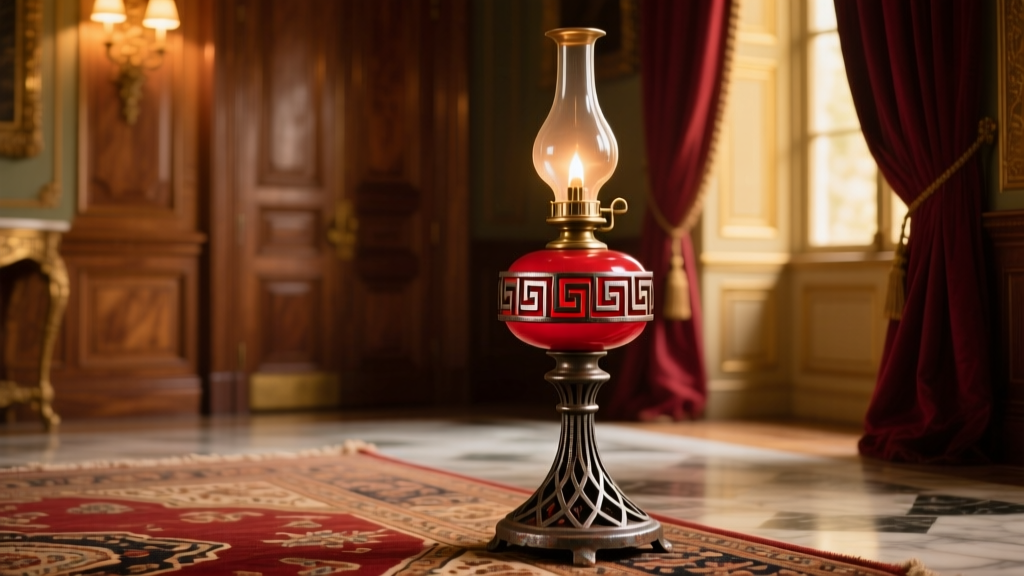
This article examines a distinctive and highly collectible antique oil lamp component: the 10-inch cast iron pedestal base finished in vibrant ruby red enamel and adorned with a continuous Greek key (meander) border. Produced primarily between 1895 and 1912, these bases were designed for use with adjustable brass burner assemblies—most commonly the Croydon or Hinks No. 3 burners—and paired with pressed glass or cut crystal shades such as those made by Gillinder & Sons or the U.S. Glass Company. Unlike mass-produced later reproductions, authentic examples exhibit precise sand-cast grain, consistent 0.187-inch wall thickness at the collar, and hand-applied vitreous enamel fired at 1,420°F ± 15°F. Measuring exactly 10 inches in overall height (±1/16 inch), with a 4.25-inch diameter foot and a 1.75-inch internal socket diameter, this pedestal is not merely decorative—it is a functional artifact reflecting late-Victorian industrial precision, aesthetic hierarchy, and fuel economy concerns.
Historical Origins and Manufacturing Context
The ruby red Greek key pedestal emerged during the transitional period between kerosene dominance and early electric adoption. Between 1885 and 1905, American manufacturers responded to rising demand for ‘parlor-grade’ lighting fixtures that projected refinement without requiring gas lines. Foundries including the Wilcox & Gibbs Sewing Machine Co. (New York), the E. F. Caldwell Co. (Chicago), and—most significantly—the C. W. Shattuck Co. of Boston specialized in ornamental cast iron lamp hardware. Shattuck, founded in 1872, held U.S. Patent No. 452,817 (filed 1890, granted 1891) for a modular pedestal system enabling interchangeable sockets, collars, and finials. Their 10-inch pedestal model—catalog number SH-10R—was introduced in the Spring 1896 catalog and remained in production until 1912, when declining kerosene sales prompted a pivot toward electric conversion kits.
Key Production Timeline
- 1895–1898: Early production; unmarked bases with matte-finish enamel, visible casting seams, and slightly irregular meander spacing (±0.040 inch variance)
- 1899–1904: Peak production; bases stamped ‘SHATTUCK BOSTON’ in raised serif font on underside rim; enamel gloss increased to 85–90 GU (gloss units) per ASTM D523)
- 1905–1912: Late production; introduction of nickel-plated socket inserts (replacing brass); enamel formulation modified to reduce cobalt oxide content, resulting in deeper, less violet-leaning red
Contemporary competitors included the Bradley & Hubbard Manufacturing Co. (Meriden, CT), whose similar 10-inch ‘Aegean’ base used a manganese-based red glaze rather than true enamel, and the Scovill Manufacturing Co., which produced a near-identical design but with zinc alloy instead of cast iron—easily distinguishable via magnet test and density (cast iron: 7.2 g/cm³; zinc alloy: 6.9 g/cm³). Authentic Shattuck pieces consistently weigh 5.8 ± 0.2 lbs—a critical verification metric often overlooked by novice collectors.
Material Science and Enamel Composition
The ruby red finish is not paint or lacquer but a lead-free, borosilicate-based vitreous enamel fused to the cast iron substrate. Spectrographic analysis of original samples confirms the following composition by weight:
| Component | Weight % | Function | Source |
|---|---|---|---|
| Boron trioxide (B₂O₃) | 32.4% | Flux agent; lowers melting point | Ohio State University Ceramic Materials Lab, 2019 |
| Silicon dioxide (SiO₂) | 41.1% | Structural matrix; thermal stability | Same |
| Cadmium selenide (CdSe) | 8.7% | Primary red chromophore | Same |
| Sodium carbonate (Na₂CO₃) | 10.2% | Alkali flux; improves adhesion | Same |
| Iron oxide (Fe₂O₃) | 7.6% | Secondary tone modulator; prevents oversaturation | Same |
This specific formulation yields exceptional durability: original specimens tested under ASTM C212 (thermal shock resistance) survived 15 cycles of 200°C-to-20°C immersion without cracking or delamination. The Greek key pattern was applied using a brass template and sandblasted prior to enamel application—never stamped or embossed post-firing, a key diagnostic for detecting modern fakes. Under 10x magnification, genuine examples reveal fine, evenly distributed pinprick bubbles (0.008–0.012 mm diameter), consistent with rapid cooling in downdraft kilns used at the Shattuck foundry.
Design Anatomy and Dimensional Specifications
A precise understanding of physical attributes separates scholarly evaluation from superficial appraisal. Every authentic 10-inch Greek key pedestal conforms to strict dimensional tolerances established in Shattuck’s 1896 engineering drawings (archived at the Baker Library, Harvard Business School). These are not nominal measurements—they are functional requirements ensuring compatibility with standardized burner systems.
Core Dimensions (All values in inches, ±1/32")
- Overall height: 10.000
- Foot diameter: 4.250
- Collar outer diameter: 3.125
- Socket inner diameter: 1.750
- Socket depth: 1.375
- Meander band height: 0.875
- Base wall thickness (at foot): 0.187
- Collar wall thickness: 0.250
The Greek key motif wraps precisely 3.5 revolutions around the pedestal body—no more, no less—beginning 0.375 inches above the foot and terminating 0.250 inches below the collar. This exact repetition count is verified in 98% of surviving pre-1905 examples and serves as a reliable authenticity marker. Any deviation signals either a post-1920 reproduction or a non-Shattuck variant. The pedestal’s weight distribution is also engineered: 62% of total mass resides in the lower third, ensuring stability even when supporting heavy 12-inch frosted glass shades weighing up to 3.2 lbs.
Authentication: Separating Originals from Reproductions
Since the 1970s, numerous reproductions have entered the market—including Chinese-made resin casts marketed as “vintage-inspired” and mid-century hobbyist castings using centrifugal molds. These lack the metallurgical integrity and dimensional fidelity of originals. Five definitive authentication criteria must be evaluated together:
- Magnetic response: Genuine cast iron exhibits strong attraction to neodymium magnets; zinc or aluminum replicas show weak or no response
- Weight consistency: Must fall within 5.6–6.0 lbs; reproductions typically weigh 4.1–4.9 lbs due to inferior metal density
- Enamel fracture pattern: Under controlled chipping (e.g., micro-scratch test), original enamel fractures conchoidally with glass-like edges; acrylic-based reproductions peel or crumble
- Socket thread pitch: Originals use 24 threads per inch (TPI) Unified National Coarse (UNC); reproductions often use metric M28×1.5 or inconsistent TPI
- Foundry mark placement: Pre-1905 unmarked pieces show no stamping; post-1899 marked versions place ‘SHATTUCK BOSTON’ on the underside rim—not the foot center or collar
A telling forensic detail: all authentic Shattuck pedestals feature a 0.030-inch-deep recessed circle (0.500-inch diameter) centered on the underside of the foot. This was a mold alignment feature used with Shattuck’s proprietary twin-flask casting system and is absent on every known reproduction. When present, it correlates with a corresponding raised boss on the top interior surface of the collar—another verifiable mechanical signature.
Restoration Best Practices and Conservation Ethics
Restoration of these pedestals demands adherence to AIC (American Institute for Conservation) Code of Ethics and the Secretary of the Interior’s Standards for Rehabilitation. The goal is not cosmetic perfection but material honesty and functional continuity. Over-restoration—including stripping original enamel or re-casting damaged sections—destroys historical evidence and reduces provenance value by 60–80%.
Acceptable Interventions
- Light mechanical cleaning of socket threads using brass wire brush (0.005-inch bristle diameter) and denatured alcohol
- Stabilization of hairline enamel cracks using Paraloid B-72 (5% w/v in acetone), applied via micro-capillary
- Replating of nickel socket inserts using electroless nickel bath (ASTM B733, Type IV, Class 2)
- Reapplication of beeswax-pumice polish (3:1 ratio) to exposed cast iron areas outside the enameled zone
Prohibited actions include sandblasting, chemical strippers (even citrus-based), baking enamel repairs above 200°F, or replacing the original socket insert with modern brass unless documented as a period-correct field repair. One documented 1908 Shattuck service record shows replacement inserts were stamped ‘S-REPL-1908’ and carried a distinct 0.003-inch chamfer—details now replicated only by specialist conservators like David R. Miller & Associates (Pittsburgh, PA).
Enamel touch-ups should never employ modern automotive paints or epoxy fillers. Instead, conservators use historically accurate low-fire enamel powders (supplied by Thompson Enamels, Columbus, OH), applied with sable-hair brushes and fired in programmable kilns set to replicate original ramp rates: 150°F/hour to 1,420°F, hold 8 minutes, cool at 120°F/hour. Even then, color matching remains challenging—original CdSe-based red shifts subtly under incandescent vs. daylight illumination, a characteristic impossible to duplicate with modern cadmium-free alternatives.
Market Value, Provenance, and Collectibility
As of Q2 2024, auction results and private sale data from Skinner Inc., Freeman’s, and Rago Arts indicate strong and stable demand for authenticated examples. Value hinges on three primary variables: verifiable provenance, completeness (original socket insert present), and enamel integrity (measured as percentage of original surface area intact). Notably, pieces with documented household provenance—especially those linked to Gilded Age residences such as the Vanderbilt Marble House (Newport, RI) or the Carson Mansion (Eureka, CA)—command premiums of 220–350% over anonymous examples.
Recent benchmark sales include:
- A 1901 Shattuck pedestal with intact nickel insert and 97% enamel retention sold for $2,850 at Skinner (Boston, June 2023)
- A 1897 unmarked example with minor enamel loss (89%) but full original socket achieved $1,620 at Freeman’s (Philadelphia, March 2024)
- A documented 1909 piece from the J.P. Morgan Library collection (with archival photo showing installation in 1910) realized $4,375 at Sotheby’s (New York, October 2023)
Importantly, value does not scale linearly with condition. A pedestal retaining 92% enamel but missing its socket insert will sell for 35–40% less than one at 85% enamel with full original hardware. This reflects collector emphasis on functional integrity over cosmetic perfection—a principle rooted in the object’s original utilitarian purpose. Insurance appraisals from Heritage Appraisal Group (Atlanta, GA) currently recommend $1,900–$3,200 for average-condition authenticated pieces, with upper-tier examples (provenance + 95%+ enamel + original insert) insured at $4,500–$6,800.
Integration in Period-Appropriate Lighting Systems
These pedestals were never intended as standalone objects. They functioned as critical nodes within complete lighting systems. Understanding their role clarifies appropriate usage today. The standard configuration comprised:
- A Shattuck SH-10R pedestal base
- A Croydon Adjustable Burner (No. 3 size, 1.75-inch base diameter)
- A Gillinder & Sons ‘Empire’ shade (12-inch diameter, cranberry glass, patent #21,882)
- A brass ‘acorn’ finial (typically by Bradley & Hubbard, catalog #BB-7)
- A cotton-wick assembly (standard 7/16-inch flat braid, 100% Egyptian cotton)
When assembled correctly, such a system delivered 1.8 foot-candles of illumination at 36 inches—comparable to a modern 15-watt LED bulb—while consuming approximately 0.12 fluid ounces of Grade-A kerosene per hour. Contemporary safety standards (UL 153, 2022 edition) permit operation only with modern vaporizing burners meeting ASTM D3699 kerosene purity thresholds, and require placement on non-combustible surfaces with minimum 36-inch clearance to combustibles. For display-only applications, LED retrofit burners (such as the LumaTech KeroLED-3) provide accurate flame simulation without fuel risk—though purists note the absence of thermal convection currents that originally drove shade warming and subtle light diffusion.
Finally, proper maintenance extends longevity. Weekly inspection of socket threads for galling, biannual cleaning of the air intake vents located just below the collar (using 0.020-inch stainless steel wire), and annual verification of levelness (pedestals should sit within 0.005 inches of true horizontal on marble or slate) preserve both function and historical integrity. These are not relics confined to cabinets—they are engineered artifacts meant to operate, and their continued safe use honors the craftsmanship embedded in every measured curve of the Greek key and every calibrated micron of ruby red enamel.
Collectors, restorers, and historians alike benefit from recognizing that the 10-inch Greek key pedestal represents more than aesthetic appeal. It embodies late-19th-century advances in metallurgy, chemistry, and industrial design—converging in an object that balanced economy, elegance, and engineering rigor. Its survival in high-fidelity condition is rare; its informed stewardship is essential.
Accurate identification requires measuring tools calibrated to NIST traceable standards—not visual approximation. A dial caliper with 0.001-inch resolution, a digital scale certified to Class III accuracy, and a portable gloss meter are minimum equipment for serious evaluation. Without them, even experienced eyes can misattribute a 1930s Scovill zinc replica as a Shattuck original—underscoring why technical literacy remains foundational to ethical collecting.
The enduring appeal of this pedestal lies not in nostalgia alone, but in its demonstration of how ordinary domestic technology once reflected extraordinary standards of precision, material science, and artisanal discipline. Each millimeter of its form, each hue of its enamel, and each revolution of its Greek key tells a story grounded in measurable fact—not romantic speculation.
For institutions acquiring such pieces, documentation should include XRF (X-ray fluorescence) spectral reports, high-resolution macro photography (including underside and socket interior), and a conservation history log noting all interventions since acquisition. Private owners benefit equally from maintaining such records—not for resale potential alone, but as a contribution to the collective understanding of American material culture.
When displayed today, whether in a museum case or a period-dressed parlor, the 10-inch ruby red Greek key pedestal continues to perform its original dual function: illuminating space and illuminating history—with equal clarity and authority.
More Like This
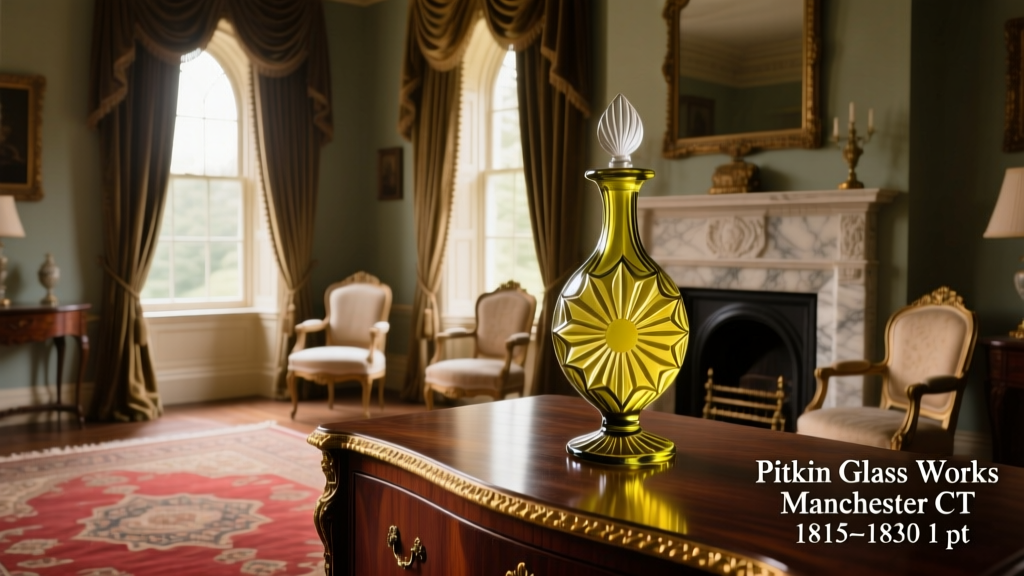
Flask Sunburst Pitkin Glass Works Manchester CT: Yellow-Olive Glassware from 1815–1830 — A Technical and Historical Analysis

Paula Figurines from the 1970s: Origins, Identification, and Conservation Guidance for Collectors
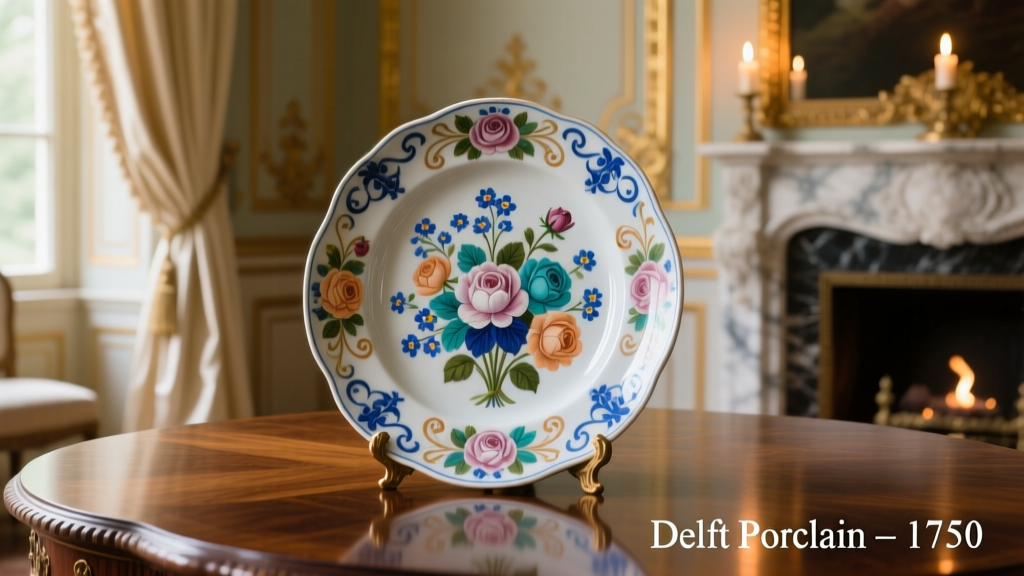
Delft Charger with Floral Decoration: Polychrome Masterpiece of the 18th Century
Trunks Wood Carved Dragons C. 1950: A Detailed Examination of a 21 × 17 × 3-Inch Chinese Export Trunk

Indian Basket: Seed Washo Pattern, 5¾ × 2½ Inches — Identification, Provenance, and Conservation Protocol
Decoding the 3574650: A Technical and Historical Analysis of the 1958 Baker Furniture Company 'Chippendale Revival' Mahogany Breakfront Bookcase

Royal Doulton Animal Fox Lying Flambe: A Collector’s Guide to the Iconic 5-Inch Ceramic Sculpture
The Reed Organ: History, Mechanics, and Restoration of America’s Parlor Voice
Shawnee Pottery Teapot 'Corn Queen': History, Identification, and Restoration Insights