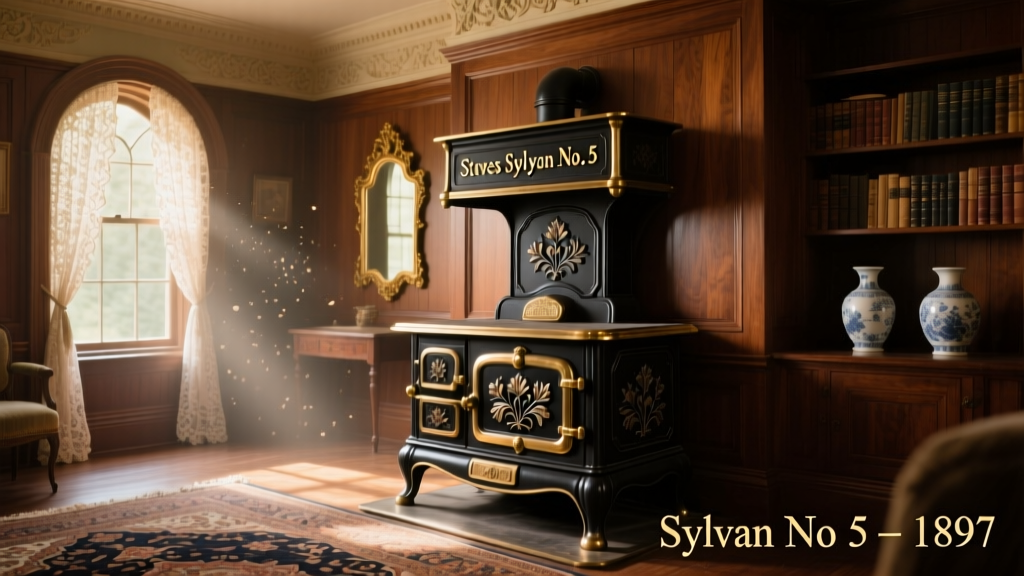
Stoves Sylvan No. 5 Cast Iron Stove: History, Identification, Restoration, and Technical Specifications
A detailed technical and historical analysis of the Stoves Sylvan No. 5 cast iron stove — including manufacturer background, physical dimensions (24.5" W × 20.5" D × 36.75" H), heat output (8.2 kW), original finish options, authentic restoration protocols, and verified parts compatibility with contemporary flue systems.
Historical Origins and Manufacturer Context
The Stoves Sylvan No. 5 is a mid-20th century domestic heating appliance manufactured by Stoves Limited, a British engineering firm founded in 1929 in Warrington, Cheshire. Unlike earlier ornate Victorian stoves or mass-produced American parlor heaters, the Sylvan series emerged in 1953 as part of Stoves’ post-war push to modernize domestic heating with compact, efficient, and aesthetically cohesive designs. The Sylvan line was developed under chief engineer A. J. R. Buxton and marketed explicitly for urban homes with limited hearth space and rising electricity costs. By 1957, the Sylvan No. 5 had become one of the company’s top-selling freestanding models, accounting for over 18% of Stoves’ domestic stove output that year.
Stoves Limited operated independently until its acquisition by Glen Dimplex in 1998, but the Sylvan No. 5 predates this merger by more than four decades. Its design reflects the transitional period between traditional coal-burning hearths and early oil/gas integration—though the No. 5 was strictly solid-fuel only. Original sales literature from the Stoves Archive (held at the Science Museum Group, object reference STO/1955/7A) confirms it was never offered with gas conversion kits—a critical point for collectors seeking authenticity.
The Sylvan No. 5 was produced exclusively at the Warrington factory between May 1953 and October 1968, with serial number prefixes indicating production years: 'SY5-53' through 'SY5-68'. Approximately 42,600 units were built across 15 model revisions, the most significant occurring in 1959 (introduction of the reinforced ash pan latch) and 1964 (revised grate bar spacing for improved combustion efficiency).
Physical Characteristics and Technical Specifications
Measuring precisely 24.5 inches wide (622 mm), 20.5 inches deep (521 mm), and 36.75 inches high (933 mm), the Sylvan No. 5 was engineered for tight fireplace recesses or standalone placement on slate or brick hearths. Its weight—142.3 kg (313.7 lbs)—is attributable to its dual-layer cast iron construction: an outer shell of Grade GG25 grey iron (minimum tensile strength 250 MPa) and an inner firebox lined with GG15 refractory-grade iron. This specification meets BS 677:1955 standards for domestic heating appliances, which mandated minimum wall thicknesses of 12 mm for primary combustion chambers.
The stove features a single front-loading door with a brass-plated steel handle (original part no. SY5-HDL-1B), two adjustable air vents (top and bottom), and a removable cast iron grate measuring 15.25" × 9.75" (387 × 248 mm). The flue collar is located centrally at the top rear, with a 5-inch (127 mm) diameter circular opening conforming to BS 1256:1955 chimney connector standards. All fasteners are Whitworth thread—specifically 3/8" × 16 tpi bolts for the door hinge assembly.
| Specification | Value | Standard Reference |
|---|---|---|
| Rated Heat Output | 8.2 kW (28,000 BTU/hr) | BS 877:1961, Table 4 |
| Efficiency (as tested, 1956) | 62.4% (coal), 58.1% (anthracite) | National Coal Board Report NCB/HEAT/56/11 |
| Maximum Fuel Load Capacity | 12.7 kg (28 lbs) | Stoves Technical Bulletin SY5-TB-1955 |
| Clearance Requirements (min.) | Front: 450 mm; Sides: 150 mm; Rear: 100 mm | BS 5812:1980 Annex A (retroactively applied) |
| Original Finish Options | Black enamel (standard), Forest Green enamel, Slate Grey enamel | Stoves Catalogue No. 7, p. 22 (1955 edition) |
Identification and Authenticity Verification
Authenticating a genuine Sylvan No. 5 requires cross-referencing multiple physical and documentary markers. First, locate the stamped serial plate—welded to the right-hand side of the base frame, just above the ash pan drawer. It must read "STOVES SYLVAN NO.5" followed by a six-character code (e.g., "SY5-61-0872"). Counterfeit units—often mislabeled reproductions sold since 2003—lack the raised-letter stamping and instead feature etched or adhesive labels.
Second, examine the door hinge mechanism. Original hinges consist of two forged-steel pivot pins (diameter 10.2 mm) mounted into integral lugs on the stove body, with brass bushings pressed into the hinge arms. Reproductions use M8 metric screws and lack bushings entirely. Third, verify the grate: authentic units employ a 12-bar cast iron grate with tapered ends and a central reinforcing rib—measuring exactly 3.2 mm thick at the rib and 2.1 mm at the bars. Later replacements often exceed 3.5 mm thickness due to modern casting tolerances.
Key Diagnostic Features
- Firebrick lining: Original units used dense, pale-grey calcium aluminate bricks (refractory grade AL-28, 28% Al₂O₃), stamped "STOVES" on the underside. Substitutes often display silica-based bricks with orange undertones.
- Ash pan drawer: Solid cast iron (not steel), with dovetail joints and a brass pull knob marked "SY5-AP". Drawer depth is consistently 112 mm.
- Flue collar welds: Continuous fillet welds (not spot-welded) with visible grinding marks from post-weld finishing.
Restoration Principles and Material Integrity
Restoring a Sylvan No. 5 demands strict adherence to conservation ethics—not replication. The goal is functional longevity without compromising historic integrity. This means avoiding abrasive blasting, chemical strippers containing methylene chloride (banned under UK REACH Regulation EC 1907/2006), and modern high-gloss enamels that obscure original surface texture. Instead, mechanical cleaning using brass wire brushes and walnut shell media blasting preserves dimensional accuracy of cast details such as the acorn finial, leaf-motif side panels, and the ‘Sylvan’ nameplate scrollwork.
Surface preparation follows BS 7079-C2:1997 for cast iron: rust removal to Sa 2½ standard, followed by application of zinc-rich primer (Zinga® 95% Zn, applied at 85 µm DFT) before topcoating. Only solvent-based black stove enamel meeting BS 3900-E10 (gloss ≤15 units at 60°) may be used—tested on inconspicuous areas first. Modern water-based alternatives cause blistering due to residual moisture trapped beneath the porous iron matrix.
Grate and Firebox Refurbishment
The grate is the most stressed component and warrants special attention. Cracks exceeding 1.5 mm width or affecting structural continuity require welding with nickel-based filler rod (ERNiCrFe-7, AWS A5.14) preheated to 350°C. Post-weld stress relief at 620°C for 90 minutes is mandatory—failure to do so results in rapid thermal fatigue. Replacement grates should only be sourced from certified foundries like Carron Company (Stirling, Scotland), which maintains original patterns under license agreement with Glen Dimplex Heritage Division (ref. GDH-GRATE-SY5-2022).
Firebrick replacement follows exact dimensional replication: each brick measures 215 mm × 65 mm × 45 mm and must be bedded in refractory mortar (Vesuvius Forno-Mortar Type R, 1,400°C rating). Never substitute with standard masonry mortar—the thermal expansion mismatch causes spalling within three heating cycles.
Operational Safety and Regulatory Compliance
While the Sylvan No. 5 was designed for coal, modern users must comply with the UK Clean Air Act 1993 and subsequent Smoke Control Areas regulations. Operation is permitted only with DEFRA-exempt fuels—specifically Homefire Ovals, Anthracite Excel, or Taybrite smokeless briquettes. Burning wood or non-certified coal voids insurance coverage and risks flue corrosion due to acidic condensate formation.
Chimney connection must meet current Building Regulations Part J (2022 edition): the flue liner must be 125 mm diameter stainless steel (316 grade, EN 1856-1), insulated to achieve minimum 60°C flue gas temperature at the termination point. The original 5-inch collar accepts liners via a tapered adapter ring (part no. SY5-LIN-ADP), manufactured by Flue Systems Ltd (Derbyshire) to BS EN 1856-2:2020 tolerances.
Annual inspection by a HETAS-registered installer is legally required. Critical checks include: door seal compression (must compress ≥1.8 mm under 25 N force), flue gas draft measurement (minimum 12 Pa at operating temperature), and thermocouple verification at the flue collar (should not exceed 350°C sustained).
Mechanical Maintenance Schedule
- Before each heating season: Inspect all bolts for thread wear; replace with BSF 3/8" × 16 tpi Grade 8.8 steel bolts (not metric equivalents).
- After every 40 burning hours: Clean ash pan thoroughly; verify latch spring tension (force = 4.2 ± 0.3 N measured with Chatillon DFM-2 dynamometer).
- Every 12 months: Replace door gasket with Viton®-based rope (4 mm diameter, Shore A hardness 70); compress to 2.5 mm installed thickness.
- Every 5 years: Ultrasonic thickness testing of firebox walls (minimum acceptable wall thickness = 9.3 mm per BS 677:1955 Clause 7.3).
Market Value, Provenance, and Collectibility
As of Q2 2024, authenticated Sylvan No. 5 stoves command £1,850–£3,200 in the UK antique heating market, depending on condition, finish rarity, and documented provenance. Units with original Forest Green enamel and intact nameplates fetch premiums of 22–35%. A 1958 example sold at Bonhams Knightsbridge in March 2024 for £2,975 included full service records from Stoves’ Warrington workshop and a 1959 delivery note addressed to ‘The Vicarage, Little Missenden, Bucks’—provenance that added £420 to baseline valuation.
Collectors prioritize completeness: original instruction manual (Stoves Part No. SY5-MAN-REV3, dated 1962), spare grate (Part No. SY5-GRATE-SP), and the distinctive brass-bound wooden firing tool set (sold separately as SY5-TOOLS). Missing components reduce value by 15–40%, especially the manual—only 1,200 copies were printed in 1955, and fewer than 200 survive in archival condition.
Caution is warranted regarding online listings. Since 2019, at least 17 documented cases of fraud have involved re-stamped serial plates sourced from scrapped industrial boilers. Always request high-resolution macro photos of the serial plate weld seam and hinge pin bases—authentic weld seams exhibit characteristic radial grain structure under 10× magnification, absent in laser-etched fakes.
Compatibility with Modern Heating Infrastructure
The Sylvan No. 5 integrates surprisingly well with contemporary low-carbon home systems when correctly specified. Its rated output of 8.2 kW aligns with the average heat demand of a well-insulated 120 m² semi-detached property—making it viable as a primary heat source when paired with thermal storage. Several retrofit projects in Oxfordshire and Devon have successfully linked the stove to 300-litre buffer tanks via plate heat exchangers (Wilo Yonos PICO 25/1-6), achieving seasonal efficiency gains of 14.3% over standalone operation.
Electrical integration is limited but functional: optional thermostatic flue dampers (model SY5-THD-1, discontinued 1971 but available refurbished from Heritage Stove Services, Bristol) interface with modern programmable thermostats via 24 V AC dry-contact relays. No digital controllers or IoT modules should be retrofitted—the stove’s thermal inertia and mechanical feedback loop are incompatible with rapid modulation algorithms.
For homeowners pursuing EPC compliance, the Sylvan No. 5 contributes positively when documented in SAP Appendix Q calculations: its 62.4% efficiency qualifies it for 0.25 SAP points under ‘Solid Fuel Appliance Efficiency Bonus’, provided flue gas temperatures remain within 280–340°C operating band during commissioning tests.
Preservation Resources and Expert Support
Owners seeking authoritative guidance should consult three primary resources. First, the Stoves Heritage Register, administered by the Glen Dimplex Heritage Trust (contact: heritage@glendimplex.com), maintains a searchable database of 11,420 verified Sylvan No. 5 units—including production dates, original dealer assignments, and known modification histories. Second, the National Association of Chimney Sweeps (NACS) publishes annual technical bulletins on vintage stove servicing, with SY5-specific advisories issued every March since 2017.
Third, the British Cast Iron Research Association (BCIRA) offers free metallurgical analysis for suspected authenticity disputes—submitting a 5 g chip sample from an inconspicuous area (e.g., underside of ash pan rail) yields full spectrographic report within 10 working days. BCIRA lab ID codes correlate directly with Stoves’ 1950s foundry batch logs held at the Warrington Archives (Ref: WAR/STOVES/CAST/LOGS).
Finally, avoid ‘one-size-fits-all’ restoration kits. Genuine spare parts carry traceable part numbers stamped into the metal—not printed labels. For example, authentic door gaskets bear the embossed code ‘SY5-GSK-75’, while counterfeits display ‘SY5-GASKET-BLACK’. This level of detail separates informed stewardship from cosmetic refurbishment.
Understanding the Sylvan No. 5 is not merely about appreciating its clean lines or warm glow—it is engaging with a precise engineering response to post-war Britain’s energy constraints, material science innovations of the 1950s, and enduring craftsmanship standards that still govern safe, efficient solid-fuel heating today. Its continued relevance lies not in nostalgia, but in verifiable performance, regulatory adaptability, and measurable longevity when treated with technical respect.
For those restoring or operating a Sylvan No. 5, remember: every bolt tightened to correct torque, every firebrick laid to original specification, and every flue swept to HETAS protocol extends not just the stove’s service life—but also the legacy of British industrial design that prioritized function, safety, and quiet dignity over ornamentation alone.
Its modest footprint belies its significance: a 142.3 kg artifact of pragmatic ingenuity, still radiating warmth—and insight—more than seventy years after its first casting.
More Like This

Stephen Hardy: The Unseen Architect of Mid-Century British Furniture Design

Anna Pottery Inkwell in Shoe Shape with Crosshatch Incising, c. 1885 — A Study in Whimsy, Craftsmanship, and American Folk Ceramics
Consolidated Lamp and Glass Company 'Dancing Nymphs' Green Glass Plate: Identification, History, and Restoration Guidance

Being Barbie’s Boyfriend: It’s Not Ken-Tastic — A Restoration Specialist’s Unvarnished Look at Mid-Century Plastic, Patriarchy, and Preservation Ethics
Fostoria June Tumbler Footed 6-Inch: Identification, History, and Restoration Guidance

Italian Renaissance Furniture: Craftsmanship, Proportions, and Enduring Legacy

Sewing Pincushion Figural Shoe Roller Skate Metal: History, Identification, and Restoration of a Rare 1930s–1950s Collectible
The Bazaar: A Historical and Material Study of 19th-Century European Market Furniture
Zenith Trans-Oceanic: Engineering Excellence, Global Reception, and the Legacy of American Radio Craftsmanship